COVID-19: Opportunities to Improve Federal Response and Recovery Efforts
The situation to date: SNAFU
Friday, June 26, 2020


Opinion analysis: Court confirms limitations on federal review for asylum seekers - SCOTUSblog

Opinion analysis: Court confirms limitations on federal review for asylum seekers - SCOTUSblog
by Kari Hong
In a 7-2 decision, the Supreme Court in Department of Homeland Security v. Thuraissigiam upheld a scheme of limited and narrow judicial review over expedited removal, a bare-bones administrative process created under the 1996 Illegal Immigration Reform and Immigrant Responsibility Act. Expedited removal allows an immigration official to make the immediate decision to deport a person without a hearing if the person is apprehended within 100 miles of a border and if they cannot prove they have lived in the country for more than two weeks.
Congress provided three exceptions to expedited removal, one of which involves asylum seekers. If a noncitizen expresses a fear of persecution, the officer must refer them to an asylum officer who conducts what is known as a credible fear interview. If the asylum officer finds a “significant possibility” that the applicant’s asylum claim would succeed, the applicant is given a full immigration hearing.
The narrow legal question for the court in this case was whether the asylum seeker can file in federal district court a petition for habeas corpus—a means of challenging unlawful confinement or vindicating federal rights—to review any legal or constitutional errors the asylum officer may have made. As the court explained, the simple answer in this case is no.
Vijayakumar Thuraissigiam, a member of the ethnic minority Tamil population in Sri Lanka, was apprehended within 25 feet of the U.S. border. He asked for asylum because he feared persecution in his home country after having been kidnapped and beaten. After a credible fear interview, an asylum officer found that there was no significant possibility that Thuraissigiam would qualify for asylum in a full hearing. An immigration judge upheld this decision after a cursory review. Thuraissigiam filed a habeas petition, alleging that the asylum officer had erred by not considering relevant facts about the identity and motives of his attackers, who he explained were government officials targeting him for his political opposition to them, and that the expedited asylum procedure itself violated due process because Thuraissigiam did not receive adequate safeguards, such as a competent translator and an opportunity to present country-condition reports.
The district court denied his claims, contending that under 8 U.S.C. § 1252(e)(2), Congress had limited the ability of federal courts to review expedited removal cases to only the narrow issues of whether Thuraissigiam was a citizen, whether the immigration officer had entered a valid removal order, and whether Thuraissigiam was wrongfully subjected to expedited removal because he had previously been granted lawful permanent residence, refugee status or asylum. The U.S. Court of Appeals for the 9th Circuit reversed, holding that the habeas review available to Thuraissigiam under Section 1252(e)(2) did not satisfy the requirements of the Constitution’s suspension clause, which guarantees the right to habeas corpus absent extraordinary situations (such as a national emergency).
Today the Supreme Court reversed the 9th Circuit and rejected Thuraissigiam’s argument that Section 1252(e)(2) violated the suspension clause and the due process clause. Writing for the majority, Justice Samuel Alito began by emphasizing the burden on the immigration system imposed by the credible fear process, “[e]ven without the added step of judicial review.” “If courts must review credible-fear claims that in the eyes of immigration officials and an immigration judge do not meet the low bar for such claims, expedited removal would augment the burdens on that system. Once a fear is asserted, the process would no longer be expedited.”
***
In Sotomayor’s view, Thuraissigiam’s habeas claim is a means to prevent the executive branch from creating an arbitrary administrative scheme plagued with errors, a right that has been the purpose of habeas since its inception. Invoking habeas is proper, not to secure Thuraissigiam’s immediate release from custody, but to grant him rightful access to laws that are supposed to be available to him.
Sotomayor also pointedly criticized the majority’s suggestion that Thuraissigiam’s “unlawful status independently prohibits him from challenging the constitutionality of the expedited removal proceedings.” “Both the Constitution and this Court’s cases,” she argued, “plainly guarantee due process protections to all ‘persons’ regardless of their immigration status, a guarantee independent of the whims of the political branches. This contrary proclamation by the Court unnecessarily decides a constitutional question in a manner contrary to governing law.” The decision “handcuffs the Judiciary’s ability to … safeguard individual liberty,” Sotomayor lamented, and “paves the way towards transforming already summary expedited removal proceedings into arbitrary administrative adjudications.”
Thursday, June 25, 2020
Sentencing Law and Policy: "Failing Grades: States’ Responses to COVID-19 in Jails & Prisons"
Sentencing Law and Policy: "Failing Grades: States’ Responses to COVID-19 in Jails & Prisons"
The title of this post is the title of this notable new ACLU and Prison Policy Initiative report by Emily Widra and Dylan Hayre.
The consequences are as tragic as they were predictable: As of June 22, 2020, over 570 incarcerated people and over 50 correctional staff have died and most of the largest coronavirus outbreaks are in correctional facilities. This failure to act continues to put everyone’s health and life at risk — not only incarcerated people and facility staff, but the general public as well. It has never been clearer that mass incarceration is a public health issue. As of today, states have largely failed this test, but it’s not too late for our elected officials to show that they can learn from their mistakes and do better.
For a kind of video version of this story of significant and dangerous failure, also be sure to check out John Oliver's coverage.
Wednesday, June 24, 2020
Professor Emerita Nadine Taub, 77, Dies After Long Illness | Rutgers Law

Nadine Taub was recruited to Rutgers Law School by Ruth Ginsburg. She was the founding director of the Women't Rights Clinic in 1971 and had a brilliant career. I collaborated with her as counsel for National Organization for Women - NOW-NJ in Collins v. Union County Jail. She was one of the most exacting lawyers I have ever worked with. I' m happy to be able to note that I gave her a shout out in my recent interview for the IPSE DIXIT Podcast last week about the history of Rutgers Law School, which we called "Peoples Electric". -gwc
Professor Emerita Nadine Taub, 77, Dies After Long Illness | Rutgers Law
Professor Emerita Nadine Taub served on the faculty in Newark for about 30 years commencing in the early 1970s and was a pioneer in the field of Women’s Rights through her groundbreaking clinical practice, teaching and scholarship. She founded the Rutgers Women’s Rights Clinic (WRC) in the early 1970s as part of women’s rights teaching and advocacy generated at Rutgers as initially conceptualized by then-Rutgers Professor Ruth Bader Ginsburg, and as depicted in last year’s movie, “On the Basis of Sex.” The Rutgers Women’s Rights Clinic is believed to be the first such clinic in the country.
As the WRC’s director, Professor Taub, with her students, pioneered work in establishing sexual harassment as a form of sex discrimination in employment under Title VII of the Civil Rights Act of 1964 and in education under Title IX of the Education Amendments Act of 1972; helped advance in the New Jersey Supreme Court, with Lou Raveson, the state constitutional right of low-income women to medicaid-funded therapeutic abortions after the U.S Supreme Court had rejected such a right under the U.S. Constitution; secured access to women to previously all-male eat¬ing clubs and accommodations under state civil rights law such as Princeton University's Ivy Club; and developed novel ways for battered women to use traditional civil remedies to obtain protection from their attackers. She also spearheaded work with the U.S. Civil Rights Commission on domestic violence issues while an active member of the New Jersey Task Force on Domestic Violence.****
Monday, June 22, 2020
Ipse Dixit podcast: George Conk on Rutgers-Newark Law School in the 1960s and 70s
IPSE DIXIT George Conk on Rutgers-Newark Law School in the 1960s and 70s
Season 1, Ep. 583In this episode, George W. Conk, Adjunct Professor of Law and Senior Fellow of the Stein Center for Law & Ethics at Fordham Law School, discusses his article "People's Electric: Engaged Legal Education at Rutgers-Newark Law School in the 1960's and 1970's," which is published in the Fordham Urban Law Journal. Conk begins by describing the uniquely progressive legal education offered at Rutgers-Newark Law School in the 1960s and 70s. He explains why it was different from other law schools, and how its focus on engagement and reform affected its faculty and graduates, including his own career. Conk is on Twitter at @GeorgeConk.
This episode was hosted by Brian L. Frye, Spears-Gilbert Associate Professor of Law at the University of Kentucky College of Law. Frye is on Twitter at @brianlfrye.

Sunday, June 21, 2020
Natural History Museum will remove Theodore Roosevelt statue

“The world does not need statues, relics of another age, that reflect neither the values of the person they intend to honor nor the values of equality and justice,” said Theodore Roosevelt IV, 77, a great-grandson of the 26th president and a museum trustee. “The composition of the Equestrian Statue does not reflect Theodore Roosevelt’s legacy. It is time to move the statue and move forward.”
The Sugarcoated Language Of White Fragility | HuffPost
The Sugarcoated Language Of White Fragility | HuffPost
by Anna Kegler
by Anna Kegler
For a while now, I’ve been thinking about how terms like “white privilege,” “inclusion” and “unconscious bias” all sound just... too nice. Don’t they seem a little on the pleasant side for words used to address a system of racist oppression? It reminds me of how, in Minnesota in January, the meteorologists will say it’s going to be a “cool evening” as they stand in front of a map showing temperatures that will literally freeze your nostrils together when you take a breath.
Something’s definitely up.
I’m reminded of how, in the novel 1984, the creepy futuristic government acts as if it’s “Opposite Day” all the time, using the Ministries of Love, Peace, Plenty and Truth to handle fear, war, rationing, and propaganda. The deliberate distortion of words is called doublespeak and we actually see it frequently in real-life politics (for example, the Clear Skies Act makes it easier to pollute the air and “enhanced interrogation“ means old-fashioned torture). Words are powerful.
Friday, June 19, 2020
Race, Diversity, Law: Rutgers Minority Student Program Turns 50 | Newark, NJ Patch

Fifty two years ago the Rutgers Law School Minority Student Program was founded. Twenty students were first enrolled. When I started in 1970 twenty percent of the entering class of one hundred fifty was minority - overwhelmingly African American.
Race, Diversity, Law: Rutgers Minority Student Program Turns 50 | Newark, NJ Patch
RACE AND SELECTIVE LEGAL MEMORY: REFLECTIONS ON INVENTION OF A SLAVE - Columbia Law Review
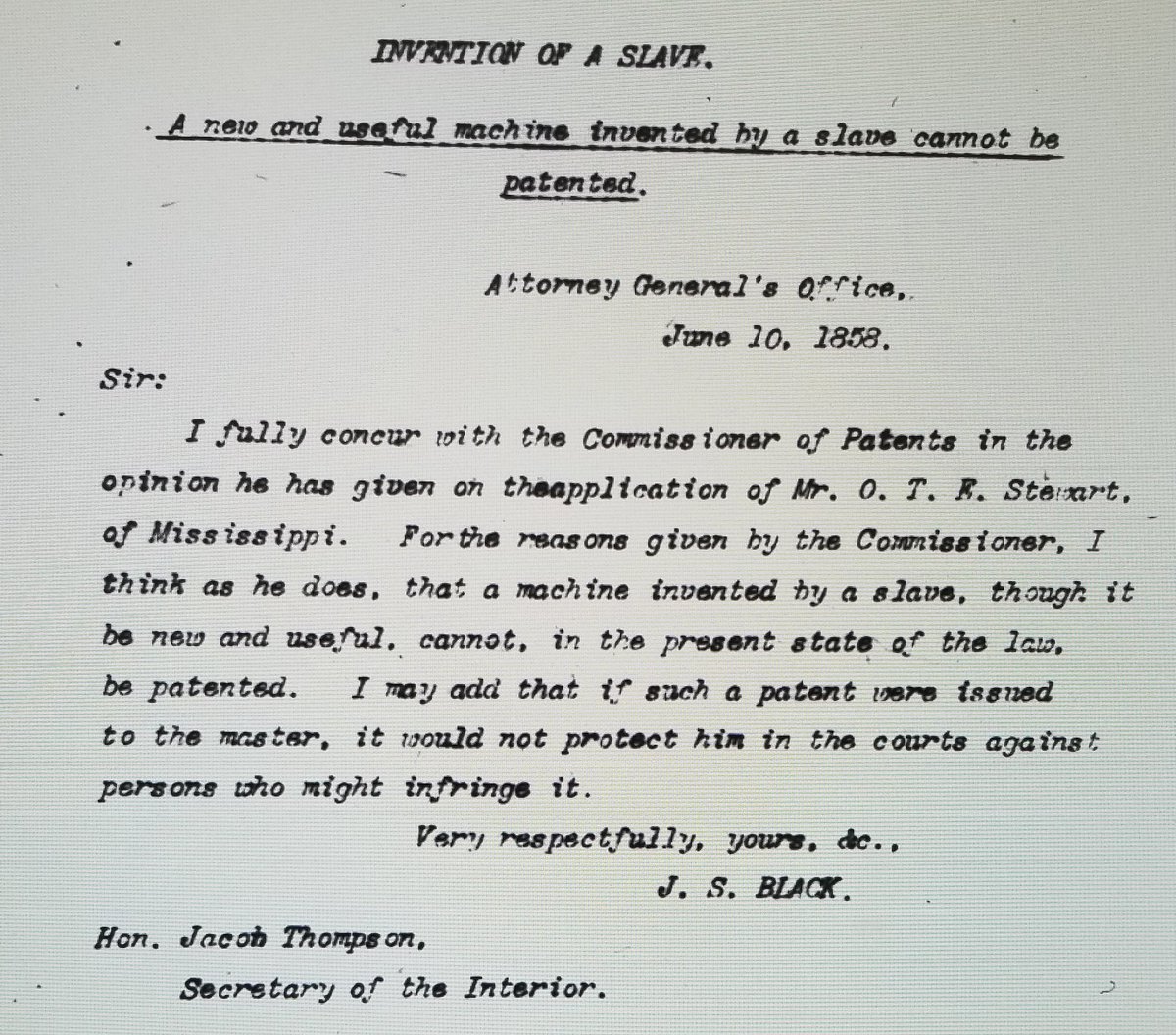
In the late 1850s, a slave named Ned invented a “double plow and scraper,” which enabled a farmer to plow and scrape both sides of a row of cotton simultaneously, among other things, depending on the configuration of its plow and scraper blades.68 Ned belonged to Oscar J.E. Stuart, a lawyer and planter from Holmesville, Mississippi, and Stuart hoped to patent Ned’s promising invention.
On June 10, 1858, the Attorney General issued an opinion titled Invention of a Slave, concluding that a slave owner could not patent a machine invented by his slave, because neither the slave owner nor his slave could take the required patent oath. The slave owner could not swear to be the inventor, and the slave could not take an oath at all.The Patent Office denied at least two patent applications filed by slave owners, one of which was filed by Senator Jefferson Davis of Mississippi,who later became the President of the Confederate States of America. But it also denied at least one patent application filed by a free African-American inventor, because African-Americans could not be citizens of the United States under Dred Scott.Brian L. Frye, 68 Syracuse Law Review 181 (2018)
RACE AND SELECTIVE LEGAL MEMORY: REFLECTIONS ON INVENTION OF A SLAVE - Columbia Law Review
by Kara Swanson (2020)
Even as a small-scale story of slavery in the antebellum United States, Invention of a Slave provides a poignant example of the contradictions between humanity and property that challenged and distorted American law in a slave society. It forces us to acknowledge that the ideology of slavery reached into the technical bureaucracy of the patent office, an area of law and of the administrative state frequently considered outside politics. The dry lines of the opinion expose the breathtaking claim by an enslaver to the mental labor of another person—an ultimate claim of whiteness as intellectual property—and another frontier in the “myriad and nefarious uses of slave property.” These features make Invention of a Slave a story worth remembering.
***
What were the stakes that drove African American activists and leaders to tell and retell the story of the enslaved inventor and his exclusion from the patent system? I argue that this memory work was performed in support of fights for the “rights of belonging,” the various civil rights that signal and accompany inclusion.
Between the formal lines of the opinion, these activists read an unintended message that patents could be political tools used to oppose anti-black racism and racist laws. They mobilized patents as government certifications that their recipients had a prized mental ability, inventiveness, in order to undercut the logic of racism in its shifting guises, including scientific racism, white supremacy, and the pernicious bigotry of low expectations. This labor resulted in publications that remained on the other side of a color line, excluded from the acknowledged repositories of legal memory.
This exclusion has carried costs, as we in law have failed to appreciate and participate in what was always in part a legal effort, even though it occurred outside formal legal publications. These storytellers, by telling one of law’s stories, were seeking legal change. Our legal erasure of both the opinion and storytellers has allowed us to encounter a well-remembered story as “forgotten” and remain blind to its relevance.
Thursday, June 18, 2020
China's ecological protection picks up steam | Brinkwire

China's ecological protection picks up steam | Brinkwire
uring an inspection tour of Ningxia Hui Autonomous Region in northwest China, President Xi Jinping visited Wuzhong, where the Yellow River flows through the city’s center, on June 8.
“[Xi’s] visiting the same river four times in one year indicates the importance of the ecological protection of the Yellow River for our country,” a commentary by Xinhua News Agency said.
Since 2012, the Central Government has put more emphasis on protecting the environment, which has been damaged by rapid economic development. The revised Environmental Protection Law that took effect in early 2015 provides stricter rules for environmental protection supervision and harsher punishment for any deeds that harm the ecological environment.
Huang Runqiu, Minister of Ecology and Environment, announced during the Third Session of the 13th National People’s Congress (NPC) in May that seven of the nine binding targets set for evaluating environmental protection work in the 13th Five-Year Plan (2016-20) had been achieved by the end of 2019. Huang’s words were backed up by a report issued by the Ministry of Ecology and Environment (MEE) on June 2, which showed that China saw a steadily improving environment in 2019.
A national strategy***
Wednesday, June 17, 2020
Assessing the Government’s Lawsuit Against John Bolton
Assessing the Government’s Lawsuit Against John Bolton
by Jack Goldsmith (Harvard) and Marty Lederman (Georgetown)
by Jack Goldsmith (Harvard) and Marty Lederman (Georgetown)
The U.S. government filed a civil suit on June 17 against former National Security Advisor John Bolton. It primarily seeks (i) an injunction against the planned June 23 publication of Bolton’s book, The Room Where it Happened: A White House Memoir; and (ii) a “constructive trust” that would give the United States the right to all of Bolton’s profits from the book. The case has been assigned to Judge Royce Lamberth of the U.S. District Court for the District of Columbia.
This post explains the case and offers our initial thoughts. The big news to us about the government’s case is that it’s weaker than we expected. We should emphasize, however, that these views are preliminary and incomplete. The case implicates a complex and in some ways unsettled area of law; and the government hasn’t yet even explained to Bolton which information in his book is allegedly classified (something that it’s promised to do by this Friday, June 19, at the latest).
The Relevant Contract (Nondisclosure Agreement) Terms
The most important thing to understand about the case is that the government is suing Bolton for a breach of contract—two contracts, in fact. As the government’s complaint describes, the contracts in question are “nondisclosure agreements” (NDAs) that Bolton signed on April 5, 2018, when he entered government service as National Security Advisor. These NDAs are included as attachments to the complaint.
The first NDA, Standard Form 312, contains obligations Bolton assumed as a condition of obtaining access to classified information generally, i.e., a “security clearance.” Two are pertinent here. First, Bolton agreed that he must never “divulge classified information to anyone” unless he either “officially verifies] that the recipient has been properly authorized by the United States Government to receive it” or he’s received “prior written notice of authorization [to divulge it] from the United States Government” entity responsible for its classification. Second, he agreed that if he’s “uncertain about the classification status” of any information, he must “confirm from an authorized official that the information is unclassified before [he] may disclose it” to anyone not authorized to receive it. We’ll refer to this second obligation as the SF-312 prepublication review requirement, although, as we explain below, it’s actually something less than that—it’s more like a simple “confirmation” requirement.
The second NDA, Standard Form 4414, set the conditions of Bolton’s access to a more sensitive subset of “Special Access Programs” classified information, commonly known as Sensitive Compartmented Information (SCI). It requires Bolton to submit to a security review by the National Security Council (NSC) “any writing . . . that contains or purports to contain any SCI or description of activities that produce or relate to SCI or that I have reason to believe are derived from SCI, that I contemplate disclosing to any person not authorized to have access to SCI or that I have prepared for public disclosure.” It further provides that he “will not disclose the contents of such preparation with, or show it to, anyone who is not authorized to have access to SCI until I have received written authorization from the Department or Agency that last authorized my access to SCI that such disclosure is permitted.” We’ll call this the SF-4414 prepublication review requirement.
The NSC’s Prepublication Review of Bolton’s Book
Martin Gugino - assaulted in Buffalo is a Witness to Non-violence | Commonweal Magazine

Different from William Barr, Patrick Cipollone, and Archbishop Dolan - Trump Catholics
A Different Kind of Catholic | Commonweal Magazine
by Paul Moses
When the Jericho Road Community Health Center asked Martin Gugino to explain why he was a donor, he responded with a passage from the New Testament. “Jesus said to clothe the naked, shelter the homeless, feed the hungry and give drink to the thirsty,” he wrote in the Buffalo nonprofit’s newsletter last fall, praising its Vive Shelter for aiding asylum seekers, including a large group of Congolese immigrants.
Now Gugino is under the glare of a much bigger spotlight, known internationally as the seventy-five-year-old protester whom Buffalo police officers pushed to the ground, causing him to bang the back of his head so hard on the pavement that blood flowed immediately from his right ear. He is the subject of one of President Donald Trump’s most asinine tweets—speculation that Gugino faked his injury as an Antifa tactic—and the victim of Trump-inspired conspiracy theorists who wildly distort who he is.
People who actually know Gugino say his Catholic faith is the root of his political activism, and that he’s a gentle man who advocates nonviolence. “He’s a devout Catholic, and really I think part of the reason that the two of us have developed a friendship is because that’s where my own social activism comes from and I recognize it in him,” said Mark Colville, who founded the Amistad Catholic Worker House in New Haven with his wife, Luz. Colville is awaiting sentencing as one of the Kings Bay Plowshares 7, the seven peace activists convicted of federal charges for breaking into a nuclear arsenal at the Kings Bay submarine base in Georgia as part of a protest on April 4, 2018.
The assumptions of white privilege and what we can do about it | National Catholic Reporter
The assumptions of white privilege and what we can do about it | National Catholic Reporter
by Fr. Bryan Massingale (Theology Dept. Fordham University)
by Fr. Bryan Massingale (Theology Dept. Fordham University)
"Every white person in this country — I do not care what he says or what she says — knows one thing. … They know that they would not like to be black here. If they know that, they know everything they need to know. And whatever else they may say is a lie." — James Baldwin, "Speech at the University of California Berkeley," 1979
It has never been easy to be black in America. Still, the past few months have pushed me to depths of outrage, pain and despondency that are unmatched in my 63 years of life. Look at what has transpired:
Equal rights win at the court is worth celebrating, no matter what US bishops' conference thinks | National Catholic Reporter
Equal rights win at the court is worth celebrating, no matter what US bishops' conference thinks | National Catholic Reporter
by Michael Sean Winters
"for every loud, obnoxious anti-gay letter from a culture warrior Catholic they fret over, five other Catholics are walking out the door because they are tired of the culture wars being preached from the pulpit"
by Michael Sean Winters
"for every loud, obnoxious anti-gay letter from a culture warrior Catholic they fret over, five other Catholics are walking out the door because they are tired of the culture wars being preached from the pulpit"
Tuesday, June 16, 2020
Environment, Law, and History: The Cigarette: A Political History

by David Shorr
Environment, Law, and History: The Cigarette: A Political History
The Cigarette: A Political History (Harvard UP, 2019) by Sarah Milov, co-founder of this blog, was recently reviewed by Reuel Schiller for Jotwell. Schiller writes that Milov's "narrative weaves together legal, political, and economic history in a manner that calls for a revaluation of the dimensions of twentieth-century liberalism and the nature of its decline. The book is a compelling exercise in historical synecdoche: its subject is the political history of the cigarette, but its story is that of the twentieth-century American state." Further excerpts:
****
The Cigarette: A Political History furthers our understanding the demise of postwar liberalism at the end of the twentieth century. While Milov does not suggest that American tobacco policy was progressive, she notes that the tactics deployed against it had a distinctly illiberal bent. By combining libertarian hostility towards the administrative state with an efficiency-based, cost-benefit attack on smoking, big tobacco’s opponents helped create a political culture that undermined egalitarian public policy. This market-based political culture denied the state a role in combatting systemic inequities within markets and ignored the fact that policies based on cost-benefit analysis frequently ignored important, not-easily-quantifiable values.
Don’t get me wrong. The fact that fewer Americans smoke now than at any time since the introduction of the cigarette is a triumph of postwar public policy. But this victory did not come without a cost. Milov concludes The Cigarette: A Political History with the dismaying observation that while the “cultural cachet” of the cigarette has all but disappeared, smokers have not. Instead, concentrated within poor and minority communities, they have become increasingly stigmatized. Most Americans blame them for an addiction that is the legacy of a century of governmental action. Nor has big tobacco’s political and economic power waned. The deregulation of tobacco farming allowed cigarette manufacturers to drive down the price of tobacco to levels not seen since the 1920s. Their political power repeatedly thwarted attempts to regulate smoking at the federal level, leading to a sieve-like patchwork of state and local restrictions.
Thus, the victory against big tobacco was hardly a total one. More complete, dismayingly, was the transformation of the relationship between Americans and the state occasioned by the fight against tobacco. Milov tells us that “the non-smokers’ rights movement refashioned what Americans believed the government owed to citizens and what citizens owed to the government.” (p. 278) Few of us, Milov included, would want to go back to a system of governance in which public and private elites worked together to promote a deadly product. But some of the values that percolated through that system – that the state should promote a measure of economic egalitarianism, that “free” markets are often anything but free, and that social solidarity rather than atomized competition might be a legitimate basis for public policy – are ones that we sorely miss.
Monday, June 15, 2020
The True Story of the Texas Rangers - The New York Times

Tales of the Texas Rangers
Another of the 1950s TV whitewashes dismantled.
The True Story of the Texas Rangers - The New York Times
reviewed by
June 9, 2020
CULT OF GLORY
The Bold and Brutal History of the Texas Rangers
By Doug J. Swanson
Larry McMurtry’s epic “Lonesome Dove,” about a great cattle drive from Texas to Montana in the 1870s, deservedly won the Pulitzer Prize for fiction in 1986. The novel’s protagonists were Woodrow Call and Augustus McCrae, former Texas Rangers who embodied the mythic cowboy traits of being loyal and fierce fighters. Occasionally McMurtry presented Call and McCrae as having bouts of laziness and unethical behavior, but for the most part, by humanizing them, he rebranded the fabled Rangers as courageous frontiersmen for the ages.
You won’t find such admirable Rangers in Doug J. Swanson’s smashup of Texas’ law enforcement legends.***
“Cult of Glory” isn’t a book for the fainthearted. Swanson, a prodigious researcher, recounts how in their nearly 200-year “attention-grubbing” history Rangers burned peasant villages, slaughtered innocents, busted unions and committed war crimes. They were as feared on the United States-Mexico border as the Ku Klux Klan was in the Deep South. “They hunted runaway slaves for bounty,” he writes. “They violated international laws with impunity. They sometimes moved through Texas towns like a rampaging gang of thugs.”
In 1823 the Rangers were created by Stephen Austin, the “father” of Anglo Texas.
Sunday, June 14, 2020
Sherilyn Ifill on why cops who kill are acquitted
Sherilyn Ifill - Director of the NAACP Legal Defense Fund - explains why cops who kill fleeing men are acquitted - depsite the law: the readiness of white people - including judges - to see Black men as a threat.
I literally woke up this morning thinking about #RayshardBrooks and abt Tennessee v Garner, the 1985 case in which the SCOTUS made clear that ofcrs cannot shoot and kill a fleeing suspect unless the suspect poses a threat to the ofcr or to others. https://t.co/hGI2jqzRjH— Sherrilyn Ifill (@Sifill_LDF) June 14, 2020
Saturday, June 13, 2020
Translation - Section 7 - Tort Liability - Civil Code - People's Republic of China

(translation updated, September 26, 2020)
Civil Code of the People's Republic of China
Civil Code of the People's Republic of China
Passed by the National People's Congress on May 28, 2020, effective January 1, 2021
China's National People's Congress on May 28, 2020, passed the long in gestation Civil Law Code.
We first published a translation of the Third Draft but now have completed our translation of the tort chapter of the Civil Code as passed. It can also be found on SSRN at https://ssrn.com/abstract=3624921
Comments and corrections are welcome.
Comments and corrections are welcome.
Chapter 7 replaces the 2009 Tort Law. In an August 4,2020 article posted on the website of the Supreme People's Procurate, a key adviser, Professor Yang Lixing 杨 立新 of People's University Law School explains the objective of the "Civil Code section on responsibility for infringement is to express clearly Chinese characteristics, showing that mainly by carrying out a merger of the continental system of law and the Anglo American legal system; keeping up with the times; establishing new norms of responsibility; responding to the requirements of society; removing inappropriate rules of responsibility for infringement; expanding the extent of harms; and safeguarding the principal rights of freedom of action."民法典侵权责任编具有鲜明的中国特色,主要表现在:实现大陆法系和英美法系融合;紧跟时代发展;制定新的侵权责任规范,回应社会提出的需求;修改不当的侵权责任规则;救济权利损害,保障民事主体行使权利的行为自由"
The reader will note that although we use the word “tort” in the title we generally abjure Anglo-American terms of art in order to more accurately capture the Chinese syntax. E.G. we would render 侵害他人承担侵权 责任 as “to bear responsibility for infringement of the rights of another”.
Another version, which draws substantially on ours can be found at China Law Translate Code Section 7 begins at Article 1164.
- GWC
The twentieth century in China was dominated by transformation from empire to Republic, then invasion, civil war, and revolution. Contemporary Chinese law began afresh in 1978 with the policy of “reform and opening” announced by Deng Xiaoping, who from 1977 to 1992 was the most prominent of the Chinese leaders, though he never became President or Chairman of the CP. After a half century of war, invasion, and revolution Deng was the architect of a policy of modernization. Universities returned to normal, and China began its rapid economic rise. Important to Deng’s program was the normalization of the legal system which had nearly collapsed.
In 1986 the legislature – the National People’s Congress adopted the General Principles of Civil Law. embraced a broad swath basic principles of civil law, including liability in tort. Over the next fifteen years law schools were built and progress in the professionalization of the courts was remarkable as the country adopted laws that brought it into conformity with the international trade system.
But Chinese legal academic leaders traced their emerging law to Germany via Japan and Russia (then the USSR). So their aspiration was to adopt a comprehensive civil code. In 2002 a discussion draft was circulated and moved toward legislative consideration. One Section of that draft civil code dealt with tort liability. But controversy – particularly regarding the law of property – stalled consideration of the tort section of the civil code. I commented on the development of the law of tort and translated the draft code. It was published as A New Tort Code emerges in China An introduction to the discussion and a Translation of Chapter 8 - Tort Law of the Official Discussion Draft of the Proposed Revised Civil Code, 30 Fordham International Law Journal 935 (2007)
In 2009 the National People’s Congress passed the Tort Law [WIPO translation] as a stand-alone law. That law has been the basic framework of China’s tort law since then. But it should be recognized that causes of action are typically grounded in specific laws such as the Traffic Safety Law, the Environmental Protection Law, etc.
The 2009 tort law has, of course, been the subject of commentary. See Mo Zhang, Introduction to Chinese Torts Law (2014); Benjamin L. Liebman, Malpractice Mobs: Medical Dispute Resolution in China, 113 Colum L. Rev. 181 (2013) and Wei Zhang Understanding the Law of Torts in China: A Political Economy Perspective in the University of Pennsylvania Asian Law Review (2018). But a meaningful survey of that literature will await another day. See also Mark Jia, Chinese Common Law? Guiding Cases and Judicial Reform, 129 Ħǻřv. Ŀ. Řěv. 2213 (2016)
The basic model that China’s legal authorities have in mind is the Continental civil law best exemplified by the German Civil Code. Development of the comprehensive code progressed slowly. It was intended not to transform the civil law but to provide a foundation for the law as it was in fact being developed by the steadily advancing array of statutory law. In 2017 the first section of the Code was passed as Basic Principles. In May 2020 the National People’s Congress met during the twin crises of instability in Hong Kong and the covid19 pandemic. It passed the comprehensive civil code.
The Civil Code replaces the elements which had previously been passed as stand-alone items. They include:
o Marriage Law [婚姻法]
o Inheritance Law [继承法]
o General Principles of Civil Law [民法通则]
o Adoption Law [收养法]
o Guaranty Law [担保法]
o Contracts Law [合同法]
o Rights in Rem Law [物权法]
o Tort Liability Law [侵权责任法]
o General Provisions of Civil Law [民法总则]
- GWC
September 26, 2020
Conk, George W., Translation: Tort Liability – Section 7 – Civil Code of the People’s Republic of China (June 11, 2020). Fordham Law Legal Studies Research Paper No. 3624921. Available at SSRN: https://ssrn.com/abstract=3624921
Subscribe to:
Posts (Atom)