Wednesday, September 7, 2016

Battleground '16: National Insecurity -Foreign Policy

Yesterday a key adviser to Hillary Clinton, retired four star general John Allen called for a larger, longer military presence in Afghanistan.  Donald Trmp gave a vacuous interview to his favorite general.  Despite Hillary's hawkishness - and knowledgeability - former members of the military favor the blustering Trump over the experienced Clinton by 19 points.
I wonder how that breaks out between white and Black veterans.  The south is the most militaristic part of the country and a disproportionate number of soldiers and sailors come from the former slave states.   We like to lionize all members of the military as heroes,  But the reality is that `we' have been bombing and invading `them' for a long time.  That encourages arrogance and chauvinism.  In a few words: racism, national chauvinism, and militarism among white veterans explains their affinity for Donald Trump. - gwc
Battleground '16: National Insecurity - Foreign Policy 

 Why the sudden national security onslaught? The candidates are tuning up for the first debate on, and while the issue isn't typically the decider for American voters, it represents one of the starkest contrasts in style and substance between Trump and Clinton. A new NBC News/SurveyMonkey poll  shows Trump leading Clinton 55 percent to 36 percent among current or former members of the military. With Election Day nearly 60 days away, national security could reap big rewards -- but it's a minefield for both.

When the Money Runs out for Public Defense, What Happens Next? | The Marshall Project

When the Money Runs out for Public Defense, What Happens Next? | The Marshall Project
by Oliver Laughland

Would a woman in Lexington, Ky., who faces fraud charges, still be in jail if her lawyer had the time to appeal a $40,000 bail bond?

Will a 50-year-old illiterate man in Cole County, Mo., charged in August with vehicular assault and facing over a decade in prison, be assigned an attorney with the resources to defend him?
Justice For Some

Part one of a three-part series about the underfunded public defenders of Louisiana.

This series was reported in partnership with Guardian US, the award-winning US digital edition of the Guardian. Download the Guardian app, sign up to be a Guardian Member, or follow Guardian US on Facebook or Twitter.


How many of the 30 defendants present for a single “mass plea” hearing in Louisiana’s 16th Judicial District in June would have pleaded not guilty if they’d had more than 20 seconds to meet with their lawyer?

In 1963, the landmark Gideon v. Wainwright Supreme Court ruling enshrined the constitutional right of indigent criminal defendants — those who cannot afford to pay for a lawyer — to receive legal counsel. But 53 years later, as the rate of incarceration across the country has more than quadrupled, and up to 90 percent of criminal defendants in the U.S. qualify as indigent, this mainstay of the justice system has reached a breaking point....

Chait dismantles Brooks on Obamacare

Reminds me of the good old pre~facebook blogging days!  Wait til David Brooks column was posted and write about what a pompous airhead he is.  How to explain Brooks' memory loss?

http://nymag.com/daily/intelligencer/2016/09/david-brooks-why-did-obama-promise-health-care-takeover.html

Monday, September 5, 2016

Phyllis Schlafly, Conservative Leader and Foe of E.R.A., Dies at 92 - The New York Times

Phyllis Schlafly, Conservative Leader and Foe of E.R.A., Dies at 92 - The New York Times
"The evil that men do lives after them.  The good is interred with their bones."  William Shakespeare, Julius Caesar (1599)
Phyllis Schlafly, enemy of women rights, was herself a powerful activist - on the wrong side of every progressive issue.  One of her more lunatic moments was forgotten tract in which she claimed that the Soviet Union's earth satellites carried nuclear weapons ready to rain down on us.  But it is here leadership in the campaign against the equal rights amendment which will live longest after her.

Sunday, September 4, 2016

Attica, Attica - the story of the legendary prison uprising// NY Times

"We are men, not beasts and we do not intend to be driven as such". L.D. Barkley, Attica Prison, 1971 The criminals proved that it was they, not the Governor, not the policemen charged with keeping the peace, who were the peacemakers. One guard - William Quinn - was murdered and 39 prisoners when the prison was retaken by state troopers and guards. Then the coverup started. It hasn't ended.- gwc

BLOOD IN THE WATER
The Attica Prison Uprising of 1971 and Its Legacy
By Heather Ann Thompson
Illustrated. 724 pp. Pantheon Books. $35.
Reviewed by James Forman, Jr.(Yale history prof and son of a leader of SNCC - the Student Non-violent Coordinating Committee)
Attica. The name itself has long signified resistance to prison abuse and state violence. ...Blood in the Water” comes out at an important time. Criminal justice reform is having something of a moment. But Thompson’s tale is a cautionary reminder that we’ve been here before. The Attica uprising took place in the midst of an earlier period of activism, and had the potential to be a turning point toward better prison conditions. When these mostly black and brown men took over the yard and asked for things like better education, the state could have recognized the legitimacy of their demands. Instead they were slaughtered, the crime was concealed, and in the decades since, America has shown little regard for prisoner welfare.
But Attica’s tragic outcome doesn’t undermine the significance of the resistance. As Thompson argues: “The Attica uprising of 1971 happened because ordinary men, poor men, disenfranchised men, and men of color had simply had enough of being treated as less than human. That desire, and their fight, is by far Attica’s most important legacy.” Just so, and “Blood in the Water” restores their struggle to its rightful place in our collective memory.

Friday, September 2, 2016

Democrats' Plea to restore "Golden Week" voting in Ohio

Plea to restore "Golden Week" voting in Ohio
by Lyle Denniston (WBUR)

The state Democratic party in Ohio and some of its county organizations and voters asked the Supreme Court on Thursday to reinstate five days of early voting in this year’s general election — the so-called “Golden Week” that had been heavily used by black and low-income voters, who tend to support Democratic candidates.
Enacted eight years ago, after a debacle that resulted in very long lines at voting places in the 2004 elections in Ohio, “Golden Week” was eliminated by the state legislature three years ago, and that action has been tied up in court challenges since then.  Two years ago, on the very eve of the start of early voting, the Supreme Court split 5-to-4 in blocking it.  That case, though, was settled before the Justices could rule on the validity of the early voting option.
In a close election in a battleground state such as Ohio, early voting can potentially affect outcomes.  In the 2004 election, 60,000 voters — many of whom were black and had low incomes — cast ballots during Golden Week, and in 2012 the comparable figure was 80,000.  President Obama won the state in both elections, with strong support among minorities.
The new Democratic plea to the Court argued that Republican officials in the state have been working since the 2012 election to arrow voting opportunities for those likely to support Democrats — including the elimination of Golden Week in 2013.  In a split decision, the U.S. Court of Appeals for the Sixth Circuit rejected the Democratic challenge to the elimination of this voting option....

In Honduras, a Spiritual and Political Awakening for Tim Kaine - The New York Times


My kind of guy. - gwc

In Honduras, a Spiritual and Political Awakening for Tim Kaine - The New York Times
by Jason Horowitz

In September 1980, as violence and civil war erupted throughout Central America, a quiet American left Harvard Law School to volunteer with Jesuit missionaries in northern Honduras.
Around him, the United States-backed military dictatorship hunted Marxists and cracked down on the Catholic clergy for preaching empowerment to peasant farmers. But some locals also looked warily on the bearded and mop-haired Midwesterner in their midst.
Just a few hours south, the Central Intelligence Agency was using Honduras as a staging ground in its covert war against Latin American communism, with right-wing forces training for operations in El Salvador and Nicaragua.
“Some of the people were wondering what’s going on, who is this guy?”Tim Kaine, then a 22-year-old volunteer and now the Democratic nominee for vice president, said in an interview. He understood why. His mentors in the priesthood had also urged him to be wary of friendly American faces.
“It was a time of such intrigue and suspicion,” Mr. Kaine said.
Far from being a C.I.A. operative, Mr. Kaine was a young Catholic at a crossroads, undergoing a spiritual shift as he awakened to the plight of the deeply poor in Honduras. In its far-flung pueblos, banana plantation company towns and dusty cities, Mr. Kaine embraced an interpretation of the gospel, known as liberation theology, that championed social change to improve the lives of the downtrodden....


Trump's Blood Libel & Press Failure


1"Watch Trump's speeches, with the yelling, the reddened face, the demand for vengeance and you see there's little to distinguish them from what we see at Aryan Nations or other white hate rallies that we all immediately recognize as reprehensible, wrong and frankly terrifying. This isn't 'rough' language or 'hard edged' rhetoric. It's hate speech. Precisely what policy solution Trump is calling for is almost beside the point. Indeed, it wouldn't be hate speech any less if Trump specified no policy solution at all.
This isn't normal. It was normal in the Jim Crow South, as it was in Eastern Europe for centuries. It's not normal in America in the 21st century. And yet it's become normalized. It's a mammoth failure of our political press. But it's not just theirs, ours. It's a collective failure that we're all responsible for. By any reasonable standard, 
"Trump's Blood Libel & Press Failure

Thursday, September 1, 2016

Our failures of political rhetoric are asymmetric// xpostfactoid Andrew Sprung

Our failures of political rhetoric are asymmetric// xpostfactoid Andrew Sprung

The study of rhetoric can yield great insights into the way power is structured and masses of people are moved. But those who study rhetoric closely are prone to mixing up cause and effect.

So it is with an essay by New York Times CEO Mark Thompson that usefully traces The Dark History of Straight Talk -- that is, of politicians' claims to authentically channel the mystical will of the people. Simpson begins with Shakespeare's rendition of Mark Anthony's funeral oration for Caesar, in which he claims to be "no orator," but a "plain, blunt man," eschewing the rhetoric that was the chief marker of political authority in Rome. He moves on to reaction against the rationalist language of the Enlightenment, to the hookup of "anti-rhetoric" with nationalism and Heidegger's fetishization of "authentic" language, culminating in his embrace of Hitler. Finally he focuses on the anti-elitism and demonization of out-groups by the current crop of authoritarians in western democracies, culminating (for the moment) in Trump.

All good so far. But here's where I think Thompson confuses conditions that make large numbers people responsive to "authenticism" with the current condition of rhetoric itself:

What we have lost and must strive to regain is a conception of rhetoric that strikes a balance between the demands of reason, character and empathy, and that strives for genuine truthfulness rather than theatrical “authenticity.”
That makes me wonder whether Thompson has ever listened to a certain Barack Obama, who won the presidency by sheer force of rhetoric -- and whose rhetoric has arguably balanced "reason, character and empathy" as powerfully as any president's since Lincoln (whose rhetoric Obama constantly, consciously channels).

Re the qualities Thompson thirsts for: for empathy, I suggest watching Obama tear up when speaking of the Sandy Hook shooting, or listening to him sing Amazing Grace after the Charleston, or read how he delineates the emotional logic of those who perceive reverse racism in his More Perfect Union speech in March 2009*, or lays out the plights of individuals who lack health insurance in his speech to rescue the health reform bill in September 2009.******

North Carolina comes up one vote short for stay in election law case : SCOTUSblog

North Carolina comes up one vote short for stay in election law case : SCOTUSblog

by Amy Howe

A closely divided Court today denied North Carolina’s request to allow the state to enforce three provisions of its controversial 2013 election law when voters go to the polls for this fall’s general elections. The state needed five of the eight Justices to agree to halt a lower court’s ruling that blocked the law, but it came up one short – illustrating the impact of the death of Justice Antonin Scalia, who likely would have joined the Court’s other conservative Justices in voting for the state.
The North Carolina legislature enacted the law in the wake of the Court’s 2013 ruling in Shelby County v. Holder, which struck down the federal formula used to determine which state and local governments must obtain advance approval for any changes to their voting rules. The law would require North Carolina voters to show a government-issued photo ID, reduce the number of days for early voting, and eliminate out-of-precinct voting, same-day voter registration, and preregistration for young voters.
A federal trial court upheld the law against claims that it was racially discriminatory. But in late July of this year, a federal appeals court barred the state from enforcing the law. The court of appeals rejected the state’s explanation that the law was intended to combat voter fraud and “promote public confidence in the election system.” Rather, the court of appeals concluded, the law “hinges explicitly on race—specifically its concern that African Americans, who had overwhelmingly voted for Democrats, had too much access to” voting.
On August 15, North Carolina asked the Supreme Court to step in and allow the state to enforce three of the law’s provisions – the voter ID requirement, the reduction in early voting days, and preregistration for young voters – during the upcoming elections. Doing so, the state told the Justices, would stave off the “voter confusion” that might ensue if the state were not allowed to use the same procedures (including the voter ID requirement) that it used in the March 2016 elections. But the federal government and civil rights groups challenging the law countered that a ruling for the state would actually increase the likelihood of “mistake and confusion,” because the state had already made plans for the November election to go forward under the terms of the appeals court’s order blocking the law.
Today’s one-page order gave no explanation for the Court’s ruling. However, Chief Justice John Roberts and Justices Anthony Kennedy and Samuel Alito indicated that they would have granted the state’s request and allowed it to enforce the voter ID requirement and reduction in early voting; Justice Clarence Thomas would have granted the request in its entirety. Notably, on August 3 Justice Stephen Breyer joined his more conservative colleagues in voting to block a federal district court order that would have required a Virginia school board to allow a transgender student who identifies as a boy to use the boys’ bathroom when school resumes last week; Breyer indicated that he did so “as a courtesy.” Breyer did not do so today.

Wednesday, August 31, 2016

Georgetown University, Learning From Its Sins - The New York Times

We were shocked to learn recently that Georgetown college sold its slaves to raise money. In a remote way all of us who benefited from Jesuit education benefited from that sale.  Similarly all of us who grew up in racially segregated all white towns like Levittown (whose builder would not sell to Black people) participated in the impoverishment of Black people who were denied the opportunities to build home equity that we had.  An unlevel field made our paths easier.  Here a Jesuit priest and historian talks about Geiorgetown's legacy. - gwc
Georgetown University, Learning From Its Sins - The New York Times
by David J. Collins
The Jesuit cemetery in St. Inigoes, Md., used to be surrounded by tobacco fields. Over the course of roughly 150 years, those fields were worked by hundreds of slaves owned by the Jesuits. In June, I sat in that cemetery, as a priest and a history professor at Georgetown University, with 16 Jesuit seminarians. We discussed what had happened there in 1838, when several hundred men, women and children were rounded up by the churchmen and their hired agents and transported first by wagon, then by ship to plantations in Louisiana.
I tell this history to seminarians every year. Both as historian and as priest, I am convinced that the past matters in the present. That is one reason I did not hesitate to lead the working group on slavery, memory and reconciliation that has as its goals the recovery of a neglected history and the pursuit of present-day reconciliation at Georgetown. The group’s recommendations for how best to acknowledge and recognize the school’s historical relationship with slavery will be released on Thursday.
The 1838 sale is the most harrowing story I tell the seminarians. But it is hardly the only such story. The visit to the plantations is a chance to teach them that the Jesuits in colonial North America and the early United States owned more than 1,000 slaves on Maryland plantations, as well as in the Midwest and Deep South. Few of the slaves were emancipated until the law required it.
This slave labor generated revenue for Catholic pastoral and educational foundations. Revenue from the sale of these men, women and children regularly supported a growing network of missions, parishes and schools. In 1838 such revenue saved Georgetown from serious debt and settled a dispute with the archbishop of Baltimore, who had wanted the plantations for himself. But even in the 1780s as church officials were planning to open Georgetown, revenues from the sale of “supernumerary” slaves were already targeted for the school’s operations.
In telling this history of slavery to the seminarians, I am also handing on what I learned myself as a first-year Jesuit nearly 30 years ago. The history of the Jesuits in colonial Maryland beginning in 1634 has so many proud chapters — of adventurousness in the face of the unknown, of resoluteness in answer to state-sponsored religious bigotry, of creativity and generosity in response to pastoral need. But there is a darker side to that history: Racism, hypocrisy and brutality are part of it, too. Two centuries of Jesuit slaveholding and slave-trading demonstrate that. I will not let the young Jesuits take pride in and inspiration from a select set of uplifting episodes without challenging them to grapple with our history’s offenses as well....

Faculty Forward Demands Changes in Wage | The Fordham Ram

Fordham Faculty Forward took part in a nation wide protest called
Faculty Forward Demands Changes in Wage | The Fordham Ram
By Laura Sanicola
Fordham recently witnessed certain trends in community activism. The overwhelming majority of the undergraduate population did not vote in the latest USG elections. Several student government positions went uncontested, with seats left unfilled after the election.
However, this year has also seen pockets of activism from small but concentrated members of the Fordham community. Students marched through the streets of Manhattan for health care reform and gender equality and faculty members wrote to the president of the university in which they called upon him to repair the “moral fabric” of Fordham. The latest development is surge of activism among student organizers and adjunct professors rallying for higher wages.
On April 15, adjunct faculty and supporters arrived from a Brooklyn wage protest and stood amid the hundreds of students waiting in line for Under the Tent tickets outside of McGinley. They began handing out flyers with staggering statistics — among them, that one in five part-time faculty members live below the poverty line.
“The quality and future of higher education — certainly at Fordham, but, beyond that, since this is a national problem in the entire country where this sort of arrangement — the reliance on a majority of underpaid and otherwise badly supported adjunct faculty, mostly part-time, has become the norm,” said Fordham adjunct Alex Trevethik.
The faculty has organized itself under an advocacy campaign of the Service Employees International Union (SEIU) called “Fordham Faculty Forward,” one of the hundreds of grassroots Faculty Forward campaigns at institutions of higher education.
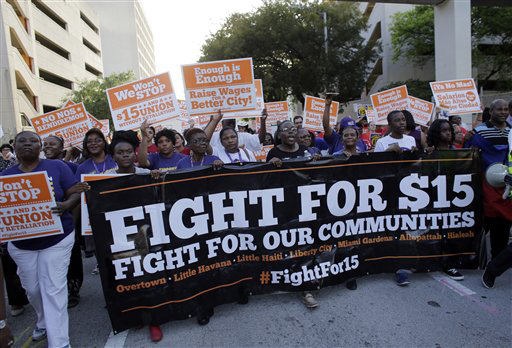
In its mission statement on the SEIU website, Faculty Forward lists three goals: (1) that adjuncts receive $15,000 per course in total compensation — an admittedly bold demand, total compensation including both salary and benefits, (2) to target “bad actors” in for-profit higher education that it claims “[saddles students] with crushing debt without delivering the quality education students deserve, and (3) to make quality higher education affordable and accessible for all students.”
Trevithik is one of approximately 650 adjunct professors employed at Fordham and an activist working for adjunct rights and improvement.
...Trevethik states that part of the mission of Faculty Forward is to garner support from the university’s president. As of Monday night, the dean of faculty has not immediately responded to a request for comment.
The university has provided data on its adjunct program, however.
Currently, for a standard undergraduate course meeting for three hours per week, Fordham University says it has a minimum pay of  $3,900. Depending on the professor’s experience and credentials, that number can reach $5,000 per course.
An adjunct position at Fordham includes three hours of teaching, four hours of preparation and grading, as well as two office hours per week. This adds up to nine total hours per course per week, the equivalent of $28 per hour over a 15-week semester.
Adjuncts at Fordham teach a maximum of two courses, or 18 hours per week. Most teach two days per week here.

Sunday, August 28, 2016

Justice Department to handle Arpaio case - POLITICO

Justice Department to handle Arpaio case - POLITICO
The Department of Justice will now handle the investigation into Phoenix Sheriff Joe Arpaio over accusations of racial profiling after federal prosecutors in Arizona asked to be removed citing unspecified conflicts of interest.
According to court filings made public on Friday and reported by the Associated Press, Arizona's federal prosecutors did not provide specific details on conflict of interests, but said there is an "existing conflicts of interest or the appearance of conflicts of interest pertaining to the matter."


Read more: http://www.politico.com/story/2016/08/joe-arpaio-justice-department-227468#ixzz4IbDT1jPV 
Follow us: @politico on Twitter | Politico on Facebook

Saturday, August 27, 2016

Article – Monroe Freedman’s Influence in Legal Education – Professional Responsibility: A Contemporary Approach

Image result for monroe freedman
When I was in law school there was only one ethical principle that mattered.  We wanted to be "people's lawyers" in Prof. Arthur Kinoy's phrase.  We wanted to be on the side of the angels - properly understood as those fighting for racial justice women's rights, and for some of us, workers' rights. There was no course in Professional Responsibility and I don't think anyone ever mentioned the canons of ethics.  Watergate and its raft of jailed lawyers changed that.  But so did Monroe Freedman.
I never met Monroe, though I corresponded with him quite a few times.  We agreed that the prosecutor in the Trayvon Martin case crossed the line, and we agreed in our otions of loyalty to clients, and our general pro-defense stance.  Here Peter Joy explores his impact on legal education. Monroe was a lawyer's law professor.  - gwc
Article – Monroe Freedman’s Influence in Legal Education – Professional Responsibility: A Contemporary Approach
By Peter A. Joy

Monroe Freedman’s influence on legal education was profound by any measure. He was much more than a gifted scholar and teacher, though he was both of those, as well as an accomplished lawyer. He was also the antithesis of a law professor disconnected from the practice
of law, who produces scholarship that has little to no relationship to the practice of law.
Monroe Freedman’s list of achievements and honors is extensive and includes trial and
appellate litigation in several state and federal courts and before administrative agencies; election to the American Law Institute and as a Fellow of the American Bar Foundation; and several state and national bar awards for his contributions to the field of professional responsibility, influential
scholarship in the field of lawyers’ ethics, and contributions to legal education and public service.
  As a law professor and a lawyer, he was the first to argue and successfully litigate that the ABA lawyer advertising restrictions violated the First Amendment.  In 1970, while teaching at George Washington University School of Law, he also directed the Stern Community Law Firm in Washington, D.C., to conduct public interest litigation. The public interest law firm ran advertisements that drew complaints leading the legal ethics and grievance committee of the District of Columbia Bar Association to investigate.  The bar committee ruled that, based on the First Amendment to the Constitution as well asother reasons, nonprofit law firms could advertise, which was the first such ruling in the United States.  
Six years later, in Bates v. State Bar of Arizona (1977), the U.S. Supreme Court held that the First Amendment protected truthful advertising of routine legal services.  The Court cited to Freedman for the idea that the legal profession’s failure to advertise may create public disillusionment with the legal profession. ...

Monroe Freedman raised questions about lawyers, their role in an adversary system, and the importance of loyalty to clients. He also demonstrated that law professors could effectively teach legal ethics not only in a Legal Ethics course but also in other courses, using his first year  Contracts course as an example. Through his scholarship and his teaching, Freedman greatly influenced legal education in the content of Legal Ethics courses, as well as how those courses are taught

Wednesday, August 24, 2016

Donald Trump is right: The election IS rigged (though not in the way he thinks)//Balkinization:

Image result for william lloyd Garrison
Americans are possessed of the strange notion that their Constitution is scriptural.  Mitt Romney even voiced the view that it is divinely inspired.  A more reasoned view is that of William Lloyd Garrison.  The great abolitionist saw it as "a Devil's pact...dripping with blood".  When the enormous blood of the Civil War re-founded the nation  new compromises were struck.  The compromise of 1877 secured white restoration in the deep south while creation of the western rectangular states promised to guarantee a Republican majority in the U.S. Senate.
Today we have in all but name replaced Lincoln's party with a white nationalist party quite like LePen's National Front in France.  The GOP is openly obstructionist and uninterested in governance.  A major portion of the population embraces or tolerates the groundless - e.g. that Barack Obama is a foreign born Muslin; that climate change (if it exists) is not related to human activity.  The great gerrymander and winner take all elections leaves us with no exit.
 The arc of history of which President Obama may bend toward justice but the arc is tilted.
- gwc

 Balkinization: Donald Trump is right: The election IS rigged (though not in the way he thinks)
by Sandy Levinson (UT Austin School of Law)

...we are victimized by our dysfunctional and even "imbecilic" Constitution. It's not only the craziness of, practically speaking, needing to rev up a constitutional convention in order to repeal a statute that made a great deal of sense in 1842 and generates really terrible consequences today; it's also the fact that the insane difficulty of constitutional amendment makes the very idea "unthinkable" among practical and "thoughtful" people as defined by the Washington Beltway and other centers of "thoughtfulness."
And Democrats are so eager to dismiss the ravings of the narcissistic sociopath regarding his own demented notion that the election is rigged--how else could somebody so magnificent actually lose the presidential election--that they/we are unwilling even to lay the basis for the deep critique of the American political system that assures that the election of Hillary Clinton, if the Republicans keep the House, will make, at best, a marginal different domestically, other than saving us from the prospect of a sociopathic president. That will be something to be grateful for, but it won't one whit lessen the overall political and constitutional crisis that faces the country and that most people simply wish to ignore because we have a Constitution that seems to assure there is no way out of it.

Forgotten Archipelagoes: 革 -Of the character 'ge', the Yiijing, ancient military texts and moral concepts

Etymology of Chinese concepts is a way to mine deeply into the culture, to find the resonance and connotaitons of a phrase.  The phrase "gai ge kai fang" 改革开放 reform and opening was the watchword of Deng Xiaoping's stunning departurefrom the straitjacket of Maoist ideology.  Flora Sapio does a brilliant job of exploring the metaphor behind the slogan.  You don't need to know Chinese to appreciate the elegance of her etymology. - gwc
Forgotten Archipelagoes: 革 -Of the character 'ge', the Yiijing, ancient military texts and moral concepts
by Flora Sapio
This is the sequel to an earlier post on 'gaige kaifang', in which I start to examine 'gaige kaifang' by focussing on the character 革 (ge).


My choice to begin the analysis of a concept  from a single character was inspired by various earlier discussions, ranging from attempts to findpossible, different interpretations of on-going trends in Chinese law, to more abstract discussions about the 'friend/enemy divide', attempts to construct an effective reading technique for Chinese texts, and so on. 

It may be argued that 'gaige kaifang', as a concept, is outdated because it is not at the centre of current policy debates, and therefore plays a largely rhetorical, or else a ceremonial function. Ceremonies and rituals, whether they be political ceremonies and rituals or ceremonies and rituals of the civil variety, however, play a lasting and important role in marking the passage through different stages of an organization, and in shaping its identity.

In this post I am focussing on the literal meaning of 革, to avoid constructing an individual interpretation, and then projecting it onto one of the fundamental (and overlooked) structures of Chinese political and legal thought. While examining ge within composites such as geming 革命 is a possibility, I believe that such an examination would separate 革 from the context of gaige kaifang, reform and opening up. ......[read more]

Tuesday, August 23, 2016

End-of-mission statement on China, by Professor Philip Alston, United Nations Special Rapporteur on extreme poverty and human rights

End-of-mission statement on China, by Professor Philip Alston, United Nations Special Rapporteur on extreme poverty and human rights
It is important to draw a distinction between the achievement of development objectives and the respect for human rights obligations. The two are mutually reinforcing, but they are not synonymous. China’s development attainments are unquestioned, but my task is to consider whether they also translate into ensuring full respect for the human rights of its people.

The most difficult and complex challenge in this respect is to understand how the leading role of the Communist Party can co-exist with the recognition of individual rights and the provision of meaningful accountability mechanisms which are an indispensable element in a human rights framework. The challenge was well captured in the President’s report to the 18th Party Congress in which he said that in order to “strengthen social development” what is needed is “a law-based social management system featuring Party committee leadership, government execution, nongovernmental support and public participation.” The reconciliation of these different dimensions is not easy.
2. Achievements
- See more HERE

Monday, August 22, 2016

Prof. David Cole's oral argument in the Kurdistan Workers Party case.

  His clarity and ability to handle the questions of Justices Scalia and Kennedy is exemplary David Cole - new legal director of the ACLU by Ronald K. Collins //Concurring Opinions
Hang into the end for Prof. David Cole's oral argument in the Kurdistan Workers Party case.  His clarity and ability to handle the questions of Justices Scalia and Kennedy is exemplary. GWC
David Cole - new legal director of the ACLU
by Ronald K. Collins //Concurring Opinions

Now that Professor David Cole has been named the new national legal director for the American Civil Liberties Union, I plan to do several posts on him and some of his views on the First Amendment.
As some may know, David Cole was the main author of the briefs in two landmark flag-burning cases:  Texas v. Johnson (1989); and United States v. Eichman (1990). William Kunstler, who argued both cases, commentedthat as the author of those briefs Cole was “the intellectual architect of the courtroom victories.” (See also Collins & Chaltain, We Must not be Afraid to be Free.)
David Cole likewise argued Reno v. American-Arab Anti-Discrimination Committee (1999) (First Amendment challenge to the selective enforcement of the immigration law against Palestinian immigrants based upon their political associations and activities). National Endowment for the Arts v. Finley (1998) was another First Amendment case Professor Cole argued (First Amendment challenge to NEA’s politically-based denial of federal funding to four performance artists whose works address issues of sexuality, and to the 1990 statutory provision requiring NEA grants to made “taking into consideration general standards of decency.”) He also served on the Advisory Board of The Free Expression Policy Project.
→ His most recent book, Engines of Liberty: The Power of Citizen Activists to Make Constitutional Law (2016) (see also his remarks at Politics & Prose Bookstore, April 2016) (YouTube)
* * * * 
For now, let us turn to Professor Cole’s arguments to the Court in Holder v. Humanitarian Law Project (2010), the “material support” to terrorist organizations case.  Below are some selected excerpts from the oral arguments in that case:

Friday, August 19, 2016

Christie rejects bill to automatically register voters - News - NorthJersey.com

Christie rejects bill to automatically register voters - News - NorthJersey.com
Christie vetoes voter registration bills," by The Record's Dustin Racioppi: 
"Governor Christie  vetoed a pair of bills intended to expand voter registration, telling lawmakers in a formal veto message that one of them should be renamed 'The Voter Fraud Enhancement and Permission Act.' The bill proposes automatically registering voters as part of the driver's license application or renewal process, but Christie signaled earlier this week that he would reject it, calling it a 'cocktail for fraud.' Although there have not been any recent confirmed cases of voter fraud in New Jersey, Christie has begun to talk of cheating at the polls. At the same time, Christie's friend Republican presidential nominee Donald Trump continues to warn voters of a 'rigged' presidential election. Trump trails in most polls against Democratic candidate Hillary Clinton."

John Timoney Had the Gall to Change Minds, One Police Department at a Time - The New York Times

John Timoney - the former police chief of New York City, Philadelphia, and Miami-has died at 68.  His voice was one long familiar - New York Irish,  his face and posture another icon - Irish Cop.  Timoney stood tall, was plain-spoken - and patient.  That last trait explains much of his success as Jim Dwyer recounts. - GWC

John Timoney Had the Gall to Change Minds, One Police Department at a Time - The New York Times
by Jim Dwyer
Shorts and sneakers, a T-shirt and a boss: The chief of the New York Police Department turned up at the Police Academy to school some young officers.
“Cuff me,” he instructed them.
Much later, the chief, John F. Timoney, described the episode. “I’m a four-star chief in a gym outfit,” Mr. Timoney said. “I’m not going to let you arrest me.”
He had wriggled, squirmed, locked his arms, squared his shoulders. The officers had struggled to pin his wrists. His point was how hard it could be for officers to subdue and handcuff an uncooperative person, and how easy it could be for them to lose their temper.
“If someone doesn’t want to get arrested, it is going to look ugly, especially to a civilian,” Mr. Timoney said. “Sometimes you have to talk your way out of these things. We have to remind cops, we didn’t hire you to be the toughest guy on the block.”
Brain and body, Mr. Timoney was cop and teacher for more than four decades. He died this week at 68. Years before cellphone and body-cam video showed violent encounters between the police and civilians, Mr. Timoney had run straight at that issue and others as a leader of departments in New York, Philadelphia and Miami. Mr. Timoney had the gall and the gravity to change minds that had been made up.
He would tell trainees about a former partner who beat a robbery suspect to death while Mr. Timoney was on vacation, and how none of the other officers stepped in to stop the pounding. “That’s part of your job,” Mr. Timoney said, and it was what the officers owed the public and one another. He incorporated a duty to intervene into the police regulations in Miami.
Then there was the most common use of lethal force by police officers.
In 1972, New York officers fired 2,510 bullets and killed 66 people. By 2014, there were 288 shots fired and eight people killed.
What happened? Mr. Timoney said that in 1972, the department put restrictions on when officers should shoot their weapons. Within a year, officers were firing about half as many shots....