Thursday, May 8, 2025

RFK. Jr. renounces germ theory - But YOU CAN KNOW THINGS

Koch’s postulates as commonly described.

The microbe must be found in all individuals suffering from the disease, but not in healthy individuals.

    • The microbe must be isolated from a diseased individual and grown into a pure culture.

  • 2.
    • The cultured microbe should cause disease when introduced into a healthy experimental host.

  • 3.
    • The microbe must be reisolated from the experimental host and shown to be the same as the original.

  • 4.

 Today's crackpots use the fact that there is an interaction between host and pathogen to minimize the role of the pathogen and focus misleadingly on the vulnerability of the host -.

https://uscode.house.gov/view.xhtml?path=/prelim@title18/part1/chapter11&edition=prelim#:~:text=(1)%20directly%20or%20indirectly%2C,any%20other%20person%20or%20entity%2C

John Snow - the first great epidemiologist traced the cholera epideic of Elizabethan London to the fecal contamination of the Broad Street pump.  He laid the basis for the vanquishment of the "miasma" or fould odors theory of disesase.  Not long after Robert Koch demonstrated the germ theory of disease.   The tubercle bacillus was identified as the source of tuberculosis, driving the sanitary movement.

But the crackpot who is now the Secretary of Health and Human Services - Robert F. Kennedy, Jr., is an adherent of the latest attempt to undermine the germ theory of disease which is  arguably the most important paradigm in the history of medicine. It states that microbial pathogens are responsible for causing infectious diseases, i.e., it denotes cause and effect. 


A NEW FORM OF GERM THEORY DENIAL


China's Tort Law - a Guide - Jeremy Daum

 Jeremy Daum of the Yale China Law Center has provided an excellent "walk through" of China's tort law - specifically the now five year old tort section of the Civil Code.

Walkthrough of Tort Interpretation.

 China’s top court recently released an interpretation on applying the torts section of China’s Civil Code. While the interpretation addresses several types of torts, two main themes emerge throughout the interpretation.

Guardianship/Parenthood: A recent legal trend has been to emphasize that the obligations of guardians are enduring, and that they retain responsibility for a child’s wellbeing and actions even if they are not directly caring for the child themselves. The interpretation discusses in what situations and to what extent others bear responsibility for torts committed by wards.

Allocation of damages: China’s civil code provides for proportional liability and joint and several liability where the acts of multiple persons cause harm..

Proportional liability (安分责任) means that the various parties at fault are each responsible only for the portion of the harm they caused. The injured party may seek compensation from any or all of these parties, but each only needs to pay for the portion of harm it caused. This proportion can either be determined at court or, where it cannot be determined, each contributing party will be responsible for an equal share.

Joint and Several Liability (连带责任)means that the injured party can recover in full from ANY of the parties at fault; and that the party giving compensation may then seek indemnification from the other parties contributing to the harm. This allows the injured plaintiff to more easily get compensation, but can be unfair to a wealthy defendant who contributed little to causing the harm, but is still liable for the full damages, while other, more at fault parties lack the resources to indemnify them.

Supplemental liability (补充责任)means that a party has responsibility for paying any remaining damages after another party first pays compensation as much as they can. Supplemental liability requires that the plaintiff first seek enforcement against a certain other party.

The situation most often addressed in the Interpretation is somewhat different than all of these, and relates to one party bearing full responsibility, while others bear responsibility for compensating only a portion of the harm. For example, if a labor staffing service dispatches a worker to a placement, and that employee causes harm to a third party, the law is clear that the placement bears full responsibility for 100% of the harm. At the same time, the staffing service may bear some liability (say 20%), if it negligently sent a poorly trained worker, resulting in the harm.

The Interpretation clarifies that in such a situation, the injured party can still sue whoever they like, but the total compensation received cannot equal more than 100% of the injury. So they cannot collect the 100% from the placement unit and 20% from the staffing service. The staffing service is not required to compensate the full harm, but if it agrees to pay more than the 20% it is liable for, it may seek indemnification from the placement for the excess portion.

KEEP READING


Monday, April 28, 2025

Hundreds of Big Firm Partners back Susman Godfrey


Susman Godfrey which represented Dominion Voting in a successful $765 million settlement of a suit against Fox News is the victim of a vindictive Trump Executive Order .  the firm has now received the support of  seven hundred of big firm partners who have joined an amicus brief.
Their argument is plain:
ARGUMENT  
A. The Executive Order exceeds the President’s authority and intrudes on core judicial functions......................................................................................................................2 
B. The Executive Order violates the First Amendment. .......................................................6 
C. The Executive Order violates the Fifth and Sixth Amendments. ...................................9
***
The Court should reject this unconstitutional Executive Order quickly, definitively, and with the forceful permanent injunctive relief the wrong requires. The Executive Order intrudes on the courts’ Article III power to decide cases based on zealous adversarial presentation, while exceeding the President’s limited Article II authority. It violates Susman’s First Amendment rights by retaliating against Susman for the views it and its clients have expressed and for its protected activity petitioning the courts on behalf of its clients. And by punishing both Susman and its clients through executive fiat, the orders violate the Fifth Amendment’s guarantee of due process as well as the Fifth and Sixth Amendments’ right to counsel

Thursday, April 24, 2025

D.C. Judges seem inclined against Trump law firm attacks

  (April 23, 2025, 9:00 PM EDT) -- Two D.C. federal judges on Wednesday expressed skepticism toward the Trump administration's justifications for targeting WilmerHale and Perkins Coie LLP with executive orders, with one judge invoking a comparison to the Red Scare.


The BigLaw firms appeared in packed courtrooms in Washington, D.C., to seek permanent injunctions against the orders in their entirety, while the U.S. Department of Justice is vying to dismiss the firms' suits.

Both U.S. District Judge Beryl A. Howell, who is presiding over the Perkins Coie litigation, and U.S. District Judge Richard J. Leon, who was assigned to the WilmerHale suit, have issued temporary restraining orders staving off much of President Donald Trump's directives. But the judges have, for now, left in place provisions stripping Perkins Coie and WilmerHale lawyers of security clearances "pending a review of whether such clearances are consistent with the national interest."

Judge Howell seemed inclined to make her temporary order permanent during a hearing Wednesday morning as she sharply questioned the Justice Department's Richard Lawson for more than two hours. While Lawson insisted that any lawyer with a suspended clearance would get an "individualized" review, Judge Howell said that such review usually happens before suspension.

The judge pointed to a declaration submitted by Perkins Coie from a former longtime Department of Defense official who said the blanket suspension of lawyers' clearances "harkens back to the repudiated and discredited programs that existed before Greene v. McElroy, including during the Red Scare."

"Is this a throwback to the McCarthy era, the Red Scare era?" Judge Howell inquired.

Lawson, who is defending the Trump administration against both suits, argued that the president's ability to trust a person is relevant when it comes to national security.

"I don't view this as punishment," he said. "It certainly would be an impediment."

But Williams & Connolly LLP partner Dane H. Butswinkas, who represents Perkins Coie, countered that the national security justifications are a "complete ruse." If the administration were truly concerned about national security, its settlements with other firms would include some remedial actions to resolve those concerns, Butswinkas said.

Judge Howell indicated those deals would be relevant context for her ruling as she quizzed Lawson on other firms' agreements to avert or rescind orders against them. Lawson, however, said he didn't know more about those agreements other than what has already been made public — including whether the deals were memorialized in writing.

"So we just have to wait for the inevitable FOIA lawsuits," Judge Howell said, predicting that Freedom of Information Act lawsuits will seek to obtain the details of those agreements.

In addition to Perkins Coie and WilmerHale, Trump inked orders against Jenner & Block LLP, Susman Godfrey LLP and Paul Weiss Rifkind Wharton & Garrison LLP. The orders suspended firm staff's security clearances, cut contracts between the firms and government, and restricted firm personnel from entering federal buildings.

Jenner & Block and Susman Godfrey have also taken the issue to court and obtained temporary restraining orders. Paul Weiss, meanwhile, struck a deal with the administration last month to get an order against it rescinded. Several other firms reached agreements with Trump to dodge impending orders targeting them.

WilmerHale's lawyer Paul D. Clement of Clement & Murphy PLLC said Wednesday that the orders "are a direct and lethal threat to an independent bar." If the sanctions were directed by Congress rather than by the president, "it would be as plain a bill of attainder as we've seen in this country for decades and decades," he said.

"The signal it sends to the whole bar is, 'Watch out,'" Clement, a former U.S. solicitor general, said.

Tuesday, April 22, 2025

Judge Wilkinson demands government take steps to return Garcia to freedom at home.

Kilmar Abrego Garcia, a lawful immigrant from El Salvador was - all admit - mistakenly seized, taken in a planeload of Venezuelan deportees, and abandoned to the mercies of a Salvadoran prison for alleged "terrorists".

On Apr. 4, Judge Paula Xinis wrote that “issuance of a preliminary injunction without further delay is necessary … to avoid ongoing irreparable harm,” and ordered the government to effectuate his return to the United States by 11:59PM April. 7. 

The Trump Justice Department appealed.

 On April 10, 2025 the United States Supreme Court began its opinion this way:

On March 15, 2025, the United States removed Kilmar Armando Abrego Garcia from the United States to El Salvador, where he is currently detained in the Center for Terrorism Confinement (CECOT). The United States acknowledges that Abrego Garcia was subject to a withholding order forbidding his removal to El Salvador, and that the removal to El Salvador was therefore illegal. The United States represents that the removal to El Salvador was the result of an “administrative error.” The United States alleges, however, that Abrego Garcia has been found to be a member of the gang MS–13, a designated foreign terrorist organization, and that his return to the United States would pose a threat to the public. Abrego Garcia responds that he is not a member of MS–13, and that he has lived safely in the United States with his family for a decade and has never been charged with a crime. 

The order properly requires the Government to “facilitate” Abrego Garcia’s release from custody in El Salvador and to ensure that his case is handled as it would have been had he not been improperly sent to El Salvador. The intended scope of the term “effectuate” in the District Court’s order is, however, unclear, and may exceed the District Court’s authority. The District Court should clarify its directive, with due regard for the deference owed to the Executive Branch in the conduct of foreign affairs.  

April 14 El Salvador’s President Bukele and ours – Donald Trump met at the White House.

Josh Marshall (Talking Points Memo)

The pair of strongmen told reporters they would not seek the release of Kilmar Abrego Garcia, a Salvadoran citizen deported from the U.S. last month during a hastily executed operation that also removed more than 100 Venezuelans under the Alien Enemies Act.

Bukele and senior Trump officials indicated they felt no obligation to comply with court orders. Bukele suggested at one point he had received no U.S. request to release Abrego Garcia, saying that doing so would be to “smuggle” him into the country. Trump advisor Stephen Miller argued the courts had no authority to compel the government to act in matters of foreign relations.

On Apr. 15, District Judge Xinis granted the motion for expedited discovery. The Judge wrote, “Defendants therefore remain obligated, at a minimum, to take the steps available to them toward
aiding, assisting, or making easier Abrego Garcia’s release from custody in El Salvador and
resuming his status quo ante. But the record reflects that Defendants have done nothing at all.”

  On Apr. 16, the Department of Justice - the defendants submitted a notice of appeal.

  On Apr. 17, the Fourth Circuit denied the Defendant’s appeal in a 7-page order. 

J. Harvie Wilkinson, a Reagan nominee, has served on the Court of Appeals since 1984!

He is considered a "feeder judge" whose Clerks often advance to clerkships on the United States Supreme Court.

FILED: April 17, 2025 

UNITED STATES COURT OF APPEALS FOR THE FOURTH CIRCUIT 

No. 25-1404 (8:25-cv-00951-PX) 

KILMAR ARMANDO ABREGO GARCIA; JENNIFER STEFANIA VASQUEZ SURA; A.A.V., a minor, by and through his next friend and mother, Jennifer Vasquez Sura, Plaintiffs – Appellees, 

v. 

KRISTI NOEM; TODD LYONS; KENNETH GENALO; NIKITA BAKER; PAMELA JO BONDI; MARCO RUBIO, Defendants – Appellants.

ORDER

WILKINSON, Circuit Judge, with whom KING and THACKER, Circuit Judges, join: Upon review of the government’s motion, the court denies the motion for an emergency stay pending appeal and for a writ of mandamus. The relief the government is requesting is both extraordinary and premature. While we fully respect the Executive’s robust assertion of its Article II powers, we shall not micromanage the efforts of a fine district judge attempting to implement the Supreme Court’s recent decision.

It is difficult in some cases to get to the very heart of the matter. But in this case, it is not hard at all. The government is asserting a right to stash away residents of this country in foreign prisons without the semblance of due process that is the foundation of our constitutional order. Further, it claims in essence that because it has rid itself of custody that there is nothing that can be done. 

This should be shocking not only to judges, but to the intuitive sense of liberty that Americans far removed from courthouses still hold dear. The government asserts that Abrego Garcia is a terrorist and a member of MS-13. Perhaps, but perhaps not. Regardless, he is still entitled to due process. If the government is confident of its position, it should be assured that position will prevail in proceedings to terminate the withholding of removal order. See 8 C.F.R. § 208.24(f) (requiring that the government prove “by a preponderance of evidence” that the alien is no longer entitled to a withholding of removal). 

Moreover, the government has conceded that Abrego Garcia was wrongly or “mistakenly” deported. Why then should it not make what was wrong, right?

Where I'd like to be right now


Perkins Coie Weekly Update 4/22/25


Perkins Coie Weekly Update 4/22/25


Trump: "What a ridiculous situation..."


Monday, April 21, 2025

Scotus has no one to blame but itself - Talking Points Memo

John Roberts embrace of the "unitary executive" theory and his affording Presdiential immunity for just about anything other than wife-beating, and cruelty to animals laid the foundation for this 100 days of tyranny blitzkrieg. 

SCOTUS Has No One To Blame But Itself For Alien Enemies Act Mess https://talkingpointsmemo.com/morning-memo/scotus-has-no-one-to-blame-but-itself-for-alien-enemies-act-mess via @TPM

Untangling The Deportation Cases - By Joyce Vance

 Untangling The Deportation Cases 

by Joyce Vance , Senior Fellow,  Brennan Center for Law & Justice - NYU

The Trump administration wants a confrontation with the courts. Trump wants to try to break them.

There are so many deportation cases happening at once that it’s difficult to keep up. Tonight, we’ll try to separate them so we can understand what is—and what isn’t—happening here. But keep in mind that while the substance of this dispute centers on the policy goal of deporting people Trump calls criminal illegal aliens, it is also a vehicle this administration is using to undercut the ability of the courts to act as a check on the executive branch and make it easier for Trump to range beyond the authority the Constitution affords to the president.That’s an essential path forward for a dictator. Like Trump’s new buddy, Nayib 

Bukele, whose government removed all of the Supreme Court Justices in El Salvador when they stood in his way and replaced them with more compliant ones. Or in Hungary, under Viktor Orbán, where the independence of the judiciary has been seriously compromised.

It’s time for people to stop pretending that it isn’t happening. Trump is trying to break the government. To control all its levers, he needs a complicit judiciary to go along with a complacent Congress. To understand the big picture, we need to spend some time in the weeds, examining the different deportation cases. There are so many of them that they turn into a jumble if we aren’t careful to parse them, which is our job for tonight. This is our roadmap to the most important deportation cases at the moment.

This is our roadmap:


Garcia - mistakenly sent to Salvador prison - Judge Wilkinson - 4th Circuit - lambasts Trump

High Administration figures admitted that  it had wrongly deported a permanent resdient alien - Garcia. 

But that prompted neither Donald Trunp nor Salvadoran President Bukele to arrange for his return to the United States.  The United States Supreme Clourt has ordered the Administration to "facilitate" his return.  Senator Chris Holland has gone to El Salvador but returned empty handed. 

Noem V. Garcia - Supreme Court - dissent


Garcia v. Noem - 4th Circuit

 J. Harvie Wilkinson III, like Learned Hand, and John Minor Wisdom has a name that suggests their mother has the bench in mind for her child at birth.

Nominated by Ronald Reagan, he has spent forty years in Richmond, VA as a judge of the United States Court of Appeals for the 4th Circuit.  A conservative Republican and Vietnam veteran, he served as Senior Judge from 1996-2003.  But what we demand via the rule of law is fealty to the law's commands - though, of course, sometimes that is unclear. As Benjamin Cardozo in The Nature of the Judicial Process :

A judge “legislates only between gaps. He fills the open spaces in the law. . . [R]estrictions . . . are established by the traditions of the centuries, by the example of other judges, his predecessors, and his colleagues, by the collective judgment of the profession, and by the duty of adherence to the pervading spirit of the law.”

As the courts have strained to adhere to those principles they have been confronted by Donald Trump's Executive Orders, and bristling attitude when a judge disagrees with him. This is the case particularly in Trump's invocation of the 1789 Alien Enemies Act to justify his deportation of aliens to a notrious Salvadorqan prison.  But even in the case of admited mistkae 


Fordham Mourns Pope Francis


Dear Fordham,

Against the odds, Pope Francis lived through Easter, and now we mourn him, comforted by the hope of the resurrection, knowing God has welcomed his faithful servant home. During his last weeks, he found the energy to go out several times, thanking the medical staff who nursed him, blessing inmates at a prison, and surprising visitors to St. Peter's in his wheelchair, because he wanted to be with the faithful. 

Francis, born Jorge Mario Bergoglio, was always an outsider, from an immigrant family that escaped Mussolini's fascism to immigrate to Argentina. He was the first pope from the Americas and the southern hemisphere, and the first Jesuit pope. He took the name of Francis of Assisi, the patron of the poor, and decided against living in the lavish Vatican palace. My favorite image is of him driving his own 1984 Renault around Rome. 

During his twelve-year tenure, Francis embodied the Jesuit way of proceeding as he moved the Church in the direction of its people, loving the Church enough to improve it. With his trademark humility, he urged the global Church to become the dream of the Gospels, one in which a justice rooted in love prevails, one that listens to its people. He reminded us that we are “fratelli tutti”—brothers and sisters all. He begged us to love God's creation and the Earth our home, to act quickly to change the dangerous trajectory of climate change. His voice was a clarion call to the world. 

We at Fordham responded to his call. Our graduate students developed the Pope Francis Global Poverty Index, which they present annually, inspired by his call for us to make an impact on poverty and well-being. When he convened the three-year Synod on Synodality, a process of listening, dialogue, and discernment that included all the voices of the Church, Fordham sent a delegation of students to the Vatican. When Fordham hosted the Outreach Conference, he sent handwritten letters of support about the power of engagement. His emphasis on social justice, inclusion, and environmental stewardship leaves a lasting legacy—one that calls each of us to continue his work.

I was blessed to meet Pope Francis when I traveled to Rome with a group of Fordham trustees and faculty. Our board chair, Armando Nuñez, spoke to him in the Pope’s native Spanish and we presented him with a Fordham jersey. He smiled and blessed our great University. 

As we mourn his passing, take some time today to read his profound writings and sit with his messages. Nothing can honor him more. Let us answer his call to care for the most vulnerable, to build bridges rather than barriers, and to live our faith with courage, mercy, and love.

With Prayers,

Tania Tetlow
President
 

Saturday, April 19, 2025

62 years ago ML King penned a letter from a Birminghm Jail.


62 years ago today - Good Friday - Martin Luther King was jailed for marching against segregation in violation of a facially unconstitutional injunction issued without notice.  The Supreme Court majority found that even an unconstitutional order must be obeyed - unless and until set aside by a court.

In Walker v. Birmingham (1967) a divided Supreme Court upheld the contempt convictions of  Rev. ML King and other leaders who defied an ex parte TRO forbidding a march on  Good Friday 1963. The order was unconstitutional on its face. The day chosen was of particular symbolic meaning to King and the Southern Christian Leadership  Conference as it commemorated the forced march and martyrdom of Jesus of Nazareth.

But the Supreme Court majority held that such an order must be obeyed  unless set aside on appeal. The ex parte order made appeal unfeasible before the symbolic date passed.

As Joyce White explains [below], Judge Boasberg in the El Salvador  case embraced the Walker principle demanding obedience to an extant court order.  Judge Boasberg is moving to punish the contempt by the defiant Trump government. He wrote:

"The Supreme Court has already set aside the temporary restraining order (TRO) the government allegedly violated and cases refiled in other jurisdictions per that Court’s orders. But, Judge Boasberg explained, as we’ve discussed here, that contempt is still appropriate: “One might nonetheless ask how this inquiry into compliance is able to proceed at all given that the Supreme Court vacated the TRO after the events in question. That Court’s later determination that the TRO suffered from a legal defect, however, does not excuse the Government’s violation. Instead, it is a foundational legal precept that every judicial order ‘must be obeyed’ — no matter how ‘erroneous’ it ‘may be’ — until a court reverses it…. If a party chooses to disobey the order — rather than wait for it to be reversed through the judicial process — such disobedience is punishable as contempt, notwithstanding any later-revealed deficiencies in the order.”

Joyce Vance, a former Federal prosecutor, now a law professor, has an excellent discussion at this link:


Scotus bars removal under the Alien Enemy Act (1789)


Scotus bars removal under the Alien Enemy Act  (1789)

by Steve Vladeck (Georgetown Law)

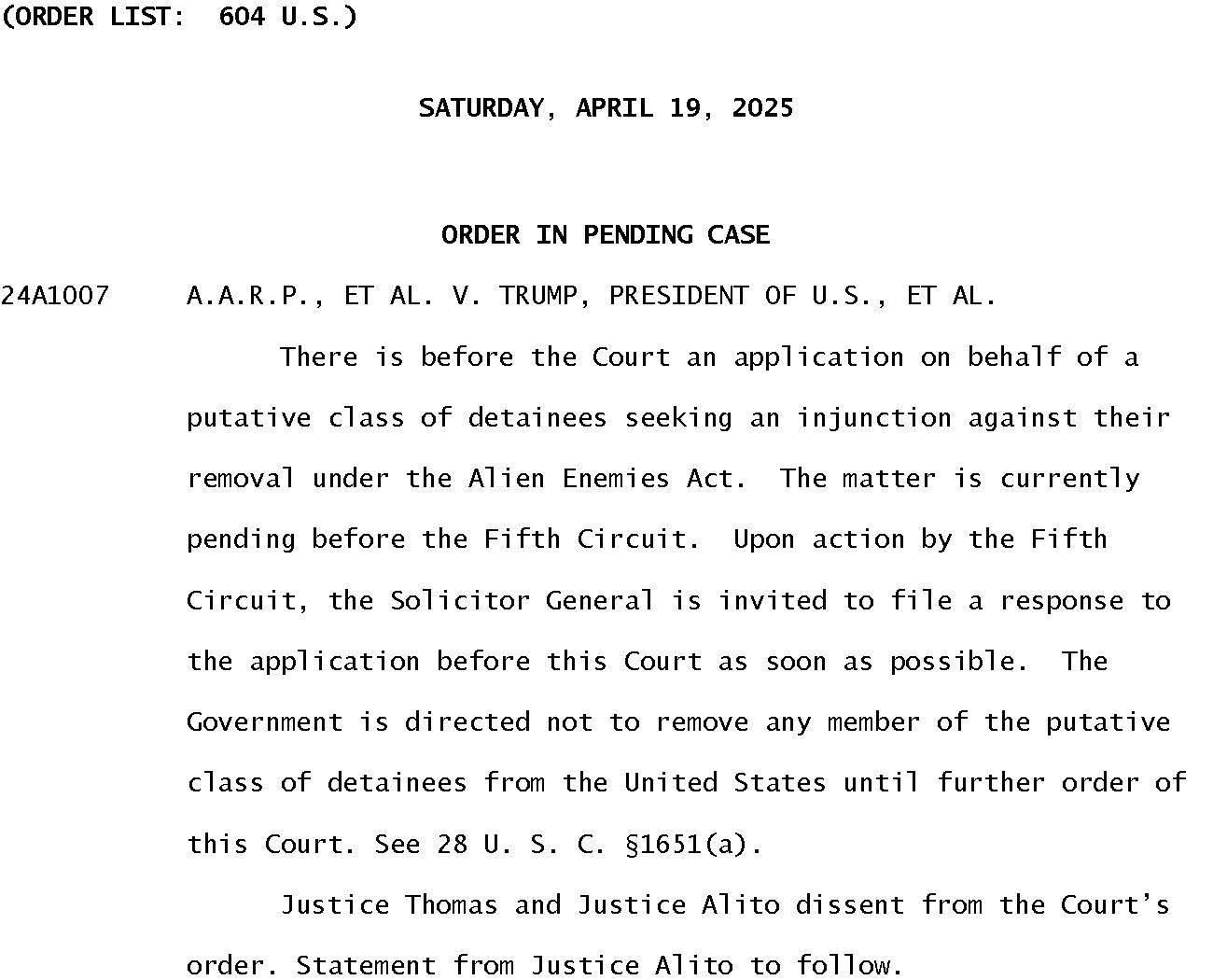
Just before 1:00 a.m. (ET) last night/very early this morning, the Supreme Court handed down a truly remarkable order in the latest litigation challenging the Trump administration’s attempts to use the Alien Enemy Act (AEA) to summarily remove large numbers of non-citizens to third countries, including El Salvador:

I wanted to write a short1 post to try to put the order into at least a little bit of context—and to sketch out just how big a deal I think this (aggressive but tentative) intervention really is.

I. The J.G.G. Ruling

As folks may recall, just 12 days ago, the Court issued a short per curiam opinion in Trump v. J.G.G., in which it held two things: First, a 5-4 majority held that challenges to removal under the AEA must be brought through habeas petitions where detainees are being held, not through Administrative Procedure Act claims in the D.C. district court (like J.G.G.). Second, the Court unanimously held that “AEA detainees must receive notice after the date of this order that they are subject to removal under the Act. The notice must be afforded within a reasonable time and in such a manner as will allow them to actually seek habeas relief in the proper venue before such removal occurs.”

As I wrote at the time, although I disagreed with the majority’s “habeas-only” analysis, the broader ruling made would’ve made at least a modicum of sense if the Court was dealing with any other administration, but it raised at least the possibility that the Trump administration, specifically, would try to play games to make habeas review effectively inadequate. And all of those games would unfold while no court has ruled, one way or the other, on either the facial legal question (does the AEA apply at all to Tren de Aragua); or case-specific factual/legal questions about whether individual detainees really are “members” of TdA. Lo and behold, that’s what happened.

II. The J.A.V. Ruling

In the immediate aftermath of the Court’s April 7 ruling in J.G.G., litigants successfully obtained TROs against AEA removals in three different district courts—the Southern District of New York; the District of Colorado; and, as most relevant here, the Southern District of Texas. In the S.D. Tex. case (J.A.V. v. Trump), Judge Fernando Rodriguez (not that it should matter, but a Trump appointee) barred the government from removing the named plaintiffs or anyone else “that Respondents claim are subject to removal under the [AEA] Proclamation, from the El Valle Detention Center.” (The other rulings were also geographically specific.)

III. The A.A.R.P. Case

Then things got messy. According to media reports, starting on Thursday, a number of non-citizens being held at the Bluebonnet detention facility in Anson, Texas (in the Northern District of Texas) were given notices of their imminent removal under the AEA (in English only), with no guidance as to how they could challenge their removal in advance. Not only did this appear to be in direct contravention of the Supreme Court’s ruling in J.G.G., but it also raised the question of whether the government was moving detainees to Bluebonnet, specifically, to get around the district court orders barring removals of individuals being held at El Valle and other facilities.

The ACLU had already filed a habeas petition on Wednesday in the Northern District of Texas on behalf of two specific (anonymous) plaintiffs and a putative class of all Bluebonnet detainees—captioned A.A.R.P. v. Trump. Judge Hendrix had already denied the ACLU’s initial motion for a TRO—based on government representations that the named plaintiffs were not in imminent threat of removal (he reserved ruling on the request for class-wide relief).

Thus, once the news of the potentially imminent AEA removals started leaking out, the ACLU did two things at once: It sought renewed emergency relief from Judge Hendrix in the A.A.R.P. case, and it went back to Chief Judge Boasberg in the J.G.G. case—which has not yet been dismissed—since that case at least for the moment includes a nationwide class of individuals subject to possible removal under the AEA. And while it waited for both district judges to rule, the ACLU sought emergency relief in A.A.R.P. from both the Fifth Circuit and the Supreme Court.

Sometime after 7 p.m. ET on Friday, Chief Judge Boasberg declined to issue a TRO in J.G.G., concluding from the bench (in my view, correctly) that he couldn’t do so in light of the Supreme Court’s ruling in his case, specifically. Meanwhile, Judge Hendrix issued a brief opinion noting that, although he had been trying to move quickly on the ACLU’s renewed emergency motion, the fact that the ACLU had already gone up to the Fifth Circuit and the Supreme Court deprived him of jurisdiction to do anything further. (I’m not sure that’s true since those were requests for emergency relief, not plenary appeals, but c’est la vie.)