Thursday, January 18, 2024

Dorf on Law: Justice Kavanaugh aims for Chevron but hits Delegation


During yesterday's oral arguments in Relentless, Inc. v. Dept. of Commerce and Loper Bright Enterprises, Inc. v. Raimondo, Solicitor General Prelogar and the Democratic appointees who do not want to see Chevron deference abandoned invoked stare decisis. Justice Kavanaugh pushed back with a clever-seeming argument that, upon inspection, has far-reaching consequences.

SG Prelogar warned that overruling Chevron would be a "shock to the system" in various ways. Regulations that have already been upheld under Chevron as reasonable could be upended. And numerous statutes in which Congress left gaps on the assumption that expert agencies would fill them would now be interpreted de novo by courts, frustrating Congress's reliance on Chevron in writing the statutes the way it did.

Justice Kavanaugh pushed back by claiming that the real shock to the system comes from Chevron itself, which allows a Republican administration to replace a regulatory regime adopted by a Democratic one and vice-versa, all without any statutory change. "Chevron itself ushers in shocks to the system every four or eight years when a new administration comes in," he said. "That is at war with stability. That is at war with reliance," he added.

Well played, no? Actually, no, unless Justice Kavanaugh's real target is not Chevron but delegation.

Consider Chevron itself. The Court construed the term "stationary source" in the Clean Air Act Amendments of 1977 as sufficiently ambiguous to allow the Carter administration's EPA to deem every smokestack a separate source and for the Reagan administration then to use the "bubble concept" by which all of the pollution-emitting devices in an industrial grouping count as a single stationary source, thus allowing cleaner burning parts to cancel out the dirtier parts. According to Justice Kavanaugh, that kind of change from one administration to the next is a shock to the system.

Maybe it is; maybe it isn't. But the problem inheres in delegation itself. To see why, suppose that the Clean Air Act contained an express delegation. Suppose it said something like the following: "The EPA shall treat each smokestack as a single stationary source unless, in the exercise of its reasonable judgment, it determines that the aggregate social costs of doing so outweigh the aggregate social benefits of doing so, in which case it may, in its reasonable discretion, aggregate pollution emitting devices within a single industrial group under a bubble concept."

Chevron does not come into play at all in construing the foregoing language; and yet the determination of the validity of an administration's shift to a bubble concept turns on exactly the same question as (what we now call) the Chevron step 2 analysis: Was the agency's decision reasonable? Every grant of discretion to an agency entails the possibility of shifting policy from one administration to the next. So if Chevron is at war with stability and reliance, then so is the express delegation of discretion to an agency.*** KEEP READING

Commission - 5th Circuit

22-40328-CV0.pdf
Consumers’ Research; By Two, L.P., Plaintiffs—Appellees, versus Consumer Product Safety Commission, Defendant—Appellant. ______________________________ Appeal from the United States District Court for the Eastern District of Texas USDC No. 6:21-CV-256 ______________________________ Before Jones, Dennis, and Willett, Circuit Judges. Don R. Willett, Circuit Judge: The Supreme Court in recent years has taken a keen interest in administrative law—the law that governs the government—reexamining foundational notions of federal regulatory power.1 In its current Term, for example, the Court is revisiting so-called Chevron deference,

Cardinal McElroy: Catholic universities should lead on climate change action | National Catholic Reporter

Cardinal McElroy: Catholic universities should lead on climate change action | National Catholic Reporter

In his epic poem, "Paradise Lost," John Milton captured the majestic drama of the fall and rise of humanity amidst the never-failing love and power of God's presence in the world. In the fourth book of the poem, Satan approaches the Garden of Eden, resolved to bring down Adam and Eve precisely because they have become a focus of God's love and tender care. As he enters the garden, Satan is stunned and overwhelmed by the sheer beauty of the paradise that the Lord has created and bestowed upon the human family. 

But where once such overpowering loveliness would have turned his heart to God, now the very beauty of paradise reminds Satan only of his own alienation from the creator, and he despises the majesty of creation, just as he despises its creator. Speaking to the sun, Satan cries out in pain.

O Thou, that with surpassing glory crowned,
Lookest from thy sole dominion like the lord
Of this new world; at whose sight all the stars
Hide their diminished heads, to thee I call, 
But with not with friendly voice, and add thy name
O sun, to tell thee how I hate thy beams, 
That bring to my remembrance from what state
I fell, how glorious once above thy sphere; 
Til pride and worse ambition threw me down.

The lament of Satan is forged by his very estrangement from the world of incomprehensible magnificence which God had created and which Satan had deformed.

Wednesday, January 17, 2024

Supreme Court to Hear Case That Could Overturn Key Chevron Precedent - The New York Times

Supreme Court to Hear Case That Could Overturn Key Chevron Precedent - The New York Times

By Adam Liptak

The Supreme Court is hearing arguments on Wednesday over whether to overturn a key precedent, one that has empowered executive agencies and frustrated business groups hostile to government regulation.

The court, which has in recent years rejected precedents on abortion and affirmative action and struck down regulations addressing climate change, student loans and coronavirus vaccines, is considering the fate of a foundational doctrine of administrative law called Chevron deference.

The doctrine takes its name from a 1984 decision, Chevron v. Natural Resources Defense Council, one of the most cited cases in American law. Discarding it could threaten regulations in countless areas, including the environment, health care, consumer safety, nuclear energy and government benefit programs. It would also transfer power from agencies to Congress and the courts.

Supreme Court to hear major case on power of federal agencies - SCOTUSblog

Supreme Court to hear major case on power of federal agencies - SCOTUSblog
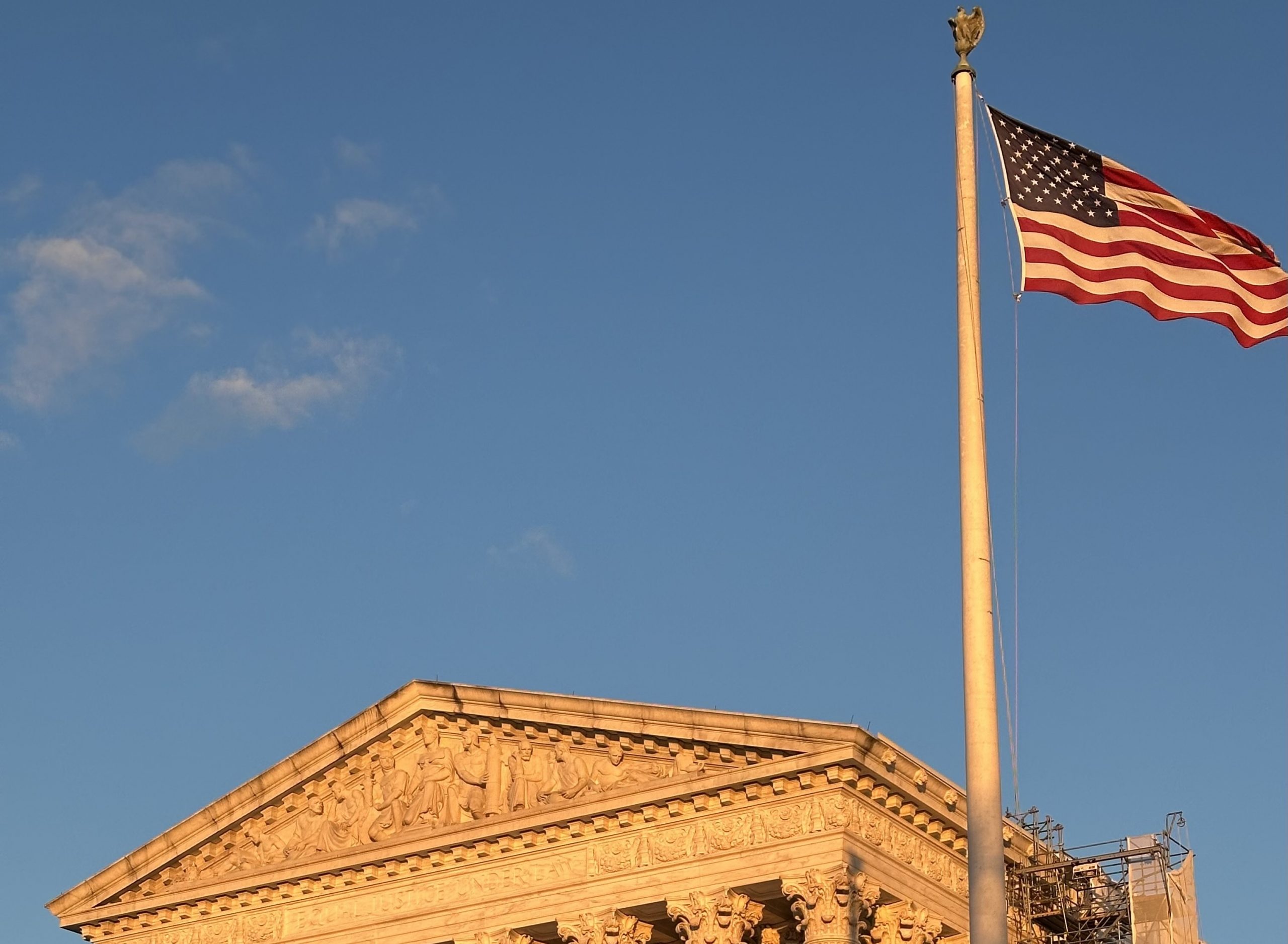
An American flag flies over the Supreme Court

The Supreme Court will hear oral argument on Wednesday in a case involving the deference that courts should give to federal agencies’ interpretations of the laws that they administer. From health care to finance to environmental pollutants, administrative agencies use highly trained experts to interpret and carry out federal laws. Although the case may sound technical, it is one of the most closely watched cases of the court’s current term, which is filled with blockbuster cases involving abortion, gun rights, and whether a former president is eligible to appear on the ballot. The stakes in the case are high: The challengers argue that the current deferential standard is unconstitutional, while the Biden administration contends that overturning the existing doctrine would be a “convulsive shock to the legal system.” 

The doctrine at the center of the case is known as the Chevron doctrine. It is named after the Supreme Court’s 1984 opinion in Chevron v. Natural Resources Defense Council, upholding a regulation issued by the Environmental Protection Agency. Justice John Paul Stevens set out a two-part test for courts to review an agency’s interpretation of a statute it administers. The court must first determine whether Congress has directly addressed the question at the center of the case. If it has not, the court must uphold the agency’s interpretation of the statute as long as it is reasonable.

In an article published in 2014, law professor Thomas Merrill suggested that the Chevron decision was not regarded as a particularly consequential one when it was issued. But in the decades since then, it became one of the most significant rulings on federal administrative law, cited by federal courts more than 18,000 times.

At the same time, Chevron has been a target for conservatives, who contend that courts – rather than federal agencies – should say what the law means. In recent years, some justices have urged their colleagues to revisit the doctrine, and the court itself has not cited Chevron since 2016. But the Supreme Court had repeatedly turned down petitions asking them to reconsider the Chevron doctrine – until last year, when it agreed to take up a case brought by a group of family-owned companies that fish for Atlantic herring.

The federal law at the center of the fishing companies’ challenge, the Magnuson-Stevens Act, gives the Secretary of Commerce and the National Marine Fisheries Service the power to “implement a comprehensive fishery management program.” The law also requires that fishery-management plans “may require that one or more observers be carried on board a vessel … , for the purpose of collecting data necessary for the conservation and management of the fishery.” Pursuant to this law, the NMFS issued a rule that requires the fishing industry to pay for the costs, estimated at $710 per day, associated with these observers.

The agency halted the monitoring last year due to a lack of funding and reimbursed fishermen for the costs of observers while the program was in effect.

The fishing companies, led by Loper Bright Enterprises, went to federal court in Washington in 2020 to challenge the NMFS rule, arguing that it was not authorized by the Magnuson-Stevens Act. Relying on Chevron, the district court rejected that argument, holding that the act clearly authorized industry-funded observers in the herring industry.

Monday, January 15, 2024

A death row lawyer stumped..Must his client pay the price? Adam Liptak ~ New York Times

 https://www.nytimes.com/2024/01/15/us/supreme-court-death-row-inmate.html?smid=url-share


An Unhealthy Definition of Rights | Linda Greenhouse | The New York Review of Books

Reviewed:

An Unhealthy Definition of Rights | Linda Greenhouse | The New York Review of Books

The public health profession uses the term “social determinants of health” to describe the social conditions that combine to influence the health of individuals and communities. These include such measurable elements as education, housing, and economic stability as well as environmental quality, structural racism, and other forms of systemic discrimination, some of which are less quantifiable. In Constitutional Contagion, Wendy Parmet demonstrates that among these elements we also need to include law.

It was a given that legal issues would arise in the course of the US response to the Covid-19 pandemic. In the spring of 2020 governors and mayors almost immediately drew on explicit or assumed legal authority to issue shutdown orders and impose other mitigation measures, even as the public health response became fuel for the country’s political polarization. By mid-2021, barely more than a year into the crisis, more than a thousand lawsuits had been filed against pandemic restrictions and mandates, and the Supreme Court had abruptly reversed itself and begun accepting religious objections to such measures rather than the recommendations of those whose job was to keep the public safe—with major doctrinal consequences that are still unfolding.

Parmet, a law professor at Northeastern University who has written widely on public health, recounts these developments, but her goal is deeper: to illuminate the currents in American legal culture that contributed to what she deems the country’s “catastrophic response” to the pandemic. She places on display an American exceptionalism of a particularly disquieting form: a legal mindset that has come to value individual freedom over communal welfare and so has “lost sight of contagion’s most compelling lesson: Our own health depends on the health of others.”

There is no dispute that the country fared poorly during the pandemic in both absolute and relative terms. The US death toll that reached one million in May 2022 represented more than 300 deaths per 100,000 people, compared to France at 230, Germany at 170, and Canada at 110. Among all high-income countries, none performed as badly as the United States.

There was no single cause for this dismal record...

Sunday, January 14, 2024

Ilana Diamond Rovner, 1st woman on 7th Circuit Appeals Court takes senior status

Judge Ilana Rovner holding a photograph 
of her father Zelig Diamants


Ilana Diamond Rovner announced last week that she will take senior status on the Chicago-based U.S. Court of Appeals for the 7th Circuit.  Her ABA biography is remarkable in its account of honors and achievements. The first woman on the Court of Appeals, she leaves four other women in their chambers, one vacated four years ago by Amy Coney Barrett on her elevation to the Supreme Court.
But her letter to President Biden - informing the President of her decision to take senior status, opening a seat on the Court of Appeals, strikes a different note - that of gratitude and solicitousness for others. Her warmth and personal experience is captured in a recent interview published in the Chicago ribune. 

Her modesty and humility is striking.  She leads not with a list of her accomplishments, but with her report that "(m)y mother and I came to the United States from Latvia in 1939, to join my father who had left a year earlier, as refugees from the Nazis, escaping the unspeakable fate that our family and friends in Europe.  This great nation took us from certain death and gave us every possible opportunity to make a new life for ourselves."

"Our experience", she writes, "gave me a deep respect  for the rule of law and a personal understanding of the horrors that can ensue when it is abandoned.  I was never more proud than on the days that I was sworn in as an American citizen and, years later, with my parents of beloved memory looking on, as a United States District Judge, and then a United States Circuit Court Judge...In the service of justice, I have endeavored always to be mindful of the ways in which the legal system can overlook, exclude, and give unequal treatment to those without resources, status, or societal acceptance."


- GWC 1/14/2024


Friday, January 12, 2024

Mark Graber - Eureka Not: The President is an Officer of the United States Redux, Redux . . .Balkinization

Balkinization: Eureka Not: The President is an Officer of the United States Redux, Redux . . .

By Mark Graber

A long exhaustive search has finally found an article published within ten years of the framing of the Fourteenth Amendment that declares that the President is not an officer of the United States.  Congratulations to Josh Blackman and Seth Barrett Tillman for unearthing the Louisville Daily Journal’s series of pieces claiming, contrary to what President Andrew Johnson said about his job description, that Johnson was not an officer of the United States.  Of course, the comment was not made in respect to Section Three of the Fourteenth Amendment, but apparently that is a trifle.  A source does exist. Eureka.

Maybe not. An historian might ask, how representative is the Louisville Daily Journal and what is the Louisville Daily Journal representative of?  With respect to the second question, a little newspaper search revealed that the Louisville Daily Journal was a Democratic party newspaper bitterly opposed to the Fourteenth Amendment, the impeachment of Andrew Johnson, and the possible presidency of radical Republican Senator Benjamin Wade of Ohio, the probable president if Johnson was impeached (unless Senators were not officers of the United States).  Before Donald Trump was subject to disqualification, originalists thought that the Republicans who voted for the Fourteenth Amendment were the authoritative source on the original meaning of that text.  Now apparently Democrats are the higher authority.  I look forward to many changes in the Supreme Court’s jurisprudence based on how white supremacists and former rebels described the post-Civil War Amendments (hint, black rule is constitutionally mandatory).

With respect to the first question, I decided to do two random searches.  The first was the record of the Andrew Johnson impeachment.  The second was American newspapers in 1868 (I used the Newspapers Archives site).  For the first, I searched “officers of.” For the second, I searched “officers of the United States” (I did a narrower search simply because “officers of,” which got 71 hits for the impeachment, would have gotten a few thousand for Newspaper Archives, almost all of which would not have been on point.  Indeed, I looked at only the first 200 of the more than five hundred hits I got).

The first finding was Common Sense 15, Blackman/Tillman 0*.  I found six references to the President or Vice President as an officer of the United States in the congressional records of the Johnson impeachment debate and nine references to the President or Vice President as an officer of the United States in the newspaper archives.  I should note the 0 is explained by my decision to read only the first 200 hits.  A quick check revealed the Louisville Daily Journal stories claiming the president was not an officer of the United States were in the database, just not in the first 200 hits.  The asterisk reflects one article that referred to a Democratic paper that claimed the president was not an officer of the United States.  Quite possibly the reference was to the Louisville Daily Journal.  

I have been deluged with other citations claiming that the President is an officer of the United States. Gerard Magliocca has done amazing work unearthing some of these citations.  John Vlahoplus has done yeoman work making many citations public and has sent me many more.  James Heilpern and Michael Worthy have a terrific piece on SSRN that geometrically expands the number of commentators and commentary from 1866 to 1868 that treats the president as an officer of the United States for Section 3 purposes.  Still, for the purposes of "scientific" accuracy (and my methods were not all that scientific), I decided not to refer to any article or citation that did not turn up in my random survey.  If we make the reasonable assumption that persons on both sides of the disqualification argument have been searching for favorable citations and that good tools for doing so are easily accessible, based on the information so far made public my best guess is that you will find more than 25 newspapers that refer to the president as an officer of the United States for every one that does not.

The second finding is that the members of Congress and newspapers that regarded the president as an officer of the United States were overwhelmingly Republican.  The members of Congress who claimed the president is an officer of the United States include Representative John Bingham of Ohio, who is often (and wrongly) regarded as the father of the Fourteenth Amendment, Representative James Ashley of Ohio, one of the main authors of the Thirteenth Amendment, Representative James Wilson of Iowa, the head of the House Judiciary Committee, and Senate Oliver Morton of Indiana, a prominent radical.  The newspapers include such Republican stalwarts as the National Republican, the Cincinnati Commercial, and the Madison Wisconsin State Journal.

So, what do we know?  With respect to Section 3 of the Fourteenth Amendment, there were at the time prominent assertions that former presidents and presidents were covered, and innumerable assertions that Section 3 disqualified anyone who held a federal or state office from holding any federal or state office.  There are numerous instances, including a congressional report, where political actors and journals make no distinction, sometimes self-consciously, between “office(r),” “office(r) of,” and “office(r) under.” There are no instances so far discovered of any person between 1866 and 1868 making a distinction between these phrases and claiming the president for purposes of Section 3 was an "officer," but not an "officer of" or an "officer under." Zero.  The only possible instance so far uncovered is of a Democrat, Reverdy Johnson (are we seeing a pattern here of those not wanting Trump to be disqualified), who recanted within approximately 15 seconds.

an Epps and William Baude on Section 3 of the 14th Amendment


Dan Epps and William Baude on Section 3 of the 14th Amendment


Monday, January 8, 2024

Justices will review lower-court ruling on access to abortion pill - SCOTUSblog

Justices will review Texas district judge's bar on access to Mifestiprone abortion pill - SCOTUSblog December 13, 2023 By Amy Howe

The Supreme Court on Wednesday morning agreed to review a ruling by a federal appeals court that would significantly restrict (but not eliminate altogether) access to a drug used in medication abortions, which account for over half of all abortions performed in the United States. Wednesday’s announcement means that the justices will weigh in on the issue of abortion for the first time since overruling the constitutional right to an abortion last year in Dobbs v. Jackson Women’s Health Organization. Their decisions in the new cases, Food and Drug Administration v. Alliance for Hippocratic Medicine and Danco Laboratories v. Alliance for Hippocratic Medicine, are likely to come sometime next summer, in the middle of the 2024 presidential campaign.

The announcement that the justices had granted review in the two cases came as part of a list of orders (the rest of which will be covered in a separate post) released on Wednesday morning.

The justices declined to take up an appeal by the challengers in the case, a group of doctors and medical groups opposed to abortion who had asked them to also weigh in on the validity of the FDA’s initial approval of the drug, known as mifepristone, in 2000. A federal judge in Amarillo, Tex., agreed with the challengers and suspended both that approval and the later changes to the conditions on the use of the drug – such as allowing the drug to be used through the 10th week of pregnancy, rather than the 7th, and allowing health-care providers who are not physicians to prescribe the drug. But although the U.S. Court of Appeals for the 5th Circuit upheld Kaczmaryk’s rollback of the later changes to conditions on the use of the drug, it ruled that the challengers’ efforts to invalidate the FDA’s initial approval of the drug came too late.

The Biden administration and the drug manufacturer Danco came to the Supreme Court this spring, asking the justices to intervene to maintain the status quo until the dispute is resolved. The justices granted that request, allowing the drug to remain widely available for now.  

The Biden administration and Danco came to the Supreme Court in September, asking the justices to weigh in on the propriety of the FDA’s decisions in 2016 and 2021 to make mifepristone more widely available, as well as whether the challengers have a legal right to bring their case at all. The doctors and medical groups asked the justices to take up their challenge to the FDA’s initial approval of mifepristone in 2000 – both its timeliness and the propriety of the decision itself.

In a brief order, the justices granted review of both the Biden administration’s and Danco’s appeals and indicated that they would be argued together, presumably sometime early next year. (2024)

The justices’ decision not to take up the challengers’ petition for review was the only denial of review noted on the one-page list of orders, suggesting that the justices wanted to make clear now that they would not weigh in on the FDA’s initial approval of the drug in 2000.

Recommended Citation: Amy Howe, Justices will review

Justices will review lower-court ruling on access to abortion pill - SCOTUSblog

Justices will review lower-court ruling on access to abortion pill - SCOTUSblog

The Supreme Court on Wednesday morning agreed to review a ruling by a federal appeals court that would significantly restrict (but not eliminate altogether) access to a drug used in medication abortions, which account for over half of all abortions performed in the United States. Wednesday’s announcement means that the justices will weigh in on the issue of abortion for the first time since overruling the constitutional right to an abortion last year in Dobbs v. Jackson Women’s Health Organization. Their decisions in the new cases, Food and Drug Administration v. Alliance for Hippocratic Medicine and Danco Laboratories v. Alliance for Hippocratic Medicine, are likely to come sometime next summer, in the middle of the 2024 presidential campaign.

The announcement that the justices had granted review in the two cases came as part of a list of orders (the rest of which will be covered in a separate post) released on Wednesday morning.

The justices declined to take up an appeal by the challengers in the case, a group of doctors and medical groups opposed to abortion who had asked them to also weigh in on the validity of the FDA’s initial approval of the drug, known as mifepristone, in 2000. A federal judge in Amarillo, Tex., agreed with the challengers and suspended both that approval and the later changes to the conditions on the use of the drug – such as allowing the drug to be used through the 10th week of pregnancy, rather than the 7th, and allowing health-care providers who are not physicians to prescribe the drug. But although the U.S. Court of Appeals for the 5th Circuit upheld Kacsmaryk’s rollback of the later changes to conditions on the use of the drug, it ruled that the challengers’ efforts to invalidate the FDA’s initial approval of the drug came too late.

The Biden administration and the drug manufacturer Danco came to the Supreme Court this spring, asking the justices to intervene to maintain the status quo until the dispute is resolved. The justices granted that request, allowing the drug to remain widely available for now.

The Biden administration and Danco came to the Supreme Court in September, asking the justices to weigh in on the propriety of the FDA’s decisions in 2016 and 2021 to make mifepristone more widely available, as well as whether the challengers have a legal right to bring their case at all. The doctors and medical groups asked the justices to take up their challenge to the FDA’s initial approval of mifepristone in 2000 – both its timeliness and the propriety of the decision itself.

In a brief order, the justices granted review of both the Biden administration’s and Danco’s appeals and indicated that they would be argued together, presumably sometime early next year.

The justices’ decision not to take up the challengers’ petition for review was the only denial of review noted on the one-page list of orders, suggesting that the justices wanted to make clear now that they would not weigh in on the FDA’s initial approval of the drug in 2000.


Posted in Merits Case

“Ruined” by Maybell Romero - Georgetown Law Journal

“Ruined” by Maybell Romero* - Georgetown Law Journal
  Judges play a critical role in one of the most important stages of a criminal case’s adjudication—sentencing. While there have been substantial limitations placed on the discretion judges can exercise in devising punishments, there are little to none on what judges say at such hearings when articulating their rationales for the sentences they impose on convicted defendants. This Article examines the language judges use when sentencing defendants convicted of rape, sexual assault, and sexual abuse that describes victims of those crimes and the harms they have sustained, especially language that describes victims as “ruined,” “broken,” or “destroyed.” The use of such language, while apparently meant to be empathetic, only serves to uphold misogynistic understandings of rape and sexual assault and actively harms victims. Judges trying to justify harsh sentences for defendants convicted of sex crimes also engage in shaming and exploitation of victims when saying that defendants have left victims “ruined” at sentencing. 
In this Article, I use traditional scholarly methods of reviewing and analyzing cases and legal doctrine to show why the use of such language is harmful to victims and fouts the purposes of criminal punishment. However, I also engage in autoethnographic methods, relying on my own experiences of rape and sexual assault, as well as prosecuting such cases. 
This Article considers how other fields such as medicine and public health have approached destigmatizing other historically stigmatized conditions such as substance use and mental illness, arguing that judges should take similar steps to destigmatize being a victim of rape and sexual assault by more carefully considering their language use at sentencing. 
I conclude by reflecting on the use of personal narrative in legal scholarship and in the classroom and argue that it can be a powerful tool that scholars should more openly embrace. 

* Felder-Fayard Associate Professor, Tulane University Law School; U.C. Berkeley School of Law, J.D. 2006; Cornell University, B.A. 2003. © 2022, Maybell Romero

Gaza Is Starving | The New Yorker

Gaza Is Starving | The New Yorker

By Isaac Chotiner 
Interview with UN World Food Program Chief Economist  Arif Husain
January 3, 2024

Last month, a United Nations report on hunger described a catastrophic situation in Gaza, where more than ninety per cent of the population has been facing “acute food insecurity,” and where “virtually all households are skipping meals every day.” Much of Gaza is at risk of famine in the next several months. Parents have been going without food to insure that their kids have at least something to eat; where food is available, moreover, prices have skyrocketed, making it inaccessible even for middle-class families. The report noted, “This is the highest share of people facing high levels of acute food insecurity” ever recorded “for any given area or country.” I recently spoke by phone with Arif Husain, the chief economist at the United Nations World Food Program, which was one of the partner organizations that compiled the report. The W.F.P. also collects data on hunger around the world and delivers food to needy people. During our conversation, which has been edited for length and clarity, we discussed what the people of Gaza are currently facing, the reasons many cannot access food, and why this crisis is so unprecedented.

Could you describe the food-access situation in Gaza right now?

The bottom line is that, in Gaza, pretty much everybody is hungry at the moment. In the food-security-analysis business, we do something called I.P.C., or Integrated Phase Classification. This is an exercise that has about twenty-three partners, including nineteen U.N. agencies and international N.G.O.s and about four donors. This group analyzes the food-security situation. And, on the basis of that, it presents a report, which is independent. It is not one agency or one entity. There’s a consensus-based analysis. This exercise is done in between forty and fifty countries worldwide that may have a food-security issue, whether it is because of conflict or climate or anything else. What an I.P.C. does in any given location is put people in five different classifications. I.P.C. Phase 1 is that everything is fine; I.P.C. Phase 2 is that people are stressed in terms of their food-security situation; I.P.C. Phase 3 is that people are, in fact, in a food-security crisis; I.P.C. Phase 4 is that people are in food-security emergencies; and the last phase is called the famine, or catastrophe, phase. Now, the same analysis was done for Gaza, which came out in December, and, according to that, pretty much the entire population of 2.2 million people is in a food-security crisis or a worse situation.

Can you describe the difference between crisis, emergency, and famine?

Old Constitutional Provisions and Presidential Selection: The folly of exhuming Section 3 of the 14th Amendment

Old Constitutional Provisions and Presidential Selection: The folly of exhuming Section 3 of the 14th Amendment
By Samuel Issacharoff (NYU Law)

The moves to disqualify former President Donald Trump in Colorado and Maine will doubtless force the Supreme Court to confront the obscure Section 3 of the 14th Amendment. In his petition for certiorari, and in particular in Part II of the argument section of the brief, Trump points to, but ultimately shies away from, a disturbing question of constitutional design. The vexing question is what becomes of a constitutional provision that lives beyond its historical context with nothing in either legislation or judicial interpretation to keep it up to date.

Section 3 of the 14th amendment, by its text, limits the application of the disqualification to only those who had previously taken an oath as an officeholder of the United States. Leaving aside the interpretive debate on whether the President and Vice President are in fact “officers of the United States” as that term has been understood, the prohibition is an odd one outside of the obvious context of the Civil War. Why would any country forbid election to high office for individuals who have engaged in insurrection or aiding national enemies, but only if they had previously been a member of government? Why prohibit an insurrectionist who had previously served one term in a state legislature from subsequent office-holding, but allow the election of a fellow insurrectionist who may have committed even more egregious acts but merely had been a county commissioner or not held office in the past?

No doubt formal arguments can be constructed around the nature of the oath. I suspect, however, that the real reason follows from the historical fact that the political and officer corps of the Confederacy were drawn from governing officials who predated secession and then emerged as drivers of the rebellion. Similarly, other countries have circumscribed the political ambition of individuals with links to government power in the service of antidemocratic aims. Following World War II, West Germany’s constitutional authority to ban political parties was meaningfully invoked only twice; once to bar former Nazis from recreating themselves after the war, and once to ban the Communist Party from serving as the propagandist for East Germany. Context matters.