Thursday, July 21, 2022

Contraception access, threatened in concurring opinion, shored up in House | Courthouse News Service

Contraception access, threatened in concurring opinion, shored up in House | Courthouse News Service
By Rose Wagner

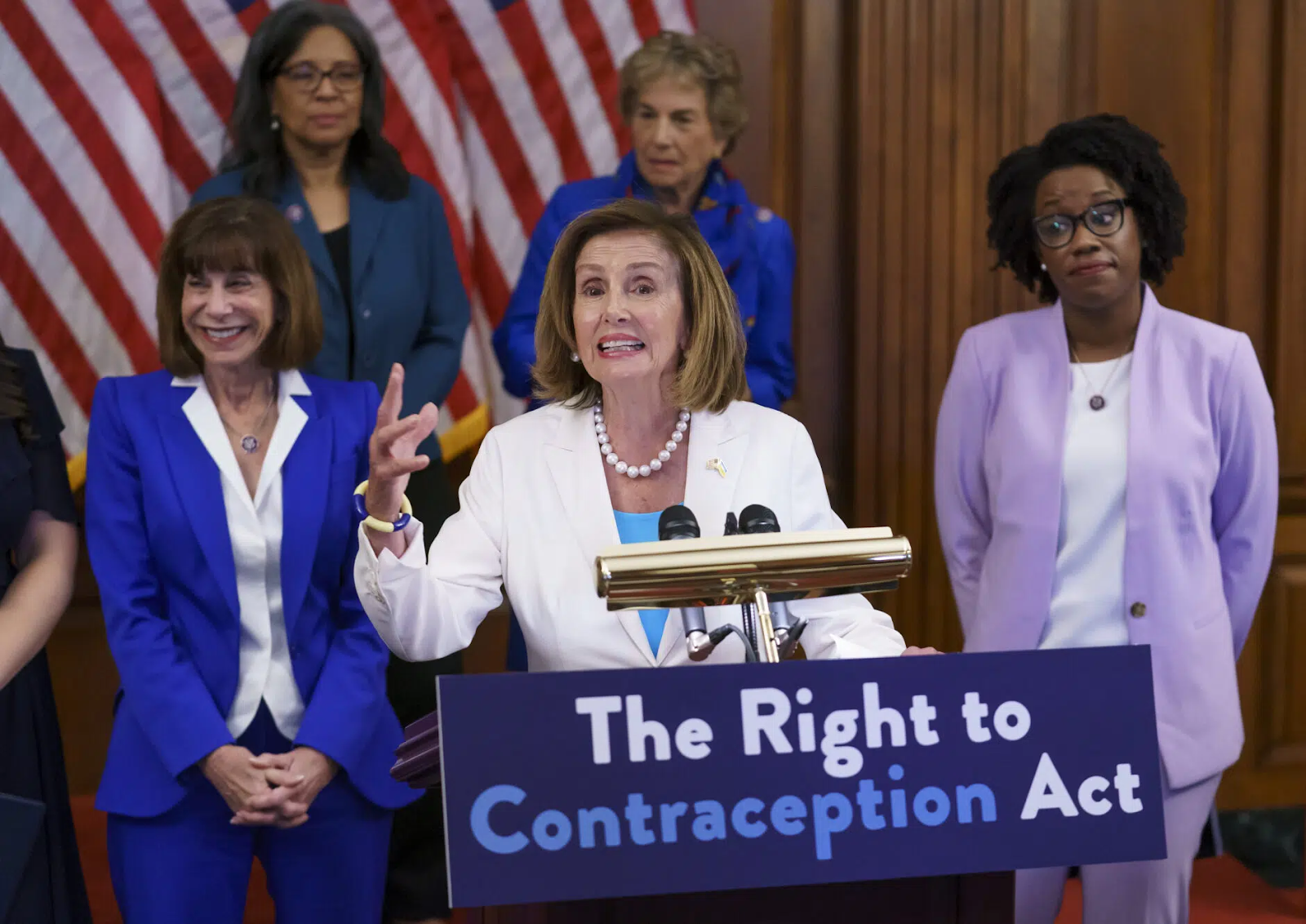
WASHINGTON (CN) — The House voted Thursday to enshrine access to contraception into federal law, the latest move by Congress to protect constitutionally understood rights in the wake of the Supreme Court’s decision to overturn Roe v. Wade.

The Right to Contraception Act, which passed the chamber by a vote of 228-195, would guarantee the federal right to contraceptives that was first declared in the Supreme Court’s decision in Griswold v. Connecticut.

It would ban states from restricting access to the pill, IUDs and emergency contraceptives while also giving both the attorney general and medical providers the authority to bring civil lawsuits against governments that restrict contraception access.

The legislation comes three weeks after the Supreme Court ruled in Dobbs v. Jackson Women’s Health Organization that the high court decision providing the right to an abortion was “egregiously wrong from the start,” rescinding a federal right that had been guaranteed for nearly 50 years.

Several states immediately enacted abortion bans in response to the ruling, with some states considering restrictions on birth control, particularly morning-after pills such as Plan B, now that their state laws define life as beginning at conception.


Gabbi Lemos Can Pursue Civil Rights Claim: Ninth Circuit


Gabbi Lemos Can Pursue Civil Rights Claim: Ninth Circuit
By Marissa Sarnoff //Law and Crime

In Gabbi Lemos v. County of Sonoma a federal appeals court has reversed an earlier panel decision barring a California woman from pursuing her excessive force claim against a sheriff’s deputy stemming from a 2015 altercation caught on camera.

Gabbi Lemos, 25, was arrested outside a high school graduation party in June of 2015, following an altercation involving her, some family members, and Sonoma County Sheriff’s Deputy Marcus Holton.Holton, who was on his routine patrol at the time, had stopped after seeing a pickup truck blocking a lane of traffic and hearing screaming, according to court documents. Holton activated his body-worn camera and began investigating what he believed at the time was a domestic dispute involving Lemos, her sister Karli Labruzzi, and her Labruzzi’s boyfriend Darien Balestrini. Labruzzi and Balestrini were in the truck, and as Holton approached so did Lemos, her mother, and a different sister.

At one point, when Holton opened the door of the truck to see whether Labruzzi had any weapons or injuries, Lemos stepped between Holton and her sister, telling him that he wasn’t allowed to do that. Things escalated, and Holton eventually arrested Lemos, forcing the 18-year-old high school graduate — who at the time weighed 105 pounds and stood five feet tall — to the ground, pinning her down.

Lemos sustained injuries to her face and claimed she incurred “thousands of dollars in medical expenses” as a result.

In November of 2015, Lemos sued the County of Sonoma, Sheriff Steve Freitas, and Holton for civil rights violations, known as 1983 claims because of the federal statute that provides a civil cause of action of deprivation of rights.

Sonoma County, simultaneously, pursued criminal charges against Lemos. The district court paused Lemos’ civil case, and in 2016 a jury convicted her of willfully resisting, delaying, or obstructing Holton, a misdemeanor.

The conclusion of Lemos’ criminal case reignited her federal civil case, but the district court dismissed on the basis of a legal theory that bars plaintiffs from suing law enforcement for civil rights violations if that plaintiff was also convicted of a crime for the same incident. The underlying idea of that theory, based on the 1994 Supreme Court decision in Heck v. Humphrey, is that a win for the plaintiff in a civil case would invalidate a criminal conviction, which presumably concluded that law enforcement’s action in the incident was legal.

keep reading

Wednesday, July 20, 2022

Georgia Fetal heartbeat law allowed to stand by 11th Circuit Court of Appeals


SISTERSONG WOMEN OF COLOR REPRODUCTIVE JUSTICE COLLECTIVE 11th Circuit July 20, 2022 

In an opinion by  William Pryor, C.J. a panel of three judges lifts the District Court injunction against Georgia's "fetal heartbeat" law.  The unanimous panel decision Court declares:
We VACATE the injunction, REVERSE the judgment in favor of the abortionists, and REMAND with instructions to enter judgment in favor of the state officials.  

 The Georgia fetal heartbeat law House Bill 481 has been allowed to stand by 11th Circuit Court of Appeals.  As I have been warning the 14th Amendment fetal personhood argument against abortion is the sleeper issue that will haunt us for the foreseeable future.  The 14th Amendment fetal personhood argument was voiced in an amicus brief by Notre Dame natural lawyer John Finnis and Princeton's Robert George. Georgia has joined issue. Its `fetal heartbeat' law now effectively bars almost all abortions.  And the United States Court of Appeals for the 11th Circuit has now allowed the law to stand.

The measure limits abortion and provides a cause of action on behalf of an aborted fetus.  It provides, most dramatically:

Modern medical science, not available decades ago, demonstrates that unborn  children are a class of living, distinct persons and more expansive state recognition of  unborn children as persons did not exist when Planned Parenthood v. Casey (1992) and  Roe v. Wade (1973) established abortion related precedents;  (4) The State of Georgia, applying reasoned judgment to the full body of modern medical  science, recognizes the benefits of providing full legal recognition to an unborn child  above the minimum requirements of federal law.

(5) Article I, Section I, Paragraphs I and II of the Constitution of the State of Georgia  affirm that "[n]o person shall be deprived of life, liberty, or property except by due  process of law"; and that "[p]rotection to person and property is the paramount duty of  government and shall be impartial and complete. No person shall be denied the equal  protection of the laws"; and (6) It shall be the policy of the State of Georgia to recognize unborn children as natural persons. 

Its implications are enormous. What does "full legal recognition of an unborn child" permit? Circuit Judge William Pryor - a prominent conservative fourteen of whose clerks have gone on to clerk for Clarence Thomas - snidely refers to the plaintiffs as "abortionists".  But his opinion persuasively draws on the majority opinion of Samuel Alito in Dobbs v. Jackson Women's Health

Georgia’s prohibition on abortions after detectable human heartbeat is rational. See H.B. 481 § 4(b). “[R]espect for and preservation of prenatal life at all stages of development” is a legitimate interest. Dobbs, 142 S. Ct. at 2284. The Georgia Legislature’s findings acknowledge a state interest in “providing full legal recognition to an unborn child.” H.B. 481 § 2(4). That “legitimate interest[] provide[s] a rational basis for” and “justif[ies]” the Act. Dobbs, 142 S. Ct. at 2284.  


Tuesday, July 19, 2022

The Miseducation of Public Citizens by Etienne C. Toussaint :: SSRN

The Miseducation of Public Citizens by Etienne C. Toussaint :: SSRN

Abstract

The American Bar Association Model Rules of Professional Conduct calls upon lawyers, as public citizens, to embrace a special responsibility for the quality of justice in the legal profession and in society. Yet, some law professors adopt a formalistic and doctrinally neutral approach to law teaching that elides critical perspectives of law, avoids the intersection of law and politics, and tends to overlook the way law can construct the very social injustices that it seeks to contain. The objective, apolitical, and so-called “colorblind” jurisprudential stance in many law classrooms inflicts intellectual violence upon law students who discover a legal doctrine in conflict with their own lived experiences, yet who feel silenced and unprepared to reckon with the moral legitimacy of unjust laws. Perhaps as a result, in recent years, law schools have begun to rethink legal education altogether, devising anti-racist curricula, professional identity trainings, and novel experiential learning programs to produce a new generation of critically conscious lawyers for the crises of our modern age.

Building upon such efforts, alongside recent scholarship in legal education and philosophical legal ethics, this Essay proposes foundational pedagogical principles to teach public citizenship lawyering. This Essay defines public citizenship lawyering as a democratic conception of professional responsibility whereby lawyers engage in routine critique of their lawyering practice through the lens of justice as a moral virtue. This pedagogy finds normative grounding in the ABA Model Rules based upon the contention that a skewed vision of professional lawyering identity has hindered a justice-oriented interpretation of the lawyer’s public citizen charge.

Specifically, this Essay articulates four pedagogical principles: (1) deconstructive framing, which guides the law professor in teaching the lawyer’s ethical duty of candor; (2) ethical reposturing, which guides the law professor in teaching the lawyer’s ethical duty of competence and professional judgment; (3) reconstructive ordering, which guides the law professor in teaching the lawyer’s ethical duty to improve the law; and (4) liberatory lawyering, which guides the law professor in teaching the lawyer’s ethical duty to assist the client and others in gaining competence. Collectively, these principles assert a counter-cultural vision of practice readiness that empowers law students to affirmatively challenge social and economic injustice in the legal profession and the rule of law. More than exalting a democratic conception of professional lawyering identity, these principles affirm the legal academy as law’s laboratory for progressive social change.

Justice Thomas is a hypocrite re originalism By Eric Segall - Georgia State

http://www.dorfonlaw.org/2022/07/justice-clarence-thomas-race-and.html?m=1&s=09

Monday, July 18, 2022

Article V, the Senate, and the House of Lords Option – Jeremy Sheff

Article V, the Senate, and the House of Lords Option – Jeremy Sheff
***But the fact that democratic reform is hard is no excuse for not putting in the work to make it happen. Precedent for de-fanging the reactionary and anti-democratic “upper” house of a national legislature is readily available—and it has been proven to be both durable and, ultimately, extremely popular. There is no reason why the United States should be a century behind the United Kingdom in reforming its national legislature to align with democratic principles. Americans who take democracy seriously should be mobilizing to support a credible threat of packing the Senate, as a second-best alternative to amending the Constitution to remove its powers. They should be making plans to admit new states and divide existing states so as to assure passage of constitutional amendments reallocating the Senate’s powers to other institutions. And they should be explicitly including these plans in their agendas and platforms, and be prepared to organize and mobilize voters to support these plans consistently and strategically over a long period of time. And they should, ultimately, be prepared to forego the implementation of such plans only if those who benefit from the anti-democratic structure of the Senate act to relinquish those benefits.

Illinois governor makes it easier for police to reject gun licenses    | Courthouse News Service

 
Governor J.B. Pritzker (D-IL)


Illinois governor makes it easier for police to reject gun licenses   

The rule change directs Illinois State Police to more broadly use "clear and present danger" reports to deny or revoke Firearm Owner ID cards.

Sunday, July 17, 2022

In progressive Massachusetts - a long history of White Supremacy //Boston Globe


Northerners like to think of themselves as enlightened - not like those prejudiced southerners. It is largely myth - as the Boston School Busing crisis demonstrated.  But even there educated liberals tend to look at that as the thuggery of working class Irish.  But the problem is much deeper, and of broader scope as University of New Hampshire historian Jason Sokol demonstrated in his All Eyes Are Upon Us: Race and Politics from Boston to Brooklyn (Basic Books, 2014).  More recently the problems have been explored by Lasalle University ethicist Maureen O'Connell in her newly published Undoing the Knots: Five Generations of American Catholic Anti-Blackness.

How to undo the knots is the subject addressed too in Linda McClain's Who's the Bigot? Learning from Conflicts over Marriage and Civil Rights Law.

- GWC

In progressive Massachusetts, a long history of white supremacy - The Boston Globe
By Danny McDonald Globe Staff,Updated July 15, 2022, 6:03 p.m

It was a deeply unsettling sight, as was surely intended. Two days before the Fourth of July, about 100 white supremacists, their faces covered, marched through the heart of Boston with riot shields, at one point brawling with a Black man.

The brazen demonstration, an apparent declaration of strength, heightened fears that white nationalist ideology had taken hold in Massachusetts, widely considered a progressive bastion, and that the national surge of extremism during the Trump administration had arrived here with troubling force.

But white supremacist movements have deep roots in Massachusetts and New England, historians said. While the displays of propaganda are shockingly hateful and vile, they are far from new.


“These ideas have been around,” said William C. Leonard, a history professor at Emmanuel College.

The Colonists, of course, codified slavery in Massachusetts in 1641, more than a century before the United States declared its independence. (The state abolished slavery in the 1780s.) In the early 1700s, the local Colonial legislature passed a law prohibiting interracial marriage and sex. The ban on sex was removed in 1786, but the ban on mixed marriages was expanded to include Native Americans. Two years later, local authorities prescribed whipping for nonresident Black people who stayed in the state more than two months.

In 1849, the state’s highest court ruled that the Massachusetts Constitution allows for segregated schools, and the US Supreme Court would later use that ruling to make the legal case for a “separate but equal” doctrine.

The anti-immigration movement also has roots in Massachusetts. In the 1890s, a trio of Boston Brahmin intellectuals founded the Immigration Restriction League, which laid the intellectual groundwork for many contemporary hard-line beliefs.

“It’s always had a nativist opposition to outsiders,” Leonard said of the region, “going back to Puritans.”


SOTU_2015_economic-mobility.pdf

SOTU_2015_economic-mobility.pdf

Sunday, July 10, 2022

“Egregiously Wrong”: The Supreme Court’s Unprecedented Turn | David Cole | The New York Review of Books

“Egregiously Wrong”: The Supreme Court’s Unprecedented Turn | David Cole | The New York Review of Books
By David Cole National Legal Director - ACLU, Georgetown Law Professor]

Over the course of the Supreme Court’s 232-year history, 110 men and six women have served as justices. Just a small handful of them have been “originalists,” holding the view that the only appropriate way to interpret the Constitution is to ask how its provisions were specifically understood at the time they were adopted. But in 2020 that handful became, for the first time, a majority of the Court when Amy Coney Barrett was confirmed, joining fellow originalists Clarence Thomas, Samuel Alito, Neil Gorsuch, and Brett Kavanaugh. (Chief Justice John Roberts is sometimes an originalist and sometimes not.) Last term—Barrett’s first—the Court proceeded cautiously, mostly seeking consensus across ideological lines through narrow decisions.

But this term, which concluded on June 30, these five abandoned caution and exerted their newfound authority like few justices ever have. The Court eliminated the right to abortion, struck down a century-old New York law that limited the public carrying of guns, required the state of Maine to fund evangelical religious education and a Washington public school to allow its football coach to pray publicly at the fifty-yard line after games, blocked President Biden’s Covid vaccine mandate for large businesses, and denied the Environmental Protection Agency the authority to require power plants to shift away from coal in order to slow global warming. Compromise, consensus, and the rule of law are out; the radical exercise of power is in.

In several of its most controversial decisions, including those on abortion, gun control, and prayer, the Court invoked originalism to overturn long-standing law and precedent. That approach, if applied consistently, would upend virtually all of constitutional law. Because so few justices throughout American history have been originalists, constitutional law as it stands today, especially with respect to its open-ended guarantees of liberty, equality, and due process, bears little resemblance to how it was originally understood. To revert to that understanding would be plainly unacceptable; it would mean, for example, reviving “separate but equal” and depriving women of equal protection. For better or worse, even the most committed originalists don’t apply originalism consistently, so it’s unlikely that the Court will resurrect Plessy v. Ferguson, the 1896 decision upholding segregation. But this term, the new majority applied originalism to disastrous effect, and only they know how far they will go.....

The Supreme Court spent its past term rejecting the rule of law - Ian Millhiser - Vox

The Supreme Court spent its past term rejecting the rule of law - Vox

By Ian Millhiser

The highest Court in the most powerful nation in the world appears to have decided that it only needs to follow the law when it feels like it.

Last December, for example, the Supreme Court handed down a decision that fundamentally alters the Union — giving states sweeping authority to restrict their residents’ constitutional rights.

At least, that’s what happened if you take the Court’s 5-4 decision in Whole Woman’s Health v. Jackson seriously. Jackson involved Texas’s anti-abortion law SB 8, which allowed “any person” who is not employed by the state to sue anyone they suspect of performing an abortion after the sixth week of pregnancy, and to collect a bounty of at least $10,000 from that abortion provider. The Court allowed that law to take effect, even though abortion was still considered a constitutional right at the time.

If you apply the logic from Jackson more broadly, any state could pass a law unleashing such litigious bounty hunters upon people who exercise any constitutional right. Perhaps a state wants to make it illegal to own a gun, or maybe it wants to allow bounty hunters to sue any Black family that sends its child to a predominantly white school — and the federal judiciary will simply stand back and let it happen. Realistically, the Court is unlikely to allow these sorts of attacks. But to spite abortion, the conservative majority was willing to open the door to them.

Jackson, moreover, was only the beginning of a Rumspringa of conservative excess led by the Court’s Republican-appointed majority.

In its just-completed term, the Supreme Court overruled Roe v. Wade, permitting states to ban abortions without having to resort to SB 8-style chicanery. It also overruled a seminal 1971 decision prohibiting the government from advancing one religious belief at the expense of others. It all but neutralized another half-century-old precedent permitting federal law enforcement officers who violate the Constitution to be sued. And the Court’s Republican majority dismantled two decisions protecting criminal defendants who were convicted or sentenced without adequate defense counsel, most likely condemning an innocent man to die in the process.

KEEP READING

Ex-Trump White House counsel Cipollone 'cooperative' with Jan. 6 committee during lengthy interview

Ex-Trump White House counsel Cipollone 'cooperative' with Jan. 6 committee during lengthy interview
https://www.supremecourt.gov/opinions/21pdf/21-418_i425.pdf

The Supreme Court’s “praying coach” decision rests on a bed of lies - Ian Millhiser - Vox

The Supreme Court’s “praying coach” decision rests on a bed of lies - Vox
by Ian Millhiser

Kennedy v. Bremerton School District is a big victory for the religious right, but only because Gorsuch misrepresents the facts of the case.

Saturday, July 9, 2022

The Supreme Court spent its past term rejecting the rule of law - Ian Millhiser - Vox

The Supreme Court spent its past term rejecting the rule of law - Vox
By Ian Millhiser

The highest Court in the most powerful nation in the world appears to have decided that it only needs to follow the law when it feels like it.

Last December, for example, the Supreme Court handed down a decision that fundamentally alters the Union — giving states sweeping authority to restrict their residents’ constitutional rights.

At least, that’s what happened if you take the Court’s 5-4 decision in Whole Woman’s Health v. Jackson seriously. Jackson involved Texas’s anti-abortion law SB 8, which allowed “any person” who is not employed by the state to sue anyone they suspect of performing an abortion after the sixth week of pregnancy, and to collect a bounty of at least $10,000 from that abortion provider. The Court allowed that law to take effect, even though abortion was still considered a constitutional right at the time.

If you apply the logic from Jackson more broadly, any state could pass a law unleashing such litigious bounty hunters upon people who exercise any constitutional right. Perhaps a state wants to make it illegal to own a gun, or maybe it wants to allow bounty hunters to sue any Black family that sends its child to a predominantly white school — and the federal judiciary will simply stand back and let it happen. Realistically, the Court is unlikely to allow these sorts of attacks. But to spite abortion, the conservative majority was willing to open the door to them.

Jackson, moreover, was only the beginning of a Rumspringa of conservative excess led by the Court’s Republican-appointed majority.

In its just-completed term, the Supreme Court overruled Roe v. Wade, permitting states to ban abortions without having to resort to SB 8-style chicanery. It also overruled a seminal 1971 decision prohibiting the government from advancing one religious belief at the expense of others. It all but neutralized another half-century-old precedent permitting federal law enforcement officers who violate the Constitution to be sued. And the Court’s Republican majority dismantled two decisions protecting criminal defendants who were convicted or sentenced without adequate defense counsel, most likely condemning an innocent man to die in the process.***

History, the Supreme Court, and Dobbs v. Jackson: Joint Statement from the AHA and the OAH (July 2022) | AHA

History, the Supreme Court, and Dobbs v. Jackson: Joint Statement from the AHA and the OAH (July 2022) | AHA

The American Historical Association and the Organization of American Historians have jointly issued a statement expressing dismay that the US Supreme Court “declined to take seriously the historical claims of our [amicus curiae] brief” in its Dobbs v. Jackson Women’s Health Organization decision. “Instead, the court adopted a flawed interpretation of abortion criminalization that has been pressed by anti-abortion advocates for more than thirty years. … These misrepresentations are now enshrined in a text that becomes authoritative for legal reference and citation in the future. The court’s decision erodes fundamental rights and has the potential to exacerbate historic injustices and deepen inequalities in our country.”

To date, 16 organizations have signed onto the statement.

Download the statement as a PDF.


History, the Supreme Court, and Dobbs v. Jackson: Joint Statement from the American Historical Association and the Organization of American Historians

In September 2021, the American Historical Association and the Organization of American Historians submitted an amicus curiae brief to the US Supreme Court presenting the relevant history to the Dobbs v. Jackson Women’s Health Organization case. We are dismayed that the court declined to take seriously the historical claims of our brief. Instead, the court adopted a flawed interpretation of abortion criminalization that has been pressed by anti-abortion advocates for more than 30 years. The opinion inadequately represents the history of the common law, the significance of quickening in state law and practice in the United States, and the 19th-century forces that turned early abortion into a crime.

Historians might note that the court’s majority opinion refers to “history” 67 times, claiming that “an unbroken tradition of prohibiting abortion on pain of criminal punishment persisted from the earliest days of the common law until 1973.” Our brief shows plentiful evidence, however, of the long legal tradition, extending from the common law to the mid-1800s (and far longer in some American states, including Mississippi), of tolerating termination of pregnancy before occurrence of “quickening,” the time when a woman first felt fetal movement. The majority of the court dismisses that reality because it was eventually—although quite gradually—superseded by criminalization. In so doing the court denies the strong presence in US “history and traditions” at least from the Revolution to the Civil War of women’s ability to terminate pregnancy before the third to fourth month without intervention by the state.

These misrepresentations are now enshrined in a text that becomes authoritative for legal reference and citation in the future. The court’s decision erodes fundamental rights and has the potential to exacerbate historic injustices and deepen inequalities in our country. We expect that historians will continue to correct the court’s misinterpretation about the history of legalized abortion in the US in their own research, teaching, and public speaking, while also addressing the multifaceted dilemmas presented by this decision.

The OAH and AHA consider it imperative that historical evidence and argument be presented according to high standards of historical scholarship. The court’s majority opinion in Dobbs v. Jackson does not meet those standards and has therefore established a flawed and troubling precedent.

The following organizations have signed onto this statement:

American Society for Environmental History
American Society for Theatre Research
African American Intellectual History Society
Association for the Study of African American Life and History
Berkshire Conference of Women Historians
Business History Conference
College Art Association
German Studies Association
Immigration and Ethnic History Society
National Women’s Studies Association
Radical History Review
Shakespeare Association of America
Society for the Study of Early Modern Women and Gender
Society for US Intellectual History
Urban History Association
Western History Association

Vermeule: WVA v. EPA is a specious attack on the Clean Air Act - The Washington Post

"West Virginia v. EPA illustrates that every last methodological tenet professed by the [conservative legal]movement will be downplayed, qualified or abandoned when the chance arises to limit the regulatory authority of the federal agencies, especially in environmental matters."
Adrian Vermeule is a brilliant and notorious Harvard Law Professor.  As I observed a few months ago in a review of his new book Common Good Constitutionalism  Vermeule will confound both progressives and conservatives.  This is conservatives' turn in the dock.  A co-author with Cass Sunstein of Law and Leviathan, Vermeule unlike other conservatives  defends the administrative state that began with the New Deal's "alphabet agencies".   He rejects the purportedly "originalist" and "textualist" rationales that mask a determination to drastically reduce the role of government. - GWC
There is no conservative legal movement - The Washington Post
By Adrian Vermeule (Harvard Law School)

On the last day of the Supreme Court’s term, in a case called West Virginia v. Environmental Protection Agency, the Court declared that the Clean Air Act does not clearly authorize the EPA to create a Clean Power Plan — in other words, to set standards for emissions from existing power plants with a view to encouraging “generation shifting” of electricity production toward sources that emit less carbon dioxide. If this does not sound like the stuff of great events, it was made so by the court’s approach to the case. Chief Justice John G. Roberts Jr., writing for the majority, announced expressly, for the first time, that the court would apply a “major questions doctrine.” According to the majority, the doctrine holds that in “extraordinary cases” the court will apply a “different approach” than the ordinary legal principles governing the interpretation of statutes. Instead, it will demand clear congressional authorization for agency action that is, in the judges’ view, “highly consequential,” posing questions of “economic and political significance.”

Commentators rushed to discuss the significance of West Virginia v. EPA for the conservative legal movement, to which they assumed the justices in the majority belong, perhaps because the court limited abortion rights and strengthened gun rights in the same term. But that framing rests on an error: In reality, as this case makes clear, there is no conservative legal movement, at least if legal conservatism is defined by jurisprudential methods rather than a collection of results. West Virginia v. EPA illustrates that every last methodological tenet professed by the movement will be downplayed, qualified or abandoned when the chance arises to limit the regulatory authority of the federal agencies, especially in environmental matters.

The conservative legal movement distinguishes itself from other approaches by declaring itself united not around “results-oriented jurisprudence” but rather around a set of supposedly neutral methods for interpreting legal texts. Conservative jurisprudence — again, as advertised — has four pillars: originalism, textualism, traditionalism and judicial restraint. Although different conservatives emphasize one or the other approach, all are staples of Federalist Society events and lauded in the opinions of conservative justices.

KEEP READING


Tuesday, July 5, 2022

SCOTUS: Paving The Road to Slaughter with Good Intentions

 Today in Highland Park, Illinois a miscreant shot from a rooftop into a July 4 parade crowd.  Six dead and dozens wounded.  Twenty-two year old “Bobby” E. Crimo III had no need for a gun.  Yet he had a legally acquired assault rifle which he used with deadly effect, killing six at current count and injuring dozens.

But last month the Supreme Court, 6-3, voided a New York law requiring demonstration of special need to buy a handgun.  But since yesterday's killer  used a high powered semi-automatic weapon of war, critics of Second Amendment rights may find themselves the objects of Samuel Alito's scorn.  In New York State Rifle Alito wrote in a concurring opinion:

Why, for example, does the dissent think it is relevant to recount the mass shootings that have occurred in recent years?  Does the dissent think that laws like New York’s prevent or deter such atrocities? Will a person bent on carrying out a mass shooting be stopped if he knows that it is illegal to carry a handgun outside the home? And how does the dissent account for the fact that one of the mass shootings near the top of its list took place in Buffalo? The New York law at issue in this case obviously did not stop that perpetrator.

Well, to me the fact that Crimo could do more damage with an assault rifle is not a reason to void New York's century old gun control laws. To me it is reason to extend them, not gut them.  But then again I think that judges should consider more than the crystalline logic of the rules which they themselves  have created.

The measures proposed as somehow within reach are almost token, though it is possible that the latest homicidal maniac would have been tripped up by the red flag provisions of the pending Senate compromise.   Once we recognize that half of gun deaths are suicides, and that there are more guns than people thoughts should turn to drastic measures, not lesser. Chief among them should be the outlawing of semi-automatic weapons like the trendy AR 15, but most importantly a massive nationwide gun buyback, and rigorous permit system.  But for the latter we will have to expand and pack the Supreme Court like the Republicans have done.

- GWC

NEW YORK STATE RIFLE & PISTOL ASSOCIATION, INC., ET AL., PETITIONERS v. KEVIN P. BRUEN, IN HIS OFFICIAL CAPACITY AS SUPERINTENDENT OF NEW YORK STATE POLICE, ET AL. 

ON WRIT OF CERTIORARI TO THE UNITED STATES COURT OF APPEALS FOR THE SECOND CIRCUIT [June 23, 2022] 

JUSTICE THOMAS delivered the opinion of the Court. In District of Columbia v. Heller, 554 U. S. 570 (2008), and McDonald v. Chicago, 561 U. S. 742 (2010), we recognized that the Second and Fourteenth Amendments protect the right of an ordinary, law-abiding citizen to possess a handgun in the home for self-defense. In this case, petitioners and respondents agree that ordinary, law-abiding citizens have a similar right to carry handguns publicly for their self-defense. We too agree, and now hold, consistent with Heller and McDonald, that the Second and Fourteenth Amendments protect an individual’s right to carry a handgun for self-defense outside the home. 
Sunday, July 3, 2022

Let’s Not Pretend We’re Keeping Our Promises on Asylum - Megan Stack - The New York Times


The Trump crowds, the Republicans in conventions assembled, chanting USA, USA have no affinity for the words of Emma Lazarus. But it's not just them.  We have admitted favored groups -mostly European,  But that sentiment has largely faded.  The late great historian of Europe Tony Judt in his masterful Post-War described the massive relocations of ethnic groups after WWII ended.  The Volga Germans were uprooted after centuries on the Volga; Jews who survived history's most brutal and systematic extermination were not welcomed in the lands of their birth - mainly Germany and Poland but were directed  to replace the Palestinians in the Holy Land.
In 1951 the United Nations adopted the Convention Relating to the Status of Refugees - which we have yet to sign.  But the Refugee Act of 1980 at 8 USC 1158 finally adopted the Convention's approach.  It says: 8 USC 1101 (42).

A “refugee” is any person who is outside his or her country of nationality (or, if stateless, outside the country of last habitual residence) and is unable or unwilling to return to that country because of persecution or well-founded fear of persecution on account of race, religion, nationality, political opinion, or membership in a particular social group.

Not included are refugees from war or famine. 
We've sent El Salvadorans back, denied entry to Haitians, and dreaded thousands of men, women and children in 'caravans' approaching the southern border.

 = GWC


Opinion | Let’s Not Pretend We’re Keeping Our Promises on Asylum - The New York Times
By Megan K. Stack [Fellow, George Washington University School of Media and Public Affairs]

In this restive age of unprecedented human displacement, 100 million people have fled disaster and oppression to try their luck in a world that’s increasingly tired of dealing with them.

The high-minded international agreements that were guiltily drafted after World War II to protect refugees and asylum seekers have been steadily hollowed out by the very same wealthy nations that consider themselves standard bearers of human rights.

The United States has been at the vanguard of this undoing. The government is well aware of its international treaty obligations: The pleas of foreigners who arrive on our territory seeking protection from persecution are supposed to be heard. Asylum seekers should be treated as potential refugees until their cases have been decided. It is illegal for governments to force people back to countries where they have a reasonable fear of persecution.

***

Generations of schoolkids learned the words of Emma Lazarus: “Give me your tired, your poor … The wretched refuse of your teeming shore.” It was a demand, not a leery acceptance. She did not write, Oh, OK, if we must, but just a few. We told ourselves that story, and maybe it made us a little better, even if it wasn’t true.

What we’re really talking about — beyond the laws and boats, the checkpoints and caravans — is the collapse of an idealism that has grown steadily less realistic. At some point, it seems, demand grew so fast it outpaced our good intentions, and we stopped trying.

Let’s at least stop being disingenuous. Let’s admit that our asylum process has become a myth and that we are the most flagrant undoers of our own ideals. We should expand legal pathways to immigration, raise the ceilings, accept our fair share of refugees, hear the cases, keep our word. We should go back to trying, which was ugly and imperfect but still gave some people a fair shake.

Or, if we can’t, we should state frankly our reasons for dismantling the asylum system and withdraw our promises. That would crush a lot of hopes, including mine, but at least we’d know who we are.