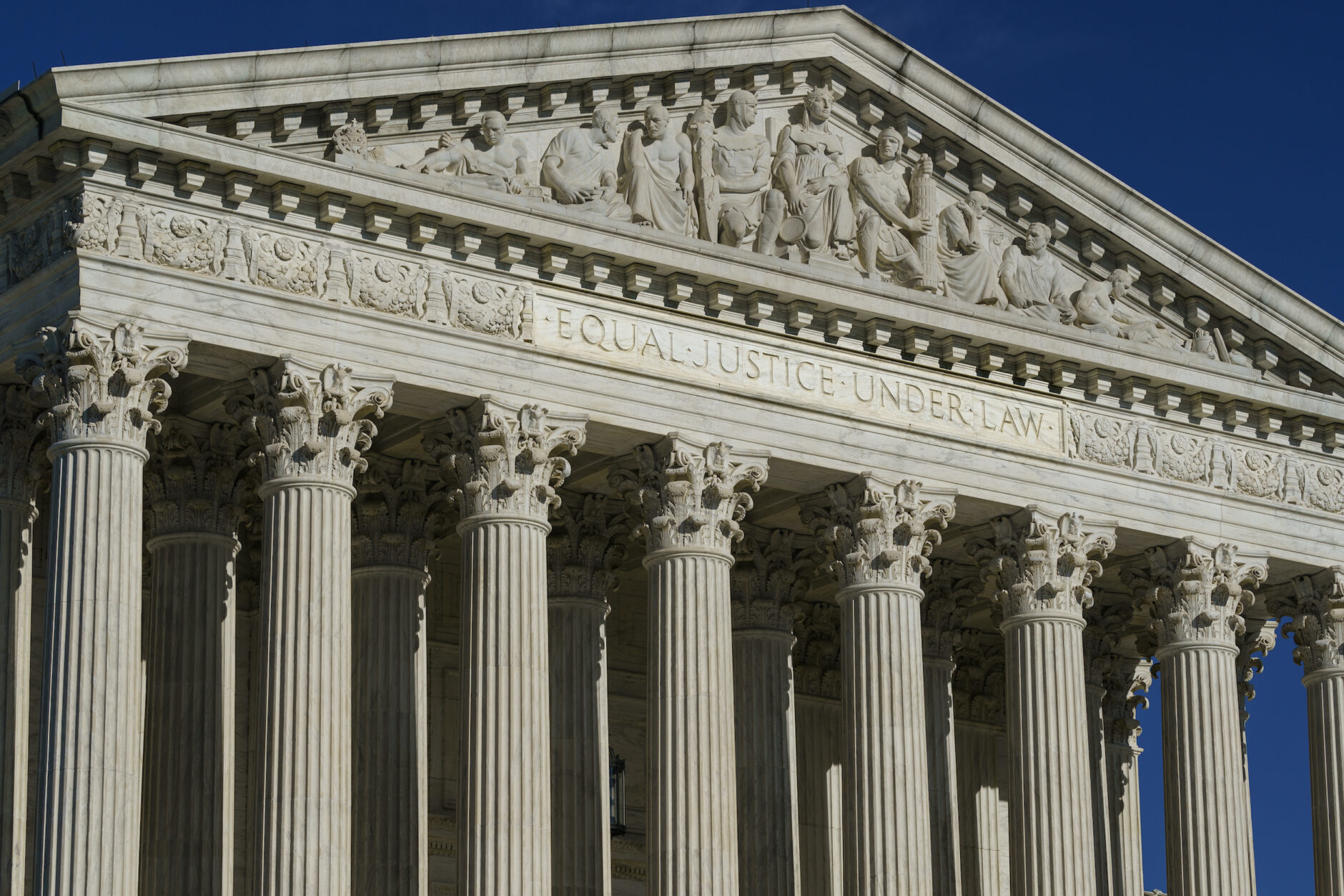
Thursday, February 17, 2022

Fed judge dismisses NAACP Arkansas Redistricting Challenge


The Arkansas State Conference of the NAACP challenged the state legislative map drawn by the Arkansas Board of Apportionment.  The challenge was brought under Section 2 of the Voting Rights Act 52 USC 10301.  It provides

A violation . . . is established if, based on the totality of circumstances, it is shown that the political processes leading to nomination or election in the State or political subdivision are not equally open to participation by members of a [protected] class of citizens . . . in that its members have less opportunity than other members of the electorate to participate in the political process and to elect representatives of their choice.

The map dilutes Black voters strength and therefore violated the law, alleged the plaintiffs in Arkansas NAACP v. Arkansas Board of Appportionment.  But Lee Rudovsky a federal District Judge  dismissed the case, relying on the Supreme Court's decision in Merrill v. Miller restoring the Alabama Congressional map which had been rejected by a three judge District Court. Justice Brett Kavanaugh, concurring, relied on the so-called Purcell principle to mandate courts to step aside from election cases as election days grow near.

But more dramatically the Judge - despite fifty years of litigation to the contrary - held that only the United States Attorney General can bring a Section 2 challenge.  Private litigants are barred, said the 43 year old Rudovsky, a 2019 appointee to the federal bench.  A longtime member of the Federalist Society he was nominated on the recommendation of Senator Tom Cotton (R- AR).  His ruling, if upheld would wreak havoc on voting rights litigation, if the Merrill decision has not already done so.  The decennial census mandates redistricting.  All such challenges are perilously close to the following Congressional midterm elections.  The Supreme Court's embrace of the "Purcell principle" jeopardizes all election-year litigation.

- GWC


Tuesday, February 15, 2022

NJ Supreme Court -Notice – Arbitration Provisions in Retainer Agreements and the Scope of an Attorney’s Disclosure Requirements (Delaney v. Dickey) – Comments Requested by March 23, 2022 – Professional Responsibility: A Contemporary Approach

NJ Supreme Court -Notice – Arbitration Provisions in Retainer Agreements and the Scope of an Attorney’s Disclosure Requirements (Delaney v. Dickey) – Comments Requested by March 23, 2022 – Professional Responsibility: A Contemporary Approach

In Delaney v. Dickey the New Jersey Supreme Court held that an attorney may  include provisions in their retainer agreements that bind the client to arbitrate a future fee dispute or legal malpractice action, provided lawyers adequately explain the provisions to the clients. But the court said that their opinion would not be the last word – and announced it was referring the issue to its Advisory Committee on Professional Ethics.

Sometimes you get what you asked for: here the ACPE urged the Court to reconsider its decision, saying that obtaining informed consent to arbitration of malpractice before any dispute has arisen is a practical impossibility.

The link below will bring you to the ACPE’s report and proposals in the event the Court does not agree to revise their view on the issue. – GWC

[Disclosure – I am a member of the ACPE]

Source: Notice – Arbitration Provisions in Retainer Agreements and the Scope of an Attorney’s Disclosure Requirements (Delaney v. Dickey) – Comments Requested by March 23, 2022

NOTICE TO THE BAR – Supreme Court of New Jersey
ARBITRATION PROVISIONS IN RETAINER AGREEMENTS AND
THE SCOPE OF AN ATTORNEY’S DISCLOSURE REQUIREMENTS
(DELANEY V. DICKEY) – COMMENTS REQUESTED
The Supreme Court requested the Advisory Committee on
Professional Ethics (ACPE) to study the issues arising in the case
Delaney v. Dickey, 244 N.J. 466 (2020), and to “make recommendations to [the] Court and propose further guidance on the scope of an attorney’s disclosure requirements.” 244 N.J. at 474. The Court in Delaney found that lawyers may include provisions in their retainer agreements that bind the client to arbitrate a future fee dispute or legal malpractice action, provided that the lawyer adequately explains the provisions to the client. In its attached report, a majority of the ACPE has recommended that the Court reconsider permitting lawyers to include provisions in their retainer agreements that require the client to arbitrate future fee disputes or legal malpractice actions. Should the Court determine not to
reconsider, the full ACPE included in its report both proposed further
guidance on lawyers’ disclosure requirements and suggested uniform
language intended to ensure that lawyers adequately explain any such arbitration provisions to clients.
The Court requests comments on the ACPE report and  recommendations by March 23, 2022. Comments should be sent to:
Advisory Committee on Professional Ethics
Attention: Carol Johnston, Committee Secretary
Richard J. Hughes Justice Complex
P.O. Box 970
Trenton, NJ 08625-0970

Disfranchisement of persons convicted of crime" Institute for Social Justice supports International Rights challenge

 The NJ Institute for Social Justice has filed an amicus brief in the Rutgers Law School International Human rights Clinic's petition to the Inter-American Commission on Human Rights challenging U.S. for widespread disenfranchisement of persons convicted of crime. The brief argues that the US is in violation of international human rights law by permitting the disenfranchisement of nearly 5.2 million US citizens.

The lead point is:

LAWS THAT DISENFRANCHISE CITIZENS WITH FELONY CONVICTIONS IN THE UNITED STATES ARE HISTORICALLY BASED ON RACIAL DISCRIMINATION AGAINST BLACK AMERICANS...

Xi Jinping: Politburo announces plan of study on strengthening legal sysem

This is a difficult time for we who have hoped that China's policy of "reform and opening" - begun in 1978 by Deng Xiao Ping - will flourish. Since then China's advances have been unmistakable - economically and in the strength of its legal system.  While some have feared that China's turn is away from law, the CPC Central Committee - especially since 2014 - has made clear that strengthening the legal system, and "rule by law" is a firm commitment.  Today China's leader Xi Jinping has reaffirmed that.
The contradiction is that while it has strengthened the competence of its judiciary, advanced the development of law, built many law schools of impressive competence, China has, on the other hand, suppressed lawyers for dissidents - many of them Christian - and has swept uncounted (by outsiders) thousands of Uyghurs into retraining and education camps.  Painted as a security measure, it seems that Sinification may be a more apt description. And there is the narrowing space for a distinct political-legal culture in Hong Kong.  
But Xin Jin Ping has made clear again that "reform and opening" and a turn to rule by law are policies from which the CP will not turn. - GWC
习近平:坚持走中国特色社会主义法治道路 更好推进中国特色社会主义法治体系建设--新闻报道-中国共产党新闻网

February 15, 2022 17:05  CPCNEWS.CN
 "Seeking truth: 
Adhere to the path of socialist rule of law with Chinese characteristics 
Better promote the construction of socialist rule of law system with Chinese characteristics"

By: Xi Jinping

Today, the Central Political Bureau conducted the thirty-fifth collective study on building a socialist rule of law system with Chinese characteristics. The purpose of arranging this study is to summarize the effectiveness of the construction of the rule of law system of socialism with Chinese characteristics, analyze the problems and shortcomings, adhere to the road of socialism with Chinese characteristics rule of law, and better promote the construction of the rule of law system of socialism with Chinese characteristics.

"Law is the right way." Our Party has attached great importance to the construction of the rule of law since the day it was founded. During the New Democratic Revolution, our Party formulated the Outline of the Constitution of the Chinese Soviet Republic and a large number of laws and decrees, and created the "Ma Xiwu trial method", which accumulated practical experience for the establishment of a new legal system. During the period of socialist revolution and construction, the Party led the people in formulating the Constitution and a series of important laws and regulations, such as the Organic Law of State Institutions, the Election Law and the Marriage Law, to establish a socialist legal framework system and a socialist judicial system. During the period of reform and opening up and socialist modernization, our Party proposed the policy of "having laws to follow, having laws to follow, enforcing laws strictly, and punishing violations", established the basic strategy of ruling the country by law, set the building of a socialist state under the rule of law as an important goal of socialist modernization, and gradually formed the socialist legal system with Chinese characteristics with the Constitution as the core. The system of socialist laws with Chinese characteristics is gradually formed with the Constitution as the core.

Monday, February 14, 2022

The Supreme Court’s lawless turn is making real judges’ work difficult.//SLATE

The Supreme Court’s lawless turn is making real judges’ work difficult.//SLATE  February 14, 2022
By Dahlia Lithwick and Mark Joseph Stern

The Supreme Court struck yet another blow against voting rights last week when it let Alabama use racially gerrymandered maps in the 2022 midterms. By a 5–4 vote, the ultraconservative justices halted a lower court order that had struck down Alabama’s redistricting plan. The state’s new plan radically dilutes the votes of racial minorities, denying them political power in violation of the Voting Rights Act.

A three-judge district court had ordered Alabama to create a new map in a 225-page decision, but the Supreme Court froze this injunction on the shadow docket without offering any explanation. Justice Brett Kavanaugh, however, wrote an alarming concurrence defending the court’s action, claiming that Alabama’s election is too close at hand to justify intervention. (The primary is more than three months away.) Kavanaugh also responded to Justice Elena Kagan’s scorching dissent, which accused the majority of once again altering the law through its shadow docket.

Americana Administrative Law by Beau J. Baumann :: SSRN

When emergencies arise people expect government power to reach its peak.  But in the covid-19 pandemic, the nation's greatest health crisis in 200 years, the Supreme Court has opted to maximize its own power and to hobble the national government.  The Presidency has been called imperial, the federal bureaucracy self-aggrandizing, the Congress a competitor for power.  But the judiciary has managed to with a straight face declare itself above the fray.  Even its most senior member - Stephen Breyer  has indulged that notion in the pages of his new book The Authority of the Court and the Peril of Politics.  John Roberts helped himself sail through his nomination by claiming to be like an umpire - calling balls and strikes.
But anyone who claims for him or herself unreviewable power cannot plausibly maintain a claim of indifference to the expansion of one's own power.  As the Supreme Court readies to reverse a half-century of precedent in the Mississippi abortion case, it has already hobbled the Department of Health and Human Services which sought to stem evictions.  Now it has crippled the ability of the Labor Department to encourage the vaccination of private sector workers.
Beau Baumann argues here that the Courts should stand back from arrogating their own power and stop interfering in Congress's work.
- GWC
Americana Administrative Law by Beau J. Baumann :: SSRN
By Beau J. Baumann - U.S. Department of Justice

Americana Administrative Law

61 Pages Posted:

Beau J. Baumann

United States Department of Justice

Date Written: February 13, 2022

Abstract

On January 13, 2022, the Supreme Court blocked the Biden Administration’s vaccine-or-test mandate, a measure meant to save thousands of lives amid a one-in-a-century pandemic. Justice Gorsuch’s concurrence suggested that the Court’s decision vindicated the nondelegation doctrine, even if indirectly. Gorsuch argued that Congress could not be left to its own devices because open ended delegations corrupt congressional incentives. The Gorsuch concurrence marks the triumph of a new pitch for judicial self-empowerment this article calls “Americana administrative law.” Rather than hyping the threat of executive aggrandizement, nondelegationists are deploying cynical and declinist notions of Congress to justify judicial self-empowerment. The “Americana” in Americana administrative law comes from nondelegationists’ attempt to restore an idealized Congress that has never worked as cleanly as they suppose. Beyond the nondelegation doctrine, the administrative law literature often justifies judicial interventions with claims of congressional “gridlock,” partisanship, and decline.

This article has two main contributions. First, this article describes the rise of Americana administrative law from the “constitutional politics” around the nondelegation doctrine. I provide a genealogy for this approach and frame it as a pitch for judicial self-aggrandizement. Second, this article provides a corrective. The courts are neither above nor outside separation-of-powers conflicts. They are instead participants in the ongoing inter-branch contest for the ability to determine outcomes. Americana administrative law ignores much of what we know about Congress. Congress is an evolving body at the end of a centuries-long Anglo-American experiment with legislatures. It has developed “hard” and “soft” powers that allow it to realize its agenda and defend itself from the other branches. This article argues that the law and the literature should drop the pretense that judicial doctrine can “fix” an institution as complex as Congress.


Baumann, Beau, Americana Administrative Law (February 13, 2022). Available at SSRN: https://ssrn.com/abstract=

Politicians in Robes | by Laurence H. Tribe | The New York Review of Books


Politicians in Robes | by Laurence H. Tribe | The New York Review of Books

Reviewed:

***Nor does [Justice Stephen Breyer's] book meaningfully engage with any of these difficult questions:

(1) Does the ability of the Court to serve as a politically independent guardrail against despotism or anarchy actually depend on propagating the myth that its members are immune from influence by their cultural and political orientations and occasionally their partisan affiliations?

(2) To what degree is any such myth sustainable in the face of current experience? As Justice Sotomayor said acerbically, during the December 2021 argument in the abortion case Dobbs v. Jackson Women’s Health Organization, the Court was earning the “stench…in the public perception that the Constitution and its reading are just political acts.” In his fine book The Case Against the Supreme Court (2014), Erwin Chemerinsky, dean of the law school at the University of California at Berkeley, recalls that Sotomayor, like Chief Justice John Roberts, found it useful in her confirmation hearings to describe what justices do as “calling balls and strikes,” when in fact we know they do much more than that, including, as Chemerinsky notes, deciding the rules of the game and defining the strike zone.

(3) Finally, if a “balls and strikes” myth of apolitical adjudication is indeed sustainable, is attempting to sustain it morally justifiable? Put otherwise, is it an example of the Noble Lie we must tell ourselves in order to avoid disaster—or just another Big Lie that threatens our democracy?

As a member of the commission, I couldn’t help asking myself questions like these—or hoping that Breyer’s book would help us grapple with them. No such luck. I did sense in some of my fellow commissioners the belief that we’d best avoid being too open about our conviction that a majority of the justices had become dangerously wedded to a political perspective inherently hostile to the premises of a flourishing, inclusive democracy representing all persons equally, and that three members of that majority had been added to the Court by political processes that lacked democratic legitimacy.

 The general mood seemed to be that the Court should be spared the slashing critique I was coming to believe it deserved—a critique best put forward by Chemerinsky and in powerful testimony before the commission by the constitutional scholars Nikolas Bowie, Michael Klarman, and Samuel Moyn.

These scholars made a persuasive case that throughout our history, and especially in its current configuration, the Supreme Court has by no means been a friend to politically underrepresented minorities, an ally to the rights of the least powerful among us, or a defender of the rights of all to full and equal participation in the project of self-government—the only reasons sufficient, in the minds of many, to warrant entrusting a power so vast to so politically unaccountable an institution. They have argued that giving the nation’s highest court not just the power of judicial review but of judicial supremacy—the final word on the meaning and application of a flawed but aspirational Constitution—has repeatedly been harmful to the cause of freedom and equality, with infamous decisions being the rule rather than the exception.

Sunday, February 13, 2022

The Radical Activist Who Showed Us a Path Past Trump’s Polarization


First published January 27, 2018
The Radical Activist Who Showed Us a Path Past Trump’s Polarization
By Ronald Radosh

Last Thursday, Julius Lester, a civil rights activist and professor emeritus at the University of Massachusetts, Amherst, died of complications from chronic obstructive pulmonary disease, surrounded by his daughter Lian Amaris, his son Malcolm, and other family members. The comprehensive obituary by Margalit Fox, appearing in The New York Times on Sunday, provides a review of his many accomplishments. His contribution to literature can be found in the obituary by Shannon Maughan in the trade publication, Publishers Weekly.

Julius, whom I knew since the 1960s and considered a friend, was not only a civil rights activist but a Renaissance man. In various phases of his life he was a professor, a photographer, a folk singer, and an essayist and novelist. In mid-life he converted to Judaism and served as a cantor in his Massachusetts synagogue, and later as a lay leader in his Vermont congregation.


Torts Today: Text - S.2342 - 117th Congress (2021-2022): Ending Forced Arbitration of Sexual Assault and Sexual Harassment Act of 2021 | Congress.gov | Library of Congress

Torts Today: Text - S.2342 - 117th Congress (2021-2022): Ending Forced Arbitration of Sexual Assault and Sexual Harassment Act of 2021 | Congress.gov | Library of Congress

Friday, February 11, 2022

Jamelle Bouie | The Supreme Court Is Just Doing What the Supreme Court Does - The New York Times

Opinion | The Supreme Court Is Just Doing What the Supreme Court Does - The New York Times
By Jamelle Bouie

Under a traditionally liberal view of the Supreme Court, its decision on Monday to uphold, at least for this year, a Congressional map in Alabama that intentionally weakens the voting strength of Black people in the state is a betrayal of its duty to protect the rights of minorities, racial and otherwise.

Under a more historical view, it is the court doing what the court does.

First, a little background on Monday’s decision. Section 2 of the Voting Rights Act bars any voting law or procedure that “results in a denial or abridgment of the right of any citizen to vote on account of race,” as the Department of Justice puts it. This includes situations where lawmakers have “cracked” minority communities into multiple districts in order to dilute the strength of their voters. To remedy this, courts can require states to create “majority-minority” districts in which these voters can then elect the candidates of their choice. This is especially important in places where voting is so polarized by race that minority communities are rarely, if ever, able to shape the outcome of an election.

Last year, Alabama’s Republican-controlled Legislature drew and passed a Congressional map that packed a large number of Black voters into a single district encompassing the cities of Birmingham and Montgomery, while spreading the remaining voters throughout six majority white districts. By “packing” one group of Black voters and dispersing the rest, Alabama Republicans successfully reduced the voting strength of the entire Black community in the state, which accounts for 27 percent of its population.

Black Alabamians filed suit. In January, after seeing evidence and hearing arguments from both sides, a three-judge district court panel (with two Trump appointees) agreed that the state had violated the Voting Rights Act. It ordered the Legislature to draw a new map containing a second majority-minority district. Republicans appealed the decision to the Supreme Court, where five members voted to stay the order, reinstating the original map.

Thursday, February 10, 2022

A Trump judge's shameless ruling against Biden's civil service vaccine mandate.//Mark Stern -SLATE


The Fifth Circuit yesterday refused to block Judge Brown's nationwide injunction - even though twelve other District Judges have refused to block the vaccine requirement for federal employees.  Circuit Judge Stephen Higginson in his dissent said:
The President is not an unelected administrator. He is instead the head of a co-equal branch of government and the most singularly accountable elected official in the country. This federal workplace safety order displaces no state police powers and coerces no private sector employers. Instead, consistent with his Article II duty to “take Care that the Laws be faithfully executed,” the President is performing his role as CEO of the federal workforce...

One can look at this ruling, like the NFIB v. Biden order striking the OSHA vaccine rule and conclude that there is a direct line between Brown's thinking and the truckers blockading Ottawa.  They hate the government and are determined to block it from protecting the public health.  In order to prove that government is ineffective they will themselves hobble it.

- GWC 

A Trump judge's shameless ruling against Biden's civil service vaccine mandate.
By Mark Joseph Stern

On Friday afternoon, U.S. District Court Judge Jeffrey Vincent Brown blocked President Joe Biden’s COVID-19 vaccine mandate for the federal workforce and issued a nationwide injunction ensuring no other district court could revive the policy. At least a dozen other courts have already declined to halt this policy, but Brown decided that they were wrong. His decision rests on several egregious misreadings of the law. Most notably, Brown—a Donald Trump nominee and Federalist Society stalwart—rewrote a major statute to vastly diminish the president’s power over federal employees. In doing so, he has imperiled a broad swath of civil service regulations that have nothing to do with vaccines, including the longstanding ban on drug use outside of the office.

Presidents have sweeping authority over federal workers under both the Constitution and federal law. Biden drew upon both sources to issue his mandate (which includes medical and religious exemptions). Of all the White House’s vaccine policies, this one is on the strongest legal footing, because it does not implicate the Supreme Court’s concerns about federalism or the separation of powers. Until now, it appeared that across the ideological spectrum, judges agreed that the chief executive has wide latitude to regulate his own workforce. That’s one reason why federal courts in Arizona, the District of Columbia, Florida, Maryland, New Jersey, Oklahoma, Texas, and Washington refused to freeze the mandate.

Congress acknowledged and formally bestowed these powers in a 1966 statute called Section 7301. It states: “The President may prescribe regulations for the conduct of employees in the executive branch.” Ever since, presidents have relied on this law to alter and update employment conditions for the civil service.

Most famously, Section 7301 provides the legal basis for the prohibition on illegal drug use among federal employees, as well as drug testing programs to enforce the rule. But presidents have used the law to implement plenty of other policies, including a ban on federal employees accepting gifts from lobbyists; a ban on tobacco use in federal workplaces; a detailed “revolving door” ban limiting federal employees’ ability to become lobbyists after their service; an expansive ethics code barring federal employees from various conflicts of interest on and off the job; a requirement that federal workplaces accommodate nursing mothers; and so much more.

It was no surprise, then, that Biden relied on Section 7301 in issuing his vaccine mandate for the civil service. But Brown has a radically different interpretation of the statute. He declared that the president may only regulate “workplace conduct” under the law—and getting vaccinated does not qualify. Brown elaborated: “Any broader reading would allow the president to prescribe, or proscribe, certain private behaviors by civilian federal workers outside the context of their employment” he wrote. “Neither the plain language of Section 7301 nor any traditional notion of personal liberty would tolerate such a sweeping grant of power.”

What? Had Brown simply Googled this statute, he would have immediately learned, in fact, this “sweeping grant of power” is exactly what the law provides.

Wednesday, February 9, 2022

The covid vaccination rate: the partisan sort. Pew poll

 The covid  vaccination rate - partisan sort.

Look at the data from the new Pew poll. A higher percentage of Democrats aged 18-29 are vaccinated than the percentage of Republicans aged 65+. A higher percentage of Democrats with a high-school education or less are vaxxed than Republicans with a postgrad education.


Tuesday, February 8, 2022

Kingdom of Characters by Jing Tsu review – Chinese writing’s near death experience | Books | The Guardian


Kingdom of Characters by Jing Tsu review – Chinese writing’s near death experience | Books | The Guardian

If the Chinese script is not abolished, China will certainly perish!” So said the literary author Lu Xun in the 1930s, and many in China agreed. History has proved him wrong, of course. How the country went from rags to first ruin, then riches has been the stuff of headlines for over a century. Yet far from being abolished, the script (known as hànzì) was successfully pressed into service for all sorts of modern technologies. In Kingdom of Characters, scholar Jing Tsu introduces us to a tumultuous century and a colourful cast of (human) characters.

In 1900, China was a great power in steep decline. European imperialism had played its usual shameful part, but there were other reasons for the country’s plight. Some of these problems were linguistic in nature. More than 80% of the population could neither read nor write, including most women. Nobody except officials spoke a standard language, and the numerous varieties of Chinese made communication beyond regional borders impossible. However, widespread illiteracy and the absence of a standard language were common in countries around the world and were living memories even in Europe. More peculiar was the fact that written Chinese reflected the state of the language as spoken 2,000 years ago rather than any of the modern vernaculars – imagine the French doing their correspondence in Latin. But the real trouble lay elsewhere: in the Chinese writing system itself.

Pope Benedict concedes failings in new letter, but no apology for German abuse cases | National Catholic Reporter

This is a kind of `6 Our Fathers, 6 Hail Mary's and a Rosary as penance' apology but it's better than nothing. - GWC
Pope Benedict concedes failings in new letter, but no apology for German abuse cases | National Catholic Reporter
By Christopher White

ROME — Retired Pope Benedict XVI on Feb. 8 acknowledged past failings of the Catholic Church in confronting clergy sexual abuse under his watch but stopped short of a direct, personal apology after an independent report faulted his handling of four cases of abuse when he was an archbishop in Germany in the 1970s and 80s.

A legal team advising the retired pope has also published an analysis challenging the German report's findings, arguing that investigators mischaracterized some of Benedict's actions or knowledge during his time as archbishop.  

"I have had great responsibilities in the Catholic Church. All the greater is my pain for the abuses and the errors that occurred in those different places during the time of my mandate," Benedict wrote in a personal letter published Feb. 8. "Each individual case of sexual abuse is appalling and irreparable. The victims of sexual abuse have my deepest sympathy and I feel great sorrow for each individual case."

Benedict, the former Cardinal Joseph Ratzinger, headed Germany's Archdiocese of Munich and Freising from 1977 to 1982 before being appointed as head of the Vatican's Congregation for the Doctrine of the Faith, and then being elected pope in 2005.

The independent report, prepared by a law firm at the archdiocese's request, was tasked with looking into abuse between 1945 and 2019 and whether church officials handled allegations correctly. The report authors concluded that in four cases during Benedict's tenure in Munich involving misbehaving priests, the future pope "can be accused of misconduct."

Following the report's publication, Benedict, through his secretary Archbishop Georg Gänswein, vowed to read the report's nearly 2,000 pages of findings and offer a response. The retired pope's new Feb. 8 letter offers a personal reflection on the report's findings, as well as an analysis that challenges some of its key findings. 

Supreme Court blocks redraw of GOP-friendly congressional map in Alabama | Courthouse News Service


Today the United States Supreme Court, freezing an order by a three judge District Court,  decided that the quarter of Alabama's population which is African American will be able to send to Washington only one member of Congress.  The three Trump-appointed Justices joined with Clarence Thomas and Samuel Alito to form a majority in Merrill, Secretary of State v. Milligan.
The American Redistricting Project maintains the docket of the challenge to the Alabama Congressional Redistricting process mandated by the decennial census.  A three judge District Court (composed under 28 USC 22840 on January 24, 2022 issued a preliminary injunction supported by a 225 page memorandum.  The order directed Alabama to redraft its Congressional map in order to create a second Black majority District.  Alabama - which has a long history of voting discrimination - is now 27% Black yet the Districts drawn by the Legislature include only one majority Black District among its seven Districts.
Yesterday the United States Supreme Court - per curiam - without opinion stayed the injunction, thereby locking in the Legislature's map.  Hundreds of thousands of Black voters will be disenfranchised until at least 2024. In a concurring opinion Brett Kavanaugh seeks to justify the Court's five member majority saying that the preliminary injunction is so close to the election that it would be disruptive.  But though primary early voting begins March 30 the election day itself is at the end of May. 
Elena Kagan dissented, joined by Sonia Sotomayor and Stephen Breyer.  The Chief Justice separately dissented from the order staying the preliminary injunction.
The case is another instance of the high court using its emergency docket (dubbed the shadow docket) to intervene early in litigation, often unexplained (as here) to achieve decisions on the merits - almost always to achieve results favored by the Republican Party.

- GWC 2/8/22
Supreme Court blocks redraw of GOP-friendly congressional map in Alabama | Courthouse News Service

In a blow to voting rights advocates, the justices blocked a lower court order that would have forced the state to redraw its congressional maps to be more friendly to Black voters.

The Supreme Court is seen in Washington on Sept. 3, 2021. (AP Photo/J. Scott Applewhite)

WASHINGTON (CN) — In a 5-4 vote Monday evening, the Supreme Court reinstated a new Republican-friendly congressional map in Alabama that a lower court blocked for violating the Voting Rights Act and diluting the influence of Black voters.  

Chief Justice John Roberts — who wrote his own opinion — joined the three liberals in dissent. Justice Elena Kagan also wrote a dissent joined by Justices Stephen Breyer and Sonia Sotomayor. Justice Brett Kavanaugh — joined by Justice Samuel Alito — wrote a concurring opinion. 

“Accepting Alabama’s contentions would rewrite decades of this Court’s precedent about Section 2 of the VRA [Voting Rights Act],” Kagan wrote. 

The Barack Obama appointee continued, “Staying its decision forced Black Alabamians to suffer what under that law is clear vote dilution.” 

Kagan notes that Black Alabamians only have influence over 14% of congressional seats in the state despite making up 27% of the state’s population. She claims Alabama is putting a new requirement on the VRA without precedent and criticizes the majority for making this decision on the emergency docket. 

“There may — or may not — be a basis for revising our VRA precedent in light of the modern districting technology that Alabama’s application highlights,” Kagan wrote. “But such a change can properly happen only after full briefing and argument — not based on the scanty review this Court gives matters on its shadow docket.” 

Last month, Alabama asked the Supreme Court for an injunction to block a lower court’s ruling throwing out its new congressional map. 

Following a redraw based on the 2020 census, the Alabama State Conference of the NAACP and the American Civil Liberties challenged the new map, claiming it violated the Constitution's equal protection clause and the Voting Rights Act. A three-judge panel agreed with the NAACP and the ACLU, throwing out the GOP-friendly map and forcing the state to redraw the districts to give Black voters more power in elections. The court’s order would force the state to add another district where Black majorities hold sway, likely giving Democrats another seat in the U.S. House of Representatives in November.  

Roberts — whose dissent was much shorter than Kagan’s — explained his vote by saying the district court properly applied existing law in an “extensive” opinion that he found no errors in. 

“The governing standard for vote dilution claims under section 2 of the Voting Rights Act is set forth in Thornburg v. Gingles…which requires ‘the minority group . . . to demonstrate that it is sufficiently large and geographically compact to constitute a majority in a single-member district,’” the George W. Bush appointee wrote. “The District Court reviewed the submissions of the plaintiffs’ experts and explained at length the factbound bases for its conclusion that the plaintiffs had made that showing.” 

However, Roberts said Gingles has given rise to considerable disagreement and uncertainty with vote dilution claims. While he suggested the court should take up the matter next term, Roberts said he still wouldn’t grant a stay in this case and the current understanding of the precedent should be used in the upcoming election. 

Monday, February 7, 2022

Amy Coney Barrett’s Long Game | The New Yorker

Amy Coney Barrett’s Long Game | The New Yorker

On December 1st, the Supreme Court had its day of oral argument in a landmark abortion case, Dobbs v. Jackson Women’s Health Organization, brought by the State of Mississippi. It was the first case that the Court had taken in thirty years in which the petitioners were explicitly asking the Justices to overturn Roe v. Wade, the 1973 decision legalizing abortion, and its successor, Planned Parenthood v. Casey, which affirmed that decision in 1992.

 If anyone needed a reminder that, whatever the Justices decide in Dobbs, it will not reconcile the American divide over abortion, the chaotic scene outside the Court made it clear. At the base of the marble steps, reproductive-rights supporters held a large rally in which they characterized abortion as a human right—and an act of health care. Pramila Jayapal, a Democratic U.S. representative from Washington State, described herself as “one of the one in four women in America who have had an abortion,” adding, “Terminating my pregnancy was not an easy choice, but it was my choice.” Jayapal could barely be heard, though, over the anti-abortion protesters who had also gathered, in even greater numbers. 

The day was sunny and mild, and though some of these demonstrators offered the usual angry admonishments—“God is going to punish you, murderer!” a man with a megaphone declaimed—most members of the anti-abortion contingent seemed buoyant. Busloads of students from Liberty University, an evangelical college in Lynchburg, Virginia, snapped selfies in their matching red-white-and-blue jackets. Penny Nance, the head of the conservative group Concerned Women for America, exclaimed, “This is our moment! This is why we’ve marched all these years!”

A major reason for Nance’s optimism was the presence on the bench of Amy Coney Barrett, the former Notre Dame law professor and federal-court judge whom President Donald Trump had picked to replace Ruth Bader Ginsburg, who died on September 18, 2020. With the help of Mitch McConnell, the Senate Majority Leader, Trump had accelerated Barrett’s nomination process, and the Senate confirmed her just a week before the 2020 Presidential election. 

As a candidate in the 2016 election, Trump had vowed to appoint Justices who would overturn Roe, and as President he had made it a priority to stock the judiciary with conservative judges—especially younger ones. According to an analysis by the law professors David Fontana, of the George Washington University, and Micah Schwartzman, of the University of Virginia, Trump’s nominees to the federal courts of appeals—bodies that, like the Supreme Court, confer lifetime tenure—were the youngest of any President’s “since at least the beginning of the 20th century.” 

Trump made three Supreme Court appointments, and Neil Gorsuch (forty-nine when confirmed) and Brett Kavanaugh (fifty-three) were the youngest of the nine Justices until Barrett was sworn in, at the age of forty-eight. Her arrival gave the conservative wing of the Court a 6–3 supermajority—an imbalance that won’t be altered by the recent news that one of the three liberal Justices, Stephen Breyer, is retiring.

Barrett has a hard-to-rattle temperament. A fitness enthusiast seemingly blessed with superhuman energy, she is rearing seven children with her husband, Jesse Barrett, a former prosecutor now in private practice. At her confirmation hearings, she dressed with self-assurance—a fitted magenta dress; a ladylike skirted suit in unexpected shades of purple—and projected an air of decorous, almost serene diligence. Despite her pro-forma circumspection, her answers on issues from guns to climate change left little doubt that she would feel at home on a Court that is more conservative than it’s been in decades. Yet she also represented a major shift. Daniel Bennett, a professor at John Brown University, a Christian college in Arkansas, who studies the intersection of faith and politics, told me that Barrett is “more embedded in the conservative Christian legal movement than any Justice we’ve ever had.” Outside the Court, Nance emphasized this kinship, referring to Barrett as “Sister Amy, on the inside.”

Why Biden Should Pick a Black Woman Politician for the Supreme Court | Washington Monthly

Who?  Well, for example:
Kamala Harris
Stacey Abrams
Terri Sewell
Stacey Plaskett
Letitia James

A Supreme Court composed entirely of heretofore little-known, black-robed appeals court careerists is something new and not altogether good.

by Matthew Cooper


Let’s consider some history that points to why politicians did well on the Supreme Court and why presidents chose them. Elected officials used to be standard fare. Today, there are none. The last elected official appointed to the Court was Sandra Day O’Connor. Appointed by President Ronald Reagan in 1981, O’Connor was the majority leader in the Arizona Senate before being appointed to a mid-level state court. The last pol to serve as chief justice was former three-term California Governor Earl Warren, nominated to the high court by Dwight Eisenhower. Warren had also been the Republican presidential nominee Thomas Dewey’s running mate in the 1948 presidential election, California’s attorney general, chair of the state’s Republican Party, and district attorney of Alameda County, which includes Oakland.

Warren became, arguably, the most influential chief justice of the twentieth century. And he did so because he used his immense political skills to forge consensus on a range of issues, from school prayer to civil rights, most notably in the unanimous decision in Brown v. Board of Education, which held that segregated public schools were unconstitutional. Warren insisted on a unanimous ruling in Brown because he wanted it to have maximum impact, and it only came about because of his cajoling and wooing. It is considered one of the most formidable acts by any chief justice in the history of the Court. (Warren’s leadership on Brown has been documented in excellent books and a few films well worth seeing.) The Warren Court, at that time, included three former senators—Hugo Black, Sherman Minton, and Harold Burton—and two former attorneys general. The land-mine-strewn political atmosphere on civil rights called for a remarkable political sensibility. In the end, Democratic- and Republican-appointed justices supported the ruling, including Black, who represented Alabama in the U.S. Senate and was no integrationist.  

Warren Harding nominated, and the Senate confirmed, former President William Howard Taft as chief justice. Taft used his political skills to press Congress for an extraordinary reorganization and modernization of the federal judiciary, establishing the judicial conference that allows judges with particular expertise to be paired with suitable cases. Taft pushed to build the Supreme Court building it is housed in today. The justices used to meet in the Capitol, and having their building be so recognizable today has helped cement the Court’s status as a coequal branch of government.