Saturday, March 21, 2020

A storm is coming: virus epidemic at Rikers

Image result for Rikers Island
A Storm is Coming: Virus Epidemic at Rikers // NY Times
by Jay Ransom and Alan Feuer // NY Times

Rikers Island right now: 5300 people locked up. 17% are over 50. 21 have tested positive for COVID-19, plus 12 jail employees and 5 correctional health workers. 58 more people being monitored. 88 beds in the contagious disease unit.

U.S. intelligence reports from January and February warned about a likely pandemic - The Washington Post

As Trump bitterly spits out the words "Chinese virus" and John Bolton growls about how the Chinese suppressed the fact of the spreading virus it becomes indisputable that the Trump administration too blew it.
But when the Chinese leadership faced up to the threat they acted decisively with drastic and effective shutdowns,  China rallied, like a family, to help Wuhan , not to stigmatize it. - GWC
U.S. intelligence reports from January and February warned about a likely pandemic - The Washington Post
March 20, 2020 at 8:10 p.m. EDT
U.S. intelligence agencies were issuing ominous, classified warnings in January and February about the global danger posed by the coronavirus while President Trump and lawmakers played down the threat and failed to take action that might have slowed the spread of the pathogen, according to U.S. officials familiar with spy agency reporting.
The intelligence reports didn’t predict when the virus might land on U.S. shores or recommend particular steps that public health officials should take, issues outside the purview of the intelligence agencies. But they did track the spread of the virus in China, and later in other countries, and warned that Chinese officials appeared to be minimizing the severity of the outbreak.
Taken together, the reports and warnings painted an early picture of a virus that showed the characteristics of a globe-encircling pandemic that could require governments to take swift actions to contain it. But despite that constant flow of reporting, Trump continued publicly and privately to play down the threat the virus posed to Americans. Lawmakers, too, did not grapple with the virus in earnest until this month, as officials scrambled to keep citizens in their homes and hospitals braced for a surge in patients suffering from covid-19, the disease caused by the corona virus.

How we got here. Where do we go from here? Ron Klain/JoeBiden

Return to normal is an aspiration of more urgency and more aspirational than we have contemplated until now.

Thursday, March 19, 2020

Crimson Contagion: A Cascade of Warnings, Heard but Unheeded - The New York Times

A week before Trump took office his staff was led through a "principal level" comprehensive briefing paper on how to deal with a pandemic.  We know that the Republican administration responded by dismantling the pandemic unit in the National Security Council.  Ann we know their hostility to government and eagerness for budget cutting blinds them to much of reality.  But a team of reporters at the `Fake News' New York Times has revealed the details of Crimson Contagion - the months long simulation that demonstrate the unpreparedness.  And today - as the Covid19 cases in New York passed 5,000 - the `President' attacked the press rather than the problem.  The consequences of unpreparedness have paralyzed the nation. - gwc 
Coronavirus Outbreak: A Cascade of Warnings, Heard but Unheeded - The New York Times


Tuesday, March 17, 2020

Editorial: SCOTUS Has Changed Settled Law on Stays Endangering our Highest Principles | New Jersey Law Journal

Image result for statue of liberty
 Our highest principles are at risk, as the Office of the United Nations High Commissioner on Refugees has warned in an amicus brief  before the Ninth Circuit.  That court heeded the message.  The Supreme Court may not. - gwc

SCOTUS Has Changed Settled Law on Stays | New Jersey Law Journal
by the Editorial Board - New Jersey Law Journal

World War II was followed by massive resettlement of refugees.  Millions were removed en masse as national boundaries were redrawn by the victorious powers at Yalta.  Some, like the Volga Germans were welcomed in their linguistic homeland, others like European Jews sought refuge and found themselves in a new conflict; in Eastern Europe collaborators with defeated powers and political enemies faced persecution at the hands of the victors.

Moved by that experience the United States and the member states
of the United Nations Organization composed the 1951 Convention on the Status of Refugees.   In 1980 we finally codified that commitment in the Asylum Act 8 U.S.C. 1158 which provides

To establish that the applicant is a refugee the applicant must establish that race, religion, nationality, membership in a particular social group, or political opinion was or will be at least one central reason for persecuting the applicant.

Regardless of point of entry anyone who can establish a credible fear of persecution is eligible to apply for asylum and have their plea decided by an Immigration Judge.


But the Trump administration, which centers much of its appeal on
opposition to immigration, has sought to block asylum applications.  Circuit Judge Richard Paez called the impact of Trump administration rules “staggering” and a 
“categorical ban on migrants who use a method of entry explicitly authorized by Congress.” When a United States District Court blocked two of its key rules and the 9th Circuit refused to stay the injunction the Supreme Court in September 2019 stepped in to allow the Rules to go into effect, blocking virtually all new asylum applications on the southern border.  Sonia Sotomayor dissented there in East Bay Sanctuary Covenant v. Barr.


In February in Wolf v. Cook County the Supreme Court stayed another injunction pending appeal - just one week before oral argument in the 7th Circuit regarding the so-called public charge rule.  The high court thereby permitted enforcement of the entry bar in Illinois.  Three weeks earlier in Department of Homeland Security v. New York the high court stayed a nationwide injunction against the new rule thus giving immigration officials leeway to turn away immigrants deemed “likely to be a public charge”.

The four liberal justices voted against both the Cook County stay and the stay of the nationwide injunction in the multi-state New York case.  Sonia Sotomayor issued another strong dissent.  She aimed at the majority, citing an essay in the Harvard Law Review by University of Texas law professor Steven Vladeck.  He showed that “in less than three years, [Trump’s] Solicitor General has filed at least twenty-one applications for stays in the Supreme Court (including ten during the October 2018 Term alone)”.


Sotomayor was appalled, saying that "Stay applications force the Court to consider important statutory and constitutional questions that have not been ventilated fully in the lower courts, on abbreviated timetables and without oral argument. They upend the normal appellate process, putting a thumb on the scale in favor of the party that won a stay." The majority has changed settled law relating to stays in order to bow to the will of the executive.


The majority has failed in its duty. We are confronted by a wide assault on civil, democratic, and republican norms.  Our nation has commitments that require judges to rise to the occasion, not simply huddle and mumble platitudes about being above politics.   National commitments such as the 1951 Convention and the Asylum Act are of an importance as great as those we undertook in the post civil war Amendments to the Constitution.  As we face a time of great disorder the principle of openness to refugees from catastrophe and disorder is as important as is that of Equal Protection - and in fact is bound up with it.  What we need from our courts - high and low - is a commitment not just to calling balls and strikes but an embrace and vindication of our highest principles.
March 16, 2020

Monday, March 16, 2020

Limit Americans' out-of-pocket exposure for Coronavirus treatment | xpostfactoid

Limit Americans' out-of-pocket exposure for Coronavirus treatment | xpostfactoid
by Andrew Sprung
Proposed: a federal reinsurance program to limit individuals' out-of-pocket spending for Coronavirus treatment.
Like all emergency healthcare measures proposed to limit the ravages of the coronavirus, capping MOOP for the treatment of one disease highlights dysfunctionality in Americans'  healthcare norms.  People shouldn't be uninsured. If insured, they shouldn't be exposed to in-network costs up to about $8,000, or to unforeseeable out-of-network costs that are effectively unlimited.  Permanent fixes are in order for all of these exposures.  But crisis-specific patches may help stave off hundreds of thousands of deaths and economic paralysis.
The bill passed by the House yesterday to ease the economic impact of the coronavirus pandemic, H.R. 6201, purports to make coronavirus testing available at no cost to all Americans. That includes office visits, urgent care center visits, and emergency room visits that lead to an order for testing.* It does not, however, include treatment for those who become seriously ill.

David Anderson and Nicholas Bagley are calling for Congress to rise to the crisis by protecting Americans against balance billing -- either by passing comprehensive consumer protection that's been stalled since last fall or, at a minimum, passing a bill to limit out-of-network billing for Coronavirus treatment.

That's vital. I've worried since late February that fear of balance billing would inhibit some Americans from seeking treatment. I've also noted a closely related problem: Americans' huge exposure to out-of-pocket costs for in-network care:

In employer-sponsored insurance, the average single-person deductible in 2019 was $1,655, according to the Kaiser Family Foundation. 28% of covered workers had a single -person deductible over $2,000. The median annual maximum out-of-pocket (MOOP) limit (after which the plan pays 100% of covered expenses) was $4,000 (the maximum allowable is $8,100). About two thirds of employer plans require coinsurance for inpatient hospital stays, averaging 20%.
Meanwhile, an ICU stay with a ventilator cost an estimated $11,000 per day back in 2005. Many people with high deductibles and MOOP are afraid to seek treatment. Half of U.S. adults say they or a family member put off or skipped some sort of health care or dental care or relied on an alternative treatment in the past year because of the cost, according to 2019 polling by the Kaiser Family Foundation.

Fear of huge expense may deter people from getting tested even if the test itself is free, as well as deterring people from seeking treatment if symptoms intensify. Along with a balance billing ban, a key measure to reduce that inhibition would be to limit individuals' maximum out-of-pocket spending for coronavirus treatment to, say, $2,000, and limit insurers' exposure by providing federal reinsurance for out-of-pocket costs above that limit.  To hold insurers to their responsibilities, the reinsurance would only cover the difference between the $2,000 cap and the plan's existing MOOP. KEEP READING


The Ides of March are Come: A Trump Tweet Causes FISA Authorities to Expire - Lawfare

The Ides of March are Come: A Trump Tweet Causes FISA Authorities to Expire - Lawfare
by Benjamin Wittes
President Trump took a brief break from his busy schedule of bungling the federal response to coronavirus and modeling disasterous presidential leadership in a crisis to, once again, make a fool of his attorney general.
At 10:44 am on March 12, with the Dow Jones having shed nearly 2,000 points since the markets had opened, the president tweeted:
Trump did not mention Attorney General Bill Barr in issuing this veto threat concerning the bipartisan compromise bill to reauthorize expiring FISA authorities. He didn’t need to. The day before, on behalf of the Trump administration, Barr had issued a statement that described the bill as follows:
I have reviewed the House FISA bill and support its passage. The bill contains an array of new requirements and compliance provisions that will protect against abuse and misuse in the future while ensuring that this critical tool is available when appropriate to protect the safety of the American people.
I am pleased that the bill contains a number of provisions Director Wray and I put forward to address past failures, including compliance failures that the Inspector General has identified for us in his recent audit work. The IG’s analysis and recommendations have helped shape our proposals. The Director and I will promulgate additional, implementing rules that advance these reforms.
It is of the utmost important [sic] that the Department’s attorneys and investigators always work in a manner consistent with the highest professional standards, and this overall package will help ensure the integrity of the FISA process and protect against future abuses going forward. This legislation deserves broad bi-partisan support.

Saturday, March 14, 2020

Coronavirus: Emergency Supplemental Appropriations Bill

Coronavirus: Emergency Supplemental Appropriations Bill

A Conservative Agenda Unleashed on the Federal Courts - The New York Times

How did this happen? Obviously we lost a lot of elections - at least two nefariously (Gore and Hillary) or due to the grossly pro-rural and unrepresentative United States Senate.

But there's something deeper: we who grew up in the Warren Court era thought the logic of the law was progressive, the vindication of the promise of the Declaration of Independence, and the fruition of the post Civil War Amendments promise of equal protection.

But a counter ideology developed: the New Deal regulatory state was a bad thing, `free markets' good, government had no right to tell us how to live (no to `forced' integration, recognizing homosexuality as inoffensive, etc) And the painful choice of abortion was stigmatized as criminal rather than a sad personal choice.

And they formed the Federalist Society. The organization, working with `think tanks', and academics often vetted and trained by the most conservative Justices, developed a cadre, an elan, and a body of thought like that above. So when Republicans held the presidency and/or the Senate that corps was ready to step into the federal courts. The 2017 change from a sixty vote requirement to mere majority in the Senate opened the door to the flood described by the Times reporters below. - gwc
A Conservative Agenda Unleashed on the Federal Courts - The New York Times
President Trump’s imprint on the nation’s appeals courts has been swift and historic. He has named judges with records on a range of issues important to Republicans — and to his re-election.
By Rebecca R. Ruiz, Robert Gebeloff, Steve Eder and Ben ProtessMarch 14, 2020, 6:00 a.m. ET
As a Republican candidate for the Texas Supreme Court, Don R. Willett flaunted his uncompromising conservatism, boasting of endorsements from groups with “pro-life, pro-faith, pro-family” credentials.
“I intend to build such a fiercely conservative record on the court that I will be unconfirmable for any future federal judicial post — and proudly so,” a Republican rival quoted him telling party leaders.
Judge Willett served a dozen years on the Texas bench. But rather than disqualifying him, his record there propelled him to the very job he had deemed beyond reach. President Trump nominated him to a federal appeals court, and Republicans in the Senate narrowly confirmed him on a party-line vote.
As Mr. Trump seeks re-election, his rightward overhaul of the federal judiciary — in particular, the highly influential appeals courts — has been invoked as one of his most enduring accomplishments. While individual nominees have drawn scrutiny, The New York Times conducted a deep examination of all 51 new appellate judges to obtain a collective portrait of the Trump-populated bench.

Friday, March 13, 2020

I don't know anything about it. I take no responsibility = Donald J. Trump


Quarantine - Pleas of the Crown - 1787


How the Horrific 1918 Flu Spread Across America | History | Smithsonian Magazine

Camp Funston
How the Horrific 1918 Flu Spread Across America | History | Smithsonian Magazine


SMITHSONIAN MAGAZINE | SUBSCRIBE


Haskell County, Kansas, lies in the southwest corner of the state, near Oklahoma and Colorado. In 1918 sod houses were still common, barely distinguishable from the treeless, dry prairie they were dug out of. It had been cattle country—a now bankrupt ranch once handled 30,000 head—but Haskell farmers also raised hogs, which is one possible clue to the origin of the crisis that would terrorize the world that year. Another clue is that the county sits on a major migratory flyway for 17 bird species, including sand hill cranes and mallards. Scientists today understand that bird influenza viruses, like human influenza viruses, can also infect hogs, and when a bird virus and a human virus infect the same pig cell, their different genes can be shuffled and exchanged like playing cards, resulting in a new, perhaps especially lethal, virus.
We cannot say for certain that that happened in 1918 in Haskell County, but we do know that an influenza outbreak struck in January, an outbreak so severe that, although influenza was not then a “reportable” disease, a local physician named Loring Miner—a large and imposing man, gruff, a player in local politics, who became a doctor before the acceptance of the germ theory of disease but whose intellectual curiosity had kept him abreast of scientific developments—went to the trouble of alerting the U.S. Public Health Service. The report itself no longer exists, but it stands as the first recorded notice anywhere in the world of unusual influenza activity that year. The local newspaper, the Santa Fe Monitor, confirms that something odd was happening around that time: “Mrs. Eva Van Alstine is sick with pneumonia...Ralph Lindeman is still quite sick...Homer Moody has been reported quite sick...Pete Hesser’s three children have pneumonia ...Mrs J.S. Cox is very weak yet...Ralph Mc-Connell has been quite sick this week...Mertin, the young son of Ernest Elliot, is sick with pneumonia,...Most everybody over the country is having lagrippe or pneumonia.”
Several Haskell men who had been exposed to influenza went to Camp Funston, in central Kansas. Days later, on March 4, the first soldier known to have influenza reported ill. The huge Army base was training men for combat in World War I, and within two weeks 1,100 soldiers were admitted to the hospital, with thousands more sick in barracks. Thirty-eight died. Then, infected soldiers likely carried influenza from Funston to other Army camps in the States—24 of 36 large camps had outbreaks—sickening tens of thousands, before carrying the disease overseas. Meanwhile, the disease spread into U.S. civilian communities.

Thursday, March 12, 2020

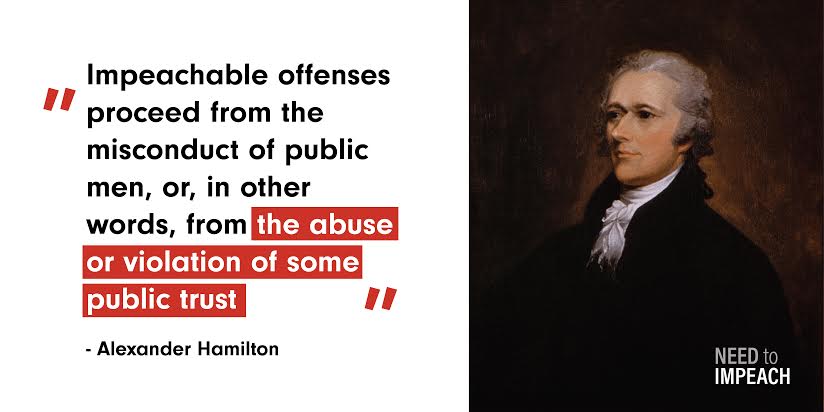
Can a Sitting President Be Federally Prosecuted? The Founders' Answer by W. Burlette Carter :: SSRN

Image result for Alexander Hamilton impeachment
Can a Sitting President Be Federally Prosecuted? The Founders' Answer by W. Burlette Carter :: SSRN

W. Burlette Carter

George Washington University Law School
Date Written: February 15, 2019

Abstract

Can a sitting U.S. President be federally indicted or prosecuted? Exploring the history of impeachment and prosecution in (1) England and Great Britain, (2) colonial America, and (3) the states immediately after independence--and comparing these to the Founders' Constitutional discussions--this article considers how the Founders would have answered that question, were it posed to them today. Deviating from most analyses of the problem, it argues that the Founders would have viewed the question as jurisdictional, involving a conflict between Courts of Law on the one hand, and the Congress -- operating as a High Grand Jury (the House) and a High Court of Impeachment (the Senate) -- on the other. 
They would have said that Congress, when operating in its impeachment role, has sole jurisdiction over removing a U.S. President for misbehavior. At the same time, they would have said that they gave to Courts of Law, concurrent power to hear cases involving crimes and misdemeanors, so long as the cases do not involve a removal. 
And so they would have answered our question with a question: Does the threatened action against the President risk removing the President, either directly or constructively? They would have believed that any criminal judicial order affirmatively or negatively enjoining powers specifically delegated to the President under the Constitution would shift those powers to others and, therefore, would be an impermissible removal attempt. Congress could insert itself into such proceedings to protect the Presidency (and, to remove or protect a President), but even if it does not, no federal court has jurisdiction to enforce such a removal order and, therefore a federal prosecutor also has no power.

Consistent with British impeachment history, the Founders would have viewed the proper issuance of Articles of Impeachment as a jurisdictional act that signaled Congress' intent to actively intervene. The adoption of such Articles would automatically stay any contrary proceeding in or related to Courts of Law, including a federal investigation and the operation of a federal grand jury. Moreover, the Founders would have said that a President has the power to fire a prosecutor if the President appointed the prosecutor. And while a President can be impeached for obstructive behavior, the Founders would have said that a President cannot, after an impeachment, be prosecuted for statutory obstruction of justice, if that prosecution is based on the exercise of powers delegated to the President under the Constitution.

The Founders would have recognized that, before the formal issuance of Articles of Impeachment, Courts of Law have the power to stay their own proceedings against a President for good cause, just as English/British common law courts with concurrent jurisdiction always could. And they would have have accepted that Courts of Law can, in the first instance, decide evidentiary issues such as executive privilege. Again, despite Parliamentary power over impeachment, common law courts had long done so in England and Great Britain, so long as they otherwise had jurisdiction.

This jurisdiction-focused answer from the Founders, on whether a President can be federally prosecuted, balances the interest in law enforcement in a given case with the larger interest of the nation in protecting the people's investment in the Presidency. It allows prosecutors to investigate the behavior of a sitting President--up to a point. On the other hand, it not only authorizes but requires that prosecutors, sworn to uphold the Constitution, exercise prosecutorial discretion in determining whether or not to mount an investigation of a sitting President and how far to take it through the Courts of Law. And it requires that Courts of Law accept the limits of their own jurisdiction when proposed injunctions or orders would threaten a removal.

The article sets forth the broad outlines of presidential removal doctrine and its jurisdictional ties. The focus is on the powers of federal prosecutors and federal courts in criminal proceedings vis a vis the President. It does not deal with the definition of high crimes and misdemeanors or other impeachment-related questions. While some of the arguments presented here might possibly apply to other types of proceedings against a President, including state prosecutions, this article focuses on federal prosecution.

Biden today on the Corona virus epidemic

An excerpt


Symposium: Forget about taxes: Mazars is a big case - SCOTUSblog

Victoria Nourse devastates Neomi Rao's attack on Congressional oversight authority.  Unfortunately Rao is on the D.C. Circuit and Nourse is still a law professor.
Symposium: Forget about taxes: Mazars is a big case - SCOTUSblog
by Victoria Nourse (Georgetown Law)
***The president’s lawyers argue that Congress cannot engage in what they term “law enforcement.” But that term is unbearably vague. If any law enforcement claim is outside Congress’ oversight jurisdiction, then congressional oversight is in serious trouble. Think about Enron. Think about the companies that sold mortgages to those who could not pay for them and precipitated the Great Recession. Investigations in these cases could all be characterized as law enforcement because fraud or obstruction of justice was involved. The president’s argument extends the idea of law enforcement to include information that might show criminal activity. 
But if potential criminal activity is the standard, then many of the long-held precedents of the court are wrong: McGrain (involving fraud), for example, and many a company subpoenaed — from Apple to Enron, Microsoft to Caterpillar, all of which have been subject to investigation (see Elise Bean’s 2018 book “Financial Exposure”) — could claim that Congress was acting outside its authority because it was engaging in law enforcement. 
The truth is that Congress cannot prosecute. It has no power to deprive any individual citizen of liberty; in that sense, it never “enforces” the law.***

History in a Crisis — Lessons for Covid-19 New England Journal of Medicine

History in a Crisis — Lessons for Covid-19 - NEJM


by David S. Jones, M.D., Ph.D.
***epidemics put pressure on the societies they strike. This strain makes visible latent structures that might not otherwise be evident. As a result, epidemics provide a sampling device for social analysis. They reveal what really matters to a population and whom they truly value.
One dramatic aspect of epidemic response is the desire to assign responsibility. From Jews in medieval Europe to meat mongers in Chinese markets, someone is always blamed. This discourse of blame exploits existing social divisions of religion, race, ethnicity, class, or gender identity. Governments then respond by deploying their authority, with quarantine or compulsory vaccination, for instance. This step generally involves people with power and privilege imposing interventions on people without power or privilege, a dynamic that fuels social conflict.
Another recurring theme in historical analyses of epidemics is that medical and public health interventions often fail to live up to their promise. The technology needed to eradicate smallpox — vaccination — was described in 1798, but it took nearly 180 years to achieve success. In 1900, health officials in San Francisco strung a rope around Chinatown in an attempt to contain an outbreak of bubonic plague; only white people (and presumably rats) were allowed to enter or leave the neighborhood. This intervention did not have the desired effect.

Judge's Criticism Of Trump Could Spur Misconduct Review - Law360

Judge's Criticism Of Trump Could Spur Misconduct Review - Law360
Federal judge Lynn Adelman who wrote in the Harvard Law & Policy Review an article titled "The Roberts' Court's Assault on Democracy". Adelman defended himself in an interviewed by Law 360.  Adelman  sees his article as consistent with a judge's role of commenting on the law - "speaking writing, and teaching" about the law and legal system as Canon 4 of the Code of Conduct of United States Judges frames it.

Such bluntness evokes the 2004 remarks by Judge Guido Calabresi - former Yale Dean. Calabresi said at a conference that George W. Bush should not be re-elected, that he had become President through the "illegitimate acts of a legitimate institution".  Calabresi later apologized for his remarks, was admonished by Chief Circuit Judge John Walker (a first cousin of Bush 42).  Walker's admonishment was ratified by a 2005 judicial discipline report of the 2d Circuit, 404 F. 3d 668.

Judge's Criticism Of Trump Could Spur Misconduct Review

Law360 (March 11, 2020, 7:21 PM EDT) -- A Wisconsin federal judge may find himself in hot water after publishing a law review article critical of Republicans and the U.S. Supreme Court, with an ethics expert forecasting misconduct complaints and a former federal judge predicting the article will lead to recusal demands.

While the code of ethics for federal judges allows for public discussion of the law, it prohibits political activity, especially when it deals with candidates for office. U.S. District Judge Lynn S. Adelman's article said conservative justices are "undermining democracy" while President Donald Trump's "temperament is that of an autocrat," Republicans are "focused on serving the wealthy," and GOP senators display "zealous partisanship [reminiscent of] those fervent defenders of slavery who pushed the South into the Civil War."

"A judge is making public remarks that can be construed as opposing a sitting president who is running for re-election," said Arthur Hellman, a University of Pittsburgh law professor who has advised Congress on judicial ethics. "The whole theory of judicial impartiality is not that judges have no views on political and social issues, but that they can separate those personal views from what they do as judges. If judges go out in public and start talking about their political and social views, I think people will legitimately wonder, can they separate them?"

Judge Adelman stood by his article in an interview with Law360 Wednesday.

"Judges are encouraged to talk about current legal issues and problems," he said, adding that it is "certainly reasonable and important to talk about" Supreme Court decisions.

Nancy Gertner, a former federal judge in Massachusetts who teaches at Harvard Law School, told Law360 that such commentary is part of academic debate.

"You can speak critically about the administration of justice," she said. "There are many of us who are law professors who have written critically about [a] decision. This is within the zone of what it's appropriate for a judge to talk about."