The Islamophobic Republican Backlash Against Ilhan Omar: Representative Ilhan Omar of Minnesota is one of the first two Muslim women in Congress. She’s also facing Islamophobic attacks from detractors accusing her of anti-Semitism, disloyalty to the U.S., and of trivializing the 9/11 terrorist attacks.
By
Friday, April 12, 2019


Maya and Kamala Harris - tag team TPM
https://talkingpointsmemo.com/dc/maya-harris-sister-kamala-harris-campaign-chairman
The mower by Philip Larkin
Check out @chowleen’s Tweet: https://twitter.com/chowleen/status/1116314920906158080?s=09
Thursday, April 11, 2019
Finra prescribes candor re departing brokers
https://advisorhub.com/finra-prescribes-candor-in-discussing-departing-brokers/
Retiring as a Judge, Trump’s Sister Ends Court Inquiry Into Her Role in Tax Dodges - The New York Times
Retiring as a Judge, Trump’s Sister Ends Court Inquiry Into Her Role in Tax Dodges - The New York Times: Maryanne Trump Barry faced complaints of judicial misconduct after a New York Times investigation found she had engaged in fraudulent tax schemes with her siblings.
by Russ Buettner and Susanne Craig
by Russ Buettner and Susanne Craig
President Trump’s older sister, Maryanne Trump Barry, has retired as a federal appellate judge, ending an investigation into whether she violated judicial conduct rules by participating in fraudulent tax schemes with her siblings.
The court inquiry stemmed from complaints filed last October, after an investigation by The New York Times found that the Trumps had engaged in dubious tax schemes during the 1990s, including instances of outright fraud, that greatly increased the inherited wealth of Mr. Trump and his siblings. Judge Barry not only benefited financially from most of those tax schemes, The Times found; she was also in a position to influence the actions taken by her family.
Judge Barry, now 82, has not heard cases in more than two years but was still listed as an inactive senior judge, one step short of full retirement. In a letter dated Feb. 1, a court official notified the four individuals who had filed the complaints that the investigation was “receiving the full attention” of a judicial conduct council. Ten days later, Judge Barry filed her retirement papers.
The status change rendered the investigation moot, since retired judges are not subject to the conduct rules. The people who filed the complaints were notified last week that the matter had been dropped without a finding on the merits of the allegations. The decision has not yet been made public, but copies were provided to The Times by two of the complainants. Both are involved in the legal profession.
Wednesday, April 10, 2019
Trump sister, a judge, retires to avoid scrutiny for tax fraud
https://www.nytimes.com/2019/04/10/us/maryanne-trump-barry-misconduct-inquiry.html
Tuesday, April 9, 2019
Barr confusion re ACA in his testimony
https://www.vox.com/policy-and-politics/2019/4/9/18302270/bill-barr-testimony-obamacare-house-lawsuit
Moving Alabama Into the Modern Age - The New York Times
The stars lined up for Doug Jones - the man who finally successfully prosecuted the perpetrator of one of the most heinous crimes of the modern civil rights movement. He finds himself in the United States Senate - a precarious spot given the white racist political domination of Alabama, Howell Raines, himself an Alabaman, reviews Jones book about his legendary quest for justice. - gwc
Moving Alabama Into the Modern Age - The New York Times:
Review by Howell Raines March 26, 2019
BENDING TOWARD JUSTICE The Birmingham Church Bombing That Changed the Course of Civil Rights
By Doug Jones
As he fell behind an accused sexual predator in returns from Alabama’s 2017 Senate election, Doug Jones admits, he allowed himself an almost “unbearable” lament familiar to thousands of frustrated Alabamians who came of age in the George Wallace era: “Oh, my poor home state.” Near midnight, it appeared that Jones’s pistol-waving opponent, the former Alabama Supreme Court justice Roy Moore, would join the century-long parade of reactionary buffoons Alabama’s white majority has sent to Congress and the governor’s mansion.
But in the final count for that Dec. 12 election, a cresting wave of modern sentiment among black voters and white women in the state’s rich Republican suburbs handed Jones a 22,000-vote victory, making Alabama the last state of the old Confederacy to join the New South. It was the biggest upset in Alabama political history, especially given Jones’s background as a successful prosecutor of Ku Klux Klansmen who perpetrated the signature civil rights crime of the 1960s, the fatal bombing of the 16th Street Baptist Church in Birmingham. KEEP READING
How Tough-on-Crime Prosecutors Contribute to Mass Incarceration - The New York Times
How Tough-on-Crime Prosecutors Contribute to Mass Incarceration - The New York Times:
Book Review:
CHARGED The New Movement to Transform American Prosecution and End Mass Incarceration
By Emily Bazelon
If you aspired to high office in the 20th and early 21st centuries, this was sound advice: Get thee to a prosecutor’s office. Politicians from both parties, from Democrats like John Kerry to Republicans like Rudolph Giuliani, parlayed prosecutorial perches into political power and nationwide fame. The basic recipe for using a prosecutor’s post as a springboard into politics required being “tough on crime,” protecting the public by putting criminals behind bars.
The vast majority of state and local prosecutors in the United States are elected, and taking a punitive tack was generally considered to be the path to re-election — and, frequently, election to higher office. Prosecutors had strong incentives to be harsh rather than lenient (or merciful) when dealing with defendants, and those incentives helped shape the criminal justice system as we know it today.
In the words of the law professor and historian Jed Shugerman, a scholar of prosecutors turned politicians: “The emergence of the prosecutor’s office as a steppingstone for higher office” has had “dramatic consequences in America.....
KEEP READING
Book Review:
CHARGED The New Movement to Transform American Prosecution and End Mass Incarceration
By Emily Bazelon
If you aspired to high office in the 20th and early 21st centuries, this was sound advice: Get thee to a prosecutor’s office. Politicians from both parties, from Democrats like John Kerry to Republicans like Rudolph Giuliani, parlayed prosecutorial perches into political power and nationwide fame. The basic recipe for using a prosecutor’s post as a springboard into politics required being “tough on crime,” protecting the public by putting criminals behind bars.
The vast majority of state and local prosecutors in the United States are elected, and taking a punitive tack was generally considered to be the path to re-election — and, frequently, election to higher office. Prosecutors had strong incentives to be harsh rather than lenient (or merciful) when dealing with defendants, and those incentives helped shape the criminal justice system as we know it today.
In the words of the law professor and historian Jed Shugerman, a scholar of prosecutors turned politicians: “The emergence of the prosecutor’s office as a steppingstone for higher office” has had “dramatic consequences in America.....
KEEP READING
China: E-Commerce Law in Effect Since January 2019 | Global Legal Monitor

China: E-Commerce Law Passed | Global Legal Monitor: (November 21, 2018)
According to the PRC E-commerce Law, (Zhonghua Renmin Gongheguo Dianzi Shangwu Fa) if an intellectual property (IP) rights holder believes that an operator on a platform has infringed its IP rights, the IP rights holder may notify the platform operator and request the latter take necessary preliminary measures, such as deleting or screening information about the alleged infringement, disconnecting the relevant webpages, or terminating the transaction or service. If the platform operator fails to promptly take the necessary preliminary measures upon receiving the notice, it is jointly and severally liable for additional damages along with the operator on the platform. (E-commerce Law art. 42; Beckett & Ge, supra.)
Whenever the platform operator knows or should have known that an operator on the platform has infringed others’ IP rights but fails to take the necessary preliminary measures, the platform operator is jointly and severally liable for all damages caused. (E-commerce Law art. 45; Beckett & Ge, supra.)
A platform operator that has failed to fulfill the abovementioned responsibilities and make corrections as ordered by the government IP authority within a specified time period is also punishable by a fine ranging from 50,000 yuan to 2 million yuan. (E-commerce Law art. 84.)
According to the Law, “electronic commerce” includes all business activities of selling goods or providing services though information networks such as the internet, with the exception of financial products and services and services that provide news, audio and video programs, publications, or cultural products. (Id. art. 2.)
The Law defines three types of “e-commerce operators”:
(1) platform operators, referring to any legal persons or unincorporated organizations that provide virtual places of business, transaction matching, information release, and other services to the parties of an e-commerce transaction to enable them to carry out independent transaction activities
(2) operators on platforms, referring to e-commerce operators that sell goods or provide services to customers through e-commerce platforms
(3) other e-commerce operators, referring to e-commerce operators selling goods or providing services through self-established websites or channels other than the platforms
Kyle Korver, NBA star on race
https://www.theplayerstribune.com/en-us/articles/kyle-korver-utah-jazz-nba
Barr the Redactor? Marty Lederman ~ Just Security
https://www.justsecurity.org/63523/barr-the-redactor/
Georgetown law prof Marty Lederman exhaustively reviews the issues regarding withholding of the Mueller report from Congress.
The grounds for redaction are very narrow and do NOT require opening an impeachment investigation.
Monday, April 8, 2019
Subservient Barr – Talking Points Memo

I have long been disturbed by the old school ties/beltway insider/DOJ rule of law club as a corruptible culture. We see, for example that the Department of Justice has virtually insulated its lawyers from discipline by anyone outside the Department - not surprising because the same is true for prosecutors and cops just about everywhere.
But post nomination weak-kneed responses to Brett Kavanaugh and William Barr were particularly noticeable among prominent "responsible" commentators and academics. As time goes on we see that Barr prostrated himself before Trump to get the job and that thee are no signs that will change.
Meanwhile dozens of misconduct complaints against Brett Kavanaugh have been swept from the table by the Chief Justice. Boys will be boys, I guess. - gwc
Subservient Barr – Talking Points Memo
by Josh Marshall
As we await Bill Barr’s ‘redactions’ of the Mueller Report, I wanted to pass on to you this note from a TPM Reader and member of the appellate bar. It may seem deep in the weeds at first. But it’s a window into Barr’s conduct so far that I was not at all aware of, or rather I knew the bare facts but hadn’t at all understood the implications. They bear directly on Barr’s subservience to the White House and current approach to executive power …
The focus on Barr and what he has done/is doing regarding the report has been fantastic.But there is another, overlooked data point that makes clear that we should be very suspicious about how Barr approaches his responsibilities as AG – including his redactions to the Mueller report and his supervision of the ongoing Trump investigations in the Southern District of New York and elsewhere.The Administration’s decision a few weeks ago to change its position and argue that the entire Affordable Care Act is unconstitutional didn’t get the attention it deserves. It is a shocking breach of the Justice Department’s duty to make reasonable arguments in support of the constitutionality of federal laws. There many such reasonable arguments in support of the ACA – as numerous conservative scholars have explained in blog posts and briefs since the DoJ announcement; it is the position that the Administration is now endorsing that is entirely unreasonable.
The New York Times’ reporting indicated that AG Barr opposed this change in position. But he appears perfectly willing to carry it out. That tells us a number of things, all of them disturbing.First, AG Barr is not going to do very much to defend key Justice Department norms against assaults by the White House. Barr’s nomination was greeted with relief by many, who believed he would restore the old DoJ norms.But his willingness to go along without a whimper with a fundamental breach of a longstanding DoJ norm shows that just isn’t true. Sometime between now and May 1 (when the DoJ brief is likely due), Barr will have to send a letter to Congress repudiating Jeff Sessions’ determination just last June that most of the ACA is constitutional; in other words, that Sessions was willing to make unreasonable arguments to defend the ACA.The change in position is the minor part of the story. Sessions’ position was bad enough, and Barr’s willingness to compound the damage to DoJ norms and principle creates a serious threat to the rule of law, as Professor Nick Bagley explained in detail in a Times op-ed. It effectively gives the Executive Branch an extra-constitutional veto, exercisable at any time, which can be checked by the courts only if another litigant has legal standing to defend a law the administration is willing to throw overboard.
Sunday, April 7, 2019
Fact and Fiction on Trump’s Tax Returns – Whatever Source Derived – Medium
Fact and Fiction on Trump’s Tax Returns – Whatever Source Derived – Medium:
by Daniel Hemel(U.Chicago Law School)
President Trump’s personal attorney, William Consovoy, sent a letter to the Treasury Department’s general counsel on Friday arguing that House Ways and Means Chairman Richard Neal “cannot legally request — and the IRS cannot legally divulge” — the president’s tax returns. The letter gets a couple of things right and other things very wrong.
by Daniel Hemel(U.Chicago Law School)
President Trump’s personal attorney, William Consovoy, sent a letter to the Treasury Department’s general counsel on Friday arguing that House Ways and Means Chairman Richard Neal “cannot legally request — and the IRS cannot legally divulge” — the president’s tax returns. The letter gets a couple of things right and other things very wrong.
First, Consovoy is correct that 26 U.S.C. § 6103(f), the once-obscure 1924 statute that everyone is now talking about, does not resolve the present controversy. Section 6103(f) says that upon written request from the House Ways and Means chair or his Senate Finance Committee counterpart, the Treasury secretary “shall furnish such committee with any return or return information specified in such request.” But that is not the end of the story.
As Andy Grewal and others have (rightly) noted, § 6103(f) cannot extend any further than Congress’s legislative power. While “[t]he power to conduct investigations is inherent in the legislative process,” it is “not unlimited.” See Watkins v. United States, 354 U.S. 178, 187 (1957). For one thing, “[t]here is no general authority to expose the private affairs of individuals without justification in terms of the functions of the Congress.” Id. Thus, a § 6103(f) request — like any investigative step by a congressional committee — “must be related to, and in furtherance of, a legitimate task of Congress.” Id. Second, § 6103(f) — like every other statute — is limited by the Bill of Rights. Congress cannot, for example, compel a witness to incriminate herself. See id. at 188.
On its face, Chairman Neal’s request satisfies the “legitimate task” test. “The power of the Congress to conduct investigations … encompasses inquiries concerning the administration of existing laws as well as proposed or possibly needed statutes.” Watkins, 354 U.S. at 187. As Chairman Neal’s letterexplains, the Ways and Means Committee “is considering legislative proposals and conducting oversight related to … the extent to which the IRS audits and enforces the Federal tax laws against a President.” This is a serious concern. The president is the head of the executive branch; the IRS is part of the executive branch; and those two facts alone lead to worries that the IRS will show favoritism in its examination of its boss’s returns. Recognizing this risk, the IRS has established an internal procedure for review of the president’s (and vice president’s) tax returns, but this procedure appears to have two significant shortcomings. First, it does not appear to apply to returns filed by the president before his inauguration that are still under audit while he is in office. (As of March 2016, the IRS was still examining Trump’s returns from 2009 onwards.) Second, it does not appear to apply to returns filed by business entities and trusts controlled by the president. It’s entirely legitimate for the Ways and Means Committee to evaluate whether the Service’s examinations of Trump’s pre- and post-presidential personal and business returns have been tainted by favoritism (or, possibly, by animus) and, if so, whether there is anything that Congress should do about that legislatively.
Saturday, April 6, 2019
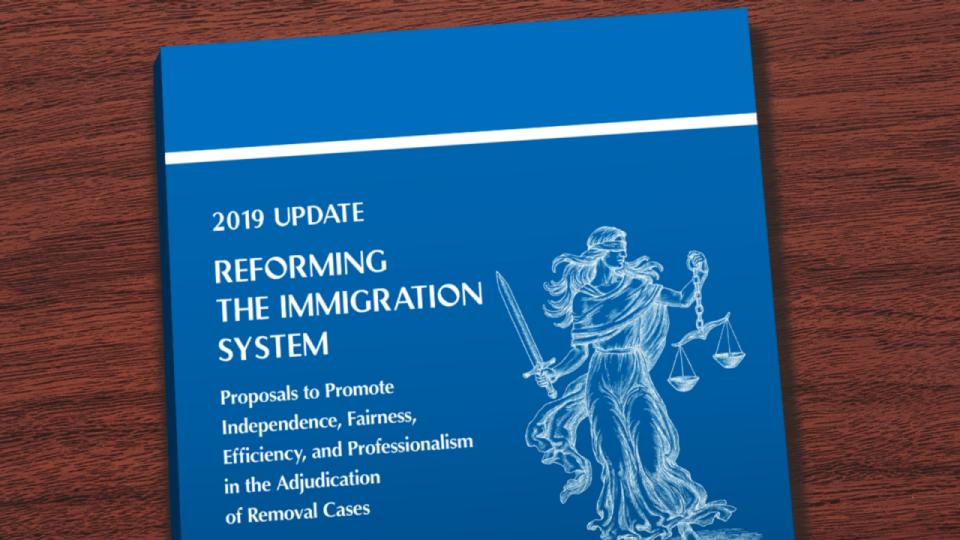
ABA: Immigration Courts face existential crisis - system "irredeemably " dysfunctional
The broad outlines of the immigration crisis are plain: several Central American nations are in deep crisis, spurring thousands to seek refuge in a no longer hospitable United States of America. An autarchic President, elected in large part on his hostility to such migrants, has narrowed the grounds for amnesty, rejected the DACA policy of regularization of young immigrants who unlawfully entered the U.S., embraced punitive policies, and refused to take measures to assure a functional system of immigration courts.
The American Bar Association Commission on Immigration - for which the Washington, D.C. firm Arnold & Porter has long played a leading role - in its 2019 report describes a system of justice that scarcely deserves the name:
The imposition of individual case production quotas and time-based deadlines tied to an immigration judge’s performance evaluation is “unprecedented”and has been widely criticized. Although proponents of the case production quotas view the requirement as a necessary step towards reducing case backlog, critics have denounced the move, arguing that it will undermine judicial independence, expose judges’ decisions to additional legal challenge, create additional backlog, and ultimately threaten due process.***
The immigration courts are facing an existential crisis. The current system is irredeemably dysfunctional and on the brink of collapse, and the only way to resolve the serious systemic issues within the immigration court system is through transferring the immigration court functions to a newly-created Article I court. This approach is the best and most practical way to ensure due process and insulate the courts from the capriciousness of the political environment. It is further our view that the public’s faith in the immigration court system will be restored only when the immigration courts are assured independence and the fundamental elements of due process are met.
ABA 2019 report reforming_the_immigration_system
Friday, April 5, 2019
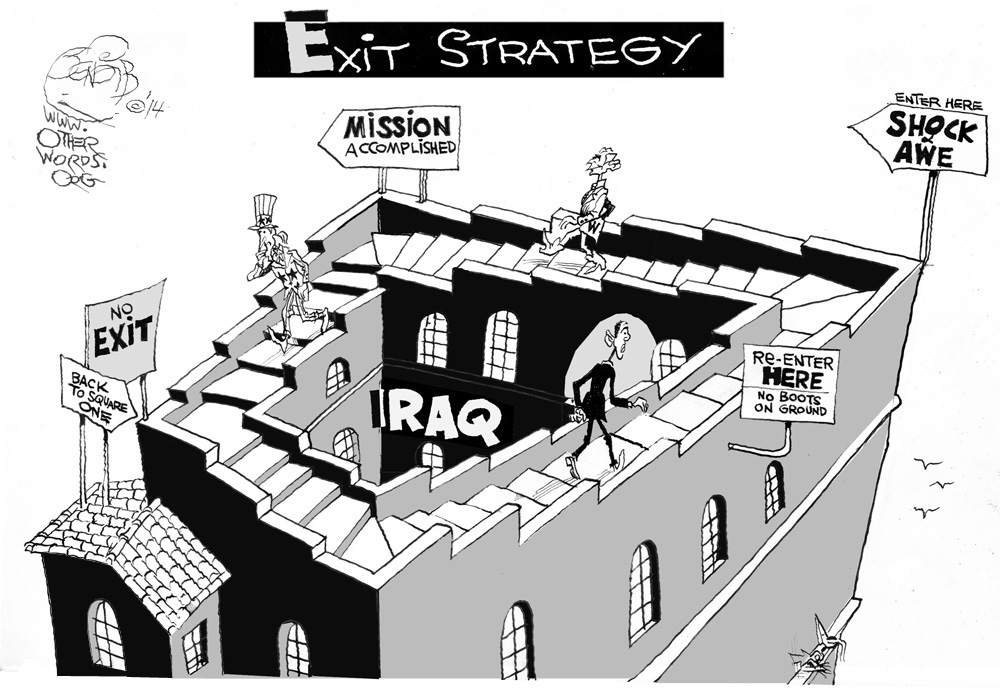
15 Years After the Iraq Invasion, What Are the Costs? | Portside

My stomach knots every time I hear someone say "thank you for service". The though in my mind, is "I am really sorry that you went through that and ashamed of what we inflicted on the Iraqis."
I thought the attacks on al-Qaida justified but why the hell did we think that we would do better than the Soviets did there. I think our chances were worse from the first. The Soviets at least had a local communist party with a real base. We have the opium traders and some of the clans some days. - gwc
15 Years After the Iraq Invasion, What Are the Costs? | Portside
This March marked the 15th anniversary of the U.S.-led invasion of Iraq.
In 2003, President George W. Bush and his advisers based their case for war on the idea that Saddam Hussein, then dictator of Iraq, possessed weapons of mass destruction — weapons that have never been found. Nevertheless, all these years later, Bush’s “Global War on Terror” continues — in Iraq and in many other countries.
It’s a good time to reflect on what this war — the longest in U.S. history — has cost Americans and others around the world.
First, the economic costs: According to estimates by the Costs of War project at Brown University’s Watson Institute for International and Public Affairs, the war on terror has cost Americans a staggering $5.6 trillion since 2001, when the U.S. invaded Afghanistan.
$5.6 trillion. This figure includes not just the Pentagon’s war fund, but also future obligations such as social services for an ever-growing number of post-9/11 veterans.
It’s hard for most of us to even begin to grasp such an enormous number.
It means Americans spend $32 million per hour, according to a counter by the National Priorities Project at the Institute for Policy Studies.
Put another way: Since 2001, every American taxpayer has spent almost $24,000 on the wars — equal to the average down payment on a house, a new Honda Accord, or a year at a public university.
As stupefying as those numbers are, the budgetary costs pale in comparison with the human toll.
As of 2015, when the Costs of War project made its latest tallies, up to 165,000 Iraqi civilians had died as a direct consequence of U.S. war, plus around 8,000 U.S. soldiers and military contractors in Iraq.
Those numbers have only continued to rise. Up to 6,000 civilians were killed by U.S.-led strikes in Iraq and Syria in 2017 –– more civilians than in any previous year, according to the watchdog group AirWars.
In addition to those direct deaths, at least four times as many people in Iraq have died from the side effects of war, such as malnutrition, environmental degradation, and deteriorated infrastructure.
Thursday, April 4, 2019
New Jersey Solo Practitioner Ordered to pay $89,000 sanction for deficient pleadings // NJ Law Journal
New Jersey Solo Practitioner Ordered to pay $89,000 sanction for deficient pleadings // NJ Law Journal
by Charles Toutant
by Charles Toutant
A federal judge has ordered a lawyer to reimburse Camden County $89,234 in legal fees for pursuing a discrimination suit after the court deemed it factually and legally frivolous.
Senior U.S. District Judge Jerome Simandle ordered Sewell attorney Cheryl Cooper on Thursday to pay that amount for her representation of John Sosinavage, a former lieutenant in the Camden Police Department. Sosinavage lost his job when that department was disbanded in 2013 and the Camden County Police Department began serving the city.
Cooper was sanctioned in February for failing to withdraw or correct her deficient pleadings even after receiving notice that those claims were not supported by facts. At that time, Simandle said Cooper pursued the failure-to-hire claim for more than three years against the county “that she knew or should have known was factually and legal frivolous, despite clear warning of precisely these deficiencies in 2015.”
Cooper sued Camden County, Police Chief Scott Thomson and two deputy chiefs, claiming Sosinavage suffered discrimination based on age, protected First Amendment activity or both, when he was not invited to apply to the Camden County Police Department while his name appeared on a statewide list of laid-off public employees. He also sued the city of Camden.
But Sosinavage testified at a deposition that he received a job application for the Camden County Police Department and instructions on how to apply by email, and that he made a conscious decision not to submit the application. Sosinavage also testified that he told others he did not want to work for the Camden County Police Department, and would not accept a position if offered a job there.
Simandle dismissed the county defendants in May 2018.
Simandle, noting that Cooper is a solo practitioner and might have limited financial resources to pay the county defendants for the fees they incurred in the case, invited her Feb. 8 to submit an affidavit addressing her ability to pay. She failed to do so.
Simandle said Cooper could submit the affidavit under seal, as long as a copy was provided confidentially to the county’s lawyer, Christine O’Hearn of Brown & Connery in Westmont. But Cooper failed to submit any such affidavit.
FLORIDA SUPREME COURT REJECTS ADEQUACY CLAIMS – SchoolFunding.Info
FLORIDA SUPREME COURT REJECTS ADEQUACY CLAIMS – SchoolFunding.Info:
School Funding Info is a project of Teachers College
School Funding Info is a project of Teachers College
In a close 4-3 decision in which the deciding judge joined in the result but not the opinion of his colleagues, the Florida Supreme Court earlier this month rejected a ten- yearlong attempt by public school students, parents and citizen organizations to have the state’s education finance system declared unconstitutional. Citizens for Strong Schools, Inc v. Florida State Board of Education.
The Florida constitution provides that education is “a paramount duty” of the state and requires that “[a]dequate provision” shall be made by law for a “high quality” education system. The plurality ruled that these terms do not provide “any manageable” standard for the court to use in assessing the adequacy of the amount of funding that the schools receive. The Court rejected plaintiffs’ position that the state’s educational standards provide such a standard, because
Adopting State standards as constitutional minima would have the perverse effect of encouraging the weakening of curriculum standards in order to achieve the higher passage rates and to satisfy court-imposed requirements.
The plurality decision also refused to consider decisions from other states that had found that less robust language in their constitutions provides judicially manageable standards. The Court did, however, note that this case was a broad, blanket challenge to the entire state school funding system, and it left open the possibility that a “challenge to a specific program or a specific funding issue” could be subject to judicial review.
Justice Barbara Pariente, writing for and two other dissenting justices, set forth a definition of “high quality” that she asserted would provide judicially manageable standards for the purposes of this case. She wrote that “high quality” means:
…an education system that allows all students an equal opportunity to learn the core content knowledge set by the State and become knowledgeable and engaged adults.
In response to the plurality’s view that the state’s educational standards could not provide a manageable constitutional standard, Justice Pariente stated that:
If the State were to intentionally adopt low standards to achieve higher pass rates, those standards could be challenged as a violation of the State’s constitutional obligation to provide a “high quality” education. Simply because Petitioners in this case do not challenge the standards set by the State does not render their claim non-justiciable.
In a separate dissent, Justice R. Fred Lewis regretted the “depth of injury” that the majority was inflicting upon Florida’s school children. He bluntly stated that courts sometimes “throw up justiciability barricades only to avoid the difficult or complex cases, taking the easy way out by using excuses to defer the decision of a case to a legislative body.” He opined that because of the majority decision in this case, the “words describing the right to a high quality education and the constitutional concept of protecting that right ring hollow without a remedy to protect that right.”
Wednesday, April 3, 2019
Trump is capturing the federal judiciary ~ Shira Scheindlin
Trump is capturing the judiciary at an alarming rate https://www.theguardian.com/commentisfree/2019/apr/03/trump-capturing-judiciary-alarming-rate?CMP=Share_AndroidApp_Blogger
Subscribe to:
Posts (Atom)