Friday, January 19, 2024

The Deference Dilemma by Adrian Vermeule :: SSRN

The Deference Dilemma by Adrian Vermeule :: SSRN

The Deference Dilemma

17 Pages Posted: 4 Nov 2023 Last revised: 27 Nov 2023

Adrian Vermeule

Harvard Law School

Date Written: October 6, 2023

Abstract

The Supreme Court faces a real dilemma in the Loper Bright case, in which the Court will explicitly consider whether to overrule the Chevron decision. The dilemma is decades in the making, and arises from the interplay of large structural forces, between which the Court is uneasily positioned. On the one hand, the background conditions of the American administrative state, which produce an array of broad and vague delegations to administrative agencies on highly technical subjects, tend to limit the scope of judicial review of agency legal interpretations. On the other hand, the fundamental importance of judicial review of agency legal authority as a legitimating mechanism for the administrative state presses judges towards plenary review of agency legal interpretations. The combination of these two large-scale pressures creates the deference dilemma. It threatens to make plenary judicial review of agency legal interpretations both intolerable and indispensable.

In what follows, I explain this basic problem, explore its causes and sources, and speculate about some possible futures for the Chevron framework in particular and the deference dilemma in general. The most interesting possibility is an express overruling of Chevron, combined however with a reframing of “deference” that preserves much of the content of Chevron under a different label. On this reframing, the overruling majority will say — along lines indicated by Henry Monaghan decades ago — that de novo or plenary judicial review of agency legal interpretations is required by legal sources (either by the Administrative Procedure Act, by Article III, or both), yet will also say that de novo interpretation might of course itself yield the conclusion that, in a given statute, Congress has delegated primary responsibility to agencies to fill in statutory gaps or ambiguities.


Vermeule, Adrian, The Deference Dilemma (October 6, 2023). Harvard Public Law Working Paper No. 23-38, Available at SSRN: https://ssrn.com/abstract=4594638 or http://dx.doi.org/10.2139/ssrn.4594638

Supreme Court likely to discard Chevron - SCOTUSblog

Supreme Court likely to discard Chevron - SCOTUSblog
By Amy Howe

It has been nearly 40 years since the Supreme Court indicated in Chevron v. Natural Resources Defense Council that courts should defer to an agency’s reasonable interpretation of an ambiguous statute. After more than three-and-a-half hours of oral argument on Wednesday, it seemed unlikely that the rule outlined in that case, known as the Chevron doctrine, will survive in its current form. A majority of the justices seemed ready to jettison the doctrine or at the very least significantly limit it.

The court’s ruling could have ripple effects across the federal government, where agencies frequently use highly trained experts to interpret and implement federal laws. Although the doctrine was relatively noncontroversial when it was first introduced in 1984, in recent years conservatives – including some members of the Supreme Court – have called for it to be overruled.

The plea to overturn the Chevron doctrine came to the court in two cases challenging a rule, issued by the National Marine Fisheries Service, that requires the herring industry to bear the costs of observers on fishing boats. Applying Chevron, both the U.S. Court of Appeals for the District of Columbia Circuit and the U.S. Court of Appeals for the 1st Circuit upheld the rule, finding it to be a reasonable interpretation of federal law.

The fishing companies came to the Supreme Court, asking the justices to weigh in on the rule itself but also to overrule Chevron. Roman Martinez, representing one group of fishing vessels, told the justices that the Chevron doctrine undermines the duty of courts to say what the law is and violates the federal law governing administrative agencies, which similarly requires courts to undertake a fresh review of legal questions. Under the Chevron doctrine, he observed, even if all nine Supreme Court justices agree that the fishing vessels’ interpretation of federal fishing law is better than the NMFS’s interpretation, they would still be required to defer to the agency’s interpretation as long as it was reasonable. Such a result, Martinez concluded, is “not consistent with the rule of law.”
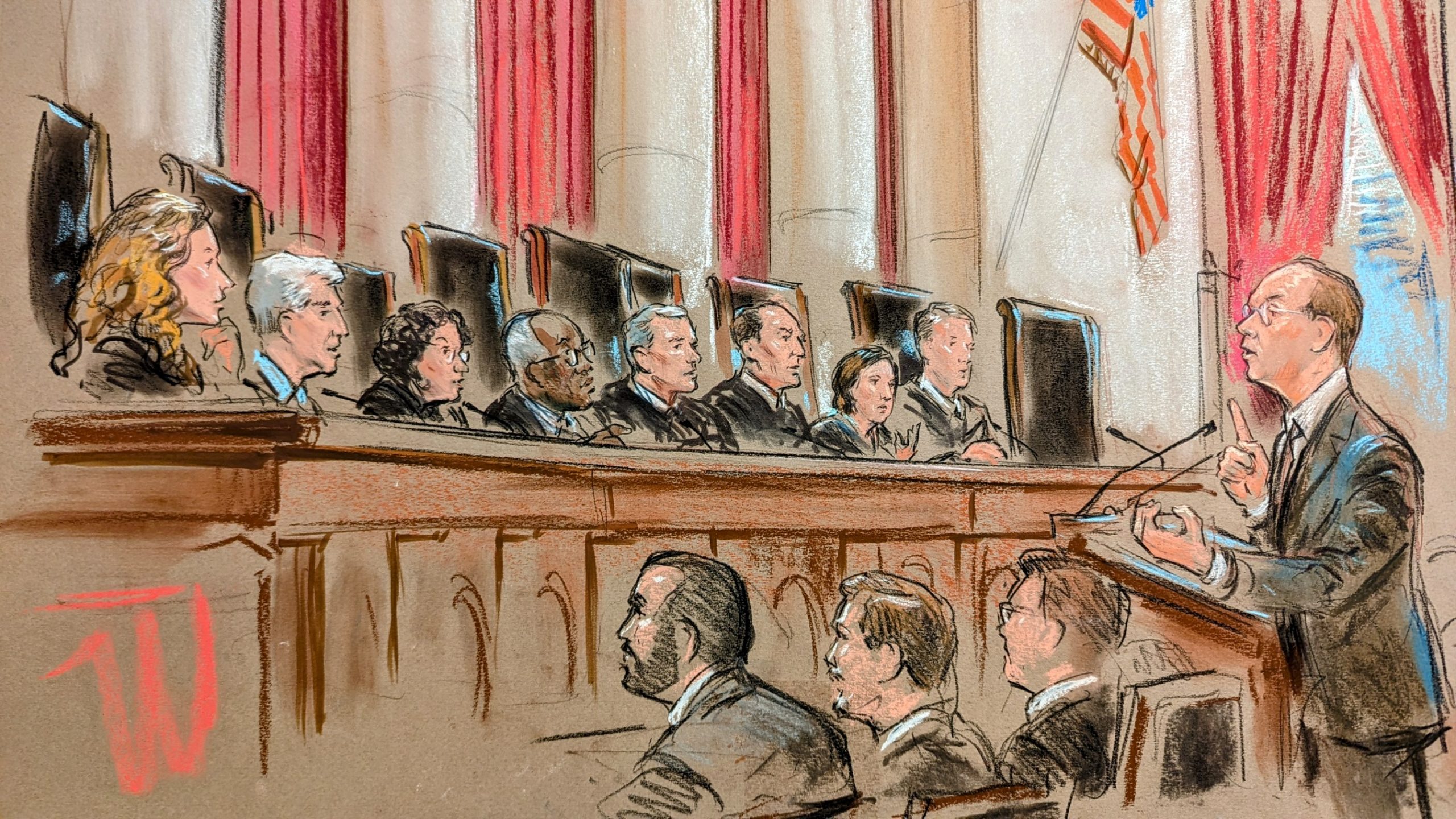
Man arguing before full bench of justices

Paul Clement argues for Loper Bright Enterprises. (William Hennessy)

Arguing on behalf of the second group of fishing companies, Paul Clement echoed Martinez’s points. Emphasizing that his clients’ case “well illustrates the real world costs of the Chevron” doctrine for small businesses, he decried the doctrine as “hopeless ambiguous” and “reliance destroying.” The question in this challenge to the rule, he said should focus on what the best reading of the statute is.  

Representing the Biden administration, U.S. Solicitor General Elizabeth Prelogar urged the justices to leave the Chevron doctrine in place, telling them that it has “deep roots in this Court’s jurisprudence.” Under the doctrine of stare decisis – the idea that courts should generally adhere to their prior cases – the court would need a “truly extraordinary justification” to overrule it, which the challengers do not have, she asserted.

The court’s three liberal justices expressed support for keeping the doctrine in place. Justice Elena Kagan repeatedly suggested that federal agencies, with their scientific and technical expertise, are better suited than courts to resolve ambiguities in a federal statute.

Kagan cited as one example a hypothetical bill to regulate artificial intelligence. Congress, she said, “knows there are going to be gaps because Congress can hardly see a week in the future.” So it would want people “who actually know about AI and are accountable to the political process to make decisions” about artificial intelligence. Courts, she emphasized, “don’t even know what the questions are about AI,” much less the answers.

Justice Sonia Sotomayor agreed with Kagan. She doubted whether there can be a “best” interpretation of a law when the justices “routinely disagree” about a law’s meaning. The real question, she said, is who makes the choice about what an ambiguous law means. And if the court needs a “tie-breaker,” she continued, why shouldn’t it defer to the agency, with its expertise?

Justice Ketanji Brown Jackson posited that the Chevron doctrine serves an important purpose. Under Chevron, she suggested, Congress gives federal agencies the power to make policy choices – such as filling gaps or defining terms in the statute. But if Chevron is overturned and agencies no longer have that power, she predicted, then courts will have to make those kinds of policy decisions.

But Justice Brett Kavanaugh saw Chevron’s deference to agencies differently. Chevron, he complained, “ushers in shocks to the system every four or eight years when a new administration comes in” and implements “massive change” in areas like securities law, communications law, and environmental law.

KEEP READING

Thursday, January 18, 2024

The Supreme Court is seizing more power from Democratic presidents. - Stern ///SLATE


So the problem with judges deferring to the expertise and policy decisions of administrative agencies like the EPA is that they'll be following the lead of elected executives, not judges who  don't like the agencies created and funded by the elected members of Congress. - GWC

...throughout Wednesday’s arguments, the conservative justices condemned Chevron as some kind of anti-accountability chaos agent that sabotages good government. Justice Brett Kavanaugh, who dissed Chevron during his audition for SCOTUS, assailed the decision’s democratic traits as a bug, not a feature. “The reality of how this works,” Kavanaugh said, “is Chevron itself ushers in shocks to the system every four or eight years when a new administration comes in—whether it’s communications law or securities law, competition law or environmental law, it goes from pillar to post.” New administrations change policy, Kavanaugh continued, “because they have disagreements with the policy of the prior administration.”
The Supreme Court is seizing more power from Democratic presidents.//SLATE
BY Mark Joseph Stern

On Wednesday, the Supreme Court’s conservative supermajority signaled its intent to overturn four decades of precedent and award itself even greater authority to strike down policies that govern every conceivable aspect of life in the United States. This revolution has been years in the making, the result of a lavishly funded campaign to transform the courts into a weapon against any regulation you can think of. The environment, the economy, health care, civil rights, education: All aspects of federal governance will be in peril, subject to the whims of unelected judges with zero expertise or accountability and a distinct bias toward deregulation. Throughout the morning, SCOTUS sounded hostile to the very notion that elections have consequences—at least when a majority of justices dislike those consequences. And the court’s right flank evinced little concern about tossing 40 years of stable law, encompassing more than 17,000 federal court decisions, in favor of the Federalist Society’s preferred regime. It appears ready, in Justice Elena Kagan’s words, to “blow up one doctrine of humility, blow up another doctrine of humility, and then expect anybody to think that the courts are acting like courts.”

Wednesday’s arguments in Relentless, Inc. v. Department of Commerce and Loper Bright Enterprises v. Raimondo target a federal regulation that prevents overfishing—though their details are largely irrelevant in light of the court’s grand, precedent-shredding ambitions. In 2020, the National Marine Fisheries Service compelled the fishing industry to help cover the cost of federal observers who monitor for overfishing. The fishers sued, drawing the government into a battle over the meaning of an overfishing statute that each side read differently.

For decades, the Supreme Court has instructed judges to use a tool called Chevron deference when faced with such ambiguities. The doctrine is rooted in a 1984 decision, Chevron v. NRDC, which involved an EPA policy that loosened restrictions on air pollution. (This policy was enacted by Justice Neil Gorsuch’s mother, EPA administrator Anne Gorsuch.) Environmental groups filed suit, but SCOTUS unanimously sided with the EPA’s approach. The court explained that agencies are staffed by experts with far more knowledge in their specific area than judges. These agencies are accountable to the president, who is in turn accountable to the citizenry. The court thus held that “it is entirely appropriate” for agencies to make the policy choices inherent in interpreting ambiguous statutes. (This notion was already deeply entrenched in statutes and precedents going back to the 1940s.)