Saturday, April 11, 2020


Experts inside and outside the government identified the threat early on and sought to raise alarms even as President Trump was moving slowly. Read some of what they had to say among themselves at critical moments.
WASHINGTON — As the coronavirus emerged and headed toward the United States, an extraordinary conversation was hatched among an elite group of infectious disease doctors and medical experts in the federal government and academic institutions around the nation.
Red Dawn — a nod to the 1984 film with Patrick Swayze and Charlie Sheen — was the nickname for the email chain they built. Different threads in the chain were named Red Dawn Breaking, Red Dawn Rising, Red Dawn Breaking Bad and, as the situation grew more dire, Red Dawn Raging. It was hosted by the chief medical officer at the Department of Homeland Security, Dr. Duane C. Caneva, starting in January with a small core of medical experts and friends that gradually grew to dozens.
He Could Have Seen What Was Coming: Behind Trump’s Failure on the Virus
An examination reveals the president was warned about the potential for a pandemic but that internal divisions, lack of planning and his faith in his own instincts led to a halting response.
April 11, 2020
The “Red Dawn String,” Dr. Caneva said, was intended “to provide thoughts, concerns, raise issues, share information across various colleagues responding to Covid-19,” including medical experts and doctors from the Health and Human Services Department, the Centers for Disease Control and Prevention, the Homeland Security Department, the Veterans Affairs Department, the Pentagon and other federal agencies tracking the historic health emergency.

Friday, April 10, 2020

When you drown the government in the bathtub, people die - The Washington Post

When you drown the government in the bathtub, people die - The Washington Post
by Dana Milbank
...the nation’s top scientists and public health experts were shouting these warnings from the rooftops — deafeningly, unanimously and consistently. In the years after the 2001 terrorist attacks, the Bush and Obama administrations seemed to be listening.
 But then came the tea party, the anti-government conservatism that infected the Republican Party in 2010 and triumphed with President Trump’s election. Perhaps the best articulation of its ideology came from the anti-tax activist Grover Norquist, who once said: “I don’t want to abolish government. I simply want to reduce it to the size where I can drag it into the bathroom and drown it in the bathtub.” 

 They got their wish. What you see today is your government, drowning — a government that couldn’t produce a rudimentary test for coronavirus, that couldn’t contain the pandemic as other countries have done, that couldn’t produce enough ventilators for the sick or even enough face masks and gowns for health-care workers.

Donald Trump's "America First" Is a Dangerous Fantasy in the Coronavirus Pandemic


Trump speaks at the daily coronavirus response briefing at the White House in Washington, D.C., April 2020 Tom Brenner / Reuters 

Donald Trump's "America First" Is a Dangerous Fantasy in the Coronavirus Pandemic:
by Philip H.  Gordon April 4, 2020 

It should come as no surprise that the administration of U.S. President Donald Trump, whose foreign policy doctrine is called “America first,” vastly underestimated the importance to U.S. security of defeating the novel coronavirus pandemic abroad. Trump was slow to recognize that the United States could not seal itself off from the virus: on February 26, the president predicted that the number of infected Americans would soon go down “close to zero,” while the White House economic adviser Larry Kudlow insisted that the United States had “contained” the threat because its borders were “pretty close to airtight.” Commerce Secretary Wilbur Ross even assessed that the troubles in China “will help accelerate the return of jobs to North America.” 
But of course American borders were not airtight at all, and the United States is now home to the highest number of reported cases of COVID-19, the disease caused by the novel coronavirus, in the world, with more than 7,000 deaths, a number almost certain to increase exponentially in the coming weeks.  
 With the domestic toll rising, the administration and many governors have belatedly implemented aggressive containment measures, and Congress has stepped in with a $2.2 trillion stimulus package to provide temporary economic relief to American workers and businesses. But Washington is still not doing nearly enough to prevent and mitigate the spread of the disease beyond U.S. borders—in some cases, the administration has even cut foreign assistance and rejected diplomacy where more of both were needed. 
The health and safety of the American people are the rightful priorities of the U.S. government, but concentrating narrowly on fighting the virus at home while allowing it to spread abroad would be as shortsighted as focusing on fighting a fire only in one’s own home when one’s whole neighborhood was engulfed in flames.
KEEP READING

Thursday, April 9, 2020

Editorial: Catholics and Trump, a reckoning | National Catholic Reporter


Editorial: Catholics and Trump, a reckoning | National Catholic Reporter:  
Several significant questions emerge, entwined, from the chaos of the moment. One is about Catholicism and its public expression, the other about our civic/political life and, in each instance, how they might be transformed in the post-pandemic era.
In the civil realm, the question is whether truth, or the pursuit of it, and competence will ever be foundational again to the way we conduct our public affairs. Or will we continue to require that truth bowl us over — actually threaten every area of life — before we believe it?
The question for the church in the United States is whether we will come out of this austere moment able to admit the role Catholics and their leaders played in electing and enabling a man who, far from being pro-life, has proven himself a distinct danger to life on several levels.
It is neither coincidence nor surprising that those who engage in fevered distortions of the truth in the political realm would have companions in the religion realm.
The combination is dangerous, and just how potentially destructive — not only of democratic processes and institutions but now of the body politic itself — is becoming all too clear. Are those bishops who reduced Catholic participation in the political process to a single issue, who tacitly approved when their culture-warrior minions delivered that message from countless pulpits, willing to take responsibility now for the sheer incompetence they helped put in place? If it profits not a man to give his soul for the world, how much worse for the church to hand over its integrity for a few conservative justices.
The consequences are enormous and have to do with much more than policy differences or even single-issue politics. As The Washington Post columnist Michael Gerson, recounting how Trump bragged about the ratings for his embarrassing afternoon "briefings," so aptly put it recently:
Exploiting this type of tragedy in the cause of personal vanity reveals Trump's spirit to be a vast, trackless wasteland. Trump seems incapable of imagining and reflecting the fears, suffering and grief of his fellow citizens. We have witnessed the total failure of empathy in presidential leadership.

Wednesday, April 8, 2020

How Delays and Unheeded Warnings Hindered New York’s Virus Fight - The New York Times

How Delays and Unheeded Warnings Hindered New York’s Virus Fight - The New York Times: The federal response was chaotic. Even so, the state’s and city’s own initial efforts failed to keep pace with the outbreak, The Times found.

RACE IN AMERICA: WHAT HAS CHANGED HALF A CENTURY SINCE MLK?HLPR Volume 14.1

American Constitution Society - Wikipedia
HLPR Volume 14.1: Harvard Law & Policy Review, Volume 14.1: Race in America: What Has Changed Half a Century Since MLK?
FOREWORD by Congressman Elijah E. Cummings of Maryland* 
I must acknowledge that when I received the invitation to contribute a foreword to this issue of the Harvard Law & Policy Review, I experienced the mixed feelings that so often accompany challenging opportunities. In part, my ambivalence was occasioned by the very complexity of the theme— “Race in America: What has changed half a century since MLK?” 
The reader will find this theme broadly and ably addressed in the following pages by serious thinkers for whom I have the greatest respect. My opportunity and challenge, therefore, is to share some added value to what these experts offer. Any assessment of the ideals, impact, and legacy of Dr. Martin Luther King, Jr. and his contemporaries within the civil rights movement of the last century will necessarily be laudatory. After all, the ideals expressed so clearly and prophetically by Dr. King were drawn from the highest ideals of justice and equality from our shared Abrahamic religious traditions, as well as (though less consistently) from the founding constitutional documents of our democratic republic. Still, a degree of humility is in order. Of equal if not greater importance, we must also recognize that Dr. King’s legacy is unfinished and, in many respects, being undone. Progressives, including progressive lawyers, have played a role in furthering Dr. King’s legacy for everyday people in our society, including people of color. Those of us who have been privileged to be trained in the law have no exclusive, proprietary interest in the highest and most noble ideals of our society. 
We are less like ministers and prophets pointing the way to a nobler promised land—and more akin to engineers and mechanics, working to apply the ideals of our culture and society to the practical circumstances of daily life for those who depend upon our expertise. The tools of our profession are litigation and legislation—tools that have been critical in expanding upon Dr. King’s legacy—and I have had the privilege to engage in both during the last 42 years of my professional life...
KEEP READING
* Congressman Elijah E. Cummings was born and raised in Baltimore, Maryland, where he still resided until his passing. He obtained his Bachelor’s Degree in Political Science from Howard University, serving as Student Government President and graduating Phi Beta Kappa, and then graduated from the University of Maryland School of Law. Congressman Cummings also received 13 honorary doctoral degrees from Universities throughout the nation. Congressman Cummings began his career of public service in the Maryland House of Delegates, where he served for 14 years and became the first African American in Maryland history to be named Speaker Pro Tem. From 1996 until his passing in October 2019, Congressman Cummings proudly represented Maryland’s 7th Congressional District in the U.S. House of Representatives. Congressman Cummings served as the Chairman of the U.S. House Committee on Oversight and Reform and as a senior Member of the U.S. House Committee on Transportation and Infrastructure. Congressman Cummings was an active member of New Psalmist Baptist Church and is survived by his wife, Dr. Maya Rockeymoore Cummings, and his three children. Congressman Cummings authored this Foreword prior to his passing, with the assistance of members of his staff: Special Assistant Michael A. Christianson, Counsel Aaron D. Blacksberg, Legislative Director and Counsel Yvette Badu-Nimako, and Legal Fellow Christina Volcy

How the Republican Party Took Over the Supreme Court | The New Republic

Supreme Inequality: The Supreme Court's Fifty-Year Battle for a ...Ruth Marcus on her Kavanaugh book, Supreme Ambition.
How the Republican Party Took Over the Supreme Court | The New Republic
Book Review By JOHN FABIAN WITT April 7, 2020
 For 230 years, the Supreme Court of the United States has been a political institution, but only rarely a partisan one. More than a century ago, the court controversially concluded that the Constitution required freedom of contract between employers and employees. The bare 5–4 majority that struck down a maximum-hours law for bakery workers in the infamous 1905 case of Lochner v. New York consisted of two justices nominated by Democrats and three nominated by Republicans. A Democrat dissented alongside three Republicans. 
SUPREME AMBITION: BRETT KAVANAUGH AND THE CONSERVATIVE TAKEOVER by Ruth Marcus Simon & Schuster, 496 pp., $28.00
SUPREME INEQUALITY: THE SUPREME COURT’S FIFTY-YEAR BATTLE FOR A MORE UNJUST AMERICA by Adam Cohen Penguin Press, 448 pp., $30.00 
 The era of Lochner was no aberration. The five-justice majority that consistently voted to strike down New Deal legislation three decades later included two justices who had been Democratic Party insiders, one of whom served as Woodrow Wilson’s first attorney general. The liberal Warren court of the 1950s and 1960s featured justices appointed by Republican President Dwight Eisenhower, including Chief Justice Earl Warren himself and the liberal icon William J. Brennan. Warren and Brennan voted with Democratic appointees like Arthur Goldberg, Abe Fortas, and Thurgood Marshall. Kennedy appointee Byron White often voted with more conservative Republican justices like John Marshall Harlan and Potter Stewart. So did Democratic appointee Justice Felix Frankfurter, who had been a member of Franklin Roosevelt’s Brains Trust in the New Deal. 
In the nineteenth century, justices appointed by Whigs and by Democrats appeared on both sides of the momentous proslavery Dred Scott decision. Even the early–Reconstruction-era Supreme Court, which was dominated by justices appointed by Republican presidents during and after the Civil War, produced scrambled coalitions. The Slaughter-House Cases decision of 1873, adopting a narrow and crabbed reading of the Reconstruction Amendments, featured four Republican-appointed justices voting along with a justice appointed by Democratic President James Buchanan.   
Today, by contrast, coalitions on the court are arranged almost exclusively along party lines. In a 2016 study, legal scholar Neal Devins and political scientist Lawrence Baum showed a sharp increase in important decisions characterized by a strictly partisan split after the confirmation of Democratic appointee Elena Kagan to what had been Republican appointee Justice John Paul Stevens’s seat. We are now at least one decade into a nearly unprecedented experiment in partisan judging at the highest court in the land. Our legal and political systems have barely begun to process what that means.
KEEP READING

Albert Petrocelli, Fire Chief Who Lost a Son on 9/11, Dies at 73 - The New York Times

Albert Petrocelli in 2002. On his fire department dress uniform, he wore a button bearing a picture of his son Mark, who was killed on 9/11. He also carried Mark’s picture in his hat.
Albert Petrocelli, Fire Chief Who Lost a Son on 9/11, Dies at 73 - The New York Times:
by Dan Barry
 In recent years, Albert Petrocelli was known in Staten Island’s Huguenot section as that nice man with the rosary beads and the bountiful garden. He walked the local streets, rosary in hand, offering to say prayers for those who could use them: a neighbor, a crossing guard, anyone. But Mr. Petrocelli, who died at 73 of the novel coronavirus on April 1, was more than a retiree with beads and time on his hands. He served in Vietnam. He served as a New York Fire Department battalion chief. He lost a son in the World Trade Center attacks. Most of all, his wife, Ginger Petrocelli, said, “He was a good guy.”
 Mr. Petrocelli was born on Feb. 21, 1947, to Peter Petrocelli, a postal worker, and Mary (Capece) Petrocelli, who ran the household. The family lived first on the Lower East Side of Manhattan and then in Bay Ridge, Brooklyn, where he attended William E. Grady High School and planned on becoming an electrician. When he was still in high school, Albert met an Irish-American girl, Ginger Walsh, at a sweet shop in Bay Ridge, and they began to date. After high school, and with the Army about to send him overseas, they married in a hurry — on March 18, 1967, the day between the Irish-centric St. Patrick’s Day and the Italian-centric St. Joseph’s Day.
KEEP READING

China’s Upward Path In Innovating: What Global Patent Data Shows | China IPR - Intellectual Property Developments in China


China’s Upward Path In Innovating: What Global Patent Data Shows | China IPR - Intellectual Property Developments in China

Thomson Reuters/Derwent has just published its 2014 State of Innovation Report. This report analyzes 12 key technology areas and offers some interesting observations about China’s growing global role in patenting and innovation. Here are some results:

In most fields, China did very well compared to other Asian economies. In some fields, China is a global leader. Many of these fields have also been a focus of China’s efforts to build a more innovative economy, or are considered a “strategic emerging industry.” In many cases, research institutions rather than companies continue to play a dominant, role.

In the Automotive Sector, there was no Chinese company amongst the top ten patent filers in Asia. The field was dominated by Japanese and Korean companies. Similarly, for Alternative Powered Vehicles, no Chinese company made the top 10 of Asia Pacific assignees. In Space Vehicles and Satellite technologies, seven Chinese institutions made the top 10 of Asia Pacific assignees.

The Computing and Peripherals technology area showed the most overall innovation of all sectors analyzed, with more than 300,000 unique inventions, more than twice as many inventions as Telecommunications, the next largest category. However, the subcategories reported didn’t reveal many Chinese stars. For example, In Smart Media, State Grid and Peking University made the top 10 of Asia Pacific assignees. No mainland Chinese company made the Asia Pacific top 10 in Semiconductor materials and processes. In Mobile Telephony, Guangdong Oppos Mobile Telecommunications made the number six Asia Pacific slot.

KEEP READING

Tuesday, April 7, 2020

Statement in Response to Firing of Inspector General Michael Atkinson - Checks and Balances

Checks and Balances
Statement in Response to Firing of Inspector General Michael Atkinson - Checks and Balances: April 7, 2020 
Not even a global public health crisis has kept the president from his continuous assault on the rule of law. Last week, President Trump notified Congress that he is firing the intelligence community inspector general, Michael Atkinson. Mr. Atkinson performed an important public service, as required by his official duties, in advancing the whistleblower complaint to Congress, which launched impeachment proceedings. 

Although the Senate ultimately voted not to convict and remove the president from office, the impeachment hearings included extensive witness testimony from current and former senior government officials that corroborated the accuracy of the initial whistleblower complaint. Throughout those proceedings, Mr. Atkinson conducted himself professionally and in accordance with his responsibilities. 
 Mr. Atkinson has released a public statement regarding his dismissal, explaining that “it is hard not to think that the President’s loss of confidence” in him is directly derived from his “having faithfully discharged [his] legal obligations as an independent and impartial Inspector General[.]”  As he points out, protecting whistleblowers is, necessarily, and legally,  a nonpartisan responsibility.
KEEP READING

Jonathan H. Adler
Donald B. Ayer
C. Frederick Beckner III
John B. Bellinger III
George T. Conway III
Carrie F. Cordero
Miranda P. Fleischer
Charles Fried
Stuart M. Gerson
D. Lowell Jensen
Peter D. Keisler
Edward J. Larson
Irina D. Manta
Trevor Potter
Alan Charles Raul
Jonathan C. Rose
Paul Rosenzweig
Andrew Sagor
Robert B. Shanks
Erin L. Sheley
Ilya Somin
J.W. Verret

China ends Wuhan lockdown // NY Times

Sunday, April 5, 2020

NY: 1000 ventilators arrive from China - donated

I thank the Joe and Clara Tsai Foundation for the donation and Ambassador Huang, the Chinese Consul General, for facilitating it. - Andrew Cuomo
Ventilators arrive at JFK.

Reverse reinsurance for COVID-19 treatment | xpostfactoid

Reverse reinsurance for COVID-19 treatment | xpostfactoid
The case for the federal government picking up the cost of all COVID-19 treatment for everyone, not just the uninsured, is compelling.* Benefits include:
  • Eliminating inhibitions about seeking treatment, thereby helping to contain contagion as well as saving lives. 
  • Avoiding a major channel of financial harm at a time when tens of millions are likely to suffer extensive financial harm.
  • Establishing a unified database of treatment/results.
  • Paying providers swiftly while eliminating price-gouging via balance billing (which enacted COVID-19 legislation has so far enabled at providers' behest).
At the same time, as we pile on trillions in federal debt with abandon, there's no reason that private insurers and self-funded health plans shouldn't pay their fair share.

updated: DOJ Inspector General backs dismissed IG Atkinson

Complaints about the erosion of rule of law are so pervasive that it becomes like the drone note in a dirge.  But very so often someone usually quiet raises a voice.  Unfortunately it's usually someone retired or who served in the ancien regime before the debacle.  So it was good to hear Michael Horowitz, who is both Chair of the `Council of the Inspectors General on Integrity and Efficiency' (CIGIE) and the Inspector General at the Department of Justice speak of dismissed Inspector General Michael Atkinson.  Horowitz has put his own job on the line. - gwc
April 5, 2020

DOJ Inspector General backs dismissed IG Atkinson

 Michael Atkinson, the Inspector General for the Intelligence Community: “Inspector General Atkinson is known throughout the Inspector General community for his integrity, professionalism, and commitment to the rule of law and independent oversight. That includes his actions in handling the Ukraine whistleblower complaint, which the then Acting Director of National Intelligence stated in congressional testimony was done “by the book” and consistent with the law...


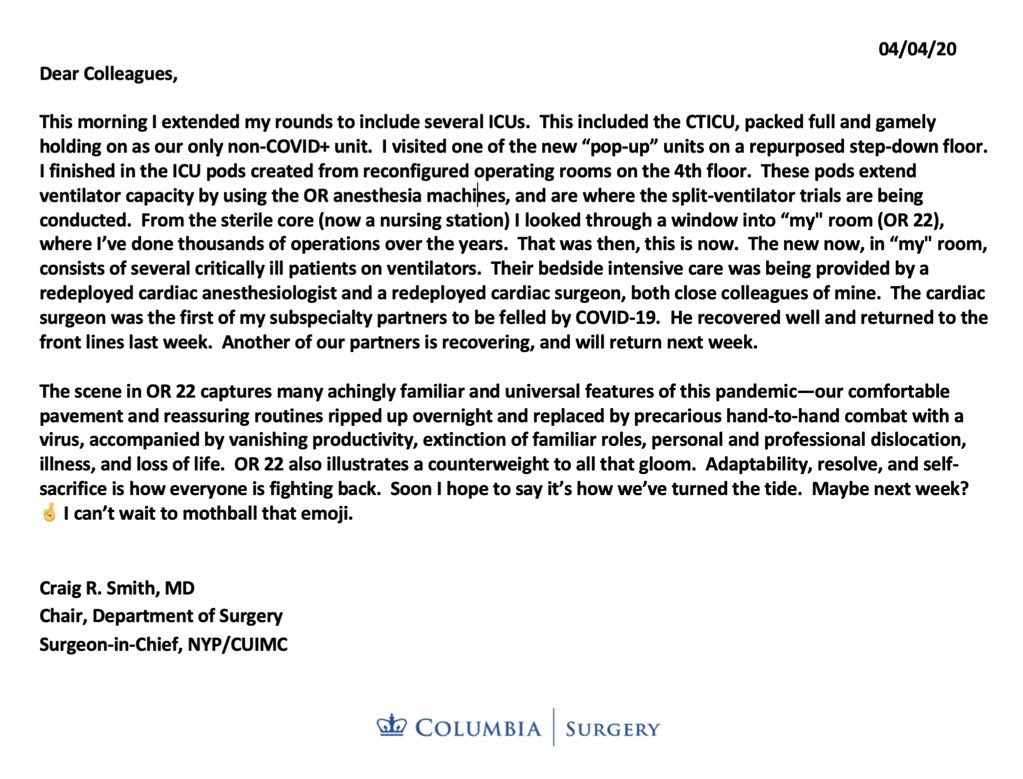
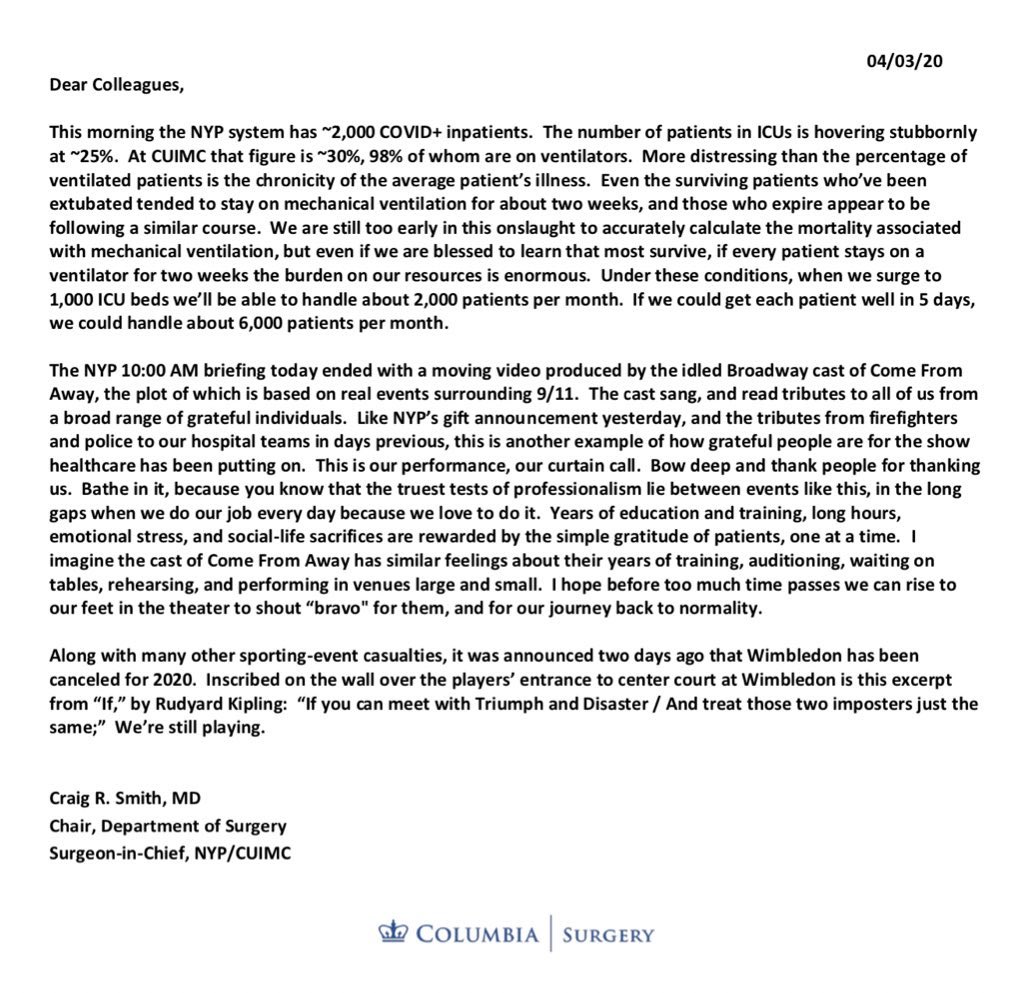
Chief of Surgery at Columbia Reports re NYP/CUIMC


I've  been on a gurney in the cardiac catheterization labs at Columbia Presbyterian (CUIMC) on Ft. Washington Avenue.  As a patient there since 1994 I know how the teams work together  in normal times.  Without them I would not be here. But COVID19 has penetrated their ranks and filled their wards.  These are not normal times.  Triage tents fill the sidewalk on Broadway at 168 Street - assessing new arrivals fitness for admission via the ER.  Almost none of the usual business goes on as they fight to save the lives of 2,000 corona virus19 patients struggling inside to breathe.  500 are on ventilators.  Donald Trump and his contemptible son in law say Governor Andrew Cuomo has asked for too many.  He's been promised 1,000 from China.  Not enough.  
Meanwhile at the hospital whose tag line is "amazing things are happening here" ventilators meant for one patient are being jury rigged for two.  Amazing. 
@ColumbiaSurgeryChief of Surgery Craig R. Smith, MD reports on Friday April 3 and Saturday April 4.  His daily reports are below. - gwc


Image

Image

Saturday, April 4, 2020

Inspector General Michael Horowitz Slams Trump | Law & Crime

Inspector General Michael Horowitz Slams Trump | Law & Crime

Coronavirus in Brooklyn: An I.C.U. Fights for Each Life - The New York Times

There's no point in excerpting the highlights.  Just read this.  Heroes and heroines.
Coronavirus in Brooklyn: An I.C.U. Fights for Each Life - The New York Times
Sheri Fink is a correspondent in the investigative unit. She won the 2010 Pulitzer Prize for Investigative Reporting and shared the 2015 Pulitzer Prize for International Reporting. She received her M.D. and Ph.D. from Stanford University.

Thursday, April 2, 2020

Supreme People’s Court’s 2020 judicial interpretation agenda | Supreme People's Court Monitor

Screenshot 2020-04-02 at 2.21.48 PM
China's Supreme People's Court is an administrative agency.  Ultimately answerable to the National People's Congress - the legislature.  It carries out many functions - it writes the rules, instructs, guides, and decides cases it deems important or constitutionally mandated (e.g. capital cases).  An important function is "Interpretations".  These often are detailed instructions to courts on how to apply more general provisions - such as for the trial of traffic accident cases, environmental protections cases, and torts arising from network abuses such as trademark violations.  There is plenty of substantive comment in the court's instructions about burden of proof, etc.
But unlike the NPC the court does not proceed by Notice and Comment.  The legislature not only posts its agenda far in advance, but also posts draft law for public comment.  The SPC however, does not proceed in that way.  So this announcement of the agenda for the coming year or more is a step forward in the transparency department.
The topics include the relationship between existing laws and the presumably overriding general Civil Code being enacted piece by piece.  Thus: 31. Interpretation of Several Issues Related to the Application of the “P.R.C. Civil Code” , and 38. Work on Cleaning up Judicial Interpretations Related to Civil Code.
- GWC
Supreme People’s Court’s 2020 judicial interpretation agenda | Supreme People's Court Monitor
by Susan Finder
On 17 March 2020, the Supreme People’s Court (SPC)’s General Office issued a document setting out a list of 49 judicial interpretation projects for which the SPC judicial committee gave project approval. This document sets out the responsibilities of various divisions and offices of the Supreme People’s Court (SPC) in undertaking an important part of the SPC’s work, promulgating judicial interpretations for 2020. As discussed in two blogposts in 2018 and two blogposts in 2019, the SPC has a yearly plan for drafting judicial interpretations, as set out in its 2007 regulations on judicial interpretation work. The plan is analogous to the legislative plans of the National People’s Congress (NPC) and its Standing Committee.

Judicial interpretations are binding on the SPC itself and the lower courts, and fill in some of the interstices of Chinese law (further explained here). One of my articles in the production pipeline provides more details about the drafting process in one area of law. It is one of the more controversial powers of the SPC, where the gap between the views of the academics, lawyers and those inside the system is particularly large. I have my views on it as well, but that is a topic for another day and perhaps another article.

“Project approval” is an initial procedure used by regulatory authorities of all types, Party and state, to approve projects. For the SPC, it reflects one of the “planned economy” aspects of the way it operates. This is the third year that the SPC has made this list public, and it is a concrete step forward in increasing the SPC’s transparency. I’m grateful to Chinalawtranslate.com for translating the list so quickly. Of those projects, 38 with an end of 2020 deadline and 11 have a deadline set for the first half of 2021. Some brief comments (some longer than others) follow below. Please see my previous blogposts commenting on the 2018 and 2019 agendas. Mark Cohen of Berkeley Law School (and Chinaipr.com) has already commented on the projects in the area of intellectual property law, so for those I will link to his comments.

As I commented previously, close observation reveals that some interpretations were listed previously, indicating that drafts were not ready for approval last year. Some of the reasons for slippage are likely to be:
the issues turn out to be more complicated than anticipated (substantively, procedurally or institutionally);
judges have less time to work on judicial interpretation drafting, with an increased caseload and document study;
many experienced SPC judges have been dispatched to circuit courts, leaving fewer at headquarters to work on judicial interpretations; and
timing may also be a factor. The SPC wants judicial interpretations to be in place for some time, and if the greater environment is not conducive for issuing the interpretation, or additional issues are seen, it will be postponed.

If an SPC division or office is listed as responsible, it means it is on its work agenda for that year. (I surmise) the head (or heads) of the related responsible divisions or offices need to provide an explanation for slippage.
Type 1 (to be completed before the end of 2020)

1. Interpretation of Several Issues on the Application of Law in Cases of Pre-trial Preservation of Assets. Responsibility: Case Filing Division. The deadline for this has been postponed for several years in a row.

Tuesday, March 31, 2020

Texas Federal Court Blocks Restrictions on “Non-Essential” Abortion Procedures, Texas Asks Fifth Circuit to Reverse – Reason.com

Texas has asked the United States Court of Appeals for the Fifth Circuit to stay the order.
I don't know the makeup of the Fifth Circuit.  But the prospects at the Supreme Court would appear to be grim. - gwc
Texas Federal Court Blocks Restrictions on “Non-Essential” Abortion Procedures, Texas Asks Fifth Circuit to Reverse – Reason.com
post by Eugene Volokh
Josh Blackman links to the briefs; here is the heart of Judge Lee Yeakel's decision blocking the restrictions:
[T]he court finds that Plaintiffs have established a substantial likelihood of success on the merits of their claim that the Executive Order, as interpreted by the attorney general, violates Plaintiffs' patients' Fourteenth Amendment rights, which derive from the Bill of Rights, by effectively banning all abortions before viability. See Planned Parenthood v. Casey505 U.S. 833, 848-49 (1992). The Due Process Clause of the Fourteenth Amendment to the United States Constitution protects a woman's right to choose abortion, Roe vWade, 410 U.S. 113, 153-54 (1973), and before fetal viability outside the womb, a state has no interest sufficient to justify an outright ban on abortions. Roe, 410 U.S. at 163-65; see also Casey, 505 U.S. at 846, 871 (1992) (reaffirming Roe's "central principle" that "[b]efore viability, the State's interests are not strong enough to support a prohibition of abortion").
Under the attorney general's interpretation, the Executive Order either bans all non­-emergency abortions in Texas or bans all non-emergency abortions in Texas starting at 10 weeks of pregnancy, and even earlier among patients for whom medication abortion is not appropriate. Either interpretation amounts to a previability ban which contravenes Supreme Court precedent, including RoePreviability abortion bans are "unconstitutional under Supreme Court precedent without resort to the undue burden balancing test." States "may regulate abortion procedures prior to viability so long as they do not impose an undue burden on the woman's right, but they may not ban abortions."
The State Defendants well describe the emergency facing this country at the present time. They do not overstate when they say, "Texas faces it worst public health emergency in over a century." The Executive Order, as written, does not exceed the governor's power to deal with the emergency. But the attorney general's interpretation of that order constitutes the threat of criminal penalties against those whose interpretation differs. Yes, the attorney general is not the enforcer of those penalties, but many of those who are charged with enforcement are named as defendants in this action. The court takes notice that the opinion or notion of the attorney general as to the breadth of a law, even if expressed informally, carries great weight with those who must enforce it.
Regarding a woman's right to a pre-fetal-viability abortion, the Supreme Court has spoken clearly. There can be no outright ban on such a procedure. This court will not speculate on whether the Supreme Court included a silent "except-in-a-national-emergency clause" in its previous writings on the issue. Only the Supreme Court may restrict the breadth of its rulings. The court will not predict what the Supreme Court will do if this case reaches that Court. For now, the State Defendants, and perhaps the others, agree that the Executive Order bans all pre-fetal-viability abortions. This is inconsistent with Supreme Court precedent. Plaintiffs have demonstrated a strong likelihood of success on the merits of their action.
For my post from Wednesday (feels like months ago) on this subject, see here.