Monday, November 13, 2023

The Constitution of American Colonialism by MAGGIE BLACKHAWK - Harvard Law Review


 From grammar school til our last days we are immersed in the fiction  of federalism - the founding myth of thirteen colonies that fought for freedom, joined together and built an Empire of Liberty, in  Thomas Jefferson's  illusory phrase.

But like many such self serving tales it requires a long list of concepts to conceal what is plain:  conquest, colonialism, and empire plainly fit once the curtain is lifted on the founding fiction.  NYU Native American (Fond du Lac Band of Lake Superior Ojibwe) law professor Maggie Blackhawk has been honored by publication of her groundbreaking, myth dismantling study in the October issue of the Harvard Law Review.

- GWC 

November 13, 2023

The Constitution of American Colonialism 

By MAGGIE BLACKHAWK Harvard Law Review

For my part I am not prepared for citizenship in the United States. I do not want it. . . . It takes greed of gain to make a successful citizen of the United States.

— Walter Adair Duncan, father of the Cherokee social welfare system, in Statehood (1893)1

Thus far [I’ve written] of the dependencies whose population is in a sufficiently advanced state to be fitted for representative government; but there are others which have not attained that state, and which . . . must be governed by the dominant country . . . .

— John Stuart Mill in Considerations on Representative Government (1861)2

Introduction


The United States holds hundreds of governments in subordination. Not historically. Today. It dominates these governments and their peoples, exploits their resources, prohibits political independence, withholds representation, and imposes its own laws, values, and norms upon these governments without consent. Mere decades ago, the United States forcefully sterilized citizens of these nations3 and removed a quarter or more of Native children from their families.4 


At the same time, the Supreme Court stripped these governments of the ability to police crimes in their own communities,5 unleashing widespread sexual violence and leaving more than one in three Native women vulnerable to rape.6 Just over a hundred years ago, the United States invaded these nations and held them under decades of martial law before unilaterally appointing civil governments.7 It ran detention camps on the lands of these governments8 and forced their children into boarding schools that promised to “[k]ill the Indian in [them], and save the man.”9 Federal agents beat Native children in such schools for speaking Native languages,10 held them in unsanitary conditions,11 and forced them into manual and dangerous forms of labor.12 Thousands died.13 


Federal law also criminalized political and spiritual practices14 and outlawed traditional marriage and family structures.15 In the last two hundred years, the United States has engaged in campaigns of mass execution16 and slaughter against citizens of these governments to a level that many have called genocide.17


But we do not consider these problems to be problems of constitutionalism. We do not invoke this history when considering questions of good governance, citizenship, representation, the ideal design of our governing institutions, or the best distribution of power across the national government and within “our federalism.” Constitutional scholars rarely discuss the problem of American colonialism at all. We lack the very language to confront these problems in a constitutional register. Our common parlance of rights, equality, and integration fails us. Our antisubordination discourse runs out. The limits of our constitutional language are seemingly the limits of our world.18


Instead, we call the component parts of American colonialism sui generis.19 We banish each to its silo. The United States did not engage in a structured and mass campaign to remove, detain, assimilate, and destroy these governments and their peoples in the name of “civilization.” Rather, we have federal Indian law;20 the law of the territories;21 foreign relations law;22 treaty law;23 the war powers;24 and the laws of naturalization, immigration, and citizenship.25 We have the puzzle of Puerto Rico,26 the fascinating but marginalized question of Native nations,27 and the forgotten history and ongoing struggles of the state of Hawai‘i.

28 

All of these puzzles are seen as so illogical and alien as to withstand theorization, defy understanding, and refuse any common logic. Rather than engage with questions born of American colonialism, we have instead declared these puzzles as beyond our constitutional theory and left them to the “plenary power” of the political branches to solve.29

Yet, these colonized nations and peoples have lived on and continue to shape the government, the Constitution, and the empire we live with today.

KEEP READING

Proper Parties, Proper Relief - Baude and Bray // Harvard Law Review


Proper Parties, Proper Relief


DOWNLOAD

Introduction

In the last Term at the United States Supreme Court, standing was the critical question in several major cases: the two challenges to the Biden Administration’s first student loan forgiveness plan, Biden v. Nebraska1 and Department of Education v. Brown,2 as well as the challenge to the Administration’s immigration priorities in United States v. Texas3 and the race-discrimination challenge to the Indian Child Welfare Act in Haaland v. Brackeen.4 Standing has featured heavily in journalistic coverage of the decision in 303 Creative LLC v. Elenis.5 And standing may have been the reason for the Court’s stay of a lower court decision about the legality of the abortion drug mifepristone.6

The centrality of standing doctrine in contemporary U.S. law has many sources. One is procedural fusion, with the consequent loss of law and equity’s distinctive formal structures.7 Another is a gradual shift over the twentieth century: from having public law questions answered defensively, when the law was being enforced against someone; to having such questions answered offensively, via suits for injunctions and declaratory judgments. Yet another is the shift beginning in the 1970s toward expansive preenforcement review of agency rules. Still other reasons standing has become more central are doctrinal developments of the 1970s, not all of which have survived on their own: easy implication of statutory causes of action, the shift to enforcing public law rights primarily through injunctions rather than damages, and the growth of structural injunctions. All of these developments from the twentieth century put greater pressure on standing doctrine, as courts increasingly came to use it as a filter for the cases to be decided.

But one more source is especially important for the centrality of standing in the twenty-first century: the role of states as litigants against the federal government.8 There is an institutional side to the story, including a dramatic infusion of resources and expertise into the offices of state solicitors general. And there is a doctrinal side, especially the Supreme Court’s decision in Massachusetts v. EPA.9 In that case, a narrow majority of the Court read state standing broadly, saying states were to be given “special solicitude in our standing analysis.”10 The consequences have been predictable. In just the last decade and a half, states have come to dominate the public law scene. States — often large coalitions of states, all represented by attorneys general from the opposite political party of the President — now file suits challenging any important action taken by the executive branch.

The last decade and a half is not normal. Measured by the yardstick of the first two centuries of constitutional cases, it is not typical for so many of our major public law cases to have names like United States v. Texas and Biden v. Nebraska. The landmark decisions of our history, cases like Dred Scott v. Sandford and Youngstown Sheet & Tube Co. v. Sawyer, have not typically had state plaintiffs. If those cases had been decided in the twenty-first century, they might have been called Massachusetts v. Buchanan and Ohio v. Truman.

Although the new state standing has transformed the federal courts and reshaped their relationship to the executive branch, these transformations might prove temporary. This past Term at the Supreme Court saw what seems to be a deliberate turn by the Justices away from expansive conceptions of state standing. But it remains unclear whether the Court grasps the larger purpose of having a doctrine of standing, and whether it internalizes that purpose or treats standing doctrine as a box to be checked.

KEEP READING

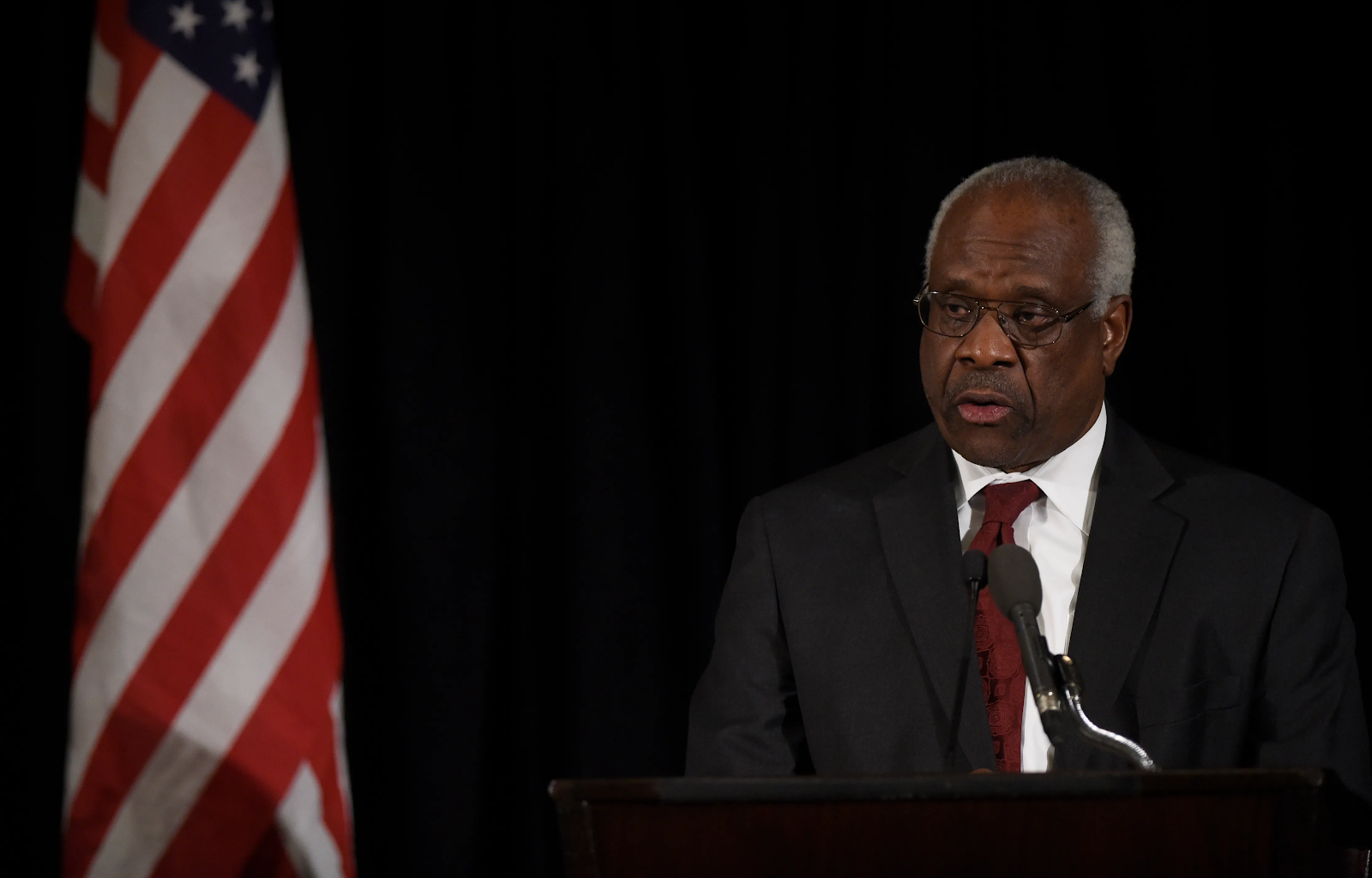
Supreme Court Adopts First Code of Judicial Conduct for Itself

Reports of undisclosed luxury travel and personal 
benefits by billionaire Harlan Crowe to Justice Clarence Thomas have built pressure on the high court to adopt an ethics code for itself


 In a notable development, spurred by reports of personal favors and luxury travel funded by wealthy benefactors, the United States Supreme Court, for the first time since the passage of the Judiciary Act of 1789,  has adopted a Code of Conduct governing its own members.   The new code closely resembles that of the Code of Conduct for United States Judges.  But contrary to the maxim that noone should be a judge in their own cause no procedure has been adopted for enforcement of the new Code. That is unlike the states, each of which has an established procedure for enforcing judicial discipline .

Like other judges of the federal courts the Justices have Constitutional grants of life tenure and their salaries may not be reduced during their tenure.  They may be removed only by impeachment for high crimes and misdemeanors.  Impeachment requires a majority vote of the House of Representatives, and conviction a 2/3 vote of the United States Senate. The Supreme Court today announced no procedure for enforcing their newly embraced Code.  In 1980 Congress passed the Judicial Conduct and Disability Act.  which allows complaints alleging that a federal judge has engaged in “conduct prejudicial to the effective and expeditious administration of the business of the courts” or has become, by reason of a temporary or permanent condition, “unable to discharge the duties” of the judicial office.

In 2019 the Judicial Conference  established a procedure for complaints about judicial conduct or disability.  The disciplinary system relies on referral of complaints to the Chief Judge of a court.  There is no distinct, staffed adjudicative body for disciplinary complaints against United States Judges who are protected by the Article III Constitutional grant of life tenure and irreducible compensation.

A workable procedure would be like that of New Jersey which temporarily assigns the senior judge of the Appellate Division of Superior Court when there is a vacancy on the State's highest court.  Such a procedure in federal court would presumably require legislation since a Circuit Court judge moving to the Supreme Court is nominated by the President and confirmed by the Senate.

- GWC

November 13, 2023


Harvard Law Review FOREWORD: THE CONSTITUTION OF AMERICAN COLONIALISM Maggie Blackhawk∗


One of the most prestigious opportunities in legal academe is to write the foreword to the Harvard law Reviews issue on the previous years term of the United States Supreme Court.

This year NYU Law Professor Maggie Blackhawk earned that place with her groundbreaking, exhaustive critique of the treatment in law of the indigenous peoples of what is now the United States of America.

- GWC

THE SUPREME COURT 2022 TERM FOREWORD: THE CONSTITUTION OF AMERICAN COLONIALISM Maggie Blackhawk∗ 

For my part I am not prepared for citizenship in the United States. I do not want it. . . . It takes greed of gain to make a successful citizen of the United States. — Walter Adair Duncan, father of the Cherokee social welfare system, in Statehood (1893)1 

Thus far [I’ve written] of the dependencies whose population is in a sufficiently advanced state to be fitted for representative government; but there are others which have not attained that state, and which . . . must be governed by the dominant country . . . . — John Stuart Mill in Considerations on Representative Government (1861) 2

INTRODUCTION The United States holds hundreds of governments in subordination. Not historically. Today. 

Friday, November 10, 2023

Shugerman on Jarkesy - Jury trial right on shaky originalist ground - Amicus SSRN


Amicus Brief in SEC v. Jarkesy on Original Public Meaning of Article II & Presidential Removal

43 Pages Posted: 25 Sep 2023

Jed H. Shugerman

Boston University School of Law

Date Written: September 5, 2023

Abstract

In holding that the SEC’s administrative law judges’ protections against removal were unconstitutional, the Fifth Circuit extended Free Enterprise Fund v. PCAOB, 561 U.S. 447 (2010), and Seila Law LLC v. CFPB, 140 S. Ct. 2183 (2020). Those precedents were based on an incomplete historical record. Subsequent historical research shows that the Founding generation never understood Article II to grant the President an indefeasible removal power.

To be sure, this evidence does not suggest Congress should have unlimited power to protect any executive office or delegate removal to itself. Rather, the bottom line is that the evidence of original public meaning is so unclear and mixed that this Court has no sufficient originalist basis to overturn long-standing congressional statutes. While the SEC’s arguments are sufficient to reverse the Fifth Circuit’s ruling without reconsidering this Court’s prior precedents on removal, it should consider doing so in light of the historical evidence.

First, this brief presents new research showing that the Executive Vesting Clause did not imply a removal power, because “executive power” did not imply removal in the eighteenth century. The English common law protected many offices as freehold property rights, meaning that the officers could not be removed without legal process and except in cases of misconduct. Many powerful British executive offices, especially in the Treasury and even in the royal cabinet, were unremovable in the eighteenth century. English and colonial administration was a hybrid of removable patronage offices and unremovable freehold offices. These protections have not been examined in the Court’s previous opinions about removal. This background explains why no English sources described removal as a royal prerogative, and why it has been so hard for unitary theorists to find any English or Ratification-era sources discussing removal as an “executive power.” It also explains why Montesquieu’s The Spirit of the Laws rejected removal at pleasure as “despotic,” and why Chief Justice Marshall concluded that William Marbury’s office was his unremovable property.

Second, this brief summarizes other new research on Article II, the law of offices, the Ratification Debates, and the First Congress, also undercutting the assumptions about presidential removal.

Third, at the broadest level, this case is a test for whether originalism is a reliable method in practice. Leading unitary executive scholars have tried to reconstruct their removal theories in response to this new evidence, but their theories contradict each other, are internally contradictory, introduce new errors, and repeat many old errors and misunderstandings without addressing the core critiques. These weak responses indicate that little evidence supports their claims about removal. The Founding era left the removal question unresolved. If this Court is committed to originalism as a check against judges voting their personal preference, it should conclude that the evidence is insufficient to overturn long-standing statutes.

Sunday, November 5, 2023

Trump faces cross examination after being twice held in contempt, and his lawyers reprimanded


UPDATE: APPELLATE DIVISION UPHOLDS TRUMP GAG ORDER IN NY FRAUD CASE November 30.2023

Former President Trump faces cross examination today in the New York civil fraud case against him and his companies after being twice held in contempt, and his lawyers reprimanded.

NY CPLR § 5104 (2022)

§ 5104. Enforcement of judgment or order by contempt. Any interlocutory or final judgment or order, or any part thereof, not enforceable under either article fifty-two or section 5102 may be enforced by serving a certified copy of the judgment or order upon the party or other person required thereby or by law to obey it and, if he refuses or wilfully neglects to obey it, by punishing him for a contempt of the court.

Donald J. Trump will begin testimony today in the sanctions phase of the civil fraud case presented by New York Attorney General Letitia James.  The trial judge  Arthur F. Engoron has already held Trump liable on summary judgment for fraudulent statements regarding his assets - which were relied on by investors and lenders in his properties.

Soon after the non-jury trial began - to determine what sanctions should be imposed for the frauds Trump and his companies committed - the former President made personal attacks on the justice's Principal Law Clerk.  In the New York Judiciary Principal Law Clerk is a career position to provide legal research and opinion drafting services for judges.  It is a confidential position, filled by a lawyer personally appointed by the judge.

The judge recites the history of Trump, Sr.'s misconduct

On October 3, 2023, after Defendant Donald J. Trump posted to his social media account an untrue, disparaging, and personally identifying post about my Principal Law Clerk, I imposed on all parties to this action a very limited gag order, "forbidding all parties from posting, emailing, or speaking publicly about any members of my staff," emphasizing, quite clearly, that "personal attacks on members of my court staff are unacceptable, inappropriate, and I will not tolerate them under any circumstances." I further made clear that "failure to abide by this directive will result in serious sanctions." (emphasis original)


When for seventeen days  Trump did not remove that statements from his campaign website the judge imposed a $5,000 sanction for contempt.  A minor sanction like that did not entitle the contemnor to a jury trial, nor were there any factual disputes that would require a neutral fact-finder.  Undeterred Trump further violated the order which is designed to preserve the dignity of the court and to secure the safety of court personnel:

On October 25, 2023, after conducting a brief hearing, I concluded that Donald J. Trump had intentionally violated my gag order by stating to a gaggle of reporters outside the courtroom the following statement in reference to my Principal Law Clerk: "This judge is a very partisan judge with a person who's very partisan sitting alongside him, perhaps even more partisan than he is," and fined him an additional $10,000.00. I imposed the gag order only upon the parties, operating under the assumption that such a gag order would be unnecessary upon the attorneys, who are officers of the Court.

Lawyers are expected, as Comment [2] of the Preamble to the ABA Rules of Professional Conduct notes

As advisor, a lawyer provides a client with an informed understanding of the client's legal rights and obligations and explains their practical implications. As advocate, a lawyer zealously asserts the client's position under the rules of the adversary system.

But Trump's lawyers, apparently copying the manner of their client for whom bombast is characteristic, themselves engaged in similar conduct.  On Friday, November 3 Justice Engoron explained:

I imposed the gag order only upon the parties, operating under the assumption that such a gag order would be unnecessary upon the attorneys, who are officers of the Court.

[But]] Over the past week, defendants ' principal attorneys, namely, Christopher Kise (admitted pro hac vice) (Continental PLLC), Clifford Robert (Robert & Robert PLLC) and Alina Habba (Habba Madaio & Associates LLP), have made, on the record, repeated, inappropriate remarks about my principal Law Clerk, falsely accusing her of bias against them and of improperly influencing the ongoing bench trial. Defendants' attorneys have made long speeches alleging that it is improper for a judge to consult with a law clerk during ongoing proceedings, and that the passing of notes rom a judge to a law clerk, or vice-versa, constitutes an improper "appearance of impropriety" in this case. These arguments have no basis.

Pursuant to 22 NYCRR § 100.3(B)(6)(6)(c): "A judge may consult with court personnel whose function is to aid the judge in carrying out the judge's adjudicative responsibilities or with other judges" ( emphasis added). This is precisely the role of a Principal Law Clerk in the New York State Courts.

The judge further cited  New York Judicial Ethics  Opinion 07-04 which explains that "The relationship between a judge and his/her law clerk is one of particular trust and confidence. Although a judge and his/her law clerk are of course not “partners,” the two engage in the kind of professional interchange that might be found between long-time colleagues in a law firm."

Noting that the `gag order does not apply to remarks about him, the judge explained his concerns:

The threat of, and actual, violence resulting from heated political rhetoric is well-documented. Since the commencement of this bench trial, my chambers have been inundated with hundreds of harassing and threatening phone calls, voicemails, emails, letters, and packages. The First Amendment right of defendants and their attorneys to comment on my staff is far and away outweighed by the need to protect them from threats and physical harm

Gag order extended to Counsel

Thus, for the reasons stated herein, I hereby order that all counsel are prohibited from making any public statements, in or out of court, that refer to any confidential communications, in any form, between my staff and me.

Failure to abide by this directive shall result in serious sanctions.


 - GWC 

11/6//2023


Wednesday, November 1, 2023

LDAD Responds to Atty. Chesebro’s Guilty Plea with Supplemental Ethics Complaints – LDAD

LDAD Responds to Atty. Chesebro’s Guilty Plea with Supplemental Ethics Complaints – LDAD

PRESS RELEASE

Lawyers Defending American Democracy (LDAD) has again filed supplemental complaints against the attorney to former President Donald J. Trump, following Mr. Chesebro’s guilty plea in Fulton County Superior Court on October 20, 2023. 
 
As LDAD described to the state bar disciplinary authorities in both states, the conduct that Mr. Chesebro has now admitted – conspiracy to file a false election certificate – requires his disbarment under the law of both states, notwithstanding assertions by his defense counsel that he will be able to retain his law license.

The reasons that disbarment is appropriate differ in each state, and LDAD has provided a detailed analysis of the law in New York and California that supports disbarment.