Monday, June 5, 2023

The cult of the classic Boston Whalers - The Boston Globe


In 1958, in a garage in Braintree, an eccentric Harvard grad named Dick Fisher revolutionized nautical design when he began crafting a little boat that looked like a blue bathtub.

He called his creation a Boston Whaler, and the unusual shape of the hull was only half of the radical design. More important was what was inside of the hull, the result of a cutting-edge foam-and-fiberglass construction process that allowed Fisher to make an unbelievable claim. IT'S UNSNKABLE.

“They’re everywhere,” said Quentin Snediker, curator for watercraft at the Mystic Seaport Museum, which has one of Fisher’s original sawed-in-half boats in its collection. “They are the right combination of seaworthiness and fun, which continues to strike a chord.”

Today, the classic Whalers — built until roughly 1993, when the company was sold and then moved to Florida and pivoted to more traditionally hulled boats — remain prized for their nostalgia factor, but also their “affordability.”

Classic Whalers come in various sizes and models, including many that were steered standing up from a center console, a Whaler innovation. Today, they can usually be had for between $5,000 and $25,000. With many new center consoles retailing for well north of $100,000, those old Whalers remain the top recommendation for people looking to get into boating safely, without a lot of experience or deep pockets. In addition, the lightweight construction means they can be towed by the average car.

KEEP READING

Sunday, June 4, 2023

The False Equivalence Between The ‘Far Right’ And The ‘Hard Left’

The False Equivalence Between The ‘Far Right’ And The ‘Hard Left’

This article is part of TPM Cafe, TPM’s home for opinion and news analysis. 

Here’s how, in its lead story Thursday, the New York Times described the House’s vote to resolve Republicans’ self-imposed debt-ceiling crisis:

“With both far-right and hard-left lawmakers in revolt over the deal, it fell to a bipartisan coalition powered by Democrats to push the bill over the finish line, throwing their support behind the compromise in an effort to break the fiscal stalemate that had gripped Washington for weeks.”  

It’s not just the Times. This false equivalence between the two parties’ activist wings has been on display in press coverage throughout the debt-ceiling votes. Politico Playbook on Sunday described Congressional Progressive Caucus Chair Pramila Jayapal’s mixed reaction to the debt-ceiling compromise as indicating that the bill may have “a chance to win votes from some on the far left.” A Washington Post sub-headline that same day noted that “far-left and far-right corners of the House have criticized the compromise.”

These descriptions conjure a world in which the wing of the Republican Party defined by Reps. Marjorie Taylor Greene (R-GA), Matt Gaetz (R-FL), Elise Stefanik (R-NY), Chip Roy (R-AZ), Lauren Boebert (R-CO) and Paul Gosar (R-AZ) is somehow balanced out by the wing of the Democratic Party defined by Alexandria Ocasio-Cortez (D-NY), Jayapal, Jamie Raskin (D-MD), Greg Casar (D-TX), Cori Bush (D-MO) and Jamaal Bowman (D-NY).

This idea is, of course, farcical — both in terms of the vote on the debt-ceiling bill and our politics more generally. Yet whenever Congress is debating a high-profile piece of legislation, the media returns to the easy description of pressures exerted by the far-right and far-left, as if these are similar forces.

In the case of the debt-ceiling compromise, 46 House Democrats and 71 House Republicans voted “no” on the legislation.

Supreme Court term: William Rehnquist's anti-integration legacy is about to get worse.

Supreme Court term: William Rehnquist's anti-integration legacy is about to get worse.

Saturday, June 3, 2023

Supreme Court term: William Rehnquist's anti-integration legacy is about to get worse ///SLATE

Supreme Court term: William Rehnquist's anti-integration legacy is about to get worse.
By Dahlia Lithwick and Richard L. Hasen //SLATE

It was impossible to listen to oral arguments this past Supreme Court term without being struck by the way this court’s conservative supermajority views the 14th Amendment. According to these justices, the key Reconstruction-era amendment was intended merely to promote a theory of “color blindness”—in which race is simply ignored—not to actively lift Black people from a previously subjugated status following the end of slavery. Indeed, the newest justice, Ketanji Brown Jackson, made headlines at one of her first oral arguments after she took pains to debunk this historically dubious theory.

In that voting rights case, Allen v. Milligan, the first Black woman to hold a seat on the Supreme Court explained that the drafters of the amendment intended that its vision be applied “in a race-conscious way” so that freed former slaves “were actually brought equal to everyone else in the society.” She went on to urge, “That’s not a race-neutral or race-blind idea.”

Unfortunately, Jackson will likely be raising these points again—this time in dissent—as the Supreme Court is poised to end the term by using the “color-blind” formulation to gut affirmative action in higher education, weaken or decimate a key part of the Voting Rights Act, and erode long-standing tribal protections for Native American families and their children. When the court does so, it will be another belated victory for William H. Rehnquist.

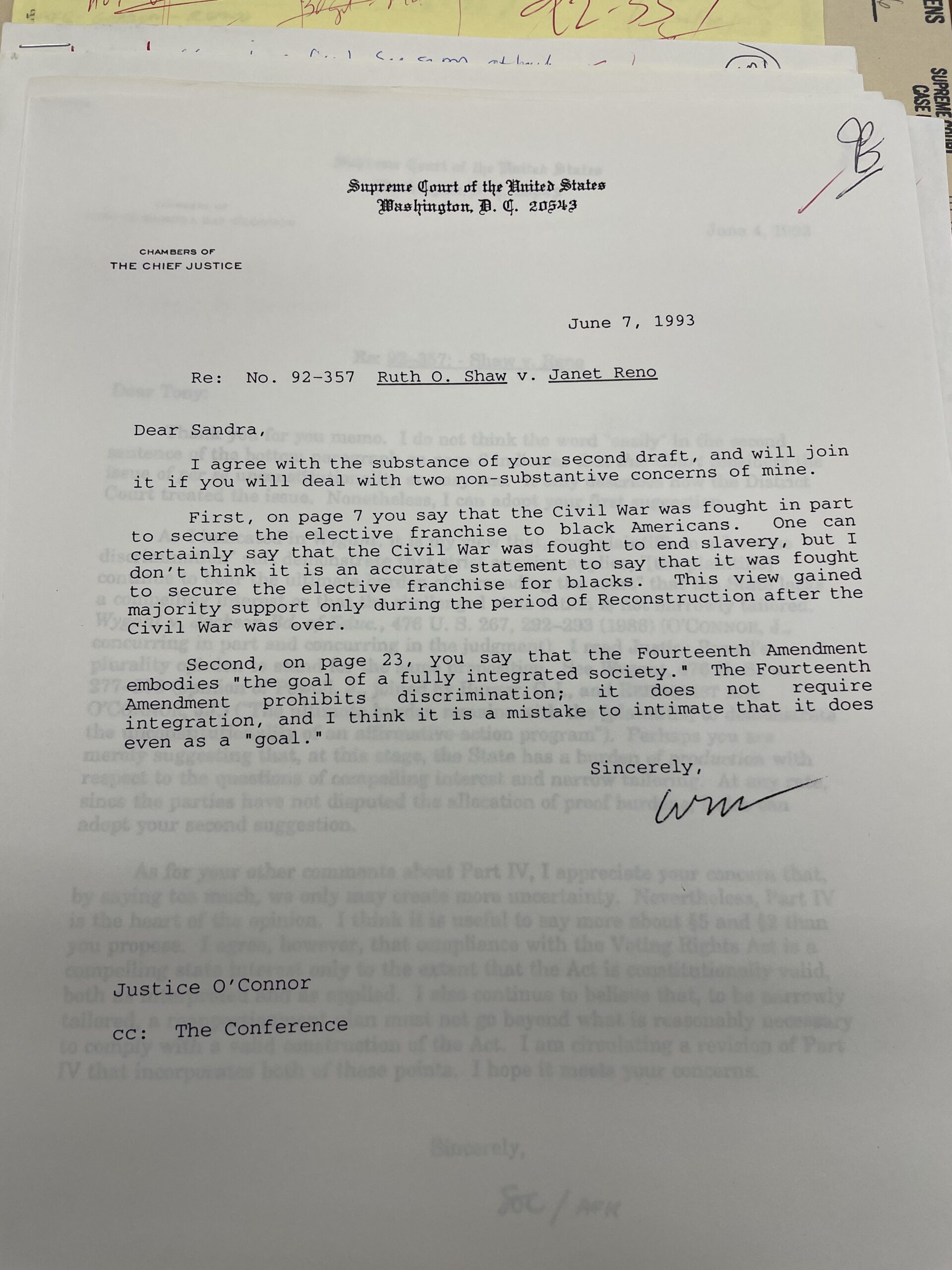
The late chief justice, who long sought to turn the 14th Amendment on its head, notoriously drafted a 1952 memo as a Supreme Court clerk that defended racial segregation in the South and the disastrous Plessy v. Ferguson decision on which the institution’s legality was based. Although Rehnquist denied during his confirmation hearings that the memo reflected his own views—saying they were meant to reflect those of Robert H. Jackson, the justice he was clerking for in 1952—a newly released court document, not previously reported, lays bare Rehnquist’s abhorrent true position on segregation as late as 1993.
That year, the then chief justice was still defending the logic of Plessy in no uncertain terms and using his position as a justice to block the court from acknowledging that the 14th Amendment barred segregation. “The Fourteenth Amendment prohibits discrimination; it does not require integration, and I think it is a mistake to intimate that it does even as a ‘goal,’ ” Rehnquist wrote in a memo to Justice Sandra Day O’Connor as part of an effort to have her remove a passage from an election decision. (For good measure, Rehnquist also requested that O’Connor remove a suggestion that the Civil War was fought in part to secure voting rights for Black people.)

KEEP READNG

Thursday, June 1, 2023

NPC Observer Monthly: May 2023 - by Changhao Wei

The National People's Congress (NPC)


NPC Observer Monthly: May 2023 - by Changhao Wei

Welcome to the first installment of NPC Observer Monthly, a monthly newsletter about China’s national legislature: the National People’s Congress (NPC) and its Standing Committee (NPCSC). Thank you for being one of our very first subscribers!

Each issue will start with “News of the Month,” a recap of major NPC-related events from the previous month, with links to any coverage we have published on our main site, NPC Observer. If, during that month, we have also written posts that aren’t tied to current events, I’ll then provide a round-up in “Non-News of the Month.” Finally, I may end an issue, as I did today’s, with some not-necessarily-polished musings on a NPC-related topic that is in some way connected to the past month.

This newsletter is very much a work in progress. If you have feedback on how we can improve this new service, or if there’s anything you’d like us to discuss in future issues, please don’t hesitate to reach out. And if you enjoyed this issue, I hope you’ll consider sharing it. —Changhao


News of the Month

On May 1, the revised Wild Animals Protection Law [野生动物保护法] (adopted on Dec. 30, 2022) took effect. This bill was put on the NPCSC’s legislative agenda soon after the initial COVID-19 outbreak as part of a coordinated effort to strengthen China’s public health legislation.

On May 25, the NPCSC concluded a month-long public consultation on a second draft of the Barrier-Free Environments Development Law [无障碍环境建设法]. This bill will likely pass in the next several months, and we’ll have more coverage then.

On May 19, the NPCSC released its annual plans on oversight and delegates work for 2023.

Oversight work: The NPCSC’s “oversight work” [监督工作] consists of both policy oversight (to monitor the general direction of administrative and judicial policymaking) and compliance oversight (to ensure implementation of binding legal obligations). The full NPCSC conducts oversight primarily by hearing and examining reports—what an annual oversight plan is mostly concerned with. It lists all the reports the NPCSC will hear throughout the year as well as the information each report must include. We plan to publish an explainer sorting the NPCSC’s various oversight reports in June.

21-1449 Glacier Northwest, Inc. v. Teamsters (06/01/2023)

The drivers at concrete producer Glacier Northwest went on strike, returring their trucks to Glacier loaded with cement.  To avoid damage to the trucks Glacier dumped the cement.  They sued the unoin for sploiaiton of Glacier's property - the cement in the trucks.  The Union asserts that it was acting lawfully when it struck and that the NLRB should determine that question.
But not according to eight members of the U.S. Supreme Court.  Only Justice Jackson dissented.  Even Justices Kagan and Sotomayor folded their cards on this latest step to dismantle a federal agency.
- GWC
21-1449 Glacier Northwest, Inc. v. Teamsters (06/01/2023)

Justice Ketanji-Brown, dissenting:
Congress’s passage of the NLRA “marked a fundamental change in the Nation’s labor policies.” Sears, Roebuck & Co. v. Carpenters, 436 U. S. 180, 190 (1978). Prior to that point, union activity had been viewed as “a species of ‘conspiracy,’” prompting substantial conflict between labor and management. Ibid. With the enactment of the NLRA in 1935, “Congress expressly recognized that collective organization of segments of the labor force into bargaining units capable of exercising economic power comparable to that possessed by employers may produce benefits for the entire economy in the form of higher wages, job security, and improved working conditions.” Ibid. The heart of the NLRA is §7, which safeguards workers’ rights “to self-organization, to form, join, or assist labor organizations, to bargain collectively through representatives of their own choosing, and to engage in other concerted activities for the purpose of collective bargaining or other mutual aid or protection.” 29 U. S. C. §157. Among the “‘concerted activities’” that the Act unquestionably protects is “the vital, economic instrumen[t] of the strike.” Garmon, 359 U. S., at 241; see §163.

Monday, May 29, 2023

NYPD’s Illegal Parking Needs to Be Curbed

NYPD’s Illegal Parking Needs to Be Curbed

Book Review: ‘Playing God,’ by Mary Jo McConahay - The New York Times


Mary Jo McConahay's new book has attracted support - such as this review by University of Nevada law and religion scholar Leslie Griffin.   Noah Feldman, is more skeptical of McConahay's critique of the conservative U.S. bishops.
- GWC
Book Review: ‘Playing God,’ by Mary Jo McConahay - The New York Times
By Noah Feldman
March 13, 2023
 

Just how conservative is the Catholic Church? So conservative that, when Pope Francis recently said that homosexuality is a sin but not a crime, observers (correctly) took that for progress. The connection between Catholicism and conservatism runs deep. It goes back to at least the Counter-Reformation, when the church had to defend the religious status quo in Christian Europe against Protestants’ radical criticisms of its priests, its hierarchy and its doctrines. In its day, the Catholic Church opposed the Enlightenment. It rejected freedom of conscience. Church teaching was for a long time extremely skeptical of democracy.

Indeed, it’s fair to say that the most profound and sustained conservative critique of liberalism comes from within the Catholic intellectual tradition. It’s no accident that the Supreme Court’s six conservative justices happen to have been raised Catholic. (One, Neil Gorsuch, was brought up in the church but now identifies as Episcopalian. One of the liberal justices, Sonia Sotomayor, is also Catholic.) When the Federalist Society set out to develop an elite cadre of legal conservatives, brilliant young Catholic lawyers were more inclined and prepared to follow in the footsteps of Justice Antonin Scalia than were, say, young evangelical Protestant lawyers.

The conservative nature of the Catholic Church has long posed a challenge for postwar American Catholic liberals. Today, politicians like Joe Biden (only the second Catholic president) and Nancy Pelosi insist on their Catholic faith while holding mainstream liberal political positions. These include on issues like abortion and gay marriage, where their perspective contradicts the church’s official teachings. In this, Biden and Pelosi are following a path trod by John Kerry, Mario Cuomo and even John F. Kennedy.

In her new book, “Playing God,” the journalist Mary Jo McConahay, herself a liberal Catholic, aims to show the extreme conservatism of a handful of American Catholic bishops and connect them, directly or indirectly, to the Trump-adjacent far right. The conservative bishops on whom she focuses are, it must be said, very conservative indeed. Bishop Joseph Strickland participated in a Stop the Steal rally on the National Mall on Dec. 12, 2020. At the same rally, which was organized by a Christian group called Jericho March, Archbishop Carlo Maria Viganò told the story of how God brought down the walls of the besieged city after the Israelites surrounded it. (Viganò, who is notorious for having called for Francis to resign, is not a U.S. bishop but an Italian-born priest who was Pope Benedict XVI’s nuncio to the United States.) Then there is Archbishop Salvatore Cordileone of San Francisco, who during the pandemic declined to wear a mask while saying Mass or distributing holy communion, and who rejected Pope Francis’ stance on Covid vaccines, telling a San Francisco Chronicle podcast in December 2021 that he had a strong immune system and that the vaccines approved by the government “are not really vaccines.”

Richard Revesz and His Agency Are Remaking the Pollution Fight - The New York Times

This headline is a sign of how marrow are the circles I in which I move, our high self-regard notwithstanding.
Richard Revesz, the Regulatory ReviewCzar - a position held a while back by Cass Sunstein - is a big name.  The immediate past director of the American Law Institute, to which I was inducted twenty years ago,  Dean of NYU Law School, he is providding oversight and guidance to the Biden-Harris administration as they confront a Supreme Court super-majority dedicated to dismantling the New Deal legacy - the administrative state.
Though there are exceptions - like Adrian Vermeule - the great bulk of conservatives are knee jerk enemies of anything that impinges on their anarchism they call libertarian.
- GWC
Richard Revesz and His Agency Are Remaking the Pollution Fight - The New York Times

Coral Davenport has been reporting from Washington on environmental regulations since the George W. Bush administration.


This spring the Biden administration proposed or implemented eight major environmental regulations, including the nation’s toughest climate rule, rolling out what experts say are the most ambitious limits on polluting industries by the government in a single season.

Piloting all of that is a man most Americans have never heard of, running an agency that is even less well known.

But Richard Revesz has begun to change the fundamental math that underpins federal regulations designed to protect human health and the environment. And those calculations could affect American life and the economy for years to come.

Mr. Revesz, 65, heads the obscure but powerful White House Office of Information and Regulatory Affairs, which is effectively the gatekeeper and final word on all new federal regulations. It has been known as the place where new rules proposed by government agencies, particularly environmental standards, go to die — or at least to be weakened or delayed.


ADVERTISEMEN

Saturday, May 27, 2023

Opinion | Neil Gorsuch Has Given Himself Away - The New York Times

In case you think that Neil Gorsuch - whose occasional apparent deviations are  attention getting - is some sort of democrat you should think again.  This is the Judge who complained bitterly at the chains of  notions such as deference to Federal agencies is owed by a judge. In the Kisor case he denounced such ideas as having created "systematic bias in favor of the federal government, the most powerful of parties, and against everyone else.” In fact, he said,   “overruling [the Auer deference doctrine] ” would take us “directly back to Skidmore [v. Swift & Co. 1944], liberating courts to decide cases based on their independent judgment and `follow [the] agency’s [view] only to the extent it is persuasive.”
As Christopher J. White has explained Justice Kagan's opinion for the Court narrows the principle - first articulated by Antonin Scalia - that if an agency regulation is ambiguous regulation the national courts should defer to the agency's effort to understand its meaning.
 t
Gorsuch has now outdone himself with a vociferousn denunciation of the policies pursued by the Centers for Disease Control to k
Jamelle Bouie | Neil Gorsuch Has Given Himself Away - The New York Times
By Jamelle Bouie

The justices of the Supreme Court aren’t always open about their views, but there are times when they inadvertently reveal just how skewed their perspectives are.

First, a little background. Last year the Biden administration announced it would end its predecessor’s pandemic-era policy of expelling asylum seekers at the Mexican and Canadian borders based on a federal law that gives the Centers for Disease Control and Prevention the power to bar entry into the United States in order to curtail the spread of infectious diseases. Title 42, as the policy came to be known, was supposedly established to protect the public. But by the time it came into effect, Covid-19 was already widespread, and there was no evidence of significant transmission by asylum seekers and other migrants. What was true is that President Donald Trump had devoted much of his time in office to dismantling the nation’s immigration system and limiting entry as much as possible from the southern border.

Several months after the administration announced its plan to end Title 42, a Federal District Court in Washington ruled that the policy was illegal and ordered the government to end it. A group of states with Republican attorneys general then sued to keep the policy in place, appealing their case to the Supreme Court. The dispute came to an end last week, when the Supreme Court remanded the case to a lower court with instructions to dismiss the motion as moot. The reason, presumably, is that the federal government had already ended the Covid-19 public health emergency. There was nothing to decide.

There was, however, something interesting about the court’s order in this case. Not content to let the instruction stand on its own, Justice Neil Gorsuch added a statement. He recounted the story of the Title 42 policy not to criticize the court’s decision but to emphasize what, in his view, was the defining aspect of the Covid-19 crisis.

Friday, May 26, 2023

Is Unpublished Unequal? Abbe Gluck et alii Cornell/Yale


if this message does not display correctly, click here

Tomorrow's Research Today

Follow SSRN:
 
LEGAL SCHOLARSHIP NETWORK: PUBLIC LAW & LEGAL THEORY PAPER SERIES
YALE LAW SCHOOL
Vol. 25, No. 2: May 26, 2023

REVA B. SIEGEL, EDITOR
Nicholas deB. Katzenbach Professor of Law, Yale University - Law School
reva.siegel@yale.edu

Browse ALL abstracts for this journal


"Is Unpublished Unequal? An Empirical Examination of the 87% Nonpublication Rate 

in Federal Appeals" Free Download
107 Cornell Law Review 1 (2022)
Yale Law School, Public Law Research Paper


ABBE R. GLUCKYale University - Law School
Email: abbe.gluck@yale.edu
JADE FORDYale University
RACHEL BROWNIndependent
SAHRULA KUBIEIndependent
KATRIN MARQUEZIndependent
BENNETT OSTDIEKYale University - Law School
Email: bennett.ostdiek@yale.edu

Federal judges resolved more than eighty-seven percent of appeals through unpublished opinions over the past five years. These dispositions are non-precedential and typically contain abbreviated reasoning. Such high rates of nonpublication may be difficult to reconcile with the core values of the federal judiciary—values grounded in precedent, reason-giving, and equal treatment. After intense attention to the prevalence of unpublished opinions some fifteen years ago, far less attention has been paid to the phenomenon in recent years. But a new debate is beginning to emerge.

This Article makes three contributions to the ongoing conversation. First, it brings hard data to the debate. Drawing on a dataset of over 400,000 appeals from the Federal Judicial Center and a sample of more than 1,400 unpublished opinions randomly selected from six federal circuits, this Article examines nonpublication rates across several dimensions, including case type, party type, and outcomes. For example, from 2008 to 2018, pro se, or as we will refer to them, self-represented, appellants were twelve times less likely to receive a published opinion than appellants represented by counsel. Appeals initiated by incarcerated people and immigrants also had publication rates significantly below the baseline for all appeals. In contrast, when the United States is the underlying plaintiff, opinions are published at a significantly higher-thanusual rate. These findings reveal a pattern of differential treatment that merits attention.

Second, we introduce an expanded theoretical framework for evaluating unpublished opinions. Rather than focusing on a single feature of these opinions (e.g., their nonprecedential status) we utilize a framework that highlights the dynamic tradeoffs involved in any system of publication and reveals that precedent, reason-giving, citation, and public dissemination—the primary features of judicial opinions implicated by nonpublication—combine to affect the legal system’s core values in complex, context-dependent, and sometimes offsetting ways.

Finally, an important takeaway from our piece relates to the serious transparency problems that pervade current nonpublication practices. Our work uncovered significant barriers to accessing and studying unpublished opinions on a large scale. These barriers make it difficult for scholars, the public, and even some judges to find these opinions, much less to study them and understand the effects of nonpublication on the judicial system and those who participate in it.