Friday, May 26, 2023

Garrison's Constitution | National Archives

Garrison's Constitution | National Archives

The Covenant with Death and How It Was Made
 

Winter 2000, Vol. 32, No. 4

By Paul Finkelman

© 2000 by Paul Finkelman
 

refer to caption

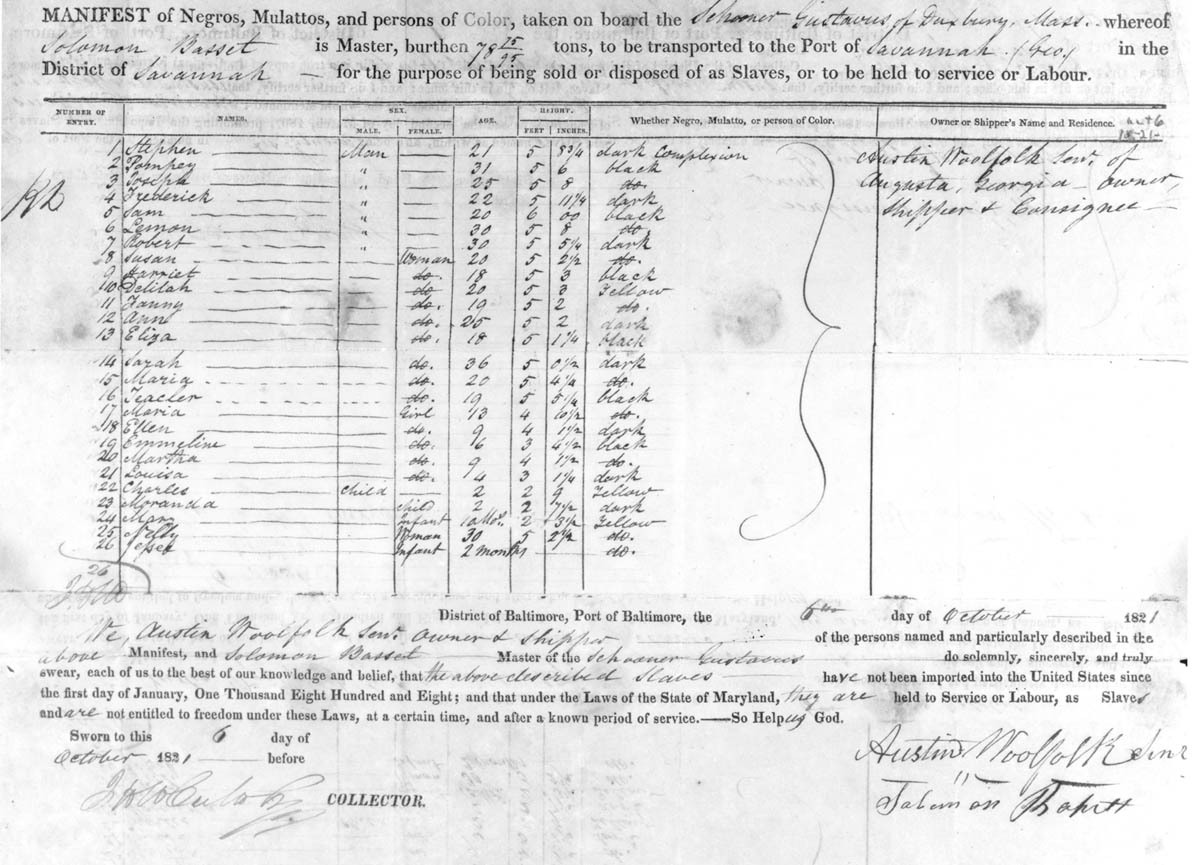
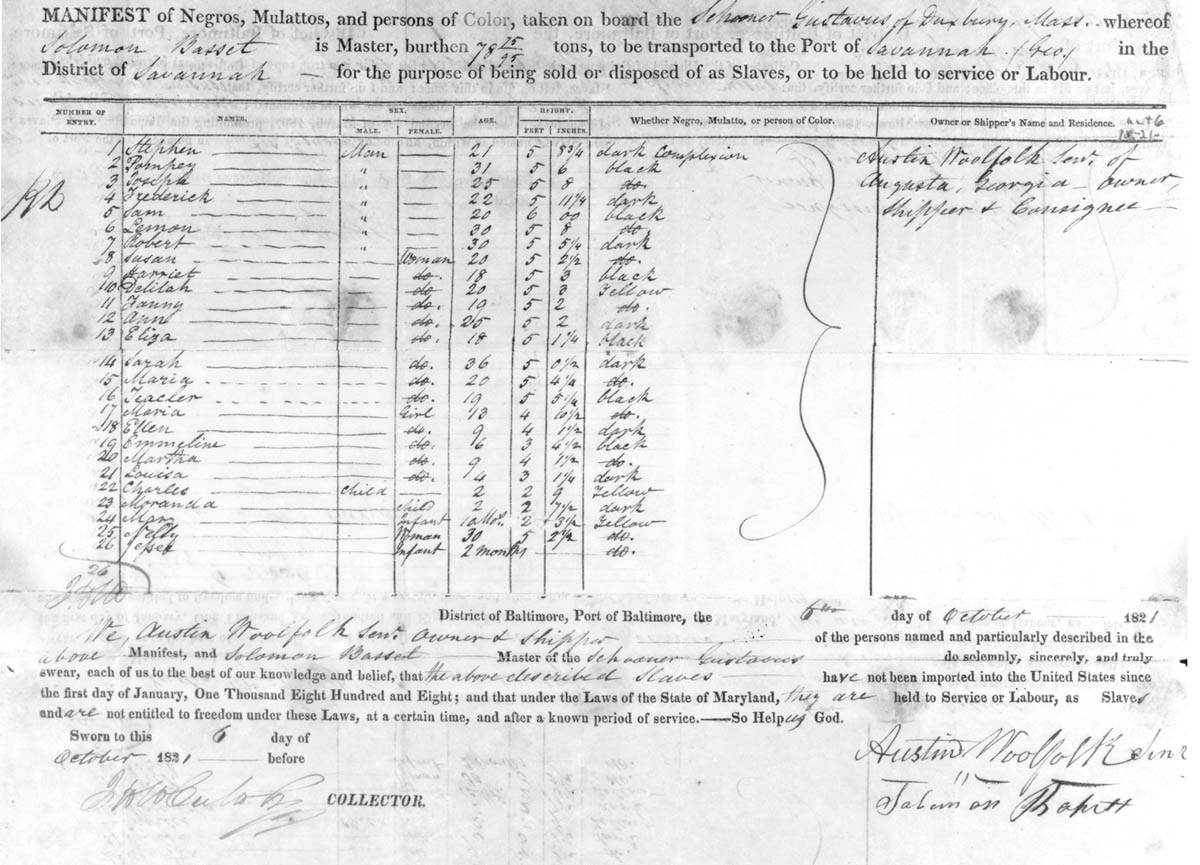
One of the compromises made by the Constitutional Convention was to close the African slave trade in 1808. This manifest from the schooner Gustavus shows the increased value of slaves in the domestic market after that date. (Records of the U.S. Customs Service, RG 36)

The abolitionist William Lloyd Garrison thought the U.S. Constitution was the result of a terrible bargain between freedom and slavery. Calling the Constitution a "covenant with death" and "an agreement with Hell," he refused to participate in American electoral politics because to do so meant supporting "the pro-slavery, war sanctioning Constitution of the United States." Instead, under the slogan "No Union with Slaveholders," the Garrisonians repeatedly argued for a dissolution of the Union.1

Part of Garrison's opposition to continuing the Union stemmed from a desire to avoid the corruption that came from participating in a government created by the proslavery Constitution. But this position was also at least theoretically pragmatic. The Garrisonians were convinced that the legal protection of slavery in the Constitution made political activity futile, while support for the Constitution merely strengthened the stranglehold slavery had on America. In 1845 Wendell Phillips pointed out that in the years since the adoption of the Constitution, Americans had witnessed "the slaves trebling in numbers—slaveholders monopolizing the offices and dictating the policy of the Government-prostituting the strength and influence of the Nation to the support of slavery here and elsewhere—trampling on the rights of the free States, and making the courts of the country their tools." Phillips argued that this experience proved "that it is impossible for free and slave States to unite on any terms, without all becoming partners in the guilt and responsible for the sin of slavery."2

The Garrisonians believed that if they worked within the political system they were merely spinning their wheels, spending their money and time on a cause that was doomed. The Constitution was proslavery, the national government was controlled by slaveowners, and politics was a waste of time. A quick look at the presidency underscored their view. From 1788 until 1860, only two opponents of slavery, John Adams and John Quincy Adams, held the nation's highest office, and for only a total of eight years. On the other hand, slaveowners held the office for fifty of these seventy-two years, and doughfaces-northern men with southern principles—like James Buchanan and Franklin Pierce—held it the rest of the time.

This did not surprise the Garrisonians, who understood that the Constitution was heavily influenced by slaveowners. The Garrisonians did not necessarily see the Constitution as the result of a deliberate conspiracy of evil men; rather, they understood it to be the consequence of political give-and-take at the Convention of 1787.

Thus, in The Constitution A Pro-Slavery Compact; or, Selections from the Madison Papers, Wendell Phillips analyzed "that 'compromise,' which was made between slavery and freedom, in 1787; granting to the slaveholder distinct privileges and protection for his slave property, in return for certain commercial concessions upon his part toward the North." Phillips argued that "the Nation at large were fully aware of this bargain at the time, and entered into it willingly and with open eyes."3 Phillips both exaggerated and understated the nature of the relationship between slavery and the Constitution. Certainly, some of those at the Convention "entered into" the bargain with great reservations, and many at the ratifying conventions may not have seen the full extent of the "bargain." On the other hand, the bargain involved more than commerce and slavery; it concerned the very creation of the Union itself. Both the text of the Constitution and the debates surrounding it help us understand that the "more perfect Union" created by this document was in fact fundamentally imperfect.

Slavery in the Constitutional Structure

Thursday, May 25, 2023

The Two Constitutions | David W. Blight | The New York Review of Books


I have long been inclined toward William Lloyd garrison''s attack on the (pre-civil war) Constitution as a" covenant with death and an agreement with Hell."  But David Blight presents James Oakes view as more nuanced. - GWC

Historians can and do change their minds about interpretations of events and the uses of evidence. We may be dead certain, or even mildly sure, about facts and the stories we tell about them, but our 

Historians can and do change their minds about interpretations of events and the uses of evidence. We may be dead certain, or even mildly sure, about facts and the stories we tell about them, but our craft requires us to remain open to new persuasions, new truths. James Oakes used to believe that the United States Constitution was essentially proslavery in its foundations, and that any attempt to breathe antislavery meaning into it was strained or rhetorical and not textually supported. But no more. In his remarkable and challenging book The Crooked Path to Abolition, he makes the case that there were effectively two constitutions written in Philadelphia that summer of 1787, one proslavery and one antislavery, which would be in conflict with each other for more than the next fourscore years.

Oakes, a distinguished professor of history at the CUNY Graduate Center, is not the only historian to have changed his view on this matter. In my first book, in 1989, I treated Frederick Douglass’s development of an antislavery interpretation of the Constitution as a slowly evolving perspective on his road to becoming a pragmatic political abolitionist and as a form of wish fulfillment in the absence of alternatives. I called his antislavery constitutionalism “dubious”—a search for political and moral ground on which he could stand to avoid embracing violent revolution by the 1850s. But I have come to see him as a deeply committed political thinker who argued his way, through what he called “careful study,” using legal and moral logic, to a vision of an antislavery Constitution. Guided by the natural rights tradition, Douglass found the core meaning of the American crisis. “Liberty and Slavery—opposite as Heaven and Hell,” he wrote in 1850, “are both in the Constitution.” What divided the nation was a Constitution “at war with itself.”

It has long been understood that without the compromises that were struck to bolster the interests of the slave states, there might have been no constitution achieved in 1787, and the thirteen original states might have careened off into regional coalitions at best. With the publication in 1840 of James Madison’s notes from the Constitutional Convention, more information emerged about pivotal crises and compromises in those famous debates. The notes fueled the endless arguments over the meaning and intent of the “founders,” a term that defies any unified definition, as Oakes argues. For instance, the notes record a dispute over a proposed tax on future slave imports, to which Roger Sherman of Connecticut fiercely objected “because it implied that they [slaves] were property.” Madison agreed and, in what may seem rather startling language for a Virginia slaveholder, declared it “wrong to admit in the Constitution the idea that there could be property in men.”


Wednesday, May 24, 2023

C.J. John Roberts, introduced by Elena Kagan, at the ALI 100th


Judge Henry Friendly, late of the Second Circuit, was the sort of guy whose biographer, David Dayen, showing no hint of embarrassment, sub-titled his book  Greatest Judge of His Era.  As former Dean of the law school in Cambridge , Massachusetts Elena Kagan's tribute to John Roberts on his receipt of the American Law Institute's highest honor - The Henry Friendly Award - fell short of Dayen's encomium.  But it's generosity is best understood as an example of two scorpions set in the same cage - lethal weapons barred by the rules - constrained by the need to work together for the foreseeable future.  The Chief Justice's acceptance speech is tolerably self-celebratory, for the `thank you for telling me I am a giant ' genre.

Austin Sarat, the eminent Amherst College writer on law, society and religion, takes  a critical view here at Justia.

Video below.

- GWC

https://t.co/LwmzyQ8lpd

Sunday, May 21, 2023

'Playing God' traces the history of Catholic conservatism gone extreme | National Catholic Reporter

Archbishops Cordileone and Vigano, Leonard Leo, Steve Bannon, 
Justice Clarence Thomas


'Playing God' traces the history of Catholic conservatism gone extreme | National Catholic Reporter
By Tom Roberts ///National Catholic Reporter

A disturbing symbiosis exists between the disruptive, norm-trashing far right in our national politics and a similar force that has become prominent within the Catholic hierarchy in the United States. The relationship is alarming, given the established wisdom of church-state separation, but hardly surprising. As Mary Jo McConahay illustrates in Playing God: American Catholic Bishops and The Far Right, the two entities have become, over decades, increasingly dependent on and subservient to each other in a mutual pursuit of cultural influence.

Neither the political nor religious — in this case Catholic — right has gained its impressively disruptive power overnight. The evolution has occurred over decades.

Scholars and journalists have established in detail the arc of development in the political realm. Such works as Democracy in Chains: The Deep History of the Radical Right's Stealth Plan for America by Duke University historian Nancy MacLean; How Democracies Die by Steven Levitsky and Daniel Ziblatt, both professors of government at Harvard University; Dark Money: The Hidden History of the Billionaires Behind the Rise of the Radical Right by investigative reporter Jane Mayer; and, earlier, Our Divided Political Heart: The Battle for the American Idea in an Age of Discontent by Washington Post columnist E.J. Dionne Jr., are several that come immediately to mind.

Friday, May 19, 2023

Christine Amanpour blasts CNN at Columbia Journalism Commencement

 Christine Amanpour as the Commencement Speaker at Columbia School of Journalism blasted CNN CEP Christ Licht for the debacle of the Trump town hall he hosted on CNN.

Sh begins at minute 32


https://www.youtube.com/live/M7M7YGaoIL0?feature=share&t=1920

Thursday, May 18, 2023

Rethinking Pacem in Terris by Massimo Faggioli// Commonweal

https://www.commonwealmagazine.org/pacem-in-terris-war-peace-biden-ukraine-pope-francis?s=03

Preliminary Injunction Against NJ Ban on Peaceable Carry

Today the U.S. District Court for New Jersey issued a very thorough 230-page preliminary injunction against much of the New Jersey legislature's Bruen response bill. As in the years after Brown v. Board of Education, some state legislatures under the sway of anti-civil rights lobbies have engaged in massive resistance to Bruen.. David Kope

l


Preliminary Injunction Against NJ Ban on Peaceable Carry

| 

The massive (250 page) order

A similar law in New York was preliminarily enjoined by several district courts, but the injunctions were stayed in a Second Circuit opinion that declined to provide any reasoning. Second Circuit oral argument was held in March.

Background: The consolidated New Jersey cases are Koons v. Platkin, no. 22-7474 and Siegel v. Platkin, no. 22-7463. Lead attorneys were David Jensen in Koons and Daniel Schmutter in Siegel. The Koons plaintiffs included the Second Amendment Foundation and the Firearms Policy Coalition, while the Siegel plaintiffs included the Association of New Jersey Rifle & Pistol Clubs.

The preliminary injunction was issued by Chief Judge Marie Bumb, D.NJ.

EWTN, once 'the work of the devil,' now gets blessing from pope | National Catholic Reporter

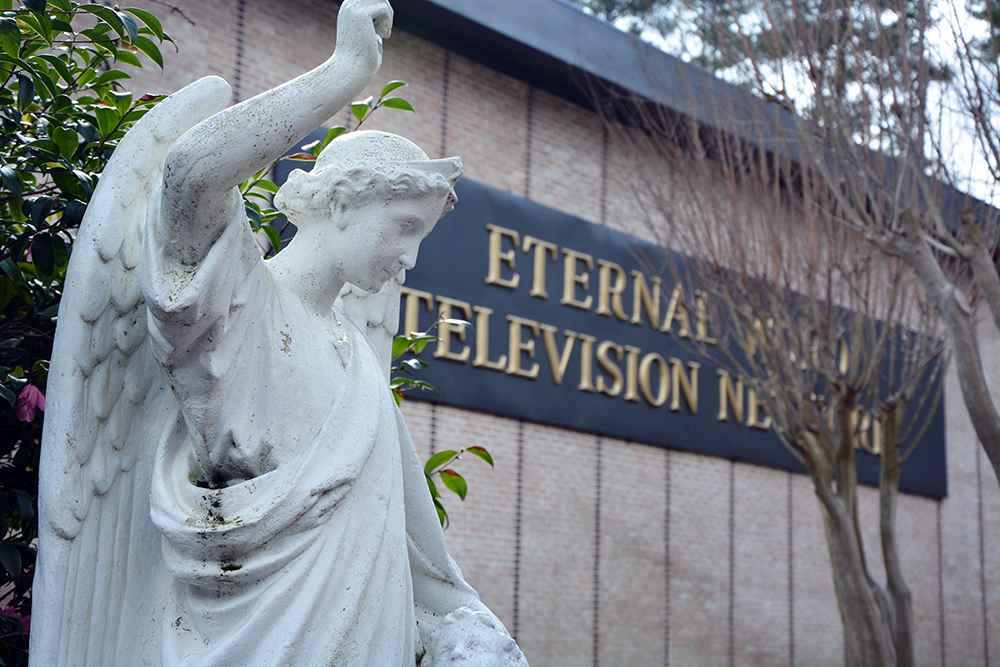
The studios of Eternal Word TV Network
Irondale, Alabama


EWTN, once 'the work of the devil,' now gets blessing from pope | National Catholic Reporter
By Thomas Reese, S.J.

"The work of the devil" is how two years ago Pope Francis labeled EWTN, the Eternal Word Television Network, a Catholic media empire known for its conservative programming. More recently, instead of sending in an exorcist, he blessed a movie produced by EWTN of Ireland.

While not directly mentioning EWTN, the pope said at a 2021 meeting with Jesuits in Slovakia, "There is, for example, a large Catholic television channel that has no hesitation in continually speaking ill of the pope." He acknowledged, "I personally deserve attacks and insults because I am a sinner, but the church does not deserve them. They are the work of the devil." Everyone knew he was speaking of EWTN.

EWTN was founded in 1981 by Mother Angelica, the most successful Catholic communicator since Bishop Fulton Sheen was a national phenomenon on radio in the 1930s and 1940s and on television in the 1950s and 1960s.***The pious programming includes broadcasting the Mass, Benediction, Stations of the Cross, lives of the saints, lectures, recitation of the rosary and other prayers. Let me be clear: I am not objecting to any of this, although much of it is pre-Vatican II piety. Supporters of the traditional Latin Mass have also appeared on the network.

Noteworthy, however, is what is missing. There is no coverage of the social justice concerns of the church, such as racism, inequality or global warming. Abortion and gender issues are the only social issues on EWTN's radar.

Its news programming is accused of having a Republican tilt, leading some of its critics to refer to it as the Fox News of Catholicism. Raymond Arroyo, who hosts EWTN's "The World Over," appears frequently on Fox News. Arroyo spends much of his program attacking Democrats and the "woke" elites. He is also critical of Pope Francis and has hosted a "papal posse" of fellow detractors.***

KEEP READING

Tuesday, May 16, 2023

How the Comstock Act Law Is Key to the Abortion Fight - The New York Times


How the Comstock Act Law Is Key to the Abortion Fight - The New York Times


Anthony Comstock, a 19th-century crusader against sexual liberty, was mocked as a prude in his own time, but wielded real power. He persuaded Congress in 1873 to pass the Comstock Act, written by and named for him, making it a federal crime to send or deliver “obscene, lewd or lascivious” material through the mail or by other carriers, specifically including items used for abortion or birth control.

By the 1960s, the Comstock Act had fallen out of use — narrowed by court rulings, partly gutted by congressional repeals — and it was made an unconstitutional relic by the Supreme Court’s decision in 1973 in Roe v. Wade, recognizing a national right to abortion. But it stayed on the books.

Now, Comstock is back, once more being wielded as a weapon by social conservatives. Their arguments use the language of the act to target the mailing of abortion pills, and they are pushing judges and the Biden administration to reopen seemingly long-settled questions.

Monday, May 15, 2023

It IS Happening Here -


The NYPD and the media we used to slam as tabloid got out front to prevent another explosion of Black Lives Matter protests .  A thirty year old mentally ill Black man named Jordan Neely had been strangled by a white guy - a 24 y.o.  ex-marine, in a way very similar to the death of George Floyd.

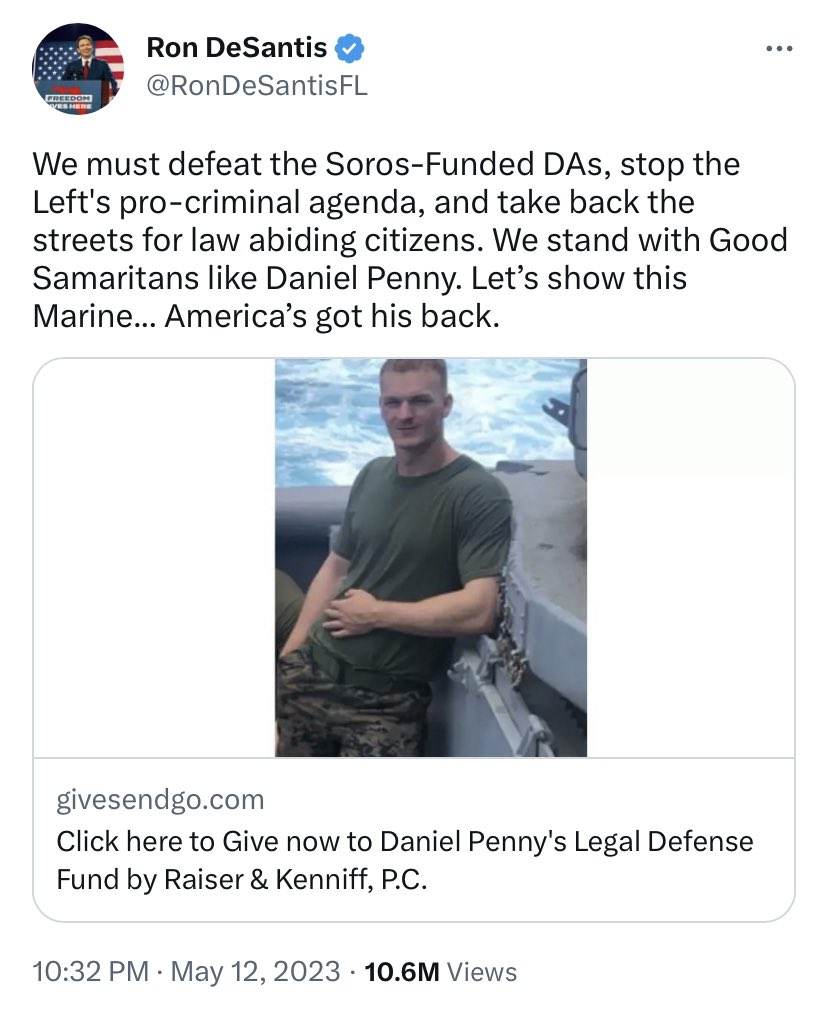
By the time independent reporters the press started poking holes in the police version of the choke-hold death it was nearly too late.  To the widespread derision of MAGAs online putative Presidential candidate Florida Governor Ron De Santis was calling to lionize the  young white ex-marine who choked Jordan Neely in plain view on the F train in lower Manhattan. As Shulam put it: 


"According to Juan Alberto Vázquez, a freelance journalist who took the only published video of Penny putting Neely in a chokehold, Neely was “aggressive” but not specifically threatening or getting physical with anyone on the train.


According to Juan Alberto Vázquez, a freelance journalist who took the only published video of Penny putting Neely in a chokehold, Neely was “aggressive” but not specifically threatening or getting physical with anyone on the train.t respond to HuffPost’s requests for comment, posted a video of Neely’s final moments on his Facebook page, along with a quote purportedly from Neely written in Spanish: “I don’t have food, I don’t have anything to drink, I’m fed up....I don’t care if I go to jail and they give me life in prison.” Neely didn’t seem to want to attack anyone, Vázquez wrote.

“He started screaming all these things, took off his jacket, a black jacket that he had, and threw it on the ground,” Vázquez told the New York Post for a story published May 2, the day after Neely’s death. He also told The New York Times that day that Neely had said, “I’m ready to die.”

As a subway rider I understand that an angry decompensating young men is frightening. But converting such a killing into a cause for celebration of vigilante justice is appalling.
- GWC

Saturday, May 13, 2023

Just a Tad Jesuit: Seattle U Faculty Contest Handbook Changes – The Spectator


A proposed change  in the statement of mission at Seattle University, a Jesuit university, now led by a lay Catholic, Eduardo Penalver has sparked anger among many faculty.
The proposed new language emphasizes both the Catholic and Jesuit character of the university.
Opponents assert that most of the faculty now are atheist or otherwise secular, and that only 25% of the student body is Catholic.

The Church's stance against abortion and opposition to policies such as recognition of same sex union are cited by faculty as grounds for objecting to the assertion of Catholic identity.  They fear that their academic freedom to criticize Church history and policy will be constrained.
The sexual abuse crisis now in its fourth decade, combined with the centrality opposition to abortion in the U.S. Catholic Bishops efforts no doubt contribute to resistance.  The article below - by the University student newspaper - describes the issue on the campus now.

- GWC

Just a Tad Jesuit: Seattle U Faculty Contest Handbook Changes – The Spectator
***A proposed change to the Faculty Handbook would have inserted language into the code which reaffirmed the Catholic and Jesuit identity of the school:

“Jesuit and Catholic signify the distinctive and defining character of Seattle University. Recognition of the transcendent dimension of human life, as expressed in diverse religious and spiritual traditions, is fundamental to the identity of a Jesuit university. Seattle University faculty are a community of teacher-scholars with an acknowledgement of and a respect for Catholic religious, intellectual, and cultural traditions, while maintaining their individual faith commitment.” 

The proposed language was a reuse of the Handbook’s phrasing before 2003. The current statement, which has been in use for two decades, is less specific about the university’s Catholic tradition:

“As a community of teachers and scholars, the faculty acknowledges the University’s religious and cultural traditions and seeks, in a wide variety of ways, to contribute through the professional endeavors of its members to the Jesuit ethos. Seattle University faculty members respect the religious dimension of human life, which is a central element of Jesuit philosophy.” ***

Friday, May 12, 2023

California Reparations Report

California Reparations Report
On June 1, 2022, the Task Force to Study and Develop Reparation Proposals for African Americans issued its interim report to the California Legislature. The interim report surveys the ongoing and compounding harms experienced by African Americans as a result of slavery and its lingering effects on American society today. The interim report also includes a set of preliminary recommendations for policies that the California Legislature could adopt to remedy those harms. A final report will be issued before July 1, 2023. 

or policies that the California Legislature could adopt to remedy those harms. A final report will be issued before July 1, 2023.

Monday, May 8, 2023

Non-refundable retainers impermissible - ABA Formal Opinion 505


Under the Model Rules of Professional Conduct, a fee paid to a lawyer in advance for services to be rendered in the future must be placed in a client trust account and may be withdrawn only as earned by the performance of the contemplated services. This protects client funds and promotes client access to legal services in the event the representation terminates before all contemplated services have been rendered. All fees must be reasonable, and unearned fees must be returned to the client. Therefore, it is not accurate to label a fee “nonrefundable” before it actually has been earned, and labels do not dictate whether a fee has been earned. 

Formal Opinion 505 examines a lawyer’s ethical obligations under the ABA Model Rules of Professional Conduct that relate to fees and safekeeping clients’ prepaid payments for nonrecurring legal work, including matters such as divorce, defense of criminal charges or civil matters not handled on a contingent fee basis.

The opinion notes that an advance on fees is often incorrectly labeled as a nonrefundable retainer. It says in a footnote that a retainer should not be construed as a “payment for the performance of services, but rather is compensation for the lawyer’s promise of availability … (and) is not an advance deposit against future legal services.”

 [T]he model rules “do not allow a lawyer to sidestep the ethical obligation to safeguard client funds with an act of legerdemain: characterizing an advance as ‘nonrefundable’ and/or ‘earned upon receipt.’ This approach does not withstand even superficial scrutiny. A lawyer may not charge an unreasonable fee.”


'Oxford Handbook of Vatican II' comprehensively covers the council and its reception | National Catholic Reporter

Pope John XXIII


'Oxford Handbook of Vatican II' comprehensively covers the council and its reception | National Catholic Reporter

BY MICHAEL SEAN WINTERS

View Author Profile

Join the Conversation

Send your thoughts to Letters to the EditorLearn more

Last Friday, I began a review of the new Oxford Handbook of Vatican II, edited by Massimo Faggioli and Catherine Clifford, focusing exclusively on the opening section of the book, which serves as a kind of frame for understanding Vatican II. Today we focus first on the painting in the frame, the event that was the council and the texts that it produced, followed by a brief examination of the handbook's thorough treatment of the reception of the council.

If the first section warranted a more detailed examination of each chapter, for the book's second section, "The Council Documents," it is enough to mention the highlights. Unsurprisingly, Richard Gaillardetz's chapter on the ecclesiology of Vatican II is exceedingly well done. He sets forth some of the important antecedent documents and events that made "the freshness of Vatican II's deliberations and principal teachings" possible. He relates the prior conciliar discussion of the liturgy to the resulting liturgico-sacramental foundation of the ecclesiology found in Lumen Gentium as well as the missionary nature of the church, which would become so central a theme in the post-conciliar landscape. Anyone familiar with Gaillardetz's work on authority will find it set forth concisely here, and how these developments were made possible by the retrieval of a theology of the local church from the ressourcement theologians.

Gaillardetz also helpfully highlights the Trinitarian origins of the church. The Christocentrism of the documents of Vatican II is evident, but not exclusive. "As Congar observed, the council's ecclesial Christocentrism escapes a more reductive Christomonism by integrating the missions of Christ with that of the Spirit," Gaillardetz writes. "Together, Christ and the Spirit 'co-institute' the Church." I have read a lot about ecclesiology but have never before encountered such a clear articulation of the pneumatology at work in the texts.

The chapter on revelation, from Australian Jesuit Gerald O'Collins, is similarly masterful. I count less than a dozen paragraphs in the entire chapter that are not underlined, asterisked or dog-eared in my copy. These two sentences strike precisely the kind of thoughtful, balanced treatment characterizes the whole: "In worship and life, revelation continues as an actual encounter with God. But this living dialogue adds nothing to the core of the divinely revealed truths, which essentially amount to Jesus Christ crucified and raised from the dead, along with the coming of the Spirit."

KEEP READING

'Oxford Handbook on Vatican II' is, pun intended, magisterial | National Catholic Reporter

Opening session of Vatican Council II - 1962
Note hats


'Oxford Handbook on Vatican II' is, pun intended, magisterial | National Catholic Reporter

BY MICHAEL SEAN WINTERS

View Author Profile

Join the Conversation

Send your thoughts to Letters to the EditorLearn more

The Oxford Handbook of Vatican II attempts a Herculean task. Part reference book, part introduction to a complex historical subject, part analysis of a still ongoing reception of the conciliar teaching, part international symposium, this Hydra of a book proves to be a Herculean achievement. Those in the English-speaking world who teach Catholic theology now have a book at hand that comprehensively considers virtually every important post-conciliar subject, filled with references and additional resources, against which scholars and average Catholics can crosscheck their arguments and intuitions.

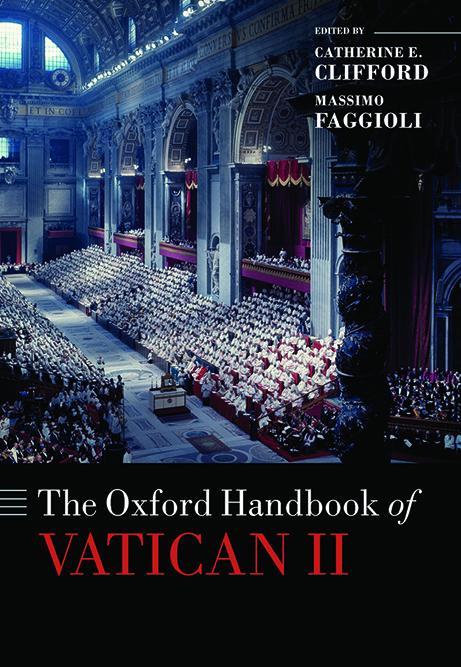
Cover to 'The Oxford Handbook of Vatican II' (Courtesy of Oxford University Press)

Cover to 'The Oxford Handbook of Vatican II' (Courtesy of Oxford University Press)

The first section of the book looks at the context and the sources of the Second Vatican Council itself, and the first chapter was penned by the late Jesuit historian John O'Malley. "Vatican Council II did not fall out of the heavens," O'Malley begins. "Like any institution and most especially any institution of the Catholic Church, the council can be understood only in the context of the situations and the issues it inherited from the past that the fathers of the council decided to address."

As in his entire career, in this chapter O'Malley's interpretative analysis would not come as a surprise to the subjects about whom he writes. Put differently, O'Malley eschews ideology and his narrative builds from his sources, it does not obscure them or force them into an analysis that is quite distinct from their own experiences and views.

O'Malley's summary of the approach the Council of Trent took to its urgent task of responding to the Protestant challenge will be well known to those who have read his book on that council, as will his assessment of Vatican I. What is remarkable here is his concise, conceptual analysis of the challenges the church faced during the Enlightenment and the development of theological ideas and movements between the first and the second councils held at the Vatican.

KEEP READING 

Friday, May 5, 2023

Fishers' Livelihood Concerns Could Bring SCOTUS Sea Change for Environmental Law | Beveridge & Diamond PC - JDSupra


Fishers' Livelihood Concerns Could Bring SCOTUS Sea Change for Environmental Law | Beveridge & Diamond PC - JDSupra

The Supreme Court has agreed to hear a group of New Jersey herring fishers’ challenge to a long-standing key administrative law doctrine—the “Chevron doctrine.” It could be the next term’s most consequential case. The Chevron doctrine requires federal courts to defer to administrative agencies’ interpretations of their governing statutes where the text of those statutes is ambiguous. As one of the most-cited Supreme Court cases, Chevron has been instrumental in administrative law practice over the past forty years. It has also become a primary target for several of the Court’s conservative justices.

In the case now before the Court, Loper Bright Enterprises v. Raimondo, Case No. 22-451, herring fisher appellants assert that the lower courts improperly applied the Chevron doctrine when they upheld a National Marine Fisheries Service (NMFS) regulation requiring them to pay a portion of the salary of a third-party compliance monitor onboard their boats. While no party questions NMFS’s authority to require that fishing vessels “carry” a federal or third-party observer onboard, the fishers challenge the agency’s power to force them to pay those observers up to approximately 20 percent of a vessel’s annual returns.

The fishers petitioned the Supreme Court to determine whether NMFS is implicitly authorized under the Magnuson-Stevens Act (MSA)1 to pass these enforcement costs onto industry and separately to either clarify that silence does not create “ambiguity” in a statute for purposes of triggering Chevron deference, or to discard Chevron doctrine altogether. The Court granted certiorari on only the second question, and the consequences for federal environmental law could be vast. Until recently, federal agencies have routinely relied upon the Chevron doctrine when defending their regulations.

KEEP READING

Tuesday, May 2, 2023

Catholic mothers, scholars urge US bishops to listen to women on abortion | National Catholic Reporter

Catholic mothers, scholars urge US bishops to listen to women on abortion | National Catholic Reporter
By Katie Collins Scott, Staff Reporter

The stringent anti-abortion activism of many U.S. Catholic leaders, including the bishops' conference, has ignored the complex lived experience of women, the realities of racial and economic inequities, and the importance of personal discernment in moral decision-making.

This assessment — coupled with a call for "brave spaces" where women can share their stories about pregnancy and parenthood — was articulated by Catholic mothers, scholars and advocates during an unusually frank panel discussion April 18. The online event, titled "Catholic Women: Reclaiming Debates about Abortion and Reproductive Justice," was organized by Faith in Public Life, a progressive interfaith nonprofit based in Washington, D.C. The event came a week after the organization published a letter highlighting similar points.

Mollie Wilson O'Reilly, a mother of four and editor at large for Commonweal magazine, said during the discussion that a miscarriage and subsequent emergency medical procedure helped her realize that as a Catholic "I'd been told a story that wasn't true, that wasn't taking into account the actual real-life experiences of people like myself, and that the story was undervaluing the lives of women."

Jeanné Lewis (Courtesy of Faith in Public Life)

Jeanné Lewis (Courtesy of Faith in Public Life)

O'Reilly was also among the more than 30 Catholic women scholars, theologians and advocates who signed the recent open letter. It urges elected officials to support robust social policies for families, calls for more thoughtful conversations about abortion, and says it's critical for the church to hear women's voices on reproductive issues in an organization that is led by an all-male clergy.

Nearly 200 individuals have since added their name to the statement.

KEEP READING

Supreme Court’s Next Target: The Regulatory State | Brennan Center for Justice

Supreme Court’s Next Target: The Regulatory State | Brennan Center for Justice
By Michael Waldman [president and CEO of the Brennan Center for Justice at NYU School of Law.]

Sometimes the big news from the Supreme Court comes not when the justices rule on a case, but when they decide to take it in the first place. That happened yesterday in a case with big implications for the role of government in American life.

And there’s a family drama at play, too. I write about that twist in my upcoming book, The Supermajority: How the Supreme Court Divided America. More about that below. 

First the news: the justices agreed to hear Loper Bright Enterprises v. Raimondo. It’s an arcane case about who pays to monitor whether fishing boats are following federal fishery plans. As I said, arcane. But the Court announced it would consider one topic and one topic only in hearing the appeal: Should it overturn Chevron v. Natural Resources Defense Council?

Those who care about the environment, worker safety, and fair markets should feel a chill. This right-wing supermajority has already shown that it is eager to heed the demand of financial interests that did so much to install its members on the Court: find a way to curb the power of regulatory agencies. 

The 1984 ruling in Chevron held that when an expert regulatory agency interprets an ambiguous law reasonably, the courts will not second-guess. It is among the most cited cases in federal courts. Over many decades, it has allowed government to function, while taking seriously notions of judicial restraint. After all, the engineers and economists and scientists of the Food and Drug Administration or the Environmental Protection Agency or the Securities and Exchange Commission . . . or for that matter, the fisheries agency! . . . must be capable of acting within the parameters set by Congress without an ideologically nosy judge jumping in. Chevron was a favorite of Justice Antonin Scalia. He thought it reflected the proper role for government — and for unelected justices and judges. 

But major industries and...

KEEP READING

Monday, May 1, 2023

Newly Right-Wing North Carolina Supreme Court Reverses Its 2022 Gerrymandering Decision


The United States Supreme Court in Rucho v. Common Cause declared non-justiciable a dispute over partisan drawing of  election district lines, thus returning the issue to North Carolina. 
The closely divided [53/47] state in 2016 sent but three Democrats to fill its thirteen seats in Congress.  The 2022 elections sent a majority of Republicans to the state's high court.  The new majority reversed the older ruling more accurately approximating the partisan divide among North Carolina voters.
In an astonishingly particsan move the new high court majority declared:

Our [North Carolina] constitution expressly assigns the redistricting authority to the General Assembly subject to explicit limitations in the text. Those limitations do not address partisan gerrymandering. It is not within the authority of this Court to amend the constitution to create such limitations on a responsibility that is textually assigned to another branch.

So much for the principle of one person one vote declared in the 1962 landmark U.S. Supreme Court decision in Baker v. Carr369 U.S. 186. Justices Earls and Morgan, dissenting, said:

...the majority has used rehearing in this case to “upend the constitutional guarantee that voters in the State will enjoy ‘substantially equal voting power,’ regardless of their political affiliations.” Id. “Such a change . . . fundamentally alter[s] the political rights of every voter in North Carolina.” Id. (quoting Harper I, 380 N.C. at 376).

- GWC 

By Kate Riga

The North Carolina Supreme Court became much more conservative after the 2022 midterms. On Friday, the newly minted justices flexed that power to overturn the court’s own months-old decision knocking down maps that were egregiously gerrymandered by the Republican state legislature. 

In Harper v. Hall the right-wing majority cloaked the decision in highfalutin language, but the decision is nakedly political. Now the Republican legislature knows that it can continue to manufacture its way into a permanent majority — regardless of the will of its voters — and that the state’s highest court won’t stop it. 


Sunday, April 30, 2023

Catholic mothers, scholars urge US bishops to listen to women on abortion | National Catholic Reporter

Catholic mothers, scholars urge US bishops to listen to women on abortion | National Catholic Reporter By Katie Collins Scott

The stringent anti-abortion activism of many U.S. Catholic leaders, including the bishops' conference, has ignored the complex lived experience of women, the realities of racial and economic inequities, and the importance of personal discernment in moral decision-making.

This assessment — coupled with a call for "brave spaces" where women can share their stories about pregnancy and parenthood — was articulated by Catholic mothers, scholars and advocates during an unusually frank panel discussion April 18. The online event, titled "Catholic Women: Reclaiming Debates about Abortion and Reproductive Justice," was organized by Faith in Public Life, a progressive interfaith nonprofit based in Washington, D.C. The event came a week after the organization published a letter highlighting similar points.

Mollie Wilson O'Reilly, a mother of four and editor at large for Commonweal magazine, said during the discussion that a miscarriage and subsequent emergency medical procedure helped her realize that as a Catholic "I'd been told a story that wasn't true, that wasn't taking into account the actual real-life experiences of people like myself, and that the story was undervaluing the lives of women."

Jeanné Lewis (Courtesy of Faith in Public Life)

Jeanné Lewis (Courtesy of Faith in Public Life)

O'Reilly was also among the more than 30 Catholic women scholars, theologians and advocates who signed the recent open letter. It urges elected officials to support robust social policies for families, calls for more thoughtful conversations about abortion, and says it's critical for the church to hear women's voices on reproductive issues in an organization that is led by an all-male clergy.

Nearly 200 individuals have since added their name to the statement.

"We are moved by compassion and conscience to say clearly that laws and policies celebrated as 'pro-life' by our Church leaders often hurt women and demean our dignity," it reads.

Jeanné Lewis, interim CEO of Faith in Public Life and moderator of the April 18 panel, said Catholics' conversations about abortion are often held "privately or in whispers or avoided altogether," while the rhetoric from church leaders is "too simplistic." The letter and the panel were ways to amplify a nuanced discussion within the public sphere, she said.  

Catholics must "wrestle with interconnectedness and the complexity in which we live," said Lewis.