Thursday, March 23, 2023

Wyoming’s abortion ban is blocked by a judge for the most hilarious reason - Vox


Wyoming’s abortion ban is blocked by a judge for the most hilarious reason - Vox
By Ian Millhiser
On Wednesday, a judge in the deep-red state of Wyoming temporarily blocked a state law that would make performing nearly any abortion in that state a felony. She relied on a 2012 amendment to the state constitution that was intended to spite then-President Barack Obama.

Obama’s early years in office were marred by a scorched-earth political campaign Republicans wielded to try to thwart what became the Affordable Care Act. Obamacare’s opponents warned of a “government takeover of health care” that would strip many Americans of their ability to make their own health decisions.

Many of these allegations were downright ludicrous, such as former Alaska Gov. Sarah Palin’s (R) false claim that Obama’s health bill would require “my baby with Down Syndrome ... to stand in front of Obama’s ‘death panel’ so his bureaucrats can decide, based on a subjective judgment of their ‘level of productivity in society’ whether they are worthy of health care.”

These attacks did not succeed. The bill became law, and Obamacare is popular now that it has been in full effect for nearly a decade without anyone being forced to stand before a death panel. But there is at least one lasting legacy of these attempts to characterize the Affordable Care Act as an attack on patients’ right to decide whether and when to seek health treatments.

In many states, opponents of Obamacare effectively took the GOP’s talking points and turned them into state constitutional amendments protecting patients’ ability to obtain health care that the government might not want them to have. Wyoming’s amendment, for example, provides that “each competent adult shall have the right to make his or her own health care decisions.”

According to Quinn Yeargain, a law professor at Widener University, similar amendments are on the books in several other states.

It remains to be seen whether the highest courts in these states, some of which are extremely conservative, will ultimately agree that these anti-Obamacare amendments prohibit abortion bans. And, in at least some cases, the amendments contain language that could mitigate their impact. Wyoming’s amendment, for example, also provides that, under certain circumstances, the state legislature may “determine reasonable and necessary restrictions on the rights granted” by the health care amendment.

keep reading

Wednesday, March 22, 2023

'No Hispanics' or 'grandmotherly types': NY prosecutors face complaints over jury bias - Gothamist


'No Hispanics' or 'grandmotherly types': NY prosecutors face complaints over jury bias - Gothamist
By SusanMax

Ten curre nt and former New York prosecutors who judges say illegally screened out potential jurors because of race or religion are facing ethics complaints that could prompt investigations or disciplinary actions.

Judges have already ruled either during trial or in appeals that all 10 prosecutors broke the law. But a group of law professors is now bringing ethics complaints against the prosecutors in the hopes of holding them accountable for what they did.

They have not yet faced any public discipline, according to state court records. Several of them were even promoted.

In some cases, the people who the prosecutors convicted filed appeals arguing that jury selection was biased and their convictions were overturned — but only after they had spent years behind bars.

The law professors are bringing the complaints, filed Monday with attorney grievance committees and shared first with Gothamist, as a way of finally holding the prosecutors accountable for violations that in some cases date back decades. The group, which calls itself Accountability NY, started submitting complaints against prosecutors accused of misconduct in 2021.

They said the violations are emblematic of a larger problem in the court system: attorneys illegally excluding jurors based on race and other aspects of their identity. Experts said it’s an illegal practice that undermines people's right to a fair trial — especially people of color.

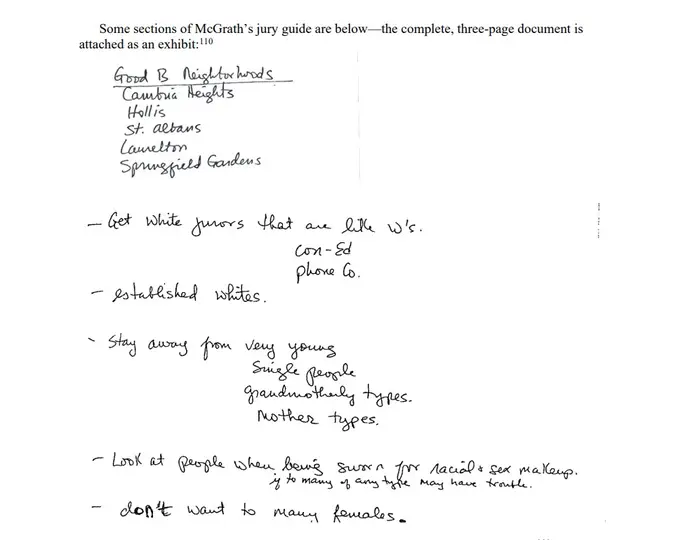
The complaints name prosecutors in five district attorneys’ offices, including Brooklyn, Manhattan and Queens. In one 2018 case, a judge found that a prosecutor acted illegally when he struck all the Latino prospective jurors for a Latino man’s trial. In another that same year, a judge ruled that a prosecutor illegally removed the only two non-white people for the trial of an Afghan-American. In one case, a former prosecutor admitted to using notes filled with racist and sexist instructions — including “No Hispanics” and “Stay away from grandmotherly types” — to avoid choosing diverse juries in the 1990s.

Notes taken in the 1990s by former Queens prosecutor Christopher McGrath that outlined types of jurors to include or exclude based on their race, religion, gender and neighborhood.

“Diversity is an essential safeguard,” said Peter Santina, managing attorney of Civil Rights Corps’ Prosecutorial Accountability Project, which helped to file the complaints. “A representative jury can mean the difference between someone being wrongfully convicted or not.”

KEEP READING

Sunday, March 19, 2023

New California Rule Compelling Attorneys to Report Misconduct by Other Attorneys to Circulate for Public Comment - The State Bar of California - News Releases


The California State Bar, alone among the state lawyer licensing authorities, has not adopted the American Bar Association 's rule requiring lawyers to report their knowledge of another attorney's ethical fitness to practice. The ABA  Model Rule Provides in part:
Rule 8.3: Reporting Professional Misconduct
Maintaining The Integrity of The Profession
(a) A lawyer who knows that another lawyer has committed a violation of the Rules of Professional Conduct that raises a substantial question as to that lawyer's honesty, trustworthiness or fitness as a lawyer in other respects, shall inform the appropriate professional authority.
 
But, reeling under the impact of treports of the State Bar's failure to respond to grossly unethical conductby two high profile attorneys - Thomas Girardi and Michaal Avenatti - the State Bar has proposed that the Supreme Court of California be obligated to report misconduct or unfitness of which they have knowledge.  The the State Bar is a governmental body but the state's Supreme Court will decide any changes. - GWC


New California Rule Compelling Attorneys to Report Misconduct by Other Attorneys to Circulate for Public Comment - The State Bar of California - News Releases

At its meeting on March 16, 2023] the State Bar of California Board of Trustees approved a 45-day public comment period for two options for a new rule that would create a duty for California attorneys to report misconduct by other attorneys.

"We want to hear from the public about whether it is time for California to join the rest of the nation in implementing some version of a rule establishing a duty for attorneys to report misconduct by their professional peers,” said Board Chair Ruben Duran. “I believe the public we are mandated to protect will be the ultimate beneficiaries of this proactive effort.”

California is the only state that has yet to adopt some version of the American Bar Association (ABA) Model Rule 8.3, which establishes a duty to report misconduct that “raises a substantial question as to the lawyer’s honesty, trustworthiness, or fitness as a lawyer in other respects.”

Since 2010, California has twice considered and rejected such a rule due to concerns raised by attorneys. The new California proposal was developed at the direction of Board Chair Duran at the November 2022 Board meeting. The Committee on Professional Responsibility and Conduct developed and circulated for public comment a proposed rule that was then revised and adopted for submission to the Board. Additionally, staff proposed an alternative version with a slightly broader set of reporting requirements.

Both alternatives require reporting if a lawyer knows of credible evidence of misconduct. The primary differences between the two alternatives are the types of conduct that must be reported and the trigger for that mandatory reporting:

  • Alternative 1: Requires reporting:
    • Of criminal acts, fraud, or misappropriation of funds or property in violation of rule 1.15 and;
    • If the conduct raises a substantial question as to an attorney’s honesty, trustworthiness, or fitness as an attorney in other respects.
  • Alternative 2: Expands the type of conduct that must be reported to include acts of dishonesty, deceit, and misrepresentation. There is no requirement that the misconduct that must be reported must “raise a substantial question,” but the duty to report criminal acts arises only if such acts reflect adversely on an attorney’s honesty, trustworthiness, or fitness as an attorney in other respects.

Both alternatives include exceptions if reporting would disclose confidential information protected by other rules or laws, such as client confidentiality or attorney-client privilege. Information obtained by a lawyer participating in any substance use or mental health program would also be exempt.

After the public comment period, the Board is expected to consider the public input and rule proposal at its May meeting before sending a proposed rule to the California Supreme Court for its consideration. The Supreme Court must approve a rule before it becomes final.

The state Legislature is also considering a bill, Senate Bill 42, which would establish a statutory duty for attorneys to report misconduct by other attorneys. Currently the bill reflects the same duty to report as outlined in ABA Model Rule 8.3.

Also during the meeting, Executive Director Leah Wilson previewed efforts being made to strengthen the State Bar’s whistleblower and whistleblower retaliation policy. The effort is among numerous reforms that have been undertaken by the State Bar, as noted in a reform chronology shared last week with the announcement regarding the May and Lazar reports into past handling of closed complaints against now-disbarred attorney Thomas V. Girardi.


State Bar of California Releases Reports Detailing Past Unethical Conduct in Handling Girardi Complaints - The State Bar of California - News Releases


State Bar of California Releases Reports Detailing Past Unethical Conduct in Handling Girardi Complaints - The State Bar of California - News Releases
 
   Categories: News Releases

The State Bar of California Board of Trustees released today two redacted reports on its past handling of complaints against disgraced and disbarred attorney Thomas V. Girardi. The Board decided to release the reports in furtherance of the agency’s public protection mission and its commitment to transparency and accountability. In releasing these reports, the State Bar has redacted information that is protected under the law, including California Business and Professions Code section 6086.1, and the right to privacy.

The first report was prepared by attorney Alyse Lazar, who in 2021 was retained by the State Bar to review 115 files of past complaints against Girardi. Her review, limited to documents in investigative files, identified numerous instances in which complaints were closed without complete investigations or despite the development of facts warranting discipline. A redacted version of the report is posted here.

The second report was completed by Halpern May Ybarra Gelberg LLP, an outside law firm hired by the State Bar to conduct a wide-ranging investigation that was not limited to file review and included interviews of 74 witnesses and extensive evidence gathering. The May report details instances where Girardi’s efforts to buy relationships and exercise influence at the State Bar—at all levels—likely impacted the handling of some complaints against him, causing those complaints to be closed improperly. A redacted version of the report is posted here.

Together, the two reports provide a clear and comprehensive review of how Girardi’s unethical and unacceptable behavior went unchecked for so long and reveal systemic organizational dysfunction that persisted for many years and through many changes of leadership. Importantly, none of the individuals whose unethical behavior is detailed in the May report are still affiliated with or employed by the State Bar in any capacity.

“To ensure that what happened in the Girardi matter never happens again, we commissioned unflinching investigations by outside experts, are making the results public to the extent we can legally do so, and are addressing the findings comprehensively,” said Ruben Duran, Chair of the State Bar Board of Trustees. “While none of the individuals named in the May report are still at the State Bar, the magnitude and duration of the transgressions reveal persistent institutional failure and a shocking past culture of unethical and unacceptable behavior. In recent years we have put in place many safeguards that serve both to prevent unethical or corrupt behavior and—if it does occur—to catch and address it quickly. That work continues. Providing this disclosure is a necessary step to demonstrate our commitment to transparency and accountability and restore public trust.” 

The findings

During a 16-month investigation, May and his team reviewed over 950,000 documents, issued 23 subpoenas, and interviewed, either voluntarily or under compulsion, 74 witnesses. The May report indicates that Girardi intentionally cultivated relationships at many levels in the State Bar to increase his influence in the agency. The report outlines several instances of past State Bar staff exercising poor judgment, ignoring or poorly handling conflicts of interest, and otherwise behaving unethically. None of the individuals identified as engaging in unethical conduct remain affiliated with or employed by the State Bar.  

Examples include:

  • Former State Bar employee Tom Layton, who was terminated in 2015, (and his wife) received gifts and payments estimated at over $1 million from Girardi, through his firm, while Layton was employed at the State Bar. Those payments and gifts were never properly disclosed.
  • Other State Bar employees and Board members accepted and failed to report gifts and other items of value from Girardi.
  • Relatives of staff members were employed by Girardi’s firm.
  • Staff in the Office of Chief Trial Counsel (OCTC) were improperly involved in matters assigned to outside conflict counsel.
  • Eight Girardi cases were closed by individuals who May determined had conflicts of interest at the time they worked on the cases. The report found that their conflicts tainted their decisions to close the cases.
  • Interim Executive Director Bob Hawley ghostwrote decisions in matters assigned to outside conflict counsel without disclosing that fact, including a decision to recommend closure of a complaint against Girardi.
  • Between 2013 and 2015, both the Executive Director’s Office and Office of General Counsel received reports about Girardi’s influence at the State Bar and connection to Layton and others but failed to investigate. 
  • Former Executive Director Joe Dunn, who was terminated in 2014, and Hawley made questionable terminations of two OCTC attorneys who were advocating for disciplinary actions against Girardi.
  • On at least one occasion, Girardi successfully deployed his connections at the State Bar to discourage people from making complaints against him.  

The May report found that—while the State Bar has since done much to remedy these problems—in the past, conflict policies were weak, record-keeping on conflicts was incomplete, and awareness of conflict rules, which should have influenced case assignments and handling, was low.

The 2021 Lazar report revealed errors made in case closures over the four decades of Girardi’s career. In particular, the report identified significant issues regarding the investigation and evaluation of high-dollar, high-volume trust accounts. The 2021 Lazar report prompted the Board to undertake the May investigation and to take several actions by the Board to strengthen the discipline system.

Actions already taken

Current Board and staff leadership have already taken many steps to reform the agency. Many of the failures outlined in the May report occurred before 2018, when the State Bar shed its professional association functions and focused more sharply on its public protection mission. Examples of these reforms include:

KEEP READING

Friday, March 17, 2023

Wyoming Becomes First State to Outlaw Abortion Pills - The New York Times

Wyoming Becomes First State to Outlaw Abortion Pills - The New York Times

What happened inside the federal hearing on abortion pills : NPR

What happened inside the federal hearing on abortion pills : NPR

The Supreme Court Conservatives’ Favorite New Weapon for Kneecapping the Administrative State | The New Republic

The Supreme Court Conservatives’ Favorite New Weapon for Kneecapping the Administrative State | The New Republic
Over the last two years, the Supreme Court’s six conservative justices have wielded tremendous power over federal decision-making by striking down a wide range of consequential policies: the Centers for Disease Control’s national eviction moratorium, the Occupational Safety and Health Administration’s Covid-19 testing mandate, and a moribund Obama-era rule on power-plant emissions. If the justices likewise nullify President Biden’s executive order on student debt relief, they will use the same mechanism as in those prior examples: the major questions doctrine.

That doctrine, which allows the justices to overturn a federal regulation if they think Congress didn’t “speak clearly” enough to authorize it, has seen a meteoric rise amid the court’s increasingly conservative tilt. And unlike most legal doctrines frequently cited by the court, this one does not have a long and distinguished history. The New York Times’ Adam Liptak noted earlier this week that it first appeared by name in a federal court opinion in 2017, when then-Judge Brett Kavanaugh mentioned it in a dissenting opinion on the D.C. Circuit Court of Appeals. Before then, it had spent only a few years percolating in conservative legal circles.

Thursday, March 16, 2023

The Evolving Mission of Peking University's School of Transnational Law by Philip McConnaughay :: SSRN

The Evolving Mission of Peking University's School of Transnational Law by Philip McConnaughay :: SSRN

Philip McConnaughay

Peking University School of Transnational Law

Date Written: February 21, 2023

Abstract

Peking University’s School of Transnational Law (“STL”), by most measures, has been an unqualified success. STL’s American law J.D. program – China’s only American law J.D. – is comparable in all substantial respects to the J.D. programs of leading U.S. law schools. STL’s China law Juris Master’s degree – with which STL’s J.D. is offered jointly – is reshaping the content and objectives of Chinese legal education and influencing legal education nationally. The value that students derive from the combination of STL’s J.D. and J.M. curriculums exceeds the value of studying each independently of the other.

Demand for admission to STL among China’s most academically gifted college graduates is extremely high. STL has recruited a multinational faculty of leading scholars, all of whom subscribe to the case study method of instruction with intensely interactive class sessions, including within STL’s largely civil law J.M. curriculum. The professional placement of STL graduates in world-leading Chinese and multinational law firms, businesses, government offices, and universities is exceptional, even during the recent economic downturn resulting from the pandemic. STL enjoys a steadily growing alumni base on the cusp of leadership in China and elsewhere. And STL provides all of this to students at very low cost, with an annual tuition not even 25 percent of that at most leading U.S. law schools.

Yet, because STL is an academic unit of a leading Chinese research university rather than a campus of an American university operating by special dispensation in China, STL is fully subject to Peking University and China Ministry of Education/central government regulations, policies, and practices. As a result, STL faces certain endemic challenges capable of jeopardizing its unique program and achievements. These include censorship, constraints on faculty governance, the absence of well-established standards for the profession of law, and the lingering effects of a “Zero Covid” policy that effectively deprived STL for three years of the international engagement on which its program largely depends.

This article examines these challenges, how STL contends with each, the prognosis for STL maintaining its academic independence and excellence, and STL’s evolution from an American law program in China into perhaps the world’s only true School of Transnational Law. Today, STL’s program blends the study of China law, U.S. law, and other legal regimes in ways designed to equip students for the practice of law in a world in which parties from different nations and legal traditions – including exclusively non-Western traditions – increasingly interact.

Keywords: China, legal education, Zero Covid, censorship, faculty governance, legal profession, non-Western, Juris Master's, Peking University

JEL Classification: K33, K40

McConnaughay, Philip J., The Evolving Mission of Peking University's School of Transnational Law (February 21, 2023). Journal of Legal Education, Forthcoming, Peking University School of Transnational Law Research Paper, Available at SSRN: https://ssrn.com/abstract=4366010 or http://dx.doi.org/10.2139/ssrn.4366010

The Owl of Minerva and “Our Law” – Ius & Iustitium


The Owl of Minerva and “Our Law” – Ius & Iustitium

Conor Casey & Adrian Vermeule[1]

On 28th February, William Baude of the University of Chicago Law School delivered the annual Scalia Lecture at Harvard Law School,[2] titled “Beyond Textualism?”—with startling results. Startling but also welcome, as we will explain.

The main question posed by Baude at the outset of his lecture is whether textualism is “missing something important”? Baude began in a conventional register by suggesting that textualism is said to reflect the “basic insight central to the structure of our government…and fabric of our law” that the job of the interpreter is (a) usually to enforce rules that have been made some place else, not to make the rules herself; and (b) not to imagine decisions that were actually never made by the legislature. In general, says Baude, the results of the “textualist revolution” have been “salutary” for embedding these ideas into legal practice and thought.

The talk, however, then took a sharp and surprising turn—indeed a turn towards the very approach to legal interpretation, the classical approach, that Ius et Iustitium was founded to advocate. Baude’s answer to the question posed at the start of his lecture turned out to be an emphatic yes. Textualism is grievously incomplete, Baude now argues, chiefly because it fails adequately to take account of other sources of law, including “unwritten background principles” and “natural law.” (Yes, everything in quotation marks is a quote from the lecture). Continue reading “The Owl of Minerva and “Our Law””

Baude concludes by warning that denying the centrality of unwritten law to American legal practice has the risk of “sending us in statutory interpretation circles, unable to explain how we can avoid being literalists…and opportunists.” If students are not exposed to the centrality of unwritten law to legal practice and interpretation, then they will be “misled into thinking the only choices are the plain text and judicial policymaking” which Baude says “is not true.” We would add only that one might even call this fundamentally false alternative an argument by slogan.

All this is a welcome development indeed. To be sure, given Baude’s recent vituperative rejection of the classical view of legal interpretation, it seems that the Owl of Minerva, symbol of wisdom, has once again waited until dusk to take wing. Nonetheless, it is better that wisdom should take wing at all than that the legal theorist learns nothing and forgets nothing. As Justice Felix Frankfurter famously observed, “wisdom too often never comes, and so one ought not to reject it merely because it comes late.”

Stripping Confederate Ties, the U.S. Navy Renames Two Vessels - The New York Times

The USS Chancellorsville, soon to be renamed for Robert Smalls.

Almost three years ago I tried to persuade my colleagues to call for the former Woodrow Wilson School at Princeton to be named after Robert Smalls.  They didn't bite.  But now the USS Chancellorsville will be renamed the Robert Smalls to honor the slave who led the mutiny which commandeered a confederate ship in Charleston harbor. - GWC
Stripping Confederate Ties, the U.S. Navy Renames Two Vessels - The New York Times

One night in 1862, as the Civil War raged, an enslaved mariner named Robert Smalls seized an opportunity.

When the enlisted crew of a Confederate steamer disembarked for a night of carousing in Charleston, S.C., Mr. Smalls, the ship’s pilot, gathered his family and the other enslaved sailors and their families. He then steered the ship for a dramatic escape past heavy fortifications to Union-controlled waters and freedom.

Disguised in a top hat and a Confederate captain’s long overcoat, Mr. Smalls gave the passcodes at each of five Confederate forts and, once past the reach of cannon fire, hoisted a white flag of sewn-together bedsheets that his wife Hannah had made — delivering the ship to Union forces.

Mr. Smalls and the crew had lined the bottom of the boat with explosives to detonate rather than be recaptured and face execution.

From Slavery Abolition to Public Education, German Radicals Made American History

German revolutionary and Union officer in the US Civil War Franz Sigel.
 (MPI / Stringer via Getty Images)


From Slavery Abolition to Public Education, German Radicals Made American History

The United States has forgotten the radical German American immigrant socialists who spilled blood for antislavery and other liberatory causes.


North Dakota Supreme Court State Constitution Protects Right to Abortion

North Dakota Chief Justice
John J. Jensen


In Wrigley v. Romanick the North Dakota Supreme Court held that There is a fundamental right for a woman to obtain an abortion in instances where it is necessary to preserve her life or health.. 


Access Independent Health Services, Inc., d/b/a Red River Women’s Clinic has a substantial likelihood of succeeding in establishing N.D.C.C. § 12.1-31-12 is not narrowly tailored to the State’s compelling interests.
Chief Justice John J. Jensen wrote:
The North Dakota Constitution guarantees the “inalienable right[ ] ... of enjoying and defending life and liberty.” N.D. Const. art. I, § 1. Commonly, an individual exercises this right of self-defense by responding to a threat of imminent serious bodily injury or death with physical force. City of Jamestown v. Kastet, 2022 ND 40, ¶ 17, 970 N.W.2d 187; State v. Olander, 1998 ND 50, ¶ 20, 575 N.W.2d 658. Where a pregnancy raises a similar threat of serious bodily injury or death, the pregnant woman has a fundamental right to preserve her life and health with the aid of a physician.


Our recognition of this fundamental right to preserve one’s life does not depend on resolving the disputed point of pregnancy at which there are two lives that must be considered. The State has a compelling interest in protecting unborn human life, which RRWC does not dispute. Majority, at ¶ 29. We have long understood   20  that a woman has an inalienable right to employ deadly force against another person when necessary to protect herself against death or serious bodily injury. State v. Leidholm, 334 N.W.2d 811, 820 (N.D. 1983); United States v. Leighton, 3 Dakota 29, 13 N.W. 347, 348 (1882). Likewise, the State’s compelling interest on behalf of an unborn child must yield to the pregnant woman’s right to abort a pregnancy when necessary to preserve her life or health. 

N. Dakota Supreme Court Blocks Abortion Ban; Says Constitution Protects Procedure - The New York Times


Wrigley v. Romanick, et al. 2023 ND 50
Docket No.: 20220260
Filing Date: 3/16/2023
Case Type: WRIT OF SUPERVISION (Civil)
Author: Jensen, Jon J.

Highlight: There is a fundamental right for a woman to obtain an abortion in instances where it is necessary to preserve her life or health.

Access Independent Health Services, Inc., d/b/a Red River Women’s Clinic has a substantial likelihood of succeeding in establishing N.D.C.C. § 12.1-31-12 is not narrowly tailored to the State’s compelling interests.

A granting of a preliminary injunction will not be overturned unless the district court abused its discretion.

N. Dakota Supreme Court Blocks Abortion Ban; Says Constitution Protects Procedure - The New York Times

Wednesday, March 15, 2023

Carl Schmitt and Democratic Backsliding

Carl Schmitt and Democratic Backsliding

The Full Audio Recording Of Judge Kyle Duncan At Stanford Law

The Full Audio Recording Of Judge Kyle Duncan At Stanford Law
David Lat has posted this on his substack newsletter.
His written commentary as the recording proceeds is excellent.
Three is also a link to a conversation posted on FIRE between Gene Lukianoff and former ACLU President (an NY Law Professor) Nadine Strossen.
I would like to think that students at Fordham would not behave like the students did at Stanford.
Whether one embraces the ACLU view voiced by Strossen, or not, the basics seem to me to be that a student group invited a judge to voice a lawful opinion.
I am fine with leaflets, postes, comments on the local Federalist Society social media sites, etc.
The conduct of Judge Duncan was - at significant points during and after - juvenile.
- GWC

Tuesday, March 14, 2023

Irish-American legal legend John Feerick

Irish-American legal legend: If you were to choose one person who personified the success of first-generation Irish Americans, you would be hard pressed to find a candidate mor...

Monday, March 13, 2023

Irish-American legal legend John Feerick

Irish-American legal legend: If you were to choose one person who personified the success of first-generation Irish Americans, you would be hard pressed to find a candidate mor...