Debates and scholarship over what the major questions doctrine is—and what it will mean for administrative law—have proliferated since the Supreme Court’s decisions in Alabama Realtors v. HHS, NFIB v. OSHA, and West Virginia v. EPA. The Association of American Law Schools (AALS) annual meeting last week was no exception, with multiple panels on the major questions doctrine. These included the Federalist Society’s annual faculty debate, moderated by my colleague Chris Walker. That conversation focused on whether the major questions doctrine is consistent with traditional tools of statutory interpretation and how the doctrine relates to constitutional values like the separation of powers and nondelegation, particularly in the West Virginia v. EPA case.
Yet none of the participants in these discussions paused to ask why the court might have chosen not to use traditional statutory interpretation tools to reach the same outcome. This has been an ongoing gap in conversations about West Virginia v. EPA since last summer, including among those who are critical of the decision and those who think the right outcome was reached but with the wrong analysis.
Answering this question is important. It is necessary to understand whether the doctrine—at least as the Supreme Court has thus far explained it—can possibly be squared with precedents like Chevron. It is also crucial for assessing how the doctrine might be deployed in future environmental and administrative law cases. So while I have many disagreements with the majority over how it ruled in this case and the arguments for a major questions doctrine more broadly, I will bite my tongue on these topics to simply address what may have been the court’s underlying motivation.
The majority’s decision to invoke the major questions doctrine, rather than use traditional tools of statutory interpretation, allowed the Justices to invalidate the Clean Power Plan without reviving federal nuisance lawsuits against fossil fuel companies—an outcome the court surely did not want. It’s difficult to know, of course, precisely what was in the minds of the Justices who signed onto the majority opinion. But this piece will explain why that result would have otherwise occurred and suggest how it may have influenced the majority’s use of the major questions doctrine.
Glacier Northwest v. Teamsters Local 174 No. 21-1449 was argued last week before the Supreme Court. The Local union went on strike against concrete supplier Glacier Northwest. They workers left cement mixer trucks running at the company's yard. But without workers to deliver the concrete the company had to pump out the trucks and discard the wet cement. The employer cried foul for destruction of property. No said a Washington State local judge. It's a subject of labor law. The Washington Supreme Court affirmed saying the matter belonged before the National Labor Relations Board. The Supreme Court will soon decide.
Is it a federal question under the National Labor Relations Act which protects the right to strike and preempts state law? Or is it a traditional intentional tort property damage case?
Is this like the spoiled vegetables that were an incidental consequence of a lawful strike ? Why did the Union do what they did? Was there a strike deadline set and announced, in which case a jury might excuse the union. Or a "wildcat" strike which could look quite different.
This case has the kind of facts that state court juries decide in intentional tort cases every day, and have for centuries.
I expect that the case will be remanded to [state or federal court] to decide the state law property damage question. The intentional tort, common law jury question is very appealing to the six "originalist" Justices.
One Stone - Many Birds: a chip off the foundation of the administrative state. Give it to a local jury, not a D.C. bureaucrat or Democrat, weaken trade unions which are fundamentally conspiracies in restraint of trade.
Tuesday’s argument in Glacier Northwest v. International Brotherhood of Teamsters provided little new insight into how the Supreme Court may decide the case. The justices from the conservative wing remained relatively quiet, allowing the three more liberal justices to dominate the argument. The issues that garnered most of the justices’ attention can be categorized under three topics: (1) what is the breadth of Garmon preemption; (2) what does it mean for striking workers to take “reasonable precautions” to prevent property damage; and (3) in what order should state courts and the National Labor Relations Board make findings regarding strike conduct when a tort action has been filed.
To recap briefly, this case concerns whether the Washington Supreme Court properly dismissed a tort action by Glacier Northwest, a concrete mixing company, arising out of a strike by the Teamsters. The company alleged that the Teamsters purposely timed their strike to inflict harm on the company and should be liable for any costs associated with the hardening of cement that was loaded into the mixers before the strike commenced. The state court, in dismissing the lawsuit, held that the NLRB should go first in assessing whether the National Labor Relations Act protected the strike conduct.
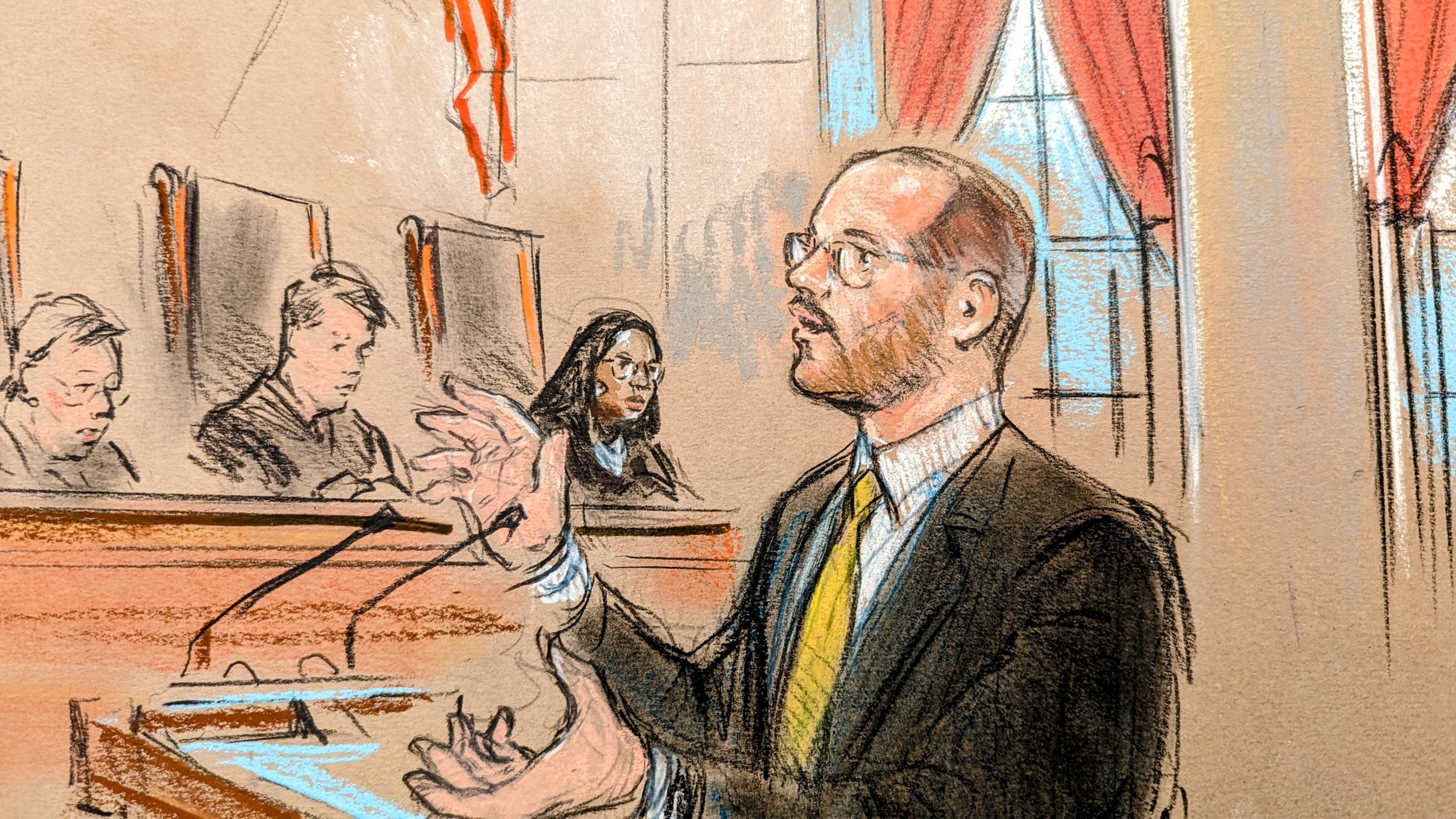
Darin Dalmat argues for the Teamsters. (William Hennessy)
By Sharon Block
Tuesday’s argument [12/10.23] in Glacier Northwest v. International Brotherhood of Teamsters provided little new insight into how the Supreme Court may decide the case. The justices from the conservative wing remained relatively quiet, allowing the three more liberal justices to dominate the argument. The issues that garnered most of the justices’ attention can be categorized under three topics: (1) what is the breadth of Garmon preemption; (2) what does it mean for striking workers to take “reasonable precautions” to prevent property damage; and (3) in what order should state courts and the National Labor Relations Board make findings regarding strike conduct when a tort action has been filed.
The first area of discussion in the argument centered around what test the Supreme Court should apply in determining whether the state court action can proceed. Put another way, when is state court action related to a labor dispute preempted by federal labor law? This type of preemption is referred to as “Garmonpreemption,” after the Supreme Court case that first articulated the standard. Justice Clarence Thomas probed whether Garmon is “normal” preemption or something more expansive. He asked both sides whether there is any precedent or statutory hook for treating Garmon preemption as imposing greater limitations on state court action than the limitations imposed by other federal regulatory regimes. Justice Neil Gorsuch phrased a similar inquiry as determining how far the “penumbra” of Garmon preemption extends – is it a “medium” or “huge” penumbra?
The next area of discussion the court focused on was how to define what type of strike conduct would remove the activity from even the arguable protection of the National Labor Relations Act. Justices Sonia Sotomayor, Elena Kagan, and Ketanji Brown Jackson pressed both the company and union lawyers on whether and how to draw a line between conduct that damages an employer’s goods and that which damages the employer’s equipment and premises. These justices seemed to be searching for a way to make a clearer distinction than the current articulation of the standard that says that unions must take “reasonable precautions” to prevent property damage in order to retain protection of the NLRA. They possibly are looking for a way to establish more clearly that damage to perishable items that happens merely as a consequence of the cessation of work is safe from tort liability, while activity that approximates vandalism – permanent harm to the company’s physical plant and equipment – is not. Chief Justice John Roberts offered a hypothetical to test this distinction. He asked whether the union was arguing that it would be okay for dairy workers to allow milk to spoil but it wouldn’t be okay for them to shoot the cows.
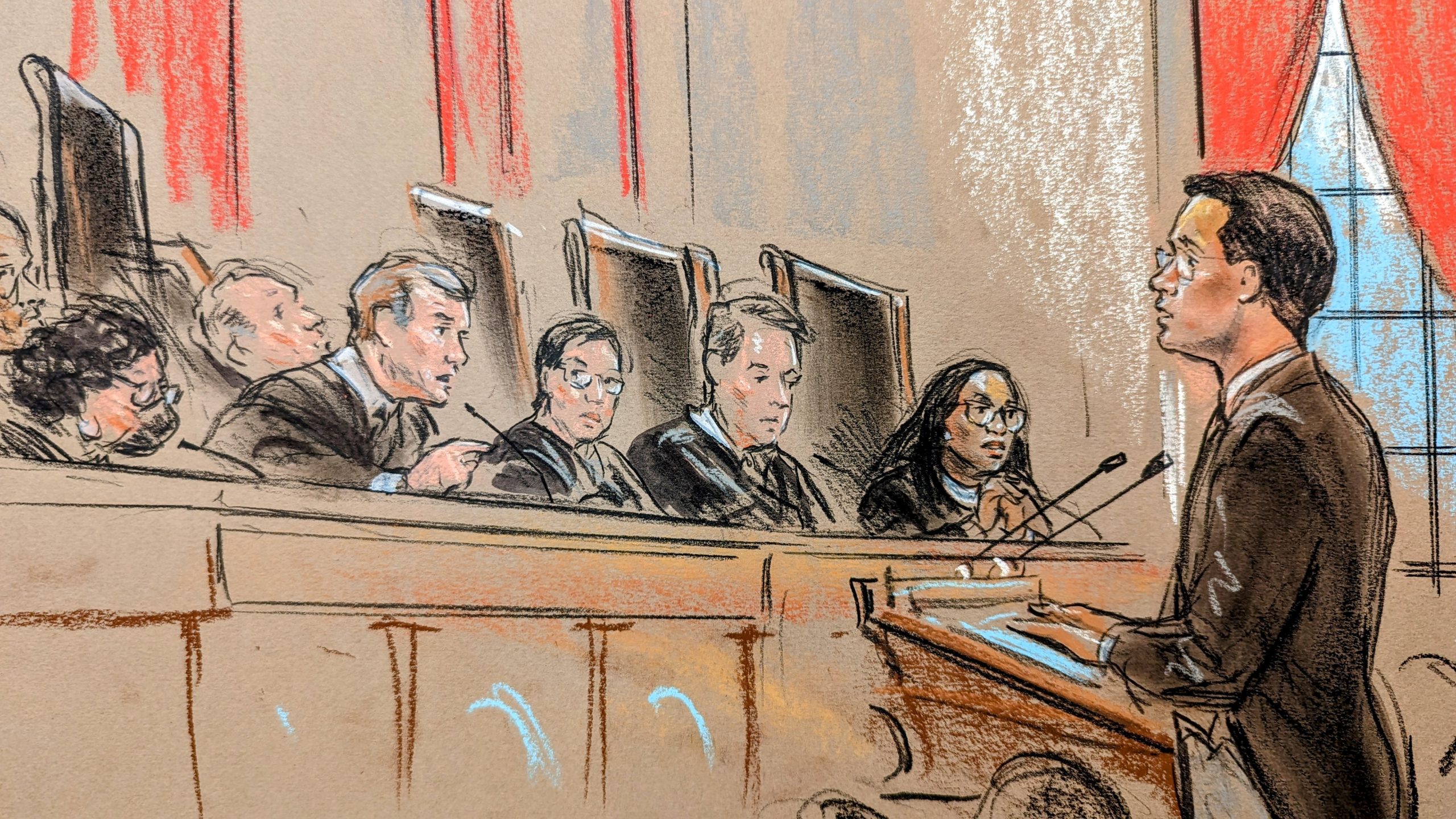
Vivek Suri argues for the United States as amicus curiae. (William Hennessy)
The final area that attracted the court’s attention was nailing down the parties’ views on who should decide what and in what order. Thomas asked the company why it wasn’t okay to allow the state court to take up the tort case after a “jurisdictional hiatus,” during which the NLRB could make findings about whether the strike conduct was protected under the NLRA. Several justices asked about the consequences of the state court and the NLRB coming to different conclusions about the facts or the law. Kagan asked Noel Francisco, representing the company, what if the state court goes first and “gets it wrong.” Without hesitation, Francisco responded that “state courts get it wrong all the time” and parties then appeal to the Supreme Court. Sotomayor questioned whether such an outcome would render the NLRB’s adjudication irrelevant. Jackson raised congressional intent – she offered that, by creating an agency with labor expertise, wasn’t it fair to assume that Congress wanted the board to take a primary role in figuring out questions like the one before the court.
Local boys make good. The Democrat leaders of the United States House of Representatives and the Senate are Brooklyn born and bred. Brooklyn born and educated - I say thanks. - GWC
OTHERWISE: Hakeem Jeffries passes the gavel: “I was born in Brooklyn hospital and raised in a working class neighborhood in Crown Heights… Somehow survived the violence or the crack c...
The opinion of Samuel Alito in Dobbs v. Jackson Women's Health suggests strongly that states could criminalize abortion. The Alabama Attorney General seems to be headed there. Justice Alito explained:
the dissent’s analogy is objectionable for a more important reason: what it reveals about
the dissent’s views on the protection of what Roe called “potential life.” The exercise of the rights at issue in Griswold [contraception],
Eisenstadt contraceptive foam], Lawrence [same sex intimacy], and Obergefell [same sex marriage] does not destroy a “potential life,” but an abortion has that effect.
So if the rights
at issue in those cases are fundamentally the same as the
right recognized in Roe and Casey, the implication is clear:
The Constitution does not permit the States to regard the
destruction of a “potential life” as a matter of any significance.
That view is evident throughout the dissent. The dissent
has much to say about the effects of pregnancy on women,
the burdens of motherhood, and the difficulties faced by
poor women. These are important concerns.
However, the
dissent evinces no similar regard for a State’s interest in
protecting prenatal life. The dissent repeatedly praises the
“balance,” post, at 2, 6, 8, 10, 12, that the viability line
strikes between a woman’s liberty interest and the State’s
interest in prenatal life. But for reasons we discuss later,
see infra, at 50–54, 55–56, and given in the opinion of THE
CHIEF JUSTICE, post, at 2–5 (opinion concurring in judgment), the viability line makes no sense. ***
Our opinion is not based on any view about if and when
prenatal life is entitled to any of the rights enjoyed after
birth.
One week after the federal government made it easier to get abortion pills, Alabama Attorney General Steve Marshall said Tuesday that women in Alabama who use those pills to end pregnancies could be prosecuted.
That’s despite wording in Alabama’s new Human Life Protection Act that criminalizes abortion providers and prevents its use against the people receiving abortions. Instead, the attorney general’s office said Alabama could rely on an older law, one initially designed to protect children from meth lab fumes.
“The Human Life Protection Act targets abortion providers, exempting women ‘upon whom an abortion is performed or attempted to be performed’ from liability under the law,” Marshall said in an emailed statement. “It does not provide an across-the-board exemption from all criminal laws, including the chemical-endangerment law—which the Alabama Supreme Court has affirmed and reaffirmed protects unborn children.”
77. Each day offers us a new opportunity, a new possibility. We should not expect everything from those who govern us, for that would be childish. We have the space we need for co-responsibility in creating and putting into place new processes and changes. Let us take an active part in renewing and supporting our troubled societies.
Today we have a great opportunity to express our innate sense of fraternity, to be Good Samaritans who bear the pain of other people’s troubles rather than fomenting greater hatred and resentment. Like the chance traveller in the parable, we need only have a pure and simple desire to be a people, a community, constant and tireless in the effort to include, integrate and lift up the fallen.
We may often find ourselves succumbing to the mentality of the violent, the blindly ambitious, those who spread mistrust and lies. Others may continue to view politics or the economy as an arena for their own power plays. For our part, let us foster what is good and place ourselves at its service. ***
From the beginning of Monday’s oral argument in Ohio Adjutant General’s Department v. Federal Labor Relations Authority, it was crystal clear that Ohio Solicitor General Benjamin Flowers would focus like a laser beam on the claim that the FLRA has no statutory authority to issue orders against state agencies.
“The Reform Act defines agencies to include executive departments, government corporations, and independent establishments,” he said, referring to a 1978 federal law that established collective-bargaining rights for employees of the federal government. “Adjutants General and state Guards are none of these things.” Ohio now clearly concedes that the dual-status National Guard technicians at issue in the case are federal employees by virtue of The Technicians’ Act. But, argued Flowers strenuously, that designation did not “convert” state agencies to federal agencies against whom the FLRA may issue orders. Justice Clarence Thomas underscored the concern: “That’s the leap that I’m having some difficulty with.”
But Justice Ketanji Brown Jackson focused on the congressional intent behind federal employee designation of the technicians — who are state employees for some purposes, and federal employees when engaged in other functions: organizing, administering, instructing, or training of the National Guard; and the maintenance and repair of supplies issued to the National Guard. Jackson asked, respecting the delegation of federal employee status to technicians, “Surely you’re not saying that we can just decide whatever we want about this policy without reference to what Congress intended.” Flowers responded: “As long as congressional intent is interpreted with respect to the statute.”
So, the textualist arguments were framed as Ohio might have liked. But the fly in the ointment continues to be that Ohio has acquiesced to the dual-employment arrangement — and benefitted from it — since the 1970s. The important factual context here is that when workers are engaged in federal employment they receive federal employment benefits (including the right to collectively bargain) and those benefits help the Guard recruit highly qualified individuals. Still, as Justice Neil Gorsuch hypothesized, the arrangement might trigger constitutional notions of federal commandeering were it not for broad state consent to this model of collective bargaining over the preceding half-century. Though — as developed during the argument — there were legislative efforts decades ago to upset the model, those efforts failed. Congress appears to have accepted the arrangement, even though it has not attempted to include the local Guard, or the state adjutant generals who act as the commanders of each state’s Guard, under the definition of “agency.” And Justice Sonia Sotomayor invoked what she called Justice Elena Kagan’s “venerable rule” (though she was actually quoting Kagan from the first case argued on Monday): “If it ain’t broke, don’t fix it.”
Chafetz, Josh, The New Judicial Power Grab (January 10, 2023). St. Louis University Law Journal, Vol. 67, Forthcoming, Available at SSRN: https://ssrn.com/abstract=4321887
The consequences of the Supreme Court majority's embrace of the right to go armed in public continue to play out. Last week a minister's claim that he has a First Amendment right to carry a pistol in on the pulpit was vindicated by a federal District Jduue in Rochester, NY. Now this decision from the entire 5th Circuit - a Court which led the fight to implement the promise of Brown v. Board of Education. the right to be armed seems to motivate that court now with the passion their predecessors - like John Minor Wisdom- once brought to eliminating racism in education root and branch. - GWC 1/9/23
Law360 (January 6, 2023, 11:40 PM EST) -- The full Fifth Circuit on Friday struck down a Bureau of Alcohol, Tobacco, Firearms and Explosives' rule banning bump stocks, reversing a Texas federal court's decision and subsequent panel ruling upholding the rule following the appellate court's en banc review.
In a split 13-3 decision, the Fifth Circuit majority held that a bump stock doesn't qualify as a "machine gun" under federal law, and the ATF therefore lacked the authority to prohibit bump stocks.
The en banc ruling vacates a Fifth Circuit panel's December 2021 decision finding that the ATF was correct to interpret the definition of a machine gun to include bump stocks, as it was Congress' intent to address the rate of firearms, not the specific mechanism that allows for it.
On Friday, the Fifth Circuit majority sided with firearms instructor Michael Cargill, who challenged the 2019 ban in Texas federal court. In doing so, it held that a semi-automatic rifle equipped with a non-mechanical bump stock doesn't constitute a weapon that "shoots, is designated to shoot or can be readily restored to shoot, automatically, more than one shot … by a single function of the trigger," the court said Friday, citing the Gun Control Act of 1968's definition of a machine gun.
Specifically, the majority said that every shot fired by a bump stock-equipped semi-automatic rifle requires a separate function of the trigger. And that means that it can't be interpreted as a machine gun under the statute prohibiting them.
Writing for the majority, U.S. Circuit Judge Jennifer Walker Elrod said that, in defining a "machine gun," Congress "referred to the mechanism by which the gun's trigger causes bullets to be fired. Policy judgments aside, we are bound to apply that mechanical definition. And applying that definition to a semi-automatic rifle equipped with a non-mechanical bump stock, we conclude that such a weapon is not a machine gun for purposes of the Gun Control Act and National Firearms Act."
She added that she cannot say the National Firearms Act and Gun Control Act "give fair warning that possession of a non-mechanical bump stock is a crime."
"Many commentators argue that non-mechanical bump stocks contribute to firearm deaths and that the final rule is good public policy," Judge Elrod said. "We express no opinion on those arguments because it is not our job to determine our nation's public policy. That solemn responsibility lies with the Congress, and our task is confined to deciding cases and controversies, which requires us to apply the law as Congress has written it."
Ultimately, the bump stock ban violates the Administrative Procedure Act, according to the decision. The Fifth Circuit remanded the case to the district court to determine "the proper scope of relief," which could be injunctive, declarative "or otherwise."
In his dissent, U.S. Circuit Judge Stephen A. Higginson — joined by U.S. Circuit Judges James L. Dennis and James E. Graves Jr. — said a bump stock should indeed be a machine gun within the meaning of the law. In particular, Judge Higginson said he disagreed with the majority's use of lenity to "rewrite this statute."
Under the rule of lenity, an ambiguous law must be applied in a manner that is most favorable to the defendant or construe it against the state. Judge Higginson said the U.S. Supreme Court has repeatedly instructed that the rule of lenity only applies if there's a "grievous ambiguity or uncertainty in the statute" to the point that a court must "simply guess" as to what Congress intended. It is intended to only be deployed as a "last resort," the judge said.
"Today, our court extends lenity, once a rule of last resort, to rewrite a vital public safety statute banning machine guns," Judge Higginson said.
He noted that the bump stock is a "device that helped the Las Vegas shooter fire over 1,000 rounds during an 11-minute long attack, at times shooting about nine bullets per second, killing at least 58 people and wounding hundreds more."
"Therefore, our court uses lenity to legalize an instrument of mass murder," Judge Higginson said.
U.S. Circuit Judge Catharina Haynes penned a short concurrence, which Chief Judge Priscilla Richman joined, writing, "I concur in judgment only because I reluctantly conclude that the relevant statute is so ambiguous such that the rule of lenity favors the citizen in this case."
On top of that, Judge Richman joined another concurrence written by U.S. Circuit Judge James C. Ho. In that concurrence, which was also joined by U.S. Circuit Judge Leslie H. Southwick, Judge Ho wrote that it is not enough to conclude that a criminal statute should cover a particular act.
"The statute must clearly and unambiguously cover the act," he said.
He likened the bump stock issue to designer drugs, which he said don't fit within the definitions established by the Controlled Substances Act but are just as lethal. The same policy justifications for banning scheduled drugs readily applied to designer drugs, he said.
"Yet all three branches agreed that existing law did not ban designer drugs," Judge Ho said.
The New Civil Liberties Alliance, which represents Cargill in the case, said in a statement Friday that it is pleased that a circuit court has recognized "that Congress must be the one to pass any bump stock ban."
"The resulting circuit split should bring this decision to the U.S. Supreme Court's attention promptly and supply a suitable vehicle for deciding this issue once and for all," the NCLA said.
ATF declined to comment late Friday.
Several other federal appeals courts have upheld the ATF's 2019 ban, including the Tenth Circuit, which declined to hold an en banc rehearing in March 2021 after affirming a decision in a similar suit in May 2020.
The ATF's ban was proposed in the wake of the deadly October 2017 shooting at the Mandalay Bay hotel in Las Vegas, where the shooter used a bump stock to rapidly fire his rifle. The ban took effect March 2019.
Cargill claimed in his suit that the ATF exceeded its authority, arguing that the ban goes against the plain language of the National Firearms Act. That law prohibits the possession of machine guns.
The district court tossed his suit, but Cargill appealed, arguing that the National Firearms Act's definition of machine guns as weapons that shoot "more than one shot … by a single function of the trigger" excludes bump stocks. Bump stocks use the gun's recoil to quickly effect multiple trigger pulls, Cargill said.
A three-judge Fifth Circuit panel disagreed with Cargill, but a majority of Fifth Circuit judges voted to grant an en banc rehearing in June 2022.
Cargill is represented by Richard Samp and Mark Chenoweth of the New Civil Liberties Alliance.
The government is represented by Brian M. Boynton, Ashley C. Hoff, Mark B. Stern, Michael Raab, Abby C. Wright, Brad Hinshelwood and Kyle T. Edwards of the U.S. Department of Justice.
What do I have in common with the Democratic Party leaders in the House of Representatives, and the United States Senate? Brooklyn natives.
Hakeem Jeffries as he passes the gavel to Kevin McCarthy
“I was born in Brooklyn hospital and raised in a working class neighborhood in Crown Heights… Somehow survived the violence or the crack cocaine epidemic and wound up here in the United States Congress, as the highest ranking Democrat in the House of Representatives.
“America is truly a land of opportunity… On this first day, let us commit to the American dream that promises that if you work hard and play by the rules, you should be able to provide a comfortable living for yourself and for your family.” - Hakeem Jeffries, Minority Leader, U.S.House of Representatives.
The South Carolina Constitution provides a right to privacy that includes the right to abortion, the state’s Supreme Court ruled on Thursday, saying “the decision to terminate a pregnancy rests upon the utmost personal and private considerations imaginable.”
The decision overturns the state’s law banning abortions after roughly the sixth week of pregnancy. More broadly, it is a victory for abortion rights in the South, where states have severely restricted access.
It is the first final ruling by a state Supreme Court on the state constitutionality of abortion since the U.S. Supreme Court overturned Roe v. Wade in June, which ended the right to abortion under the federal constitution that had been in force for half a century, and left the matter to the states.
Abortion rights groups responded to that decision by filing suits in 19 states, seeking to establish a right to abortion under state constitutions, in many cases citing explicit provisions in those documents protecting a woman’s privacy and equal rights. The South Carolina case was a critical first test — and success — for that strategy.
Today, the Federalist Society hosted a debate between Ilan Wurman and Chad Squitieri on the major questions doctrine (the “MQD”). The debate was interesting and it reminded me about something I was pondering over the holidays. The debate was framed around whether the MQD is consistent with textualism/originalism. The textualist critique of the MQD has a really different flavor from the non-textualist critiques. When Chad and Ilan are debating the MQD, they’re holding a canon of statutory interpretation up against a pre-loaded conception of the judicial role in statutory interpretation. In an important sense, they’re talking about whether the MQD is a legitimate tool of statutory interpretation by channeling their shared grammar for evaluating judicial doctrine.
That conversation, the textualist debate on the MQD, has all the warm familiarity of a genre movie. A textualist who wants to write that paper can call on all the “moves” that people have been making in textualist papers for thirty years. That’s not to say that textualists don’t have sub rosa disagreements that we often just glide right over. But they at least have a shared language for debating whether the absurdity doctrine, avoidance, lenity, and Chevron deference are inconsistent with a textualist’s take on the judicial role in statutory interpretation. Justice Barrett, for example, wrote a paper examining substantive canons’ consistency with textualism and legislative supremacy. Whether a textualist critique of the MQD is a good or bad paper just turns on the level of craft, kind of like the director of a straight-up western.
By contrast, non-textualist critiques of the MQD have focused on describing the MQD’s horrendous consequences. To be clear, that’s important work. We have papers describing the likelihood that the MQD will calcify political polarization into judicial doctrine, make it more difficult for the federal government to tackle global issues like climate change, and undermine our national security apparatus. And you have many papers suggesting that the MQD makes for bad judicial doctrine because it is unmanageable. But while these papers suggest that the MQD is bad doctrine, they only discuss whether the MQD is an appropriate tool of statutory interpretation when leveling a hypocrisy charge at the conservative and avowedly textualist justices for moving beyond text. So if you, like me, cynically think that the consequences and imprecision of the MQD are entirely foreseeable and perhaps intentional, then it’s hard to think that these papers will persuade anyone not already disposed towards viewing the MQD with suspicion. (I don’t think anybody still supporting the MQD will be turned around by charges that the doctrine—gasp—has a deregulatory bend.)
I think there’s at least a few reasons why non-textualist critics of the MQD have avoided making similar claims. First, and most obviously, non-textualist critics of the MQD lack a preloaded and ascendant conception of the judicial role in statutory interpretation. Second, and relatedly, non-textualists are probably feel pretty queasy about reinforcing the kind of formalism that defines modern textualism and originalism. The best way to approach the MQD is as judicial policymaking. Once we acknowledge that the descriptive case for the MQD—the idea that Congress “speaks” clearly when addressing major questions—is just a really bizarre fiction, all roads lead to acknowledging that the MQD is judicial policymaking. I don’t think anybody seriously thinks the MQD is required either by the Constitution or anything else. Even the most hardcore pro-MQD constitutional formalists think it is a second-best option to the nondelegation doctrine. But if you think the MQD is about “second-best originalism,” that’s still a question of policymaking.[i] Non-textualist critics of the MQD can evaluate the doctrine as judicial policymaking—there’s plenty of work to be done there—but to do so critically may require approaches that are unpalatable to purposivists and pragmatists.
Regardless, there’s a noticeable hole in the literature where the non-textualist take on the MQD’s legitimacy should be. Just as an avid consumer of the literature and low-level participant, I’m hoping 2023 is the year where we get more of these kinds of critiques of the MQD. I don’t really mean to suggest that MQD critics ought to adopt any particular conception of the judicial role in statutory interpretation. I just think that whatever your priors on judicial policymaking, folks can do a lot of work in making those priors explicit and evaluating the MQD accordingly. I think there’s a ton of ways to do this without dipping a toe into textualism.
My own thinking on this has evolved over the last year. I’m trying to more rigorously separate my reasons for thinking that the MQD is bad from my suspicions that the doctrine is illegitimate. For me, it all goes back to interpretation-construction distinction (which is a concept for the judicial role that may be older than the Republic). My whole worldview in statutory interpretation acknowledges that there’s some role for judicial policymaking at the tail end of the interpretive process—at least as it has been done in this country since the Founding. But it’s not limitless and the limits are what I’m bringing to the table when I call the MQD an illegitimate tool of judicial self-aggrandizement. Confining courts’ policymaking to construction keeps them from overriding statutory text, undoing legislative supremacy, and subverting democracy. Reinforcing the interpretation-construction distinction is basically what the Court already did in Kisor. (Dibs on the “we just need to Kisor the MQD” essay.) Before Kisor, Chevron and Auer skeptics complained that deference was leading to judicial abnegation. Judges were deferring without giving an honest go at following their best read of statutory and regulatory text. So the Kisor Court made abundantly clear that lower courts are only to defer after they jump through a bunch of hoops. Chevron and Auer are tools of construction, only to be applied in cases of ambiguity as a last resort. MQD just does what critics were always accusing Chevron and Auer of doing. If we did manage to Kisor the MQD, well then the construction zone is a more acceptable place for judicial policymaking. Afterall, judges need to decide cases somehow, even if statutes are hopelessly ambiguous. (I’d prefer if they minimized their judicial policymaking more aggressively but c’est la vie.) If the MQD were a tool of last resort, it would still be awful in my eyes—you know, judicial self-aggrandizement, “made up” yada-yada—but I couldn’t say that there was anything illegitimate about it—at least as a question of judicial practices that have existed for hundreds of years. I wouldn’t even bother to write about that MQD.
Overall, I think that it’s important to start addressing the legitimacy of the MQD. When the shoe was on the other foot, when Chevron skepticism was in its highest gear, scholars, practitioners, and activists objected that Chevron was illegitimate. That language of legitimacy is important for persuasion when folks disagree about their policy priors. To do that kind of work with the MQD, you have to invoke some theory of the judicial role explicitly and hold it up against what the Court is doing.