Monday, October 12, 2020

Trump's Christian Judges March On - Rolling Stone

Trump's Christian Judges March On - Rolling Stone
by Sarah Posner
n August, Justin Walker, a federal judge in Louisville, Kentucky, issued an unusual order in favor of Chelsey Nelson, a local wedding photographer and blogger. Nelson, a Southern Baptist, claimed in a lawsuit that her Christian faith dictates “that God ordained marriage to be a covenant between one man and one woman so that this relationship would point people to the special relationship between God and His bride, the church.” Because of this, Nelson contended, she could not provide photography services to same-sex couples, or write about her views of same-sex marriage on her website. Nelson did not report receiving requests for her photography services from any same-sex couples, nor had any government agency investigated Nelson’s business or sought to prevent her from writing about her religious views or any other subject. The Louisville Metro Human Relations Commission, which is charged with enforcing the municipality’s nondiscrimination ordinance prohibiting discrimination on the basis of, among other factors, sexual orientation and gender identity, had never heard of her.
Nelson had a powerful defender in addition to her lawyers at Alliance Defending Freedom, the formidable legal firm that has pioneered the argument that religious freedom collides with LGBTQ rights. The United States Department of Justice filed a “statement of interest” in the case, arguing: “Forcing Ms. Nelson to create expression for and to participate in a ceremony that violates her sincerely held religious beliefs invades her First Amendment rights.
Judge Walker, who had been nominated to the federal bench by President Donald Trump in 2019, waved away the Commission’s argument that Nelson had no viable legal claim. He allowed Nelson’s suit to go forward and entered an order preemptively barring the government from taking an action it had never even contemplated while the case proceeds. Just like gay and lesbian Americans cannot be treated as second-class citizens under the Constitution, Walker wrote, neither can Christians who oppose the Constitutional right to marry. “America is wide enough for those who applaud same-sex marriage and those who refuse to,” he wrote.
The opinion was a victory for Christian-right legal activists who have spent the better part of the past decade building lawsuits to give conservative Christians who oppose LGBTQ rights wide latitude to opt out of complying with state and local laws that prohibit discrimination based on sexual orientation or gender identity. And now, with a growing number of sympathetic judges on the bench, Christian-right activists more firmly established the legal precedent for those claims, carving out exemptions for conservative religious objectors refusing to issue LGBTQ marriage licenses or photograph weddings, or to place foster or adoptive children with same-sex couples.
 On the Supreme Court’s docket this term is a case, Fulton v. City of Philadelphia, in which the court will decide whether the city of Philadelphia violated the constitutional rights of a Catholic foster care placement agency when it declined to work with the agency because of its refusal to place foster children with same-sex couples. The case “is of great concern to advocates for children in foster care, the LGBTQ community, members of minority faiths, and states and cities that contract out important government services like foster care to the private sector,” says Leslie Cooper, deputy director of the American Civil Liberties Union’s LGBT & HIV Project. “There is simply no support in the law for the argument that the constitutional right to religious liberty entitles an organization to screen out people based on religious criteria when providing a government service.”

Sunday, October 11, 2020

Trump’s Swamp: Taxes Trace Payments to Properties by Those Who Got Ahead - The New York Times

So NY Assembly Speaker Sheldon Silver (D Manhattan) is in jail (over a dubiously criminal favor), and Senator Dean Skelos (R Nassau) is still under house arrest (for corruptly helping out his son).  But Donald Trump is still in the White House.  Perhaps his day will come. - gwc
Trump’s Swamp: Taxes Trace Payments to Properties by Those Who Got Ahead - The New York Times

Saturday, October 10, 2020

Court Packing as an Antidote by Rivka Weill :: SSRN

Court Packing as an Antidote by Rivka Weill :: SSRN
by Rivka Weill [Herzliyah - Radzyner School of Law]
Court packing is considered the nuclear weapon that may unleash total chaos on the American constitutional system. Even in the face of a highly controversial appointment process to the US Supreme Court during the 2020 presidential election season, scholars caution against the wisdom and utility of resorting to court packing. This Essay makes three bold arguments: First, a President may nominate a candidate to the Supreme Court at any time, including his last year in office; this is true both empirically and normatively. It is the Senate’s responsibility to ensure the People’s will is not frustrated. Second, never since the American Civil War did the Senate confirm a Supreme Court Justice in a presidential election year without bipartisan support. In fact, except for the sensational appointment of Justice Peter Daniel in 1841, all appointments to the Supreme Court in presidential election years involved either bipartisan consent or confirmation by the incoming Senate with a fresh mandate. This is true even of appointments made after presidents became lame-duck or lost re-election bids and even when the President’s party controlled the Senate. Disregard of this embedded constitutional convention undermines fundamental principles of popular sovereignty. Third, the breach of this constitutional convention is not a matter for political repercussions alone. Well-aware of the potential of court packing to rein-in a Court, the Founding Fathers intentionally allowed its exercise in the Constitution. Further, they adopted life-tenure for Justices while relying on the availability of court-packing as a restraining mechanism to protect popular sovereignty. Court packing is the antidote by constitutional design to a partisan takeover of the Supreme Court during election time as part of the inherent checks and balances of a popular sovereignty system. Senators must be aware that an appointment confirmed by a purely partisan vote during presidential election time legitimizes court-packing as a counter-measure.
Keywords: court packing, life tenure, constitutional convention
Weill, Rivka, Court Packing as an Antidote (October 9, 2020). Available at SSRN: https://ssrn.com/abstract=

H-Block and Armagh Prisons Independent Panel Report Details the Systemic Inhumane Treatment of Prisoners | News | Garden Court Chambers | Leading Barristers located in London, UK

Richard Harvey, an old friend, after his return to his native England dedicated himself to uncovering the disgraceful practices of the British courts and prisons in Northern Ireland.  This is his latest contribution.  - GWC
H-Block and Armagh Prisons Independent Panel Report Details the Systemic Inhumane Treatment of Prisoners | News | Garden Court Chambers | Leading Barristers located in London, UK
An unprecedented new report released today by the Independent Panel of Inquiry into the Circumstances of the H-Block and Armagh Prison Protests 1976-1981 concludes that protesting prisoners in the H-Blocks and HMP Armagh were subjected to systemic inhuman and degrading treatment, in some cases amounting to torture.
The report, titled ‘I Am Sir, You Are A Number’ is the first comprehensive review and analysis of the experiences of men and women prisoners held in the H-Blocks and Armagh following the withdrawal of Special Category Status on 1st March 1976. 
It identifies forty-seven key findings reflecting persistent abuses of power endured by the men and women held in the H-Blocks and Armagh and the long-term impact on the lives of former prisoners and their families.
The Independent Panel was chaired by the late Warren Allmand, former Solicitor-General for Canada; alongside Richard Harvey, Barrister-at-Law, Garden Court Chambers, London; and Dr John Burton, retired family doctor and researcher in Human Rights Law.
Panel member and international Barrister Richard Harvey, said:
“Evidence we gathered from the UK Government’s confidential documents show it was known and accepted that extreme brutality would be used in implementing the withdrawal of Special Category Status in violation of prisoners’ rights under Article 3 of the European Convention.”
The Panel heard testimonies from Republican blanket protestors, Loyalist prisoners, former prison governors, medical practitioners (including a consultant psychiatrist) and lawyers, academics, politicians and clergy.
In harrowing evidence before the Panel, former prisoners revealed the circumstances and consequences of the severe policies and punishing practices directed against them over a sustained period.
Documents accessed by the Panel’s researchers demonstrate that the UK Government, NI Civil Servants and the NI Prison Service were aware of the consequences of ending Special Category Status, described in one official document as ‘an administrative and disciplinary disaster’, within the prisons.

Friday, October 9, 2020

Amy Barrett: A Different Kind of Originalist | Commonweal Magazine

Amy Coney Barrett's legal philosophy is deeply antidemocratic - Los Angeles  Times
A Different Kind of Originalist | Commonweal Magazine
By Gregory Bassham
If confirmed by the Senate, Judge Amy Coney Barrett will become the sixth conservative justice on the Supreme Court, likely ensuring a solid right-wing majority on the court for many years to come. For that reason, it is imperative that the Senate set aside the partisan passions of the moment and reflect on what Barrett’s nomination might mean for the future of the court and the nation.
In her White House speech accepting President Trump’s nomination, Barrett stated that Justice Antonin Scalia’s “judicial philosophy is mine, too.” A look at her extensive academic scholarship, however, reveals a very different picture.
Barrett served as a law clerk for Scalia, a conservative. Like her mentor, she takes an “originalist” approach to legal interpretation. Originalists claim that written legal texts, including constitutions, must be interpreted according to their original meanings. In this view, the Constitution is not a “living document” that adapts to changing circumstances and evolving values. Its meaning is fixed when it is adopted, and is considered binding law until formally changed or repealed by amendment.
Also like Scalia, Barrett embraces a particular brand of originalism, now fashionable in conservative legal circles, called “public meaning originalism.” According to this view, the meaning of a legal text is not determined by the intentions or purposes of its authors or adopters, but rather by its public “textual” meaning. What matters is the law’s conventional or ordinary meaning in context—how a typical informed reader of the time would have understood it—not the expressed or unexpressed “intent” of those who wrote or enacted the law.
On these basics Scalia and Barrett agree. But they have very different views on the critical issues of judicial restraint and respect for legal precedent.
For Scalia, the central virtue of originalism as a method of interpreting the Constitution is the way it limits judicial policymaking by unelected and tenured judges, thus honoring the basic democratic values of our constitutional tradition. By contrast, Barrett argues that it was a mistake for “early originalists” such as Scalia to stress the importance of judicial restraint. In her view, the original textual meaning of the Constitution is the law, period. Originalist judges have a sworn duty to uphold the law—even if that requires activist rulings, which may be deeply unpopular and invite frequent collisions with Congress and other democratically accountable legislative bodies.
In Barrett’s view, the original textual meaning of the Constitution is the law, period.
One clear example of this activist bent is Barrett’s rejection of the long-standing view that courts, in interpreting statutes, should view themselves as “faithful agents” of the relevant legislative bodies. Since lawmaking powers have been granted to legislatures, not courts, in our constitutional system, judges have been seen as properly playing a subordinate role in furthering and implementing the rule-making prerogatives of legislatures. Barrett once accepted this traditional view, but recently renounced it in a 2017 article “Congressional Insiders and Outsiders.” When interpreting statutes, judges should see themselves as “agents of the people,” not of legislatures, she argued. They can best carry out this populist role by enforcing statutory words in their “plain,” ordinary meanings, even when such meanings were clearly not intended or desired by the lawmakers, and even when such readings lead to apparent absurdities or gross injustices. (Why such absurdities and injustices are thought to be in the interest of “the people” is unexplained.) The upshot is that courts would see themselves not as partners and honest agents of legislative bodies, but as adversarial watchdogs. This is an activist conception of the judicial role, not a subordinate or passive one.
A second (and related) major point of disagreement between Barrett and Scalia is the importance of respecting prior court decisions that are mistaken according to public meaning originalists. KEEP READING

Thursday, October 8, 2020

Union County Lawyer Suspended for 2 Years Over Taxes, Mortgage Loans to Client | New Jersey Law Journal

Union County Lawyer Suspended for 2 Years Over Taxes, Mortgage Loans to Client | New Jersey Law Journal
By Charles Toutant
The New Jersey Supreme Court has suspended Kenilworth attorney Howard Burger for two years over improper loans to a client.
Burger made a series of loans totaling $410,000 between 1997 and 2009 to Al Amjady, the operator of a used-car lot in Elizabeth, whose business relationship with Burger had evolved into a close friendship, according to the Disciplinary Review Board.
He made the initial loan of $150,000 to allow Amjady to purchase land for the used-car lot, and the loans were secured by the land, the disciplinary board said.
The board found Burger committed tax fraud by collecting interest payments from Amjady, failing to deposit the payments in a bank account and failing to pay federal or state taxes on that income.
But Burger later filed amended tax returns and paid back taxes owed to the federal and state governments, the disciplinary board said.
The board also said Burger “arguably” committed insurance fraud by taking out a life insurance policy for Amjady, which was based on misrepresentations of Amjady’s income and net worth. It also noted that Burger engaged in tax fraud, despite his masters degree in corporate law and his experience as founder of The Enterprise Bank, a commercial financial institution.

‘Exclusively in Cash’

In 2017, after Amjady stopped making payments on the debt, Burger brought a foreclosure action. Amjady, through counsel, sought to nullify the mortgages based on Burger’s alleged conduct in making loans that were “not fair or reasonable” and were “not fully disclosed or understood,” the disciplinary board said. A superior court judge ruled for Burger, entering a judgment of foreclosure after finding Amjady was a sophisticated businessman and the mortgage was valid.
A District Ethics Committee found that Burger violated New Jersey Rules of Professional Conduct 1.7(a)(2), which governs conflict of interest, and 1.8(a), improper business transaction with a client. It found an attorney-client relationship existed between Burger and Amjady at the time the loans were made, and Burger failed to obtain Amjady’s signature on a conflict waiver. The ethics committee declined to charge Burger with violation of Rules 8.4(b), commission of a criminal act, and 8.4(c), conduct involving dishonesty, fraud or deceit.
The Disciplinary Review Board reinstated the charges based on 8.4 (b) and (c) after the Office of Attorney Ethics argued that Burger willfully evaded income taxes, even though he was not charged criminally with tax evasion. The Office of Attorney Ethics cited Burger’s statements under oath that he recorded all his finances on Quicken software, with the exception of the interest payments from Amjady.
Burger “engaged in numerous improper mortgage loan transactions with Amjady, spanning more than nineteen years,” and that he “committed all this misconduct for the pecuniary benefit of himself, his family and other investors, operating exclusively in cash, reaping a significant profit, and then willfully evading income taxes on that very profit from 2010 to 2016. In fact, respondent finally admitted, during oral argument before us, after multiple prior denials during the course of these ethics proceedings, that he paid his back tax obligations only after the ethics grievance was filed in this case,” the board said.
By way of mitigation, Burger pointed out that he provided pro bono assistance for his synagogue and for surrogates’ courts in Essex and Union counties, including assisting victims of the 9/11 terrorist attacks. He also cited his extensive involvement in his local Rotary Club and his experience as an Eagle Scout.
Five Disciplinary Review Board members voted for a two-year suspension of Burger, and three others voted to disbar him.
The Supreme Court upheld the charges of vRPC 1.7(a)(2), 1.8(a), 8.4(b) and (c) and the two-year suspension, in an order made public Wednesday.
Petar Kuridza of Lewis Brisbois Bisgaard & Smith in Newark, representing Burger in the case, did not return a call for comment.

Jim Dwyer, Pulitzer Prize-Winning Journalist, Dies at 63 - The New York Times

Mr. Dwyer covered the subway system for New York Newsday, and his columns became the basis for a book, “Subway Lives: 24 Hours in the Life of the New York Subways.”
Jim Dwyer died this morning.  At 63. Lung cancer. Like Jimmy Breslin, he had the common touch. A journalist in the tradition of the Front Page. Like Pete Hamill and Mike McAlary he was a tribune of the people, a reason to buy the New York Daily News or New York Newsday or any paper for which he wrote. He was a veteran of the New Jersey dailies in Jersey City, Elizabeth, and Hackensack.  Jesuit educated (Loyola Prep and Fordham) we had that tribal link.  I had the good fortune to, like him, be a regular for breakfast at Vicky's the local Greek diner on West 187 Street in Washington Heights, now a casualty of covid19.  He loved my yellow Labs, tied up in front of the diner where I sat in the table by the window to keep them calm.  He appreciated their names and personalities: Seamus Heaney, and James J. Muldoon, named for great Irish poets.  His father, who never lost his Irish accent, often joined him for breakfast.  Jim was a character in Nora Ephron's Lucky Guy about McAlary and the other New York tabloid heroes.  Separated at breakfast by the corona virus, I didn't know he was ill.  I'm sorry I did not get to say goodbye to a man who deserved a long life. - GWC
Jim Dwyer, Pulitzer Prize-Winning Journalist, Dies at 63 - The New York Times
By Robert D. McFadden
Jim Dwyer, a Pulitzer Prize-winning reporter, columnist and author whose stylish journalism captured the human dramas of New York City for readers of New York Newsday, The Daily News and The New York Times for nearly four decades, died on Thursday in Manhattan. He was 63.
His death, at Memorial Sloan Kettering Cancer Center, was announced by Dean Baquet, the executive editor of The Times, and Clifford Levy, the paper’s metropolitan editor, in an email to the Times staff. The cause was complications of lung cancer.
In prose that might have leapt from best-selling novels, Mr. Dwyer portrayed the last minutes of thousands who perished in the collapse of the World Trade Center’s twin towers on Sept. 11, 2001; detailed the terrors of innocent Black youths pulled over and shot by racial-profiling state troopers on the New Jersey Turnpike; and told of the coronavirus besieging a New York City hospital.
Mr. Dwyer won the 1995 Pulitzer for commentary for columns in New York Newsday, and was part of a New York Newsday team that won the 1992 Pulitzer for spot news reporting for coverage of a subway derailment in Manhattan. Colleagues called him a fast, accurate and prolific writer who crusaded against injustice, worked for six metropolitan dailies and wrote or co-wrote six books.

Second Circuit again rebuffs Trump attempt to block Manhattan Grand Jury Subpoena


 The United States Court of Appeals for the Second Circuit has again rebuffed Donald Trump’s efforts to block any investigator from getting access to his tax and other financial records via the subpoena issued by a New York Grand Jury to Trump's accountants Mazars, LLC.  


Two hundred years ago, a great jurist of our Court established that no citizen, not even the President, is categorically above the common duty to produce evidence when called upon in a criminal proceeding. We reaffirm that principle today and hold that the President is neither absolutely immune from state criminal subpoenas seeking his private papers nor entitled to a heightened standard of need. - C.J.  John Roberts in Trump v. Vance (2020)

But, said Roberts:

"a President may avail himself of the same protections available to every other citizen. These include the right to challenge the subpoena on any grounds  permitted by state law, which usually include bad faith and undue burden or breadth. 

On remand from the Supreme Court, the President filed a Second Amended Complaint (SAC) in federal district court in Manhattan, under 42 USC 1983, for broad relief:

a. A declaratory judgment that the subpoena is invalid and unenforceable.

b. A permanent injunction quashing or modifying the subpoena as necessary to protect the President’s legal rights.

                                    c. A permanent injunction prohibiting the District Attorney from taking any action to enforce the subpoena, from imposing sanctions for noncompliance with the subpoena, and from

inspecting, using, maintaining, or disclosing any information obtained as a result of the subpoena.

The Circuit court recounts that Trump and the companies he owns and controls allege that the subpoena to Mazars is overbroad and was issued in bad faith. On overbreadth, the SAC alleges that many of the requested documents bear no relation to the payments made by Michael Cohen in 2016—which the SAC, relying on a contemporaneous New York Times article and the earlier subpoena to the Trump Organization, characterizes as the “focus” of the grand jury investigation. The SAC also notes the broad scope and timeframe of the Mazars subpoena to argue that the subpoena exceeds the District Attorney’s jurisdiction. Finally, the SAC alleges that the Mazars subpoena is overbroad and must have been issued in bad faith because it largely mirrors a legislative subpoena issued to Mazars by the House Committee on Oversight and Reform.

In a per curiam opinion issued October 7 the panel unanimously affirmed Judge Victor Marrero’s  dismissal of the complaint filed by Trump.  Judges Robert Katzmann, Pierre Leval and Raymond Lohier found that the overbreadth allegations did not meet the test of plausibility which a complaint must satisfy in a federal court in order to defeat a motion to dismiss under FRCP 12 (b)(5). “Similarly, the President’s allegations of bad faith fail to raise a plausible inference that the subpoena was issued out of malice or an intent to harass.”

The President’s lawyers sought to accomplish what they had failed to do in the first place, and the second, and the third - at the United States Supreme Court.  On remand the Trump lawyers filed a complaint alleging that the state prosecutor - here New York County District Attorney Cyrus Vance, Jr. - was acting in bad faith.  Proceeding under the post civil war era civil rights act 42 USC 1983 - the Trump complaint echoed the allegations in the landmark case of Dombrowski v. Pfister (1965).  But there the Louisiana prosecutors were proceeding under the state’s Communist Control Act.  The Louisiana statute was identical to a Washington State law that the Supreme Court had declared unconstitutional.  So there the allegation of bad faith was more than plausible.  Further dooming the Trump effort to block the subpoena is the doctrine of deference to state law and prosecutors which is deeply embedded in the law.  See, for example, Younger v. Harris (1972) which further constrained federal courts ability to interfere in state prosecutions.

The parties on October 2 agreed on an expedited briefing schedule including that if the District Attorney prevailed the DA will "forbear" enforcement and the Trump parties will within five days seek relief from the United States Supreme Court.

Monday, October 5, 2020

Thomas and Alito: "ruinous consequences" for religious liberty

Pin on Homosexuality / Gender / LGBT
The Obergefell case, recognizing the right to marriage of same sex couples, has had "ruinous consequences" for religious liberty, Justice Clarence Thomas, joined by Samuel Alito, has warned in a statement on the denial of certiorari in the case of Kentucky Clerk Jean Davis.
The two deplore the decision because the matter should have been left to the elected branches of government on a state by state basis.  Instead those who, like orthodox Catholics, embrace the Catechism which, despite Pope Francis softer stand, still labels homosexuality as "intrinsically disordered", may be treated as bigots by unelected judges.

Thomas and Alito may feel emboldened by the expected arrival of Amy Coney Barrett.  She has taken a similar tack in dissent approving Trump administration policies like the "public charge" rule barring indigent immigrants.  Chief Justice Roberts too dissented from the Obergefell decision so Barrett, a Catholic pentecostal,  will make four votes.  That leave Brett Kavanaugh to provide the fifth vote to overturn the uncertainly founded Obergefell opinion of his protector and sponsor Anthony Kennedy.

The Thomas Alito statement portends much posturing about precedent, reliance, state sovereignty and deference to the popular will.  It also poses a strong challenge to the one nation idea that equal protection means the same thing in Alabama as it does in Massachusetts.

Sunday, October 4, 2020

We have a political problem no one wants to talk about: very old politicians - Vox

In four weeks we will elect the oldest President in our history.  Should four more years be a rallying cry?

I am a strong supporter of the elder of the candidates.  But should he really contemplate a second term?   Finish up at 87, like Chuck Grassley who is still clinging to the Judiciary Committee gavel?

When I was younger (not young) I readily began long term projects.  I started studying Chinese at 60.  Still plugging away.  But should I - at soon to be 75 - embark on new long term projects?  That's not a rhetorical question.  It's a question.  I oppose term limits, but would we choose life tenure for judges again?  Shouldn't we term limit them?  At full pay, fine.  Subject to recall...fine.  But do you think that our octogenarian judges know what is happening in the culture?  Or do you think it doesn't matter? - gwc

We have a political problem no one wants to talk about: very old politicians - Vox

by Harold Pollack (University of Chicago)

In one of the most dramatic moments in the Senate in years, 80-year-old John McCain rallied from surgery and a diagnosis of brain cancer to cast a 1 am vote that torpedoed Republican efforts to repeal Obamacare — for now. The vote had been put on hold once already, to give him time to recuperate.
For all the drama, we shouldn’t be surprised that a medical emergency interfered with Senate business. The highest levels of American politics bear an uncomfortable resemblance to a gerontocracy. From the Senate to the presidency to — perhaps most strikingly — the Supreme Court, top positions are held more and more by people in their 70s or above.
Disruptive medical tragedies are an unavoidable statistical consequence of this trend, as is the risk that key political actors will develop cognitive impairment. There's no easy solution to the problem, but it demands a frank conversation.
Reforms such as term appointments for justices could help with the problem, but it’s just as important to try to shift societal norms to take more seriously some elemental realities of human aging.
Tact and, perhaps, anxiety surrounding our own mortality too often short-circuit these conversations.
McCain's diagnosis was hardly the first time senatorial health played a key role in the partisan battles over health reform. The Affordable Care Act passed in the first place because 92-year-old Sen. Robert Byrd was wheeled out onto the Senate floor for three vital votes in 2009. And Byrd’s votes were especially critical as a result of Sen. Edward Kennedy’s poignant struggle with the brain cancer that killed him, at 77, in August 2009.
Kennedy was replaced by Republican Scott Brown, depriving Democrats of a filibuster-proof majority and therefore almost destroying the centerpiece achievement of the Obama presidency.

Friday, October 2, 2020

The Case for Ending the Supreme Court as We Know It | The New Yorker

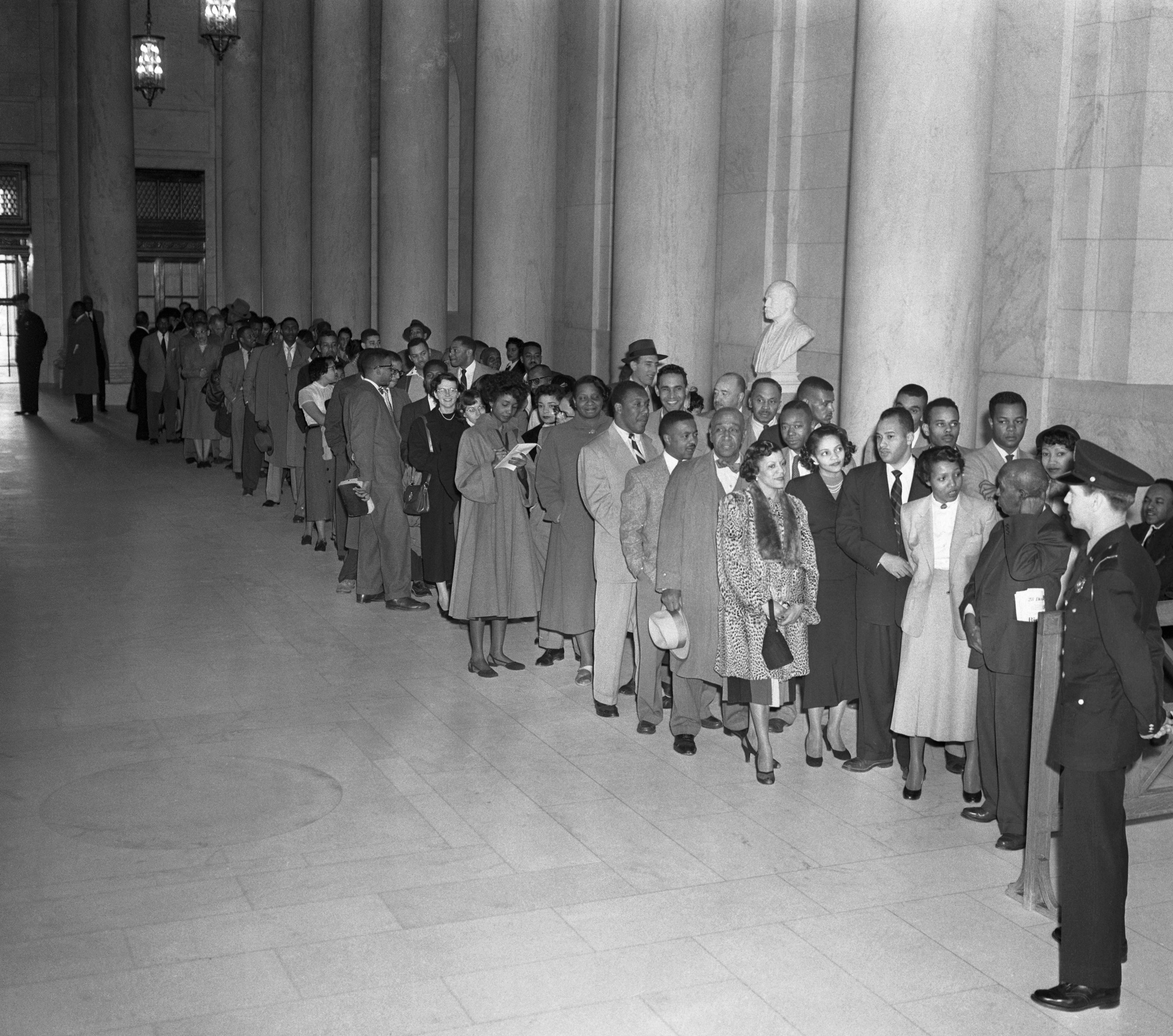
A long line of people wait in the halls of the U.S. Supreme Court building.
African-Americans lined up to attend oral argument in 
Brown v. Board of Education 1954
The Case for Ending the Supreme Court as We Know It | The New Yorker


Last week, Donald Trump was confronted with a new accusation of sexual assault (Trump, as always, denied it), and then delivered a bizarre speech at the National Archives, demanding ideological conformity in public-school curricula through what he described as “patriotic education” that “celebrates the truth about our nation’s great history.” Instead of facing scrutiny or scorn for these latest outrages, he has been awarded yet another opportunity to select a Justice to serve on the Supreme Court. Trump barely concealed his delight at the chance to replace Justice Ruth Bader Ginsburg, tweeting at the Republican Party, the morning after Ginsburg’s death, “We were put in this position of power and importance to make decisions for the people who so proudly elected us, the most important of which has long been considered to be the selection of United States Supreme Court Justices. We have this obligation, without delay!”
It is simply unconscionable that Trump—who lost the popular election by millions of votes; who was impeached last December, for abuse of power; and who has openly espoused racist, xenophobic, and sexist ideas, while also encouraging political violence against his perceived opponents—will, with voting in the Presidential election already under way, select a third candidate for a lifetime appointment to the Supreme Court. Of course, no one has forgotten that, after Justice Antonin Scalia died in February, 2016, the Republican Senate Majority Leader, Mitch McConnell, refused to hold a Senate hearing for President Obama’s nominee to the Court, Merrick Garland, effectively blocking Obama from choosing Scalia’s replacement. Now, with McConnell still in power, there is little doubt that the Senate will hold a confirmation hearing for Trump’s candidate. Not only does the likelihood of another Trump appointment shred the illusion that the Supreme Court stands above the political rancor of the executive and legislative branches; it weaponizes the Court, by gifting Trump one more opportunity to limit the political rights of the minority populations that he disparages and despises.
Trump’s influence on American jurisprudence has been the quietest and most successful part of his destructive Presidency. He has appointed more than two hundred judges to federal courts, surpassing almost any other recent President at this point in their tenure. He has also made sure that the judges he has selected for these lifetime appointments are among the youngest ever—on average, forty-eight years old—insuring the longevity of their impact. And, with eighty-five per cent of his appointees being white, he has cemented the gross mismatch between the federal judiciary and the public. This latest development should certainly call into question the haphazard rules and procedural tricks that allot Trump the power to decisively tip the scales of justice in his favor. Pressed further, one might also ask: Why should the Supreme Court, an unelected body that is richer, whiter, and more male than the United States is, continue to have such outsized power in the lives of ordinary people?
The insistence that the Supreme Court is not a political body is a principle of high folly in American politics. Just last fall, Chief Justice John Roberts lamented the perception that the Court was politicized, saying, “When you live in a polarized political environment, people tend to see everything in those terms. That’s not how we at the Court function, and the results in our cases do not suggest otherwise.” In reality, appointments to the nation’s highest court reflect the current balance or imbalance of political power, making it impossible to neatly untie them from the political bodies that determine who sits on the Court and who does not. Anyone who doubts this need look no further than the partisan rage displayed by Justice Brett Kavanaugh during his Senate confirmation hearing, in late 2018. From blaming an inquiry into his personal history on “revenge on behalf of the Clintons” to proclaiming “What goes around, comes around” to Senate Democrats, the future Justice arrogantly flexed raw Republican power.

Moreover, as the branch of government that is least accountable to the American public, the Supreme Court has tended, for most of its history, toward a fundamental conservatism, siding with tradition over more expansive visions of human rights. 

Super-spreader 101 - Everywhere that Donald went the virus was sure to go - Politicoagnosis

As I watch the Amy Coney Barrett super-spreader toll mount, and reports of Covid + tests coming out of the Cleveland Presidential debate site, I just feel really sad for our country, that so many have indulged the ignorance, cowardice, intolerance, and absolutism that is Trumpism.
Super-spreader 101
Where Trump went (and who he was with) leading up to his coronavirus diagnosis - POLITICO
Who done it?
President Donald Trump walks with Judge Amy Coney Barrett and first lady Melania Trump to a news conference announcing Barrett as his nominee to the Supreme Court.images from Saturday White House Scotus Event