Thursday, January 2, 2020

Can We Know the Past? | Talking Points Memo


Can We Know the Past? | Talking Points Memo
by Josh Marshall
If you’ve observed or been engaged in the debate over The New York Times ‘1619 Project‘ I have a book I want to recommend to you. It’s not about that specific debate at all, not about slavery or the Civil War or American history, at least not directly. It’s called That Noble Dream: The ‘Objectivity Question’ and the American Historical Profession. I was reminded of it today for a totally random reason – a quote from deep in the book by the late historian of slavery Eugene Genovese.
That comes from a debate within the American Historical Association between left-radicals and more methodologically traditional and politically moderate historians. Genovese, the one-time communist, current marxist and future conservative – in a characteristically over the top demand – labels the left group “totalitarians” and demands the Association “put them down, put them down hard, and put them down once.” Not that Genovese wasn’t capable of some humor. On being expelled from the US Communist party as an undergraduate he said it happened “for having zigged when I was supposed to zag.”


As the title implies, Novick’s book is about whether such a thing as objective history is even possible and more specifically how the 20th century academic history profession wrestled with that question over time. The question is a central though in some ways implicit one in the ‘1619’ debate. And I’m sorry to say this book will not answer the question for you. It’s a far more diffident read than that. But it is a fascinating, fascinating, quite human study – intimate and idiosyncratic like most of Novick’s work – and you will learn something about the historical profession, a lot about how historians have thought about this question and how they’ve understood the value or significance of their work in the context of that question.

Explosive New Emails Add To Pile Of Evidence That Trump Personally Ordered Ukraine Aid Freeze | Talking Points Memo

Image result for Mike Duffey OMB
Where is John Marshall when we need him.  A simple Writ of Mandamus would have solved the problem.
Then again...
Explosive New Emails Add To Pile Of Evidence That Trump Personally Ordered Ukraine Aid Freeze | Talking Points Memo
Newly leaked emails from the Pentagon add to the pile of evidence showing that President Donald Trump himself ordered a freeze on U.S. money destined to Ukraine, which officials have testified was part of an effort to pressure Ukraine to do Trump’s political bidding.
The emails, which were leaked to Just Security, show communications between the Pentagon and the White House Office Office of Management and Budget (OMB).
For example, after a key meeting between the Defense Secretary and Trump on Aug. 29, a day after the aid freeze had become public, OMB political staffer Mike Duffey emailed the Pentagon.
“Clear direction from POTUS to hold,” he said.

Monday, December 30, 2019

Tort Law - National Peoples Congress posts revised civil code chapter for comment NPC Observer

Image result for national people's congress
The new tort law chapter of the Civil Code of China has been posted.  h/t National Peoples Congress Observer
The National Peoples Congress has posted several sections of the draft civil code for public discussion and comment.  China's one party state does not engage in partisan debate in its legislature - the National Peoples Congress.  But members do represent different regions and strata of society and of government.
So a notice and comment style of legislation (similar to our Administrative Procedure Act)  has developed.

Saturday, December 28, 2019

Friday, December 27, 2019

Fact Checking the 1619 Project and Its Critics – AIER

Image result for the 1619 project
Below is the article that Kevin Gannon criticizes on Twitter [@The TattooedProf]. Magness presents a serious response. It's beyond my ken on the independence war. But seems right on Lincoln, though no one has cited Eric Foner's The Fiery Trial on his evolution.
At this point I am skeptical of the weight and wisdom to be afforded Jefferson and Madison for their Enlightenment and Republican project. It took four score and seven years and history's bloodiest war for those values to prevail. And the back sliding soon began. The Trump rise has bent backwards the arc of history we progressives are fond of (K. Marx, ML King, B. Obama). That encourages a skeptical view of how much the noble notions in the Declaration counted. The Brits ferried thousands of slaves to Canada (where the underground railroad led). The Revolutionaries freed none.
Fact Checking the 1619 Project and Its Critics – AIER
by Philip Wadness 


Thursday, December 26, 2019

Five-Year Work Plan for Advancing Adherence of Catholicism in our Nation (2018-2022)to the Direction of Sinification (2018-2022) : China Law Translate

The first Jesuits sought to integrate themselves into Chinese society.  First presenting themselves as Buddhist monks they soon realized they were seen as beggars.  Next they headed for the Mandarinate - approximately their position in Europe.  They embraced Confucianism as an ethical tradition but when the Pope found their sinification heretical they found themselves expelled from China and suppressed in Europe. See Liam Brockey's Journey to the East - The Jesuit Mission to China 1579 - 1724 - gwc
推进我国天主教坚持中国化方向五年工作规划(2018 - 2022) Five-Year Work Plan for Advancing Adherence of Catholicism in our Nation to the Direction of Sinification (2018-2022) : China Law Translate
In order to spread the gospel of Jesus Christ to all people in the world, Paul the Apostle initiated the idea: "I have become all things to all men." (1 Cor 9:22). From an historical perspective, the healthy development of Catholicism in our country and the Church's adaptation to society and culture are the same, and there have been both positive and negative experiences that can be drawn from in this regard. After the Second Vatican Council, discussion of localization among the churches of the world opened a new route for the local development of the Catholicism. In our country, adherence to the direction of sinification of Catholicism has had an important significance, and since the establishment of new China, especially in the 40 years since Reform and Opening, the Catholic Church in China has worked to adapt to the socialist society with Chinese characteristics and has had great achievements on evangelizing. As our country has entered into a new era of development, it is urgent to solidify the foundation for the development of the Church in our country's society and culture by deepening the sinification of Catholicism. It is therefore necessary to be problem-oriented, to focus on study of theological ideology, and to establish examples of the sinification of Catholicism, to forcefully advance the sinification of Catholicism.
II. Guiding Ideology, Primary Goals, and Basic Meaning
(1) Guiding Ideology
Guided by Xi Jinping Thought on Socialism with Chinese Characteristics for a New Era, particularly the spirit of his speeches on the adherence to the direction of sinification of religions in our country, and led by the Core Socialist Values, follow the direction and path of sinification clearly identified by the 9th National Congress of Chinese Catholic Representatives; to continuously promote the sinification of Catholicism and gradually enrich the sinification of Catholicism, on the basis of bible and inheriting traditions, and complying with the thoughts and discussion of the Second Vatican Council.
(2) Main Goals
Increase understanding and recognition within the Church of adherence to the direction of sinification of Catholicism, advancing the adaptation of Catholicism and socialist society in our nation, leading the clergy and congreagations to practice the Core Socialist Values, strengthening the Church's own construction, advancing the church's spreading of its blessings, giving play to the active role of Catholicism in promoting out nation's economic and social development, and give strength to the realization of the Chinese Dream of the great rejuvenation of the Chinese People.
Further explore content in religious doctrine and canon that are conducive to social harmony, modern progress, and human civilization; interpret doctrines and canon in line with contemporary Chinese developments and improvements and China's outstanding traditional culture, continuously solidifying the harmonious foundation for relations between Catholicism and the Party, government, society, other faiths, and non-believers.
(3) Basic Meaning
Adherance to the direction of sinification of Catholicism in our country requires conscientious approval in politics. Love of the motherland, and obedience to the national regime is the responsibility and obligation of every Christian. The core of political approval is accepting the leadership of the Chinese Communist Party, supporting the Socialist system, and preserving the authority of the Constitution and laws, the unity of the people, and the integrity of the mother land;
Adherence to the direction of sinification of Catholicism in our country requires conscientious cultural integration. Practice the Core Socialist Values and accept infusion of the exceptional Chinese traditional culture; advocate Chinese styles and integrate with Chinese culture in suggestions on theological ideology, expressions of social rites, and in construction of churches, painting, music and art.
Adhering to the direction of sinification of Catholicism in our country requires conscientious adaptation to society. To adapt to and serve society, and to fulfill its social responsibility, carry out all work of the Catholicism in accordance with law, preserve the lawful rights and interests of the Church, carry forward the Catholic spirit of being the ‘salt and light' of the world, explore and expand new paths for serving society, promoting social harmony, and join in building a beautiful China.
III. Deepen the Political, Legal and Social Recognition of the Chinese Catholic Church
Lead clergy and congregations to actively practice the Core Socialist Values, ardently love the motherland, support the leadership of the Communist Party and the socialist system, observe law and discipline, and serve society.
(1) Carry out Publicity and Education on Socialism with Chinese Characteristics and the Core Socialist Values
1. Study and implement Xi Jinping Thought on Socialism with Chinese Characteristics for a New Era through methods such as publicity, visits, and study exchanges; strengthening clergy and congregations' self-confidence in the path, theory, systems, and culture of socialism with Chinese characteristics; and recognition of the unity between patriotism and devotion, and between the healthy development of Catholicism and the prosperity and strength of the motherland;
2. Carry out publicity and education on the Core Socialist Values, and make their practice a basic requirement of adherence to the direction of sinifying the Catholic Church; and guide clergy and congregations to establish and adhere to correct views of history and ethnicity, and strengthen awareness of the community of the Chinese people.
3. Implement the charter and work regulations of the Patriotic Association, complete and improve each local organization of the patriotic association, and give play to the role of the patriotic association organizations as bridges and ties.
(2) Persist in the Principle of Independent and Autonomous Self-management of the Church.

网络信息内容生态治理规定 Provisions on the Governance of the Online Information Content Ecosystem : China Law Translate

网络信息内容生态治理规定 Provisions on the Governance of the Online Information Content Ecosystem : China Law Translate
Chapter III: Online Information Content Service Platforms
Article 8: Online information content service platforms shall carry out entity responsibility for information content management, strengthen the platforms' governance of the online information content ecosystem, and cultivate an online culture that is positive, healthy, and supportive.

Wednesday, December 25, 2019

Adam Serwer: Historians Clash With the 1619 Project - The Atlantic

Image result for 1619 project
Adam Serwer's Atlantic article is a very measured response to the critique of the New York Times 1619 Project.  Led by Nicole Hannah Jones (@nhannahjones).  The letter initiated by Sean Wilentz and joined by four other leading liberal historians of early American history raises sharp questions about how much the American War of Independence sought to protect slavery rather than advance the Enlightenment values of the Declaration so fundamentally defied by the reality of the Founding slaveholders lives. - gwc
Historians Clash With the 1619 Project - The Atlantic
by Adam Serwer
***Underlying each of the disagreements in the letter is not just a matter of historical fact but a conflict about whether Americans, from the Founders to the present day, are committed to the ideals they claim to revere. And while some of the critiques can be answered with historical fact, others are questions of interpretation grounded in perspective and experience.
In fact, the harshness of the Wilentz letter may obscure the extent to which its authors and the creators of the 1619 Project share a broad historical vision. Both sides agree, as many of the project’s right-wing critics do not, that slavery’s legacy still shapes American life—an argument that is less radical than it may appear at first glance. If you think anti-black racism still shapes American society, then you are in agreement with the thrust of the 1619 Project, though not necessarily with all of its individual arguments.

Tuesday, December 24, 2019

Considering History: Dorothy Day and the True Spirit of Christmas | The Saturday Evening Post


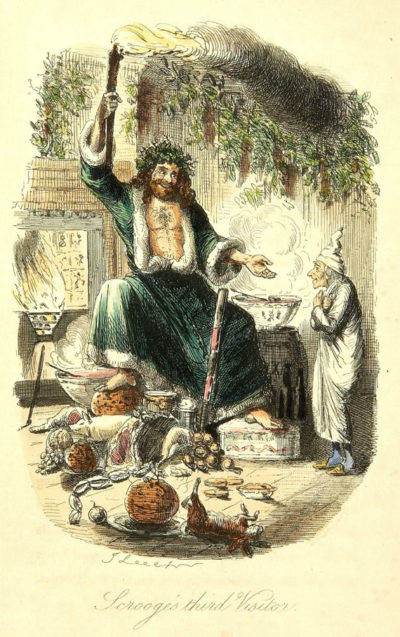
Ebenezer Scrooge encounters the Ghost of Christmas Present, as the spirit feasts before a roaring fire.Dorothy Day at a writing desk.


Considering History: Dorothy Day and the True Spirit of Christmas | The Saturday Evening Post
by Ben Railton
Charles Dickens’ novel A Christmas Carol (1843) is one of the most enduring and popular holiday stories, but its central anti-poverty theme is too often forgotten. Ebenezer Scrooge learns a number of lessons in the course of the novel, but the most poignant and powerful are those he learns from the Cratchit family about the horrors of poverty. As the Ghost of Christmas Present puts it, after quoting Scrooge’s own despicable sentiments about “the surplus population” back at him when it comes to the question of young Tiny Tim’s survival, “It may be, that in the sight of Heaven, you are more worthless and less fit to live than millions like this poor man’s child. Oh God! to hear the Insect on the leaf pronouncing on the too much life among his hungry brothers in the dust!”
This holiday season has seen a renewal of longstanding American debates over whether and how to collectively, publicly celebrate Christmas. In many ways those debates represent a constructed distraction, an attempt to divide Americans over issues that are not in fact in dispute (we are and have always been free to celebrate whatever holidays we choose in whatever manner we’d like). But if we take to heart the lessons of Dickens’ holiday tale, we can use them during this season to celebrate an American whose life exemplifies the true spirit of Christmas: Dorothy Day.

Convict Trump: The Constitution is more important than abortion - The Christian Post

Go to Homepage
Unity against the Trump danger requires a respecful response to voices like The Christian Post's. - gwc


Convict Trump: The Constitution is more important than abortion - The Christian Post

Christians should advocate for President Donald J. Trump’s conviction and removal from office by the Senate. While Trump has an excellent record of appointing conservative judges and advancing a prolife agenda, his criminal conduct endangers the Constitution. The Constitution is more important than the prolife cause because without the Constitution, prolife advocacy would be meaningless.
The fact that we live in a democratic republic is what enables us to turn our prolife convictions from private opinion into public advocacy. In other systems of government, the government does not care what its citizens think or believe. Only when the government is forced to take counsel from its citizens through elections, representation, and majoritarian rule do our opinions count.
Our democratic Constitution — adopted to “secure the blessings of liberty” for all Americans — is what guarantees that our voice matters. Without it, we can talk about the evils of abortion until we are blue in the face and it will never affect abortion policy one iota. The Constitution — with its guarantees of free speech, free assembly, the right to petition the government, regular elections, and the peaceful transfer of power — is the only thing that forces the government to listen to us.
Trump’s behavior is a threat to our Constitutional order. The facts behind his impeachment show that he abused a position of public trust for private gain, the definition of corruption and abuse of power. More worryingly, he refused to comply with Congress’s power to investigate his conduct, a fundamental breach of the checks and balances that is the bedrock of our Constitutional order.