Saturday, March 19, 2016

Why the GOP’s Merrick Garland strategy could be a disaster for Republicans - Salon.com

 Why the GOP’s Merrick Garland strategy could be a disaster for Republicans - Salon.com

by Andrew Koppelman (Northwestern Law School)

The election strategy by which McConnell hopes to keep Republican control of the Senate — and his own office as majority leader — depends on preventing voters from associating their Republican senator or Senate candidate with Trump. The Democrats in turn will try to superglue any Republican to Trump. But the Democrats have a problem of their own: Most Republican officeholders aren’t affiliated with Trump and aren’t doing anything to help him. In order for superglue to work, you need a large contact surface.

The united front against Garland could change that. You can imagine one Democratic line of attack: They would declare that the Republican candidate wants to trust Trump to fill a Supreme Court vacancy – and that voters have to decide whether they love Trump as much as their Republican Senator or Senate candidate evidently does.

The attacks would be effective because they would obviously be accurate.
Trump has cited, as precedent for his proposed mass exclusion of Muslims, World War II Japanese-American internment camps, one of the nastiest human rights violations in America’s history. President Trump might be badly inconvenienced by a Supreme Court that took its job seriously. Civil liberties are a bother. Does your Republican Senator agree that it’s okay to put American citizens in concentration camps on the basis of their ancestry? If he doesn’t think that, why is he so keen to give a Supreme Court appointment to a man who does?

Friday, March 18, 2016

Judge Garland and the Future of Human Rights Litigation //PrawfsBlawg:

PrawfsBlawg: Judge Garland and the Future of Human Rights Litigation
by Seth Davis

 It’s hard to deny that Judge Merrick Garland, President Obama’s nominee to the Supreme Court, is “is an amazingly qualified, brilliant judge,” even for commentators who think he’s a “bad choice.” He shouldn’t be blocked by Senate Republicans. He probably will be, though perhaps we’ll see a lame-duck hearing and confirmation vote. For now, there’s much to see --- and like --- in his jurisprudence on the D.C. Circuit.

For instance, I’d say his dissenting opinion in Saleh v. Titan Corp. is one to like. The question in that case was whether Iraqi nationals who were abused at the Abu Ghraib military prison could sue private military contractors for wrongs that both President George W. Bush and President Obama “repeatedly and vociferously condemned.” The panel held they couldn’t, reasoning that “tort law is preempted on the battlefield.” Judge Garland objected that the “country’s legal system [should] take its ordinary course and provide a remedy for those who were wrongfully injured.” Individuals who “were beaten, electrocuted, raped, subjected to attacks by dogs, and otherwise abused by private contractors” should have a remedy under a state’s “traditional, generally applicable tort law.”
We shouldn’t lightly assume, in other words, that the United States’ foreign policy preempts an individual’s right to a remedy under state law. To the contrary, Judge Garland suggested, “facially neutral state tort law” may be an important source of remedies for international human rights violations.
If Judge Garland’s dissent in Saleh is any guide, then a Justice Garland might shift the future of human rights litigation in the United States. In recent years the Supreme Court has restricted human rights litigation under the Alien Tort Statute. In Kiobel v. Royal Dutch Petroleum Co., for example, the Court applied the presumption against extraterritoriality to limit claims in federal court under the ATS. State law might, however, step in to fill the remedial gap, as this symposium in the UC Irvine Law Review explored. In the “ordinary course,” as Judge Garland put it, our legal system “provide[s] a remedy for those who were wrongfully injured.” Whether the Court will let our system run its ordinary course in human rights cases is but one of many controversial questions that may be at stake with this nomination.

Posted by Seth Davis on March 18, 2016 at 01:11 PM | Permalink

What does it take to be a Supreme Court Justice

The days when a former Governor (like Earl Warren or Frank Murphy) or Senator (Hugo Black) or civil rights litigator (Thurgood Marshall). - gwc

What Do You Need to be a Supreme Court Justice
by Ian Millhiser
IF someone could weaponize credentials — if a person could have a résumé so impressive that the mere sight of it could turn the tide of a war — that person would be Merrick B. Garland. Degrees from Harvard. A Supreme Court clerkship. A partnership in a multinational law firm. Multiple senior roles at the Department of Justice. Nineteen years on the second-most-powerful court in the country. Now he’s just one very challenging confirmation vote away from his own seat on the Supreme Court.
Judge Garland is more than just credentialed. He has dominated a profession that is obsessed with credentials. There’s a common joke that the practice of law is a pie-eating contest where the prize is more pie. The contest starts early: Undergraduates strive for spots at the country’s top law schools, and the treadmill continues for spots on law review, prestigious clerkships, associate jobs at the best firms and on to partnerships. Partners have more prizes to chase — a political appointment, a higher political appointment, maybe even a judgeship.
President Obama noted how well Judge Garland had climbed the ranks in his remarks announcing his nomination on Wednesday. “Merrick graduated magna cum laude from Harvard Law, and the early years of his legal career bear all the traditional marks of excellence,” the president said.
The story of Judge Garland is one of impeccable credentials, and an ambitious person who racked up accomplishments until he was nominated for his dream job. But what does it say about the court and the law that our notion of who is unimpeachably qualified is so narrow — and growing even narrower still?

The rise of American authoritarianism

http://www.vox.com/2016/3/1/11127424/trump-authoritarianism

Judge Garland and Going to Extremes //E.J. Dionne

Judge Garland and Going to Extremes // E.J. Dionne
In a span of about twelve hours, Americans were given definitive evidence that the Republican Party is now in thrall to its most ideologically and tactically extreme forces while the Democrats still look to the center ground and to compromise.

Exhibit A: The results of Tuesday’s primaries. Exhibit B: President Obama’s nomination of Judge Merrick Garland, as moderate and consensus-building a choice as he could have made, to the Supreme Court.

Chicago, Cleveland Prosecutors Defeated //NY Times

Voters Tell Prosecutors, Black Lives Matter http://nyti.ms/1R7HwFQ

Thursday, March 17, 2016

Johnson & Johnson hit with $498 million verdict in Pinnacle hip implant case


J&J hit with $498 million verdict in Pinnacle  hip implant  case
by Sindu Sindhar
Law360, New York (March 17, 2016, 12:57 PM ET) -- Johnson & Johnson was hit with an eye-popping $497.6 million verdict Thursday in the second bellwether trial in the multidistrict litigation over allegedly defective Pinnacle hip prosthetics manufactured by its DePuy Orthopaedics Inc. unit, a major win for the plaintiffs in the litigation who had this time put forth the consolidated claims of five patients alleging problems from the devices.

After a two-month trial and days of deliberations, a Dallas jury found in favor of all five plaintiffs in the trial, delivering a verdict that included $360 million in punitive damages, lead plaintiffs' attorney Mark Lanier of the Lanier Law Firm confirmed to Law360 Thursday.

The punitive damages are expected to be reduced to $10 million based on the statutory cap in Texas, according to John Beisner of Skadden Arps Slate Meagher & Flom LLP, an attorney for J&J. The plaintiffs had tried to argue that the commercial bribery exception to the Texas statutory punitive damages cap would apply, claiming that one of the surgeons who had treated some of the trial plaintiffs was a "highly paid" consultant for DePuy and J&J and that those payments swayed his decisions to use the devices. The jury on Thursday rejected the commercial bribery allegations.

The jury found for the plaintiffs on their failure-to-warn and design defect claims, holding both J&J and DePuy liable, Lanier said. About $240 million of the punitive damages were assessed directly against J&J while DePuy is on the hook for the other $120 million. The $140 million in compensatory damages will be divided among the plaintiffs based on the extent of their individual injuries, Lanier said. Juries are generally just asked to award damages without factoring in the cap, which the judge usually applies later, after sometimes asking the parties to brief him on the issue.

"The jury was very careful and deliberate in the way they went about working through the evidence, and it took a week to come to the conclusion," Lanier told Law360. "I'm not surprised by the outcome."

The defendants will appeal the verdict, according to DePuy spokeswoman Mindy Tinsley. The products at issue included the Pinnacle Acetabular Cup System, a metal hip implant product with a cobalt-chromium liner that the company brands the "Ultamet" liner.

“We have no greater responsibility than to the patients who use our products, and our goal is to create medical innovations that help people live more active and comfortable lives,” Tinsley said. “DePuy acted appropriately and responsibly in the design and testing of ULTAMET Metal-on-Metal, and the product is backed by a strong record of safety and effectiveness in reducing pain and restoring mobility for patients suffering from chronic hip pain.”

The trial had involved the consolidated claims of plaintiffs Margaret Aoki, Jay Christopher, Donald Greer, Richard Klusmann and Robert Peterson, who all underwent hip arthroplasty, where a hip joint is replaced with a prosthetic. In their case, the prosthetics were DePuy Pinnacle metal-on-metal devices, which they alleged cause serious health problems including inflammation of surrounding tissues, bone erosion and metallosis, a toxic condition allegedly caused when the device’s components grind against each other and shed metal debris into the bloodstream.

Beisner indicated that he believed J&J would prevail on its arguments at appeal to the Fifth Circuit.

"We expect this to be a pyrrhic victory for plaintiffs’ counsel as the grounds for appeal are strong and the punitive damages will be reduced to around $10 million subject to the Texas statutory cap," he said Thursday.

U.S. District Judge Ed Kinkeade, who is presiding over the trial and the MDL, had ruled on Jan. 8 that the five cases had enough issues in common that they would be consolidated for trial. In particular, all five plaintiffs here underwent similar implantation surgeries, their doctors received similar warnings, and the patients all alleged similar injuries, according to his ruling.

Aoki, who had filed her suit in March 2013, was implanted with a DePuy Pinnacle metal-on-metal device in 2010. She contended that after DePuy's other hip implant product, the DePuy ASR Hip System, was recalled in 2010, J&J doubled down on marketing the metal-on-metal device as a replacement.

She claimed that the ASR recall spurred J&J into "damage control" mode, where it assured surgeons that the metal-on-metal device was safe but knew it posed the risk of complications including metallosis. She claimed in particular that more than 1,300 adverse event complaints had been made to the U.S. Food and Drug Administration about the devices — among the roughly 150,000 such devices sold — and that J&J knew that patients implanted with those devices wound up with unsafe levels of cobalt and chromium in their bloodstream.

The first bellwether trial in the MDL ended in a significant verdict for J&J, in which a federal jury in October 2014 unanimously cleared DePuy Orthopedics of similar accusations.

The jury had found in favor of Johnson & Johnson on all counts, rejecting plaintiff Kathy Herlihy-Paoli's claims of negligence, defective design, failure to warn and violations of the Montana Consumer Protection Act after an eight-week trial in Dallas. The product at issue in the trial was the Ultamet metal-on-metal articulation.

The MDL was consolidated in May 2011, when the U.S. Judicial Panel on Multidistrict Litigation centralized three actions and identified 54 potential tag-along actions. There are now more than 8,000 cases in the MDL, all involving Pinnacle devices that contain sockets with metal, ceramic or polyethylene lining, according to court documents.

The plaintiffs are represented by W. Mark Lanier of The Lanier Law Firm, Larry Boyd, Wayne Fisher and Justin Presnal of Fisher Boyd Johnson & Huguenard LLP, Richard J. Arsenault of Neblett Beard & Arsenault and Jayne Conroy of Simmons Hanly Conroy.

Johnson & Johnson and DePuy are represented by Michael V. Powell and Seth M. Roberts of Locke Lord LLP and John H. Beisner, Stephen J. Harburg, Jessica Davidson Miller and Geoffrey M. Wyatt of Skadden Arps Slate Meagher & Flom LLP.

The five cases consolidated for trial are Aoki v. Johnson & Johnson Services et al., case number 3:13-cv-01071; Christopher et al v. Johnson & Johnson Services Inc. et al., case number 3:14-cv-01994; Greer v. DePuy Orthopaedics Inc. et al., case number 3:12-cv-1672; Klusmann et al v. DePuy Orthopaedics Inc. et al., case number 3:11-cv-02800; and Peterson et al v. Johnson & Johnson Services Inc. et al, case number 3:11-cv-01941, all in the U.S. District Court for the Northern District of Texas.

The MDL is In re: DePuy Orthopaedics Inc. Pinnacle Hip Implant Products Liability Litigation, case number 3:11-md-02244, in the U.S. District Court for the Northern District of Texas.

Take to the streets for Merrick Garland||Rick Hasen ||TPM

Okay, the headline is a bit much.  UCLA law prof Rick Hasen's real point is that GOP senators in swing states must see stonewalling the moderate Merrick Garland as a political liability~if the Obama nominee is to have a chance. ~gwc
http://talkingpointsmemo.com/cafe/take-streets-progressive-supreme-court-justice

Paul Weiss had conflict in Caesar's case

http://www.law360.com/legalethics/articles/772407?nl_pk=f3937dfc-fb25-4034-80ee-484ceff18f92&utm_source=newsletter&utm_medium=email&utm_campaign=legalethics

Wednesday, March 16, 2016

Former law clerk on Merrick Garland

http://www.thedailybeast.com/articles/2016/03/16/merrick-garland-for-supreme-court-a-good-man-who-doesn-t-deserve-what-s-about-to-happen.html?via=newsletter&source=DDMorning

John Snow cholera map

https://www.udel.edu/johnmack/frec682/cholera/

Marco Rubio: 'I ask the American people: Do not give in to the fear' - LA Times

Marco Rubio's withdrawal speech.  He laments the politics of resentment - but he built his career on it, and it has been the foundation of Republican politics for the last fifty years.  He's still blaming the wrong people.  And seeks the wrong solutions. - gwc
Marco Rubio: 'I ask the American people: Do not give in to the fear' - LA Times

...So, from a political standpoint, the easiest thing to have done in this campaign is to jump on all those anxieties I just talked about, to make people angrier, make people more frustrated. But I chose a different route and I'm proud of that.

That would have been -- in a year like this, that would have been the easiest way to win. But that is not what's best for America. The politics of resentment against other people will not just leave us a fractured party, they are going to leave us a fractured nation.

They are going to leave us as a nation where people literally hate each other because they have different political opinions.

That we find ourselves at this point is not surprising, for the warning signs have been here for close to a decade. In 2010, the tea party wave carried me and others into office because not enough was happening and that tea party wave gave Republicans a majority in the House, but nothing changed. In 2014, those same voters gave Republicans a majority in the Senate and, still, nothing changed. And I blame some of that on the conservative movement, a movement that is supposed to be about our principles and our ideas. But I blame most of it on our political establishment.

A political establishment that for far too long has looked down at conservatives, looked down at conservatives, as simple-minded people. Looked down at conservatives as simply bomb-throwers. A political establishment that for far too long has taken the votes of conservatives for granted, and a political establishment that has grown to confuse cronyism for capitalism, and big business for free enterprise. 
I endeavored over the last 11 months to bridge this divide within our party and within our country because I know that after eight years of Barack Obama this nation needs a vibrant and growing conservative movement and it needs a strong Republican Party to change the direction now of this country or many of the things that are going wrong in America will become permanent, and many of the things makes us a special country will be gone. America needs a vibrant conservative movement, but one that’s built on principles and ideas, not on fear, not on anger, not on preying on people’s frustrations.

GM Ignition Engineers Gagged By Orwellian Rules, Jury Told - Law360

GM Ignition Engineers Gagged By Orwellian Rules, Jury Told - Law360
Law360, New York (March 15, 2016, 11:20 PM ET) -- As GM refrained from urgently investigating reports of failing ignition switches, engineers deep within the organization were effectively prevented from sounding alarms by a policy that forbade terms like “problem,” “bad” and “rolling sarcophagus,” a former automotive industry engineer testified in a bellwether trial Tuesday.

(Credit: AP)
The company is engaged in a three-week trial over the claims of Louisiana driver Dionne Spain and passenger Lawrence Barthelemy, whose Saturn roadster spun out on an icy bridge two years ago. They walked away with few injuries. But the plaintiffs blame the now-infamous ignition switch, whose hair trigger could shut down the car while it was moving, even at high speeds. General Motors LLCclaims the switch wasn’t involved in Spain and Barthelemy's crash.

Slides shown in court Tuesday laid out a list of terms engineers were directed to avoid. They included “safety,” “big time,” “good,” “defect,” “ghastly,” “Challenger,” “powder keg,” “deathtrap,” “widow-maker” and “Cobain.”

“This practice of limiting how engineers can describe situations was one of the factors that allowed this situation to stay down and not get the attention that it needed for such a long time,” former Delphi engineer Steve Loudon told the court. Loudon spent his career in automotive electronics, writing software that controls airbags, among other things. He’s now a frequent expert witness in car-defect cases.

“You’re limiting [engineers] from being as precise and accurate as they could be,” Loudon said.

But in a deposition played soon after, a GM employee offered a defense of the policy. “‘Problem’ is judgmental: You’ve already decided that there was a problem,” engineer Eric Buddrius said on video.

Meanwhile on Tuesday, on a different floor of the same building, a Second Circuit panelappeared troubled by the landmark bankruptcy ruling that largely shielded the post-Chapter 11 version of General Motors from liability tied to the deadly ignition-switch defects, with one appellate judge wondering how the decision could have been made in the bankruptcy context at all.

2nd Circ. Has Doubts About New GM's Ch. 11 Liability Shield - Law360

2nd Circ. Has Doubts About New GM's Ch. 11 Liability Shield - Law360
Law360, New York (March 15, 2016, 3:39 PM ET) -- A Second Circuit panel appeared troubled Tuesday by a landmark bankruptcy ruling that largely shields the post-Chapter 11 version of General Motors from liability tied to deadly ignition-switch defects, with one appellate judge wondering how the decision could have been made in the bankruptcy context at all.

(Credit: AP)
At a closely watched appeal in which various claimant groups are seeking leave to target General Motors LLC, or New GM, Circuit Judges Chester J. Straub, Denny Chin and Susan L. Carney all expressed displeasure at U.S. Bankruptcy Judge Robert Gerber's April 2015 decision to wall off the $47 billion auto giant.

That decision came just months before a $900 million settlement between Old GM and criminal prosecutors.

Front-and-center in Tuesday's arguments was a stipulation between Chapter 11 GM and plaintiffs in which, according to Judge Gerber's opinion, "at least 24 Old GM personnel (all of whom were transferred to New GM), including engineers, senior managers and attorneys, were informed or otherwise aware of the ignition switch defect" before a 2009 sale agreement rescued the automaker.

“Old GM knew,” Judge Straub told the automaker's counsel Arthur Jay Steinberg of King & Spalding LLP. “The very same people who knew went to New GM. No one told the court. No one told the claimants. How are we to deal with that?”

13th Five-Year Plan is the first to include PM2.5 targets | Liu Qin - China Dialogue


Having been in Beijing for last December's "airpocalypse" when schools were shut and odd-even driving days imposed, I am glad to see the government there committing to reduced emissions targets. - gwc

13th Five-Year Plan is the first to include PM2.5 targets | Liu Qin - China Dialogue

In his address to China’s National People’s Congress on March 5, Premier Li Keqiang called for “heavy blows” to be struck against air and water pollution that have exacted a heavy toll on large swaths of the world's most populous country.

Li cited targets to improve environmental standards across the board, but focused in particular on measures to tackle urban smog that would deliver “good air quality” day readings for 80% of the year.

The targets are part of the forthcoming 13th Five-Year Plan (FYP), a policy blueprint that will shape China’s economic development over the next five years up to 2021.

The premier’s speech was delivered on the opening day of the session and set the tone for discussions that will continue until March 16.

The full list of proposals will not be published until the close of the twin legislative sessions. However, Li’s speech has already indicated that the government will limit factory emissions of tiny harmful particulate matter (PM2.5) - a major cause of air pollution - down by 25%.

This is the first time in the China’s history that a specific PM2.5 target has been included in a FYP.

Tuesday, March 15, 2016

Rubio Failed, and Not Just Because of Trump - Bloomberg View

How did this happen? Jonathan Bernstein asks.  Like other politcial scientists he embraced the The Party Decides.  I.E. The RNC, Fox News, the money people, the right wing think tanks together winnow the field, and the voters ratify their choice.  That led to Marco Rubio as the nominee but....
Three theories:
A) The party chose a fatally flawed candidate - Marco Rubio
B) The Republican Party is broken and dysfunctional
C) Trump is a unique challenge
D) All of the above

- gwc

Rubio Failed, and Not Just Because of Trump - Bloomberg View
by Jonathan Bernstein

The 2016 demise of Marco Rubio has been obvious for a while, but it is nevertheless a very big event. He was the Republican Party’s choice. He lost.

Starting last fall, I said he was the most likely winner. I continued writing that through the early primaries and caucuses. In fact, he seemed on track to win up until his disappointing Super Tuesday on March 1, and even after that I thought he was in fairly good shape, right up until his support collapsed the weekend after Super Tuesday.

Since I have been dead wrong about Rubio, I can't turn around immediately and tell you why he lost. It’s something all of us who study presidential nominations are going to need to study, and it’s going to take some time, especially for those who believe that strong parties made up of formal organizations and informal networks control their presidential nominations.

Is this year a fluke? A sign that the system has changed? Frankly, I don’t know right now.

But I can run through some reasonable explanations of what happened with Rubio.

Senior NFL official acknowledges football's link to brain disease CTE | Sport | The Guardian

Senior NFL official acknowledges football's link to brain disease CTE | Sport | The Guardian
An NFL official has acknowledged a link between football and a degenerative brain disease for the first time.
Jeff Miller, the NFL’s senior vice president for health and safety, spoke about the connection during an appearance Monday at a congressional committee’s round table discussion about concussions.
Representative Jan Schakowsky (D-Illinois) asked Miller: “Do you think there is a link between football and degenerative brain disorders like CTE?”
Miller, who was referring to chronic traumatic encephalopathy (CTE), began by discussing the work of Boston University neuropathologist Dr Ann McKee, who has found CTE in the brains of 90 out of 94 former pro football players.
“Well, certainly, Dr McKee’s research shows that a number of retired NFL players were diagnosed with CTE, so the answer to that question is certainly ‘yes,’ but there are also a number of questions that come with that,” Miller said.
Advertisement
Schakowsky repeated the question: “Is there a link?”
“Yes. Sure,” Miller responded.
The NFL has not previously linked playing football to CTE, a disease linked to repeated brain trauma and associated with symptoms such as memory loss, depression and progressive dementia. It can only be detected after death. Among the players found to have CTE in their brains were Hall of Famers Junior Seau and Ken Stabler.
During Super Bowl week, Dr Mitch Berger, a member of the NFL’s head, neck and spine committee, would not draw a direct line from football to CTE.

Monday, March 14, 2016

President Obama’s Interview With Jeffrey Goldberg on Syria and Foreign Policy - The Atlantic


A long article with video.  Very much worth reading.  Obama is a better President than the American electorate envisioned or realizes.  - gwc
President Obama’s Interview With Jeffrey Goldberg on Syria and Foreign Policy - The Atlantic


The Obama Doctrine
by Jeffrey Goldberg: 
"...Libya proved to him that the Middle East was best avoided. “There is no way we should commit to governing the Middle East and North Africa,” he recently told a former colleague from the Senate. “That would be a basic, fundamental mistake.”

President Obama did not come into office preoccupied by the Middle East. He is the first child of the Pacific to become president—born in Hawaii, raised there and, for four years, in Indonesia—and he is fixated on turning America’s attention to Asia. For Obama, Asia represents the future. Africa and Latin America, in his view, deserve far more U.S. attention than they receive. Europe, about which he is unromantic, is a source of global stability that requires, to his occasional annoyance, American hand-holding. And the Middle East is a region to be avoided—one that, thanks to America’s energy revolution, will soon be of negligible relevance to the U.S. economy."

Could three seemingly simple laws really reduce US gun deaths by more than 90 percent?

Sentencing Law and Policy: Could three seemingly simple laws really reduce US gun deaths by more than 90 percent?
from CNN:
Passing federal laws that require universal background checks for firearm purchases, background checks on ammunition purchases and firearm identification could reduce the rate of U.S. gun deaths by more than 90%, according to a new study.  "We wanted to see which restrictive gun laws really work, as opposed to saying 'restrictive laws work,' and figure out if we are pushing for a law which might not work," said Bindu Kalesan, assistant professor of medicine at Boston University and lead author of the study...  in The Lancet.
Researchers arrived at the projection by looking at the number of gun-related deaths in every state in 2010 and the types of laws that existed in those states in 2009, including restrictive laws, such as background checks and child access prevention laws, and permissive laws, such as stand-your-ground laws.  They took into account differences in rates of gun ownership, unemployment and homicides that did not involve guns deaths.  Out of the 25 existing state laws that Kalesan and her colleagues studied, nine were associated with lower rates of gun-related deaths.
The researchers found the largest effects for universal background checks, which were associated with a 39% reduction in death, and ammunition background checks, which were associated with an 18% reduction in death. Laws around firearm identification, which make it possible to determine the gun that fired a bullet, were associated with a 16% reductions in deaths.
Researchers projected that federal laws expanding background checks for firearms purchases would reduce the U.S. gun death rate by 57%, while background checks for ammunition purchases would cut gun death rates by 81% and firearm identification would reduce the rate by 83%. The researchers said it would take many years to lower the rates so far.  Although a federal policy known as the Brady Law requires background checks on individuals who want to buy a firearm from a licensed dealer, it leaves a large gap, as an estimated 40% of firearms are acquired through unlicensed sellers, such as some online and at gun shows....
The researchers found that nine of the 25 laws they analyzed were linked to higher rates of gun-related deaths. Another seven laws did not seem to have an impact one way or the other on gun-related deaths.  Some of the laws that were linked with greater numbers of gun related deaths came as a surprise to the researchers. For example, bans on assault weapons, such as semi-automatic guns, were associated with a 15% increase in mortality....
In an editorial published with the study, Harvard School of Public Health Professor David Hemenway said the study was "a step in the right direction" to understand the scientific evidence about policies to reduce gun violence. But, he said, cutting mortality rates so dramatically is more complicated than simply implementing background checks for firearms and ammunition. "That result is too large -- if only firearm suicide and firearm homicide could be reduced so easily," Hemenway wrote.

Sunday, March 13, 2016

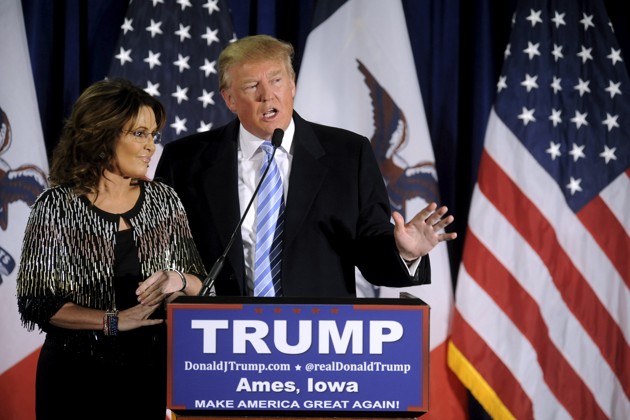
Why Even Sarah Palin Knows More Than Trump - The Atlantic

I am an incrementalist.  As a lawyer I learned how to move the law forward an inch, with teamwork a yard.  But how does one make a mark in the  tsunami of coverage and commentary about Donald Trump and the GOP?  

I add only this:  if an incompetent is the nominee of the Republican Party it will bring dangerous political instability to the United States of America.  Trump victorious will unleash tribal passions that we have long (if excessively) prided ourselves on avoiding.  - gwc
Why Sarah Palin Knows More Than Trump - The Atlantic
by James Fallows

After the latest GOP debate, I noted that Donald Trump was remarkable for his very high-level performance skills, and for his near-absolute lack of knowledge about policy or public affairs. Then readers weighed in to the same effect. Now, more from readers on Know-Nothingism and the Rise of Trump.

I’ve heard from a reader who for professional reasons has carefully studied a very large number of “newsmaker” interviews in recent years. The reader writes that Trump’s cumulative record is remarkable, especially when compared with Sarah Palin’s:
In the year or so after the election, I listened to a lot of Palin interviews, and although her range of knowledge is certainly quite limited, she spoke very confidently and enthusiastically about some Alaska-specific issues, one being the oil industry in the state. Another was less important but still fascinating—the myriad complexities of voting and getting votes counted in Alaska. She took obvious pleasure in her mastery of these subjects and pleasure in explaining them to people who didn't know much about them.
I have now been through dozens of interviews with Trump with a variety of interviewers, and I have never once—not once—heard him discuss anything, any subject of any kind, with any evidence of knowledge, never mind thought. None. Zero. He's like a skipping stone over a pond. He doesn't even come close to the level of dilettante.
You'd think at some point, something, anything would have engaged his interest enough to read up on it and think about it, but as far as I can tell, nothing has. Much more so even than George W., he appears to lack anything resembling intellectual curiosity. Maybe he's faking it, but while understanding can sometimes be faked, you can't fake ignorance convincingly.
Most liberal folks in my experience have never really listened closely to either Trump or Palin very much but rely instead on superficial appearance and caricature, I thought I'd contribute the view of a liberal who has actually listened to them very carefully....
KEEP READING

China's environmental Minister blasts local officials||VOA

http://m.voanews.com/a/china-environmental-minister-blasts-local-officials/3231960.html

Friday, March 11, 2016

G.O.P. Debate: The “Never Trump” Movement Gives Up - The New Yorker

The next stages of the GOP Presidential campaigns: passivity, rationalization, acceptance. Shouldn't be too hard. It's just the step from dog whistles to cat calls. - gwc
G.O.P. Debate: The “Never Trump” Movement Gives Up - The New Yorker
by Benjamin Wallace-Wells
At last night’s Republican debate, in Miami, the campaign to stop Donald Trump from within the Party appeared to be all but over. The chairman of the Republican National Committee, Reince Priebus, appeared onstage before the debate to reassure the audience that “this Party is going to support the nominee—whoever that is—one hundred per cent.” 
During the main event, Marco Rubio and Ted Cruz seemed to have parachuted in from an earlier moment in the campaign, when the stakes were low and the policy discussions were earnest. “I cannot believe how civil it’s been up here,” Trump observed midway through. “Be smart and unify,” he said in his closing statement. Trump is trying to seem more Presidential. The Party is trying to find a way to live with him.

Troice v. Proskauer Reose, LLC


R. Allen Stanford after his 2012 conviction

Texas law grants immunity to a law firm, even for claims alleging that it aided and abetted fraud.  In this case it is the massive Ponzi scheme of Allen Stanford. The all-Republican Texas Supreme Court, a graveyard for plaintiffs, affirmed that there is no fraud exception from Texas law granting immunity to lawyers for claims by non-clients.  So regardless of the failures to two major law firms to recognize the mega-fraud being perpetrated on investors by Allen Stanford, they are immune from claims made by defrauded investors. The link below is to the full opinion. - gwc
Troice v. Proskauer Rose, LLP, Chadbourne Park, et al
U.S. Court of Appeals for the Fifth Circuit, March 10, 2016 

This case represents more fallout from Allen Stanford’s massive Ponzi scheme. Plaintiffs filed this putative class action against one of Stanford’s lawyers, Thomas Sjoblom, and the law firms where he worked, arguing that they aided and abetted Stanford’s fraud and conspired to thwart the SEC’s investigation of Stanford’s scheme. After this case went to the Supreme Court and back on an issue not relevant here, defendants moved to dismiss plaintiffs’ complaint as barred by attorney immunity under Texas law. The district court denied that motion, holding that plaintiffs’ allegations met a “fraud exception” to attorney immunity, and defendants appealed. 
 We are now confronted with two issues. First, under Texas law, is attorney immunity a true immunity of suit, such that denial of a motion to dismiss based on attorney immunity is appealable under the collateral order doctrine? 
Second, should we reverse the district court’s order denying defendants’ motions to dismiss based on attorney immunity now that the Texas Supreme Court has clarified that there is no “fraud exception” to attorney immunity? For the reasons below, we answer both questions in the affirmative.

Storm King again // Environment, Law, and History


Citizen action has been a driving force in the modern environmental movement. David Schorr here highlights a new book about the struggle against the Storm King hydro-electric project on the Hudson River - a great environmentalist victory. -gwc
Environment, Law, and History: Storm King again

We've posted on the 1960s Storm King controversy before, and plan to do so again, soon. In the meantime, here's a notice (by way of Legal History Blog) of the recent publication of Storm King Mountain and the Emergence of Modern American Environmentalism by Robert Lifset (U. Pittsburgh Press, 2014). The publisher's description:

The beauty of the Hudson River Valley was a legendary subject for artists during the nineteenth century. They portrayed its bucolic settings and humans in harmony with nature as the physical manifestation of God’s work on earth. More than a hundred years later, those sentiments would be tested as never before. In the fall of 1962, Consolidated Edison of New York, the nation’s largest utility company, announced plans for the construction of a pumped-storage hydroelectric power plant at Storm King Mountain on the Hudson River, forty miles north of New York City. Over the next eighteen years, their struggle against environmentalists would culminate in the abandonment of the project.
Robert D. Lifset offers an original case history of this monumental event in environmental history, when a small group of concerned local residents initiated a landmark case of ecology versus energy production. He follows the progress of this struggle, as Con Ed won approvals and permits early on, but later lost ground to environmentalists who were able to raise questions about the potential damage to the habitat of Hudson River striped bass.
Lifset uses the struggle over Storm King to examine how environmentalism changed during the 1960s and 1970s. He also views the financial challenges and increasingly frequent blackouts faced by Con Ed, along with the pressure to produce ever-larger quantities of energy.
As Lifset demonstrates, the environmental cause was greatly empowered by the fact that through this struggle, for the first time, environmentalists were able to gain access to the federal courts. The environmental cause was also greatly advanced by adopting scientific evidence of ecological change, combined with mounting public awareness of the environmental consequences of energy production and consumption. These became major factors supporting the case against Con Ed, spawning a range of new local, regional, and national environmental organizations and bequeathing to the Hudson River Valley a vigilant and intense environmental awareness. A new balance of power emerged, and energy companies would now be held to higher standards that protected the environment.

Tuesday, March 8, 2016

Migrant children deserve a voice in court //NY Times editorial

Migrant Children Deserve a Voice in Court http://nyti.ms/21YrrJs

Abolish Absolute Governmental Immunity in Snow and Ice Cases | New Jersey Law Journal


 When Chris Christie became Governor of New jersey, pledging to "turn Trenton upside down" he aimed for the repudiation of the state Supreme Court's dedication to equitable school funding and open housing.  Although he has not achieved that, he has got a Republican majority which has been chipping away at the court's legacy of expansion of tort liability.  The Law Journal Editorial Board is not reconcile dto that path.  Here it urges the court to take a modest step forward to hold liable government enterprises like the state's mass transit operator NJ Transit. - gwc
Abolish Absolute Governmental Immunity in Snow and Ice Cases | New Jersey Law Journal
by the Editorial Board
In the petition for certification now before it in Mann v. New Jersey Transit —a snow and ice case—the New Jersey Supreme Court has an opportunity to answer a question that has long discomfited some judges on the Appellate Division: Should a mass transit operator's Tort Claims Act liability for dangerous conditions of its property be subject to the same duty of care as a public housing authority's?

At common law, the sovereign was immune to suit absent consent. But as government expanded, providing housing and mass transit, pressure grew for government to bear liability comparable to that of private businesses. The 1946 Federal Tort Claims Act was among the first to do so. In the 1968 case Jackson v. Hankinson and Bd. of Ed. of New Shrewsbury, our Supreme Court said:

"And although there has thus far been no express and complete disavowal of active wrongdoing terminology, there has been a shift towards frank recognition that municipal entities, along with all others, should justly be held accountable for injuries resulting from their tortious acts and omissions under ordinary principles of negligence, except, as a matter of policy, in situations involving so-called discretionary determinations and the like."

Later that year, in Miehl v. Darpino, the court refused to extend a cause of action to a snow hazard created by plowing snow into a bank that made it hazardous to cross at an intersection. The municipality's efforts to clear the roads should not create liability where none would exist if they had not acted at all, the court decided. Spurred by the prospect that the court could sweep away governmental immunity, the Legislature in 1972 adopted the Tort Claims Act. Though Title 59 generally embraced the court's call for reform, it codified the Miehl rule, retaining governmental immunity for injuries "caused solely by the effect on the use of streets and highways of weather conditions."

Twenty years later, the court construed the Tort Claims Act in Bligen v. Jersey City Housing Authority (1993). In an opinion by Justice Marie Garibaldi, the court found that neither the Tort Claims Act nor the principle of common law governmental immunity barred imposition of liability upon a public housing authority. The court distinguished the agency's role as property manager of its "internal driveways" from the statute's grant of immunity for snow removal on "streets and highways."

Since then, the Appellate Division has sharply limited Bligen to its facts. Other public entities have been held to be immune in a raft of snow and ice cases, a result often thought to be commanded by Miehl, commonly referred to as the "common law rule". If by that courts mean that Miehl preceded the Tort Claims Act, then the designation is accurate. But if one has in mind a mass transit operator like New Jersey Transit, the common law rule has long been that of Kelly v. Manhattan Ry. Co. (1899), a snow and ice case:

"...[I]n the approaches to the cars, such as platforms, halls, stairways and the like, a less degree of care is required, and for the reason that the consequences of a neglect of the highest skill and care which human foresight can attain to are naturally of a much less serious nature. The rule in such cases is that the carrier is bound simply to exercise ordinary care in view of the dangers to be apprehended."

In the 1998 case Lathers v. Township of West Windsor, which involved a fall on an icy path at a municipal building, the court felt constrained by Bligen and its progeny. But one panel member invited our Supreme Court to "review the existing law, perhaps to declare that sidewalk ice or snow hazards be treated as any other dangerous condition under the Tort Claims Act." The Supreme Court denied certification.

This past December, Judge Jack Sabatino, concurring in the dismissal of yet another snow and ice case—Mann v. New Jersey Transit Corporation—renewed that call. Sabatino pointed out the elementary nature of the negligence claim and the need to treat like cases alike. No substantial basis exists to distinguish New Jersey Transit's 159 stations from the extensive properties of municipal housing authorities. Fear of excessive liability should be tamped down by the requirement of Title 59 that liability for unsafe conditions of public property is to be found only if the public entity's conduct is "palpably unreasonable." Governmental entities also have the benefit of the Brooks v. Odom (1997) rule that "a plaintiff must sustain a permanent loss of the use of a bodily function that is substantial."

The court now has before it a petition for certification. The construction for which Sabatino calls is well within the court's power to develop tort law through statutory interpretation, as it did in Bligen. If the court embraces the recognition of a duty on public mass transit operators to assure safe transit on their properties, the Legislature can study the issue and address it. But our 40 years of experience with the Tort Claims Act shows that the slippery slope arguments that are often raised are no threat here. The massive New York City bus and subway system, for example, has not been reduced to insolvency by the long established duty of ordinary care. In Bethel v. NYCTA (1998) the New York Court of Appeals declared that on or off the rails the Transit Authority has the duty of ordinary care in the management of its hundreds of stations, terminals, fleets of vehicles and rolling stock.

Our Supreme Court long ago recognized the anomaly of governmental immunity for negligent maintenance of facilities. It is time to finally abandon the rule of absolute immunity, which encourages the derisive view that slipshod efforts are "close enough for government work." We think the court should grant the petition and eliminate the anomaly of absolute immunity in snow and ice cases against some but not other public agencies.
Read more: http://www.njlawjournal.com/id=1202751473821/Abolish-Absolute-Governmental-Immunity-in-Snow-and-Ice-Cases#ixzz42Ke2Nf3a

Monday, March 7, 2016

Lessons From Flint | Legal Planet

Lessons From Flint | Legal Planet
by Jim Salzman // UCLA School of Law

A public-minded researcher discovers serious contamination of drinking water. His efforts to alert local officials are rebuffed. Concerned over how this will affect their reputation and the town’s economy, the authorities sit on the evidence and deny any problems. All the while, trusting people continue to drink unsafe water.

While the setting may call to mind recent events in Flint, Michigan, this is actually the plot from Henrik Ibsen’s classic 1882 play, An Enemy of the People. The places and dates have changed, but the challenges of providing drinking water remain. Just how safe really is our water and how can we make it safer?

We marked the fortieth anniversary of the Safe Drinking Water Act in 2014. In many respects, it was a date well worth celebrating. Most Americans take tap water for granted. We enjoy some of the safest and most reliable drinking water in the world. More than 90 percent of customers receive water that meets all standards all the time. This is a far cry from a century ago, when waterborne illnesses and deaths were commonplace. The famed aviator brother, Wilbur Wright, died of typhoid in 1914. The 1916 polio epidemic required quarantines in New York City, where 9,000 cases were reported. Today, these and other waterborne diseases have virtually disappeared in America. Glass half full.

Yet the glass remains half empty. Just ask the residents in Charlestown, West Virginia, where two years ago a chemical spill shut down water supplies, or in Toledo, Ohio, where seven months later an algal bloom closed their water system. The threats in those cases were due to causes beyond the reach of the Safe Drinking Water Act – a breach in a chemical storage tank atop a river bank in Charlestown, and excessive nutrients from agriculture flowing into Lake Erie in Toledo. These incidents made clear that action to ensure safe drinking water needs to start well upstream of the water treatment plant.

The Flint case is different and more disturbing.

We, as water drinkers, must ultimately rely on the actions of regulators and water authorities, trusting that the water coming out of our tap is in fact safe to drink. Few consumers have the technological savvy or means to test their water for arsenic, Cryptosporidium, lead, or the myriad other potential threats, much less at concentrations of parts part million. One can use the popular water filters, which will remove some pollutants but not lead and many others. Ultimately, we have no choice but to trust the experts.

That’s why Flint is so particularly damaging. Local, state, and federal regulators’ failure to act in a timely manner harmed not only Flint residents but undermined the public’s confidence in our water supply management more generally. In California, the ongoing drought has water suppliers looking closely at directing highly treated waste water back into the mains for household use. Will consumers trust the authorities to treat the water sufficiently?....

Sunday, March 6, 2016

Alabama gives up same sex marriage fights//Howard Wasserman /Prawfs Blog

Alabama Probate judges are issuing marriage licenses to same sex couples - because they are obeying a federal court order, although the Alabama Chief Justice's directive to follow Alabama law remains in place, as  Martin Lederman  and Howard Wasserman explain. - gwc
Alabama Supreme Court dissmisses same-sex marriage mandate // Prawfs Blawg

The Supreme Court of Alabama today dismissed the mandamus action, and all pending motions, filed by several advocacy groups to stop probate judges from issuing marriage licenses to same-sex couples. I have not had a chance to read it yet; it includes a lengthy opinion from Chief Justice explaining why he is no longer recusing himself from the action and why Obergefell is evil.
The upshot is that there is no longer any state-court order obligating probate judges to act inconsistently with Obergefell. Some still might, of course, but they cannot rely on the state court to justify doing so.
More (no pun intended) later this weekend.

Saturday, March 5, 2016

Judicial reform of Chinese courts||Supreme People's Court white paper

最高法院发布中国法院司法改革白皮书
中国法院司法改革

China's Supreme People's Court has issued a white paper on Judicial Reform of China of China's Courts
Consistent with the CP's rule by law initiatives it calls for strengthening lawyers positions as advocates.  But that does not restrain the governmental authorities who have stretched laws like those against fighting words to apply to postings on WeiBo or WeChat - Chinese social media sites.

American crossroads: Reagan, Trump, and the southern strategy||

American crossroads: Reagan, Trump and the devil down south
The Guardian reviews the GOP's fifty year cultivation of white voters, especially in the south.

Why Republican criticism of Trump fails | GOPLifer

Why Republican criticism of Trump fails | GOPLifer
by Chris Ladd

Before we can confront the racism of Trump, we must come to terms with bigotry that sits much closer to the party’s core. Unless we reckon with the genteel racist rhetoric of respected figures like Mitt Romney or Paul Ryan, any triumph over trolls like Trump is just a lull between disasters.

Romney’s comments go to the heart of what Trump’s supporters hate about the Republican Party – its hypocrisy. For half a century Republicans have been trying to recruit white nationalists without stating our intentions out loud. During election seasons we issue coded assurances to nervous racists that we support them. Concealed beneath rhetoric about constitutionalism, or religious freedom, “conservative values,” or government dependence is a promise to put the genie back in the bottle. Brown folk and women and foreigners will all be nudged back into their rightful place, properly subjugated and presumably happy. We will “take our country back.” We will “make America great again.” America will once again be a white Christian nation.

Frustrated by our failure to overtly embrace their agenda, Republican bigots have finally found a candidate who has dropped the pretense and run an explicitly white nationalist campaign. We are discovering that no one ever really cared much about abortion. No one cared about fiscal restraint, or tax cuts or nationalized health care. The Republican base we painstakingly assembled across fifty years is only really interested in one thing – preserving the dominant position of their white culture against a rising tide of pluralism. Other issues only mattered to the extent that they helped reinforce and preserve white supremacy.

No one should misunderstand Romney’s supposedly courageous stance against Trump. Renouncing the KKK requires no courage whatsoever from anyone in almost any era. His stance is not a departure from past practice. Mitt Romney condemned the KKK? George Wallace was doing that in the Fifties.

Friday, March 4, 2016

Kasich flames out // James Fallows // The Atlantic

Forty Seconds Kasich will regret for the rest of his life - James Fallows

John Kasich - the `rational Republican' blew the opportunity to stand up for a reasonable GOP when at the debate Thursday night he said he would support Trump if he is the GOP nominee.  Romney's rebellion ended quickly. - gwc

Civilian Complaint Review Board - APU and Police Discipline

NYC PAPERS OUT. Social media use restricted to low res file max 184 x 128 pixels and 72 dpi
Richard Emery is Chairman of the New York City Civilian Complaint Review Board which prosecutes complaints of improper conduct by police officers.  The Police Commissioner retains the power to decide the level of discipline in all cases that are "substantiated" by an Administrative law judge.  Emery has no adjudicative role.

Emery is a name partner in a law firm which sometimes represents plaintiffs in federal civil rights actions against police officers and the City.  After the CCRB found a complaint to be "substantiated" the firm filed suit on behalf of the complainant.  Emery applied to the City's Conflict of Interests Board for a a waiver under the City Charter's §2604. it provides:
Prohibited interests and conduct. a. Prohibited interests in firms engaged in business dealings with the city. 1. Except as provided in paragraph three below, (a) no public servant shall have an interest in a firm which such public servant knows is engaged in business dealings with the agency served by such public servant; provided, however, that, subject to paragraph one of subdivision b of this section, an appointed member of a community board shall not be prohibited from having an interest in a firm which may be affected by an action on a matter before the community or borough board,
According to a report in the Daily News the COIB granted a waiver which required that he be screened from any involvement, and, presumably, from sharing in any fees earned.
On February 17, 2017 a police union, the NYC Sergeants Benevolent Association issued this statement:
New York - The 13,000 member New York City Sergeants Benevolent Association (SBA) has learned that the Chairman of the Civilian Complaint Review Board, Richard Emery, through his law firm, Emery, Celli, Brinckerhoff & Abady, is now representing a former CCRB complainant in a civil rights lawsuit against the City and several members of the NYPD.
While this revelation is outrageous, it is not surprising. Mr. Emery's firm has made a fortune suing the City of New York and the members of its police department for many years.
“This is outrageous and demands an immediate investigation by the New York City Conflicts of Interest Board,” said SBA President Ed Mullins. “It appears that Mr. Emery is using his position as Chairman of CCRB to steer potential clients to his law firm and influence investigations at CCRB in which his firm has a potential financial benefit. It is no coincidence that Mr. Emery's firm entered the case of Luckey v. City of New York et al immediately after CCRB completed its prosecution of Mr. Luckey's CCRB complaint.
“The rank and file members of the NYPD continue to be the most scrutinized law enforcement agency in the United States,” added Mullins. “Although we encourage accountability and do not object to fair inquiries, the realization that the Chairman of CCRB - which defines itself as an ‘independent agency’ charged with investigating police misconduct - seeks to personally profit financially from his own agency’s decisions, is astonishing and unethical.
“The simple fact that Mayor DeBlasio chose to appoint a lawyer with a decades’ long history of suing the NYPD is, in and of itself, shocking. CCRB is an agency which has virtually no credibility among law enforcement officers and the public. This newest revelation merely confirms what New York City police officers have long believed: CCRB is a fraudulent agency which makes no effort at impartiality. Mr. Emery’s efforts to obtain personal gain off the backs of honest cops is brazen and immoral.”
There will doubtless be a motion to disqualify Emery's firm by the defendant police officer whose lawyers will presumably be retained by the union.

What is the authority of the CCRB?
What does the Administrative Prosecution Unit Do?
Emery's firm filed a civil complaint on behalf of someone who the Board found had been the victim of police misconduct.
Does Emery's firm have a conflict of interest under RPC 1.7? 
 Under RPC 1.8?
 Is RPC 1.10 type screening adequate? 
Should the COIB waiver and screening bar  disqualification under RPC  1.11?

Civilian Complaint Review Board - APU and Police Discipline


Historically, when the board substantiated a complaint and found that an officer committed misconduct, it forwarded the case to the New York City Police Department (NYPD), in most cases with a disciplinary recommendation.

While the CCRB has the authority to investigate complaints and to determine if misconduct occurred, under the law only the police commissioner has the authority to impose discipline and decide the appropriate penalty.

However, on April 2, 2012, the NYPD and the CCRB signed a Memorandum of Understanding (MOU) which conferred on the CCRB the power to prosecute substantiated cases where the board recommended “charges and specifications,” the most serious discipline.

As a result, the CCRB’s Administrative Prosecution Unit (APU) now prosecutes nearly all these cases, with limited exceptions. The trials are held at the police department, before an administrative law judge, known as a deputy commissioner for trials. If an officer is found guilty, punishment can be: a warning and admonishment, loss of vacation days, suspension without pay, a dismissal probation, or termination from the NYPD. The police commissioner retains the authority to decide the level of punishment.

 Read the latest APU quarterly report to the police commissioner

Wednesday, March 2, 2016

Tuesday, March 1, 2016

Rhode Island Approves Attorney’s “Winning” Advertisement | Legal Ethics in Motion

Rhode Island Approves Attorney’s “Winning” Advertisement | Legal Ethics in Motion
POSTED BY VINCENT CALARCO ON FEB 26, 2016 IN AD. RULES | 0 COMMENTS
A lawyer whose last name rhymed with win may use an advertisement that proclaims “Win with [insert attorney’s rhyming last name].” Rhode Island Supreme Court’s Ethics Advisory Panel (“The Panel”)Opinion 2015-03 held that the slogan is not misleading, and a reasonable person would not be hoodwinked into believing the lawyer will always succeed; however, it should be noted that the inquiring attorney indicated the advertisement would include the disclaimer “Prior results do not guarantee similar outcome.” Moreover, the attorney plans to include similar language in his retainer agreement where a client will initial that statement.

The Panel framed the issue as “whether there is a substantial likelihood that the proposed rhyming slogan…would lead a reasonable person to form an unjustified expectation about the results that the inquiring attorney would achieve.” The Panel found that the slogan would not be misleading and based its decision on Rhode Island’s Rule 7.1: Communications Concerning A Lawyer’s Services and the 2007 amendments to the rule.

In 2007, Rule 7.1 was amended, and new comments explaining misleading statements added the qualifiers “substantial likelihood” and “reasonable person” to Comments [2] and [3] of the rule.

Comment [2] states:

A truthful statement is misleading if it omits a fact necessary to make the lawyer’s communication considered as a whole not materially misleading. A truthful statement is also misleading if there is a substantial likelihood that it will lead a reasonable person to formulate a specific conclusion about the lawyer or the lawyer’s services for which there is no reasonable factual foundation.
Comment [3] states:

An advertisement that truthfully reports a lawyer’s achievements on behalf of clients or former clients may be misleading if presented so as to lead a reasonable person to form an unjustified expectation that the same results could be obtained for other clients in similar matters without reference to the specific factual and legal circumstances of each client’s case . . .
The Panel explained that in today’s world, advertising is found everywhere—billboards, print, television, radio, and the Internet. Thus, “reasonableness” is the standard used to determine whether an advertisement is misleading. The Panel found the attorney’s advertisement that cleverly rhymes his last name with “win” to be reasonable in light of his disclaimers and the public’s constant exposure to all manner of advertising in today’s digital world.

For more information on the advisory opinion click here.