Saturday, September 12, 2015

Colleges Flush With Cash Saddle Poorest Students With Debt - ProPublica

Colleges Flush With Cash Saddle Poorest Students With Debt - ProPublica
by Annie Waldman and Sisi Wei

New York University is among the country’s wealthiest schools. Backed by its $3.5 billionendowment, the school has built campuses in Abu Dhabi and Shanghai, invested billionsin SoHo real estate, and given its star faculty loans to buy summer homes.
But the university does less than many other schools when it comes to one thing: helping its poor students.

Debt By Degrees

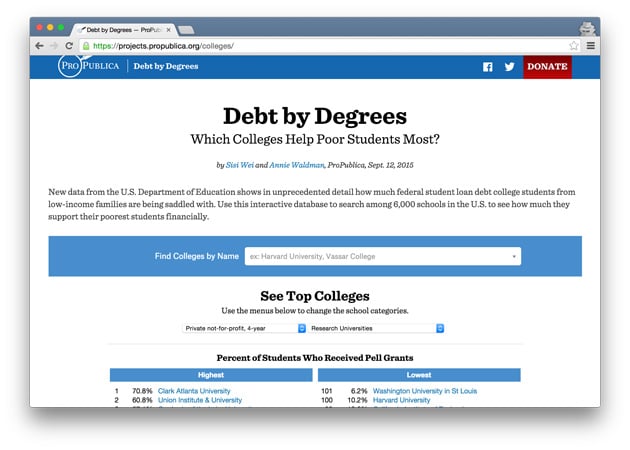
Use our interactive database to search new federal data on almost 7,000 schools in the U.S. to see how well they support their poorest students financially. Explore the app.
(Sisi Wei and Annie Waldman, ProPublica)
A ProPublica analysis based on new data from the U.S. Department of Education shows that students from low-income families graduate from NYU saddled with huge federal loans. The school’s Pell Grant recipients – students from families that make less than $30,000 a year – owe an average of $23,250 in federal loans after graduation.
That’s more federal loan debt than low-income students take on at for-profit giant University of Phoenix, though NYU graduates have higher earnings and default less on their debt.
NYU is not the only university with a billion-dollar endowment to leave its poorest students with heavy debt loads. More than a quarter of the nation’s 60 wealthiest universities leave their low-income students owing an average of more than $20,000 in federal loans.
At the University of Southern California, which has a $4.6 billion endowment, low-income students graduate with slightly more debt than NYU’s graduates: $23,375. At Boston University ($1.5 billion endowment), it’s $27,000, and at Wake Forest University ($1.1 billion endowment) low-income students graduate with $29,150 in debt.

This new data on student debt is drawn from numbers that the Obama administration assembled as part of a planned effort to create grades for every college. In the face of fierce lobbying from universities, the administration backed away, but has made much of the data public on a new website called College Scorecard. ProPublica has used that material to create Debt By Degrees, an interactive database that allows you to search information for almost 7,000 schools. The data provides an unprecedented level of detail on the financial burden that the poorest college students face, showing for the first time how much federal debt poor students take on compared to their wealthier peers, and how well these students are able to repay their loans. The database also shows how much graduates earn on average after leaving school.

Judges, Juries, and the Politics of Tort Reform by David Andrew Logan :: SSRN

Former Roger Williams Law School Dean David Logan mounts something all too rare: an academic's defense of the jury system and a straightforward critique of the so-called "tort reform" movement.  - gwc
Judges, Juries, and the Politics of Tort Reform by David Andrew Logan :: SSRN
Abstract:      

The civil justice system has many repeat players with a deep interest in the civil justice system because they are often the target of personal injury lawsuits, most prominently product manufacturers and physicians, and the companies that insure them. Following a blueprint drafted by leading corporate lawyer Lewis Powell, prior to his appointment to the Supreme Court of the United States, these deep pocket interests have spent four decades and tens of millions of dollars maligning the civil jury and trying, with notable success, to influence legislators, administrators, and judges, both state and federal, under the catchy, but misleading banner of “tort reform.” These campaigns have been amplified by media coverage of the civil justice system that has been unsophisticated, and at times misleading.

This article argues that separation of powers concerns counsel that we should be cautious about constricting the role of the jury, one of our most democratic institutions. Juries provide checks and balances on government; juries are independent; juries bring community values into the judicial system; juries are fair; juries legitimatize the civil justice system; and, juries generally “get it right.”

Instead of draconian reforms like damage caps, the article argues for the primacy of judges when adjustments to the civil justice system are called for. Judges bring legal experience and knowledge not shared by most legislators and administrators; the nature of the judicial process makes judges predictable and their work transparent; judges are far less likely to be “captured” by special interests than legislators and administrators; and state judges have the best perspective of how the civil justice system works and are thus in the best position to implement reforms when necessary.

The article concludes with a survey of various tools, some time-tested and others novel, by which judges can oversee the work of juries, and the civil justice system more generally.

When good intentions fall short in fixing schools - The Washington Post

When I saw the photo - of Mark Zuckerberg, Chris Christie, and Cory Booker - announcing the Harvard dropout Facebook CEO's huge donation to the Newark Public Schools I knew enough to be very skeptical.  Christie alone was enough to spoil the party - guaranteeing that attacks on the teacher's union would be part of the plan.  I don't know how to fix the Newark Public Schools - but firing teachers and eliminating their job security is surely not among them. - gwc
When good intentions fall short in fixing schools - The Washington Post


THE PRIZE
Who’s in Charge of America’s Schools?
By Dale Russakoff
Houghton Mifflin Harcourt. 246 pp. $27
Five years ago, a cluster of superstars aligned for an unprecedented and ambitious reform of Newark’s long-struggling school system. Two formidable politicians, Newark’s Democratic mayor, Cory Booker, and New Jersey’s Republican governor, Chris Christie, put aside partisan differences and conspired to overhaul the Brick City’s schools. The revamp sought to open more charter schools, change the teachers’ contract to more easily fire weak teachers and reward high-performing ones, and aggressively close schools with lagging test scores.
These reforms are being tested and debated in cities across the country, but Booker and Christie enlisted some particularly deep pockets to help bring them to Newark: Facebook founder Mark Zuckerberg donated $100 million in grant money with the condition that the New Jersey politicians find donors to match it. When the earnest young billionaire, the suave mayor and the tough-talking governor announced the gift during an episode of Oprah Winfrey’s talk show in September 2010, raising another $100 million seemed easy. With free publicity, ample political capital and gobs of Silicon Valley cash, what could go wrong?
Just about everything, it turns out, as documented in former Washington Post reporter Dale Russakoff’s incisive new book, “The Prize.” Russakoff gives her accounting in chapters that (roughly) alternate between the stories of key leaders — especially Booker and Newark school Superintendent Cami Anderson — as they attempt to impose top-down reform on a skeptical community, and the tales of educators and students working to improve their own lives and schools. The narrative is rooted in vivid, sometimes incongruous events, from the buffet dinner at a Sun Valley townhouse where Booker first pitched his vision to Zuckerberg, to the bloody handprints that a charter school leader found on the walls of her school one morning, detritus of a late-night brawl involving nine young men.
Keep reading
*Sarah Carr is the author of “Hope Against Hope,” which tells the story of the New Orleans schools after Hurricane Katrina. She directs the Teacher Project, an education reporting fellowship at Columbia Graduate School of Journalism.

Friday, September 11, 2015

In Praise of Law Reviews (And Jargon-Filled, Academic Writing) by Cass R. Sunstein :: SSRN

In Praise of Law Reviews (And Jargon-Filled, Academic Writing) by Cass R. Sunstein :: SSRN
Abstract:

Many people, including many lawyers and judges, disparage law reviews (and the books that sometimes result from them) on the ground that they often deal with abstruse topics, of little interest to the bar, and are sometimes full of jargon-filled, excessively academic, and sometimes impenetrable writing. Some of the objections are warranted, but at their best, law reviews show a high level of rigor, discipline, and care; they have a kind of internal morality. What might seem to be jargon is often a product of specialization, similar to what is observed in other fields (such as economics, psychology, and philosophy). Much academic writing in law is not intended for the bar, at least not in the short-term, but that is not a problem: Such writing is meant to add to the stock of knowledge. If it succeeds, it can have significant long-term effects, potentially affecting what everyone takes to be “common sense.”

DOJ Outlines New Policy Regarding White Collar Cases Against Individuals | WilmerHale

DOJ Outlines New Policy Regarding White Collar Cases Against Individuals | WilmerHale
The Department of Justice has released a new policy intended to further the Department’s effort to hold individuals accountable for corporate wrongdoing. The policy was laid out in a September 9, 2015 memorandum authored by Deputy Attorney General Sally Quillian Yates. The new policy is more than a clarification of existing practices; it constitutes the most significant new measures taken since the Department intensified its focus on pursuing white collar cases against individuals last year. The policy, and in particular the requirement that corporations provide the Department with “all relevant facts relating to the individuals responsible for the misconduct” in order to receive any cooperation credit, could have significant implications for how corporations investigate potential misconduct and share factual findings with the Department.

What Does Marriage Equality Have to Do with Dred Scott? - The New Yorker

Annals of hyperbole. - gwc
What Does Marriage Equality Have to Do with Dred Scott? - The New Yorker
by Amy Davidson

"They can do same thing that Abraham Lincoln did about the Dred Scott decision of 1857,” Mike Huckabee, the former governor of Arkansas, said, speaking of what conservatives might do about Obergefell v. Hodges, the Supreme Court decision in favor of marriage equality. “He simply ignored the ruling and said, ‘That’s not correct.’ ” Huckabee wasn’t alone. Rick Santorum, who, like Huckabee, is running for President, said, “Just as they have in cases from Dred Scott to Plessy, the Court has an imperfect track record.” Penny Nance, the conservative activist,* wrote, “This case is about much more than marriage and will go down in history alongside other appalling Supreme Court rulings, like Dred Scott and Roe.” And Roy Moore, the chief justice of Alabama, said, “In the Dred Scott case the Supreme Court ruled that blacks were property, not citizens of the U.S…. Were they right? Of course not.”

The comparison to marriage equality seems odd and forced, yet Chief Justice John Roberts also made it, in his dissent to the Obergefell decision. And even he wasn’t the first: the alarm about a new Dred Scott has been heard, from activists like Ralph Reed and in the columns of the National Review, at least since the Windsor decision did away with the Defense of Marriage Act, two years ago. What is going on here? What does Dred Scott really have to do with Obergefell?


In part, Dred Scott is simply being used to give Obergefell a bad name—as pure invective, another way to call the decision rotten and the Supreme Court deluded. This is low enough; Dred Scott is a truly degraded decision, in a way that no other of the Court, conservative or liberal, has since matched. And, in part, the analogy reflects the notion, held by some contemporary conservatives, that they are now the “real” victims of bigotry. Roberts disparages the Obergefell decision, but he also does something more subtle. His argument is that both Obergefell and Dred Scott are the results of caring too much about “substantive due process.” Due process is the guarantee, made in the Fifth and Fourteenth Amendments, that a person can’t be deprived “of life, liberty, or property, without due process of law”; “substantive” means that this guarantee is more than formalistic (or “procedural”). In Roberts’s view, Justice Roger Taney’s opinion for the majority in the Scott case and Justice Anthony Kennedy’s in Obergefell are of the same ilk. In the first, the Court found that slave owners couldn’t be deprived of slaves; in the second, it found that gays and lesbians can’t be denied marriage—but both, to Roberts, are cases of due process gone wild.

Federal judge rules health care lawsuit can go forward// JURIST

In an unprecedented move a judge has allowed an action by the House of Representatives to go forward which attacks the rules by which subsidies are paid to insurers under the Affordable Care Act.  There is an ideological movement so dedicated to denying the federal government the power to govern in a modern, national way.  This movement - which has sometimes won majority support on the U.S. Supreme Court - construes the "necessary and proper" clause of the Constitution in a way that could cripple government.  They came close in Sebelius v. NFIB where a majority construed the commerce clause so narrowly that only John Roberts embrace of the tax power saved the Affordable Care Act from history's dustbin.
At the root of it is hostility to government, an embrace of the narrow vision of power of the founders whose embrace of a national government was highly qualified.  One result is our extremely inefficient national government which, in the majority view, does not have a general "police power" - the ability to enact nationwide measures to protect the general health and welfare. So extreme is their federalism that they have crippled the Voting Rights Act in Shelby County v. Holder , and - in a shameful concession by Justice Breyer and Kagan in NFIB v. Sebelius - allowed states to opt out of Medicaid expansion, leaving millions of poor people without health insurance. - gwc

JURIST - Federal judge rules health care lawsuit can go forward
[JURIST] A judge for the US District Court for the District of Columbia [official website] on Wednesday ruled [text, PDF] that Republican members of the House of Representatives have standing to sue the Secretaries of the Department of Health and Human Services and Department of Treasury regarding the Patient Protection and Affordable Care Act (ACA). The Secretaries asked the court to dismiss the case, saying this is a political issue and that the Executive has the power to implement law. Judge Rosemary Collyer [official profile] addressed only the issue of whether the House can sue the Secretaries of the departments. Plaintiffs are claiming that the Secretaries have spent billions of dollars supporting the ACA violating, Article 1 of the Constitution, and that the Secretaries have amended parts of the ACA, narrowing its scope. The court ruled that the plaintiffs have standing to sue the departments for their constitutional claims regarding money spent, but do not have standing concerning the argument that the department heads amended the act.
Comprehensive health care reform [JURIST backgrounder] was passed by Congress in March 2010, and recent legal challenges have reinvigorated debate. The National Conference of State Legislatures (NCSL) [official website] reports that between 2010 and 2015, at least 21 states enacted laws attempting to challenge or completely opt out of mandatory provisions of the ACA. In June the Supreme Court ruled [JURIST report] inKing v. Burwell [SCOTUSblog materials] that tax credits available to those who buy health insurance through state exchanges are also available to those who buy it through the federal exchange. Last year the court ruled[JURIST report] in Burwell v. Hobby Lobby [SCOTUSblog backgrounder] that closely held corporations can deny contraceptive coverage to their employees for religious reasons.

Towering lights of 9/11 video

The Towering Lights of 9/11 http://nyti.ms/1ULbe55


House challenge to health care funding can go ahead : SCOTUSblog

House challenge to health care funding can go ahead : SCOTUSblog
by Lyle Denniston

Breaking new constitutional ground with a ruling that will be tested in higher courts, a federal trial judge in Washington, D.C., has cleared the way for a lawsuit by the House of Representatives claiming that the Obama administration is spending billions of dollars on the new health care program without Congress’s permission to do so.  The administration plans to appeal Wednesday’s ruling, and this fundamental controversy over inter-branch relations seems destined ultimately for the Supreme Court.  Never before has a lawsuit like this one gone forward in court.
U.S. District Judge Rosemary M. Collyer, in a forty-three-page opinion, rejected the government’s argument that the House had no right to go to court at all, to pursue what officials have argued is nothing more than a political ploy by Republican lawmakers in their ongoing challenges to President Obama, and especially to the Affordable Care Act.  On the contrary, the judge decided, at stake in the lawsuit is the specific grant to Congress by Article I of the Constitution of the power to control when federal funds are spent, and the House is threatened with fundamental harm to that constitutional role.
The ruling, however, is not a final decision that the House will ultimately win on its constitutional claim.  The judge has now told both sides to come up with a schedule for how the case moves on from this point, toward such a final decision.  In the meantime, however, officials at the White House and the Justice Department vowed to appeal — probably first in the U.S. Court of Appeals for the District of Columbia Circuit.  The government would have the option, now or later, to go to the Supreme Court.
While the Affordable Care Act has been challenged repeatedly, in court, in Congress and in politics, by its critics, and while two of the most serious court challenges failed in the Supreme Court, the House’s lawsuit opens a new arena of constitutional combat that potentially could deeply undercut one of the main financial parts of the ACA.  The government spent about $3 billion on that provision in the last fiscal year and projects spending of about $175 billion for it over the next decade.

Tuesday, September 8, 2015

`Free Kim Davis'

It's deja vu, kinda. 
A member of Christ Fellowship in North Carolina preached in support of Kim Davis during a prayer rally at the Carter County Detention Center in Grayson, Ky., on Tuesday.

Why Prosecutors Should Stop Hiding Behind Grand Juries" Ben Trachtenberg,Legal Ethics Forum:

Of all the proposals made post Ferguson, post Eric Garner, etc. this is the one that  strikes me as most solid.  The idea of the Grand Jury has been the citizen check on prosecutorial abuse.  But i think that is a myth.  It is either a rubber stamp or the citizen whitewash.  It doesn't work as a trial because it is not a trial.  The Prosecutor is the sole authority in the room.  Since transforming it to something adversarial (e.g. targets lawyers in the room) would be, well, transformative I am inclined to transform it out of existence. - gwc
Legal Ethics Forum: Ben Trachtenberg, "No, You 'Stand Up': Why Prosecutors Should Stop Hiding Behind Grand Juries"
Abstract
This Essay argues that prosecutors should not allow grand juries to consider indicting defendants whom the prosecutors themselves believe should not be indicted. To illustrate the problems with this practice, this Essay uses the example of St. Louis County Prosecutor Robert P. McCulloch – who encouraged deliberations by the grand jury that heard evidence concerning the shooting death of Michael Brown in Ferguson, Missouri, despite personally believing that Brown’s killer, police officer Darren Wilson, should not be indicted. The arguments against allowing grand juries to conduct such needless deliberations include (1) the exercise wastes the time of citizens forced to serve on grand juries; (2) the deliberations might, despite the prosecutor’s wishes, result in indictments contrary to the interests of justice; and (3) by “passing the buck” to the grand jury, the prosecutor evades accountability for his own decisions.

Legal Ethics Forum: The Kentucky county clerk, the judge who opposes the death penalty and the risk of imposing a religious test for public office: Is there any room for religious or other ethical objection to carrying out a portion of a public official’s duties?

 Legal Ethics Forum: The Kentucky county clerk, the judge who opposes the death penalty and the risk of imposing a religious test for public office: Is there any room for religious or other ethical objection to carrying out a portion of a public official’s duties?
by Richard Painter

I supported same sex marriage in amicus briefs filed with the United States Supreme Court. If I were a county clerk I would issue the licenses as required by law and I would not have to endure conflict between such duties and the teachings of my Church, which supports same sex marriage.

http://www.washingtonpost.com/news/acts-of-faith/wp/2015/07/01/why-the-episcopal-church-is-still-debating-gay-marriage/

But what if I were a judge faced with a death penalty case? Since the 1958 General Convention, U.S. Episcopal bishops have maintained a position against the death penalty.

Religious Organizing Against the Death Penalty, Statement of the 1979 General Conference

Many other religious denominations also oppose capital punishment. Should a judge be required to impose the death penalty even if his fundamental religious belief is that it is wrong – perhaps a grave sin – to order the death of another person even for a horrible crime?

If we go too far in forcing people to undertake official duties regardless of religious beliefs, we will de facto impose a religious test for public office despite Article VI, paragraph 3 of the Constitution:

The Senators and Representatives before mentioned, and the Members of the several State Legislatures, and all executive and judicial Officers, both of the United States and of the several States, shall be bound by Oath or Affirmation, to support this Constitution; but no religious test shall ever be required as a qualification to any office or public trust under the United States.***

Read more HERE

Monday, September 7, 2015

Obama overcompensates for winning | xpostfactoid

President Obama's interview with the Forward's editor about the Iran deal was strong.  But as Andrew Sprung points out - his fawning loyalty to Israel tightened my stomach.  Nations have interests.  Leaders serve them.  Frankly I don't see that Israel serves our interests - though we serve its. The tribalist blindness to the interests of the Palestinians costs us a fortune, brings misery to the Palestinians, and does absolutely nothing for the cause of peace. - gwc
Obama overcompensates for winning | xpostfactoid
by Andrew Sprung
Obama's defense of the Iran deal in an interview with the Jewish Daily Forward's editor-in-chief Jane Eisner was marked by bulletproof logic and and impressive grasp of nuance. It was marred, however, by grotesque overcompensation for having beaten back Netanyahu's attempt to control U.S. policy on this front. Obama foreclosed on the the possibility of a fundamental divide in interests, not to say values, in terms inappropriate to relations between nations:
There are always going to be arguments within families and among friends. And Israel isn’t just an ally, it’s not just a friend — it’s family.
And then:

I think the most important thing for those of us who believe it is our sacred obligation to stand up for Israel and to ensure its security — and that’s for American Jews but also non-Jews who feel that same affinity — the most important thing we can do I think is to continue to have honest conversations and honest debate about what is most likely to provide that kind of long-term security.
That's the language of a nation that has ceded its freedom of action in a  dangerous way. With respect to policy, there are no "family" relations among nations. The U.K. is in one sense literally parent to the U.S. Yet if the U.K. gave way to an aggressive dictatorship and started threatening its neighbors -- say, re-litigating its dispute with Ireland and finding pretext to bite off additional pieces, Putin style -- or level Dublin, also Putin-style -- family ties would not (or should not) obligate the U.S. to maintain a commitment to British "security." - See more at: http://xpostfactoid.blogspot.com/2015/09/obama-overcompensates-for-winning.html#sthash.SIeiY4mY.dpuf

Life on the Streets - The New York Times


The Times has a feature today on people living on the streets of New York - mostly around parks/  There are several compelling portraits of people with serious problems.  None can be solved by simple commands: get a job, etc. though for several that is a reasonable goal.  The first, Jose Reyes is living near Yankee Stadium, in or around the field where the stadium once stood. - gwc
Life on the Streets - The New York Times
By Nate Schweber
AGE
19
ORIGINALLY FROM
Highbridge section of the Bronx
HOMELESS SINCE
May 2014 (sporadically)
LOCATION
Outside Heritage Field


Jose Morales and his 17-year-old girlfriend, Kimberly Williams, who is five months pregnant, had built a shelter out of a blanket tethered to a fence, underneath the No. 4 train.

Mr. Morales said he grew up in a troubled home in the Bronx and eventually attended high school at a residential treatment center for drug and alcohol addiction. When he got out, he went into foster care with a family in Brooklyn, because his mother had been sent to prison on drug charges. He rebelled.

"I didn't want to listen, I didn't want to do no chores, I didn't want to obey no curfew," he said. "If I was able to go back right now, I'd apologize and fix it."

He was sent to another foster home in the Bronx. That was when he met Ms. Williams over Facebook. When she was kicked out of her home on Long Island after a fight with her grandmother, Mr. Morales allowed her to stay with him — a violation of house rules. They were both evicted.

They squatted on a rooftop in Brooklyn before taking up residence in their current location. They went to the city intake center in the Bronx for homeless families, but learned they were ineligible because they were not married or in a domestic partnership.

On Wednesday night, they huddled together on the sidewalk and watched a praying mantis crawl on the fence above their bed.

"I go around, I ask for a job here and there, but nobody's hiring," Mr. Morales said. "This isn't good for her, it isn't good for me."

Does anyone know what is going on with Kim Davis in Rowan County, KY? // Marty Lederman // Balkinization

Torts Today: Does anyone know what is going on with Kim Davis in Rowan County, KY? // Marty Lederman // Balkinization
Marty Lederman (Georgetown Law) tries to parse out the situation in Kentucky where federal judge David Bunning has thrown County clerk Kim Davis into the brig because she is in contempt of preliminary injunction to cease her "no marriage licenses policy".  The judge has spared the Deputy Clerks who have agreed to perform the ministerial act of issuing marriage licenses.

But if you can get married in Rowan County by getting a license from a Deputy clerk, why is Kim Davis in jail?  She thinks it is because only she can authorize the Deputies to issue licenses, and she refuses to do it because she does not approve of same sex marriage, and issuance by her office of such a license would make her complicit in something that violates her conscience.  Mike Huckabee agrees with her, as presumably, does Catholic Neo-Con Robert George.  They say Obergefell v. Hodges is today's Dred Scott - an act of judicial lawlessness (they're wrong about Dred Scott).
Judge Bunning could issue marriage licenses (FRCvP 70 - on my Miller v. Davis resource page), or appoint a master to do it, but doesn't want to take on that function when there is an office in Rowan charged by Kentucky law with the duty.  In any event the federal court has power here - as in the school desegregation cases - to override state law, as Cornell's Michael Dorf points out.

Personally I think that Davis is wrong - that there is nothing more personal about her office issuing a marriage license than the signature of Jacob Lew, Secretary of the Treasury on the twenty dollar bill in my pocket.  It is the State that acts, not her - she could readily be replaced by an App.  And probably should be.
But this is a post to draw attention to Marty Lederman's quite thorough survey, which is well worth reading.  He asks four questions:

The Law

So where do things stand now? Let’s break it down into four key questions:

1. If licenses issued in Rowan County included Davis’s name, would she be authorizing or approving the subsequent marriages?

2. Must the licenses include the County Clerk’s name, “Kim Davis,” in order to be valid?

3. Can Deputy Clerk Mason issue licenses if Clerk Davis has directed him not to do so?

4. Was Judge Bunning justified in holding Davis in contempt and remanding her to federal custody?

Does anyone know  what is going on with Kim Davis in Rowan County, KY? // Marty Lederman // Balkinization

A Class Bias on Rights? A Different Take on Kim Davis // Mark Graber // Balkinization

Balkinization: A Different Take on Kim Davis
by Mark Graber
Put more broadly and more polemically, the fuss over Kim Davis demonstrates that the Constitution of the United States remains an effective means of combating governmental policies that inflict stigmatic harm on members of the upper-classes, but a far less effective means of combating government policies that inflict material deprivation on the lower classes. Consider simply the following. Who is likely to be inconvenienced more in a red state, A same-sex couple wanting to exercise their constitutional right to be married or a poor women more than twelve weeks pregnant who has decided to exercise her constitutional right to have an abortion?

Sunday, September 6, 2015

Senator Cory Booker agrees to back "flawed" Iran Arms Agreement

It's good news.  But I'm getting a bit tired of this "flawed deal but I'll back it" talk. There is a pledge not to build a nuclear weapon, a huge reduction in plutonium production, verification, and a long time commitment.  What would impress me is if some major politician actually stood up and pointed out that Israel has hundreds of nuclear weapons, is the only Mid-East nuclear state. It is not only a  member of the club that threatens to unleash genocidal violence on others, but refuses to acknowledge it, and does not even renounce first strike. Want a non-nuclear Mid-East?  Ask Israel to lead the way.  - gwc
Senator Cory Booker Will Back Iran Deal
Senator Cory A. Booker, Democrat of New Jersey, endorsed President Obama’s nuclear agreement with Iran on Thursday, padding support for the accord, which already has enough votes in the Senate to thwart a Republican-backed resolution of disapproval.
Echoing language other Democrats have used in recent weeks, Mr. Booker said in a statement that supporting the deal was “the better of two flawed options.” Backing away from the nuclear pact at this point, he said, would leave the United States and its allies with few options to restrain Iran’s ambitions.
“I believe rejection of the deal would allow Iran to achieve an aim it has wanted all along: a significant unwinding of sanctions without the constraints on its nuclear program that this deal provides,” Mr. Booker said.


With Mr. Booker’s announcement, supporters of the deal now have 37 votes in the Senate backing the agreement. Two other Senate Democrats, Mark R. Warner of Virginia and Heidi Heitkamp of North Dakota, also announced their support for it on Thursday.

Lynn Walker Huntley, Lawyer in Prominent Civil Rights Issues, Dies at 69 - The New York Times


A life well lived. - gwc
Lynn Walker Huntley, Lawyer in Prominent Civil Rights Issues, Dies at 69 - The New York Times
by David Stout

Lynn Walker Huntley, a lawyer who was deeply involved in a wide spectrum of civil rights cases and causes, including capital punishment, race relations and employment discrimination, died Aug. 30 at her home in Atlanta. She was 69.
The cause was cervical cancer, her husband, Walter Huntley, said.
Ms. Huntley was at various times an official in the Department of Justice, general counsel to the New York City Commission on Human Rights, a lawyer for the NAACP Legal Defense and Educational Fund, a scholar and program director for the Ford Foundation and president of a charity that works to improve education for children.
“We must continue to struggle against racism, sexism and other forms of oppression, not only because it is the right thing to do, although it is,” Ms. Huntley once said. “We must continue to struggle because to give in and give up is to ensure that all is lost and to betray what we stand for.”
Ms. Huntley spoke those words early in her tenure at the Southern Education Foundation, whose mission is to raise educational standards in the South, especially for black children and those from poor families. Ms. Huntley joined the foundation in 1995 and in 2002 became its first female president. By the time she retired in 2010, she had raised more than $44 million and doubled its endowment, the organization said.

Doctrine of Discovery: A scandal in plain sight | National Catholic Reporter

Doctrine of Discovery: A scandal in plain sight | National Catholic Reporter
by Vinnie Rotondaro
In 2009, the Episcopal Church repudiated the Doctrine of Discovery. 
In 2012, The Unitarian Universalist Association followed suit. Other religious groups — the Christian Church (Disciples of Christ), the World Council of Churches, New York Yearly Meeting of the Religious Society of Friends, the United Methodist church, to name a few — have also repudiated it. 
But the Vatican has refused to publicly address Catholicism’s role in bringing about the Doctrine of Discovery, or revoke the papal bulls that articulated it. Perhaps, then, it is not surprising to find that most Catholics know almost nothing about it.
Libby Comeaux, a lawyer and co-member of the Loretto Community, recalls the first time the Loretto sisters were confronted by the history. It was January 2012. Comeaux was a convener of a law review symposium at the University of Denver, of which the Loretto community was a sponsor. 
“A number of Loretto sisters and members were at the gathering,” Comeaux said, “and one of the themes was the rights of nature, public trust, that sort of thing, as it applied to water. And a law professor from Denver University stood up and started giving us some feedback that was fairly uncomfortable to hear. … He was saying, ‘You’re talking about rights of nature as if you invented this term, and you’re Catholics. What do you think about the Doctrine of Discovery? What are you doing about it?’
Francis-cartoon-book.jpgGet NCR's newest book:The Chronicles of Francis, the Cartoon Strip, featuring cartoons from the popular series Francis.
Buy it now!

“I may have been the only Catholic in the room who knew what he was talking about,” she said.
In November 2013, the Loretto community sent a letter to Pope Francis.
The letter called on the pope to “formally and publicly repudiate and rescind the Dum Diversas Bull of 1452, and other related bulls, which grant the Pope’s blessing ‘to capture, vanquish, and subdue the Saracens, pagans, and other enemies of Christ and put them into perpetual slavery and to take all their possession and their property.’ We also call upon the Pope to repudiate and rescind the Inter CaeteraBull of 1493 that granted authority to Spain and Portugal to ‘take all lands and possessions’ so long as no other Christian ruler had previously claimed them. These bulls instilled the Doctrine of Discovery, the papal sanctioning of Christian enslavement and power over non-Christians.” ****

Saturday, September 5, 2015

Posner's Passion Sparks Dispute on Judge's Use of Internet Research // Rowe v.Gibson 7th Circuit

Judge Richard Posner exhibited an extraordinary passion for justice when he wrote  “It is heartless to make a fetish of adversary procedure if by doing so feeble evidence is credited because the opponent has no practical access to offsetting evidence.”  The prolific 7th Circuit judge was writing in Rowe v. Gibson. The court  reversed the grant of summary judgment and dismissal to defendant prison officials who were alleged to have been deliberately indifferent to plaintiff’s medical condition in violation of the cruel and unusual punishment clause of the Eighth Amendment.  Rowe claims prison officials callously withheld and administered the  medication necessary for care of  his reflux esophagitis - GERD.

 Like his colleagues Posner found Rowe’s claims sufficient to reverse grants of summary judgment.  Posner disputed  the credentials of  credentials of the prescribing physician - a  defendant who testified as an expert in his own defense, in a field not his own.  To reach and support his conclusions  - and doubtless fueling his anger - Posner conducted  his own independent research about the drug commonly known as Zantac.   Posner gathered  materials from the drug’s manufacturer GlaxoSmith Kline, and widely relied upon authoritative sources such as the National Institutes of Health, the Mayo Clinic, Web MD and Wikipedia in discussing the pro se plaintiff’s physical condition and legal claims.

Posner’s efforts were  sharply criticized by his colleague David Hamilton.  He took exception to Judge Posner’s reliance on the sources, finding them to be investigations of fact, beyond the scope of what is permitted of a neutral magistrate. - gwc

Friday, September 4, 2015

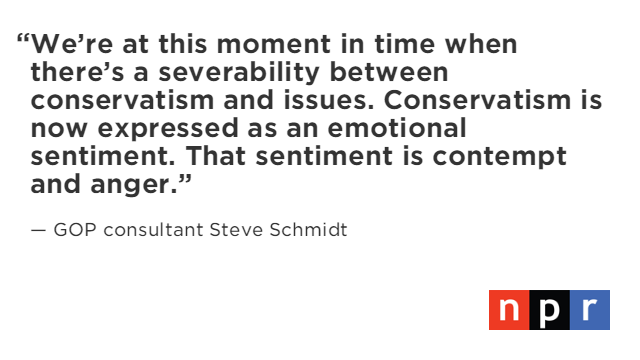
Explained: The intellectual collapse of conservatism as a political movement in America

John McCain's top guy in 2008
Embedded image permalink

Curse of the Obama Doctrine // David Rothkopf FP

http://foreignpolicy.com/2015/09/03/the-curse-of-the-obama-doctrine-middle-east-arab-world/?utm_source=Sailthru&utm_medium=email&utm_campaign=New%20Campaign&utm_term=Flashpoints

Wednesday, September 2, 2015

Congressional Testimony: Immigration Reforms Needed to Protect Skilled American Workers | Economic Policy Institute

I'm basically an old-fashioned class struggle sort.  I think that the famously pro-immigration policies of Microsoft, et al. is driven by the drive to lower labor costs.  Forty eight years ago! when I was in the Peace Corps travelling around India by train I met many young engineers who wanted to come to "America proper" because there wasn't work for them at home.  They are the core of the vulnerable, employer-dependent programming corps at many U.S. companies; doing the less skilled work of writing code - the grunt work of the industry. - gwc
Congressional Testimony: Immigration Reforms Needed to Protect Skilled American Workers | Economic Policy Institute
Testimony of EPI Research Associate and Associate Professor of Public Policy at Howard University Ron Hira before the U.S. Senate Judiciary Committee hearing on “Immigration Reforms Needed to Protect Skilled American Workers,” Dirksen Senate Office Building, March 17, 2015.
***
  1. The Intent of Our Immigration Law is to Protect American Workers – Instead Our Guestworker Programs Inflict Serious Harm on Them
Congress and multiple Administrations have inadvertently created a highly lucrative business model of bringing in cheaper H-1B workers to substitute for Americans. There are mainframe-sized loopholes built into the H-1B program’s design – the statutory law, regulations, administrative law, and policy guidance – and a complete disinterest on the part of multiple Administrations in enforcing the current rules, however weak they may be. Some of these loopholes are intentional, some are not, but they all add up to a system that encourages employers to exploit the H-1B program for cheap labor. Given the extraordinarily high profits involved in using guestworkers instead of Americans, it should surprise no one that many employers are taking advantage of this business model and lobbying to expand it.
In explaining the H-1B program rules the U.S. Department of Labor prominently and plainly states, “The Immigration & Nationality Act (INA) requires that the hiring of a foreign worker will not adversely affect the wages and working conditions of U.S. workers comparably employed.”1
The clear intent of the law [8 U.S. Code §1182], is that hiring foreign workers will not harm American workers. Yet the H-1B program is most definitely harming American workers, harming them badly, and on a large scale. Most of the H-1B program is now being used to import cheaper foreign guestworkers, replacing American workers, and undercutting their wages. So, contrary to intent of the INA, the use of the program is indeed “adversely affecting American workers’ wages and working conditions.” The scale of this damage is large and its effects long lasting, adversely impacting: the careers of hundreds of thousands of American workers; future generations of students; and, America’s future capacity to innovate. This is not just adversely affecting a few workers. The H-1B program is very large with approximately 120,000 new workers admitted annually. Once admitted those workers can remain in the U.S. up to six years. While no one knows exactly how many H-1Bs are currently in the country, analysts estimate the stock of H-1B workers at 600,000.
There are hundreds of thousands of additional guestworkers admitted on L-1 and OPT visas, and they too are harming the job prospects of American workers. Because Congress never expected L-1 and OPT workers to be potential competition to American workers those programs have virtually no rules to protect American workers. That expectation was incorrect. As with the H-1B program, these guestworker visa programs are now being used too to replace and undercut American workers.
Congress needs to significantly overhaul these programs to protect American workers in order to meet the intent of the INA. And the Executive Branch needs to use its full authority to investigate and stamp out any violations that are occurring. Further, it needs to propose and promulgate new regulations and policy guidance to ensure compliance with its own statements about the INA.
Current protections in the H-1B program are seriously flawed. Skilled guestworker programs can serve important purposes: bringing in workers with unique or specialized skills; serving as a bridge to employment-based permanent immigration for specialized workers; and, offering practical training for foreign students. But those positive uses have been overwhelmed by the use of these programs for cheaper labor.

Rand Paul: If you want to get married go to a church

C3bs7buxrqxssyh9ksg5
"I think people who do stand up and are making a stand to say that they believe in something is an important part of the American way," Rand Paul told Boston Herald Radio, according to The Washington Post.
 "I think one way to get around the whole idea of what the Supreme Court is forcing on the states is for states just to get out of the business of giving out licenses," [Senator] Paul said. "Alabama has already voted to do this, they’re just no longer going to give out licenses. And anybody can make a contract. And then if you want a marriage contract you go to a church. And so I’ve often said we could have gotten around all of this also in the sense that I do believe everybody has a right to a contract."
- Senator Rand Paul (R-KY), September 2, 2015
That government governs best which governs least is an old conservative meme.  Every so often Rand Paul reminds you that he comes from the wacko libertarian freedom of contract camp.  If you want to get married - go to a church.  Or sign a contract.  Of what sort?  I suppose that there's a lot of work for lawyers drafting pre-nups, to look on the bright side. On the dark side even a "libertarian" Kentucky pol can't bring himself to say that liberty requires the freedom to marry a person of your choice.  - gwc