Cardinals Joseph Tobin- Newark, Cupich - Chicago, and McElroy - D.C. Say NO to ICE - National Catholic Reporter
A high-ranking Catholic leader is ratcheting up criticism of the Trump administration's immigration crackdown and urging people of faith to be more vocal in calling out injustice.
Responding to a sense of helplessness many people are feeling in the wake of violence at the hands of federal immigration officials, Cardinal Joseph Tobin of Newark, New Jersey, urged people of faith not to shy away from the news and to use their voices to say, "No."
In a reflection delivered Jan. 26 during an online interfaith prayer service hosted by Faith in Action, Tobin employed some of the strongest language yet by a U.S. cardinal to condemn the Trump administration's immigration crackdown, describing Immigration and Customs Enforcement "lawless" and urging Catholics to tell their lawmakers to vote against additional funding.
Recounting a story from Bread and Wine, a 1936 novel by Ignazio Silone, Tobin described a character lamenting the incursion of fascist forces who asks a priest, "Father, what can we do?" With "the machinery of death" set in motion, as Tobin put it, the priest tells the young woman that what worries dictators and authoritarian regimes is the person who scrawls on the piazza wall, "No."
"I think if we are serious about putting our faith in action, we need to say 'no,' each one of us," Tobin said. What saying "no" looks like today, he continued, is by telling the truth about what is happening and honoring those whose lives are upended.
Over the weekend, immigration enforcement agents killed Alex Pretti, a 37-year-old Minneapolis resident and intensive care nurse who was filming at the protest. Federal authorities say that Pretti was armed and a threat to law enforcement, but video analysis by The New York Times and other media outlets dispute that account. According to reports, Pretti's gun had already been secured by officers before two agents shot him at least 10 times.
"One way that we say 'no' is that we mourn, we do not celebrate death, and, what is probably worse, we do not pretend it doesn't happen. We say names. We pray for the dead," Tobin said. "We mourn for a world, a country, that allows 5-year-olds to be legally kidnapped and protesters to be slaughtered."
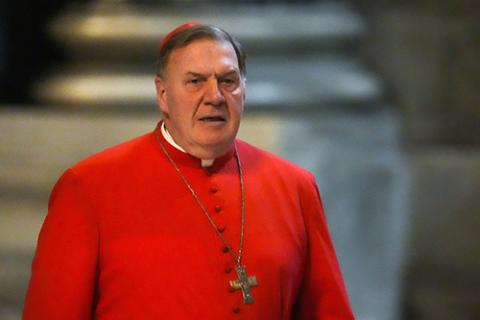
One of three U.S. cardinals who recently signed a statement condemning President Donald Trump's foreign policy aims and calling for the White House to focus on peace, Tobin noted that he was speaking within a few miles from two detention centers.
"Everyday people from many faith communities go to Delaney Street here in Newark, and to the Elizabeth Detention Center, and they say 'no' by standing at the gates, by talking with the ICE personnel, by insisting on the rights of the detainees within," he said. "They bring them human comfort, they console the families of those who aren't always admitted to see their loved ones. How will you say 'no?' How?"
Citing the Gospel story of the Good Samaritan, and invoking the Rev. Dr. Martin Luther King, Jr., Tobin asked how people will say "no" to what's happening today.
"How will you say 'no?' How will you say 'no' to violence?" he said. "How will you say 'no' this week when an appropriations bill is going to be considered in Congress? Will you contact your congressional representatives, the senators and representatives from your district? Will you ask them, for the love of God and the love of human beings, which can't be separated, to vote against renewing funding for such a lawless organization?"
Full text of statement by Chicago Cardinal Blase J. Cupich, Washington Cardinal Robert W. McElroy, and Newark Cardinal Joseph W. Tobin:
Charting A Moral Vision of American Foreign Policy:
In 2026, the United States has entered into the most profound and searing debate about the moral foundation for America’s actions in the world since the end of the Cold War. The events in Venezuela, Ukraine and Greenland have raised basic questions about the use of military force and the meaning of peace. The sovereign rights of nations to self-determination appear all too fragile in a world of ever greater conflagrations. The balancing of national interest with the common good is being framed within starkly polarized terms. Our country’s moral role in confronting evil around the world, sustaining the right to life and human dignity, and supporting religious liberty are all under examination. And the building of just and sustainable peace, so crucial to humanity’s well-being now and in the future, is being reduced to partisan categories that encourage polarization and destructive policies.
For all of these reasons, the contribution of Pope Leo in outlining a truly moral foundation for international relations to the Vatican diplomatic corps this month has provided us an enduring ethical compass for establishing the pathway for American foreign policy in the coming years. He stated:
In our time, the weakness of multilateralism is a particular cause for concern at the international level. A diplomacy that promotes dialogue and seeks consensus among all parties is being replaced by a diplomacy based on force, by either individuals or groups of allies. War is back in vogue and a zeal for war is spreading. The principle established after the Second World War, which prohibited nations from using force to violate the borders of others, has been completely undermined. Peace is no longer sought as a gift and desirable good in itself, or in pursuit of "the establishment of the ordered universe willed by God with a more perfect form of justice among men and women." Instead, peace is sought through weapons as a condition for asserting one’s own dominion.
Pope Leo also reiterates Catholic teaching that "the protection of the right to life constitutes the indispensable foundation for every other human right" and that abortion and euthanasia are destructive of that right. He points to the need for international aid to safeguard the most central elements of human dignity, which are under assault because of the movement by wealthy nations to reduce or eliminate their contributions to humanitarian foreign assistance programs. Finally, the Holy Father points to the increasing violations of conscience and religious freedom in the name of an ideological or religious purity that crushes freedom itself.
As pastors and citizens, we embrace this vision for the establishment of a genuinely moral foreign policy for our nation. We seek to build a truly just and lasting peace, that peace which Jesus proclaimed in the Gospel. We renounce war as an instrument for narrow national interests and proclaim that military action must be seen only as a last resort in extreme situations, not a normal instrument of national policy. We seek a foreign policy that respects and advances the right to human life, religious liberty, and the enhancement of human dignity throughout the world, especially through economic assistance.
Our nation’s debate on the moral foundation for American policy is beset by polarization, partisanship, and narrow economic and social interests. Pope Leo has given us the prism through which to raise it to a much higher level. We will preach, teach, and advocate in the coming months to make that higher level possible.
Signed,
Cardinal Blase J. Cupich, Archbishop of Chicago
Cardinal Robert W. McElroy, Archbishop of Washington
Cardinal Joseph W. Tobin, C.Ss.R., Archbishop of Newark


No comments:
Post a Comment