Minneapolis I hear your voice....First Avenue, Minneapolis


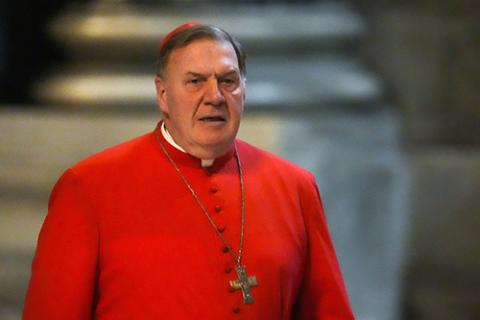
Cardinals Joseph Tobin- Newark, Cupich - Chicago, and McElroy - D.C. Say NO to ICE - National Catholic Reporter
A high-ranking Catholic leader is ratcheting up criticism of the Trump administration's immigration crackdown and urging people of faith to be more vocal in calling out injustice.
Responding to a sense of helplessness many people are feeling in the wake of violence at the hands of federal immigration officials, Cardinal Joseph Tobin of Newark, New Jersey, urged people of faith not to shy away from the news and to use their voices to say, "No."
In a reflection delivered Jan. 26 during an online interfaith prayer service hosted by Faith in Action, Tobin employed some of the strongest language yet by a U.S. cardinal to condemn the Trump administration's immigration crackdown, describing Immigration and Customs Enforcement "lawless" and urging Catholics to tell their lawmakers to vote against additional funding.
Recounting a story from Bread and Wine, a 1936 novel by Ignazio Silone, Tobin described a character lamenting the incursion of fascist forces who asks a priest, "Father, what can we do?" With "the machinery of death" set in motion, as Tobin put it, the priest tells the young woman that what worries dictators and authoritarian regimes is the person who scrawls on the piazza wall, "No."
"I think if we are serious about putting our faith in action, we need to say 'no,' each one of us," Tobin said. What saying "no" looks like today, he continued, is by telling the truth about what is happening and honoring those whose lives are upended.
Over the weekend, immigration enforcement agents killed Alex Pretti, a 37-year-old Minneapolis resident and intensive care nurse who was filming at the protest. Federal authorities say that Pretti was armed and a threat to law enforcement, but video analysis by The New York Times and other media outlets dispute that account. According to reports, Pretti's gun had already been secured by officers before two agents shot him at least 10 times.
"One way that we say 'no' is that we mourn, we do not celebrate death, and, what is probably worse, we do not pretend it doesn't happen. We say names. We pray for the dead," Tobin said. "We mourn for a world, a country, that allows 5-year-olds to be legally kidnapped and protesters to be slaughtered."
One of three U.S. cardinals who recently signed a statement condemning President Donald Trump's foreign policy aims and calling for the White House to focus on peace, Tobin noted that he was speaking within a few miles from two detention centers.
"Everyday people from many faith communities go to Delaney Street here in Newark, and to the Elizabeth Detention Center, and they say 'no' by standing at the gates, by talking with the ICE personnel, by insisting on the rights of the detainees within," he said. "They bring them human comfort, they console the families of those who aren't always admitted to see their loved ones. How will you say 'no?' How?"
Citing the Gospel story of the Good Samaritan, and invoking the Rev. Dr. Martin Luther King, Jr., Tobin asked how people will say "no" to what's happening today.
"How will you say 'no?' How will you say 'no' to violence?" he said. "How will you say 'no' this week when an appropriations bill is going to be considered in Congress? Will you contact your congressional representatives, the senators and representatives from your district? Will you ask them, for the love of God and the love of human beings, which can't be separated, to vote against renewing funding for such a lawless organization?"
Full text of statement by Chicago Cardinal Blase J. Cupich, Washington Cardinal Robert W. McElroy, and Newark Cardinal Joseph W. Tobin:
Charting A Moral Vision of American Foreign Policy:

Minnesotans march against ICE


Mark Carney - Canadian PM at Davos

A SPEECH FOR THE HISTORY BOOKS - CANADIAN PM MARK CARNEY AT DAVOS
By James Fallows [a former Presidential speechwriter for Jimmy Carter]
It’s impossible to judge the long-term effect of oratory, in the short term. Many presentations that loom large in history were almost ignored at the time. Here’s just one example of many:
At Harvard’s commencement ceremony in 1947, then-Secretary of State George Marshall spent 12 minutes outlining why it was in America’s interest to help Europe recover from the devastation of World War II. Even though this would mean Americans pouring more tax money into the continent where so many of them had already sacrificed. Even though it would include helping Germany, so recently the Allies’ bitter foe.
At the time, the speech barely drew any coverage. But eventually it was recognized as the debut of what became the Marshall Plan, which in turn was the basis for Marshall himself receiving the Nobel Peace Prize in 1953.1
None of us can know for sure whether yesterday’s brief address at Davos, by Canada’s prime minister Mark Carney, will similarly be remembered as marking a turning point in understanding world power, and of America’s role. But there’s a chance it will be. And in any case, to keep it above the slurry of the latest outrage news, it’s worth noticing the craft, the composition, and the content of these 17 minutes on stage.
I’ll call this out with line-by-line annotations on the text, below. But the main accomplishments of the speech were these:
KEEP READING Text embedded
The new colossus: DO NOT SEND ME YOUR TIRED, YOUR POOR, YOUR HUDDLED MASES YEARNING TO BREATH FREE
Perdomo v. Noem, 790 F. Supp. 3d 850 (C.D. Cal. 2025)
"Give me your tired, your poor, / Your huddled masses yearning to breathe free"
Emma Lazarus
So engrained in our national ethic were those words at the base of the Statue of Liberty that Ronald Reagan – whose conservative bona fides were beyond question – stood on the deck of an aircraft carrier near the Statue to mark our nation’s bicentennial.

But half a century later the Department of Homeland Security searches for unauthorized immigrants in Maine under the rubric of “Catch of the Day”. Like Lewiston and Portland, Maine, Minnesota is home to many Somali emigrees embraced by Lazarus’s famous words.
But today’s President – Donald J. Trump strikes a gravely different tone. Speaking of Minnesota he has said
“It's a rigged state. And the Somalians vote as one group even if they're not citizens. They all ought to get the hell out of here. They're bad for our country.”
After swarming Minneapolis with thousands of masked ICE troops attention turned to Los Angeles where United States District Judge Maame Frimpong found that agents have seized people based on language and appearance but the agents’ “knowledge that undocumented individuals use and seek work at car washes falls woefully short of the reasonable suspicion needed to target any particular individual at any particular car wash.”
The Judge asked:
Is it illegal to conduct roving patrols which identify people based upon race alone, aggressively question them, and then detain them without a warrant, without their consent, and without reasonable suspicion that they are without status? Yes, it is.
• Is it unlawful to prevent people from having access to lawyers who can help them in immigration court? Yes, it is.
And, further,
are the individuals and organizations who brought this lawsuit likely to succeed in proving that the federal government is indeed conducting roving patrols without reasonable suspicion and denying access to lawyers? This Court decides—based on all the evidence presented—that they are.
And second, what should be done about it?
The District Judge found that [DHS] failed to provide any concrete details as to what factors led Defendants to stop and question Gomez specifically nor indicate the nature of surveillance and intelligence data gathered that would give rise to reasonable suspicion.
The District Judge explained that “the
field agents' testimony (that it was "INS policy to conduct complete
sweeps of all community residences, with or without information as to specific
residences") … contradicted the official policy of the defendant agency
(that such sweeps should be done only upon "individualized
suspicion"),
Perdomo v. Noem, 790 F. Supp. 3d 850,
894 n.29, 33 (C.D. Cal. 2025)”
Today we are again faced with the challenge Emma Lazarus posed. Unfortunately the majority of the United States Supreme Court in a summary order lifted the injunction granted by a United States District Judge in California. Associate Justice Brett Kavanaugh found that ICE agents “may briefly detain” an individual “for questioning” if they have a “reasonable suspicion…that the person is an alien illegally in the United States.”
But Associate Justice Sonia Sotomayor’s description of ICE conduct departs markedly from Justice Kavanaugh’s sanitized version. She concluded that the four factors cited by the government do not “taken together ..satisfy the Fourth Amendment’s requirement of reasonable suspicion.” The District Court, she concluded, properly temporarily enjoined the Government from continuing its pattern of unlawful mass arrests.”
The four factors are generalized, not specific: 1) apparent race or ethnicity, 2) whether they spoke Spanish or English “with an accent”, 3) their location such as at a car wash or bus stop, and 4) the type of job they appeared to work. Individualized suspicion is not satisfied, Sotomayor wrote...but Justice Kavanaugh was satisfied, asserting that 2 million of the 20 million residents of Los Angeles area are present “illegally”.
Even if Kavanaugh’s estimate is correct the Department of Homeland Security has embarked on a campaign of mass deportation of unprecedented scope which would drastically affect life in LA and elsewhere, disrupting schools, the labor force, and much more.
ICE has announced it is now deploying its forces to Maine which, like Minneapolis, has a substantial population of Somali refugees from war and tyranny.
We recognize that significant effort is required to accommodate emigrees. But our country has been built on such a foundation. Emigrees come here fleeing poverty tyranny, climate sister and in hope of liberty and prosperity. Generosity, not hostility, should guide our policies.
- George Conk
- 1/21/2026
ALL CANDIDATES CAN CHALLENGE ELECTION LAWS
Supreme Court Bost v. Illinois Bd of Elections

NOTE: This is NOT an analysis of the shooting of Re.nee Good
It depicts a "routine" stop in which the pedestrian refuses to show ID, and is ordered toenter the patrol vehicle
Minneapolis
Trump faces a series of setbacks - NY Times - January 10, 2026
Childcare funding: A federal judge in New York temporarily blocked the Trump administration from freezing roughly $10 billion in federal funding for child care and social services destined for five Democratic-led states, keeping funds flowing until a lawsuit against the government can progress. After the ruling, the administration announced it was freezing food assistance funding in Minnesota.
Minnesota refugee review: The Trump administration said that it was reviewing the applications of thousands of refugee cases in Minnesota amid an immigration crackdown in the state. Immigrants who previously received approval may face new interviews and background checks. Read more ›
Kennedy Center: The Washington National Opera decided to move its performances out of the John F. Kennedy Center for the Performing Arts, abandoning the hall where it has played since 1971 in perhaps the largest artistic rebuke yet to President Trump’s campaign to remake the Kennedy Center in his image. Read more ›

Reporting from Washington

A federal judge blocked the Trump administration on Friday from enforcing part of an executive order directing the government to withhold federal election funds to states that do not alter their voting procedures in line with the president’s demands.
Judge John H. Chun, of the U.S. District Court in Seattle, wrote in a 75-page opinion that threats aimed at states that declined to make several changes President Trump outlined violated the separation of powers and impeded states’ ability to administer their own elections. “The Constitution assigns no authority to the president over federal election administration,” he wrote.


