https://truthsocial.com/@realDonaldTrump/115398251623299921


Vladeck - The Massive Stakes of Trump v. Illinois
By Steve Vladeck (University of Texas School of Law - Austin)
"On Friday afternoon, the Trump administration filed its latest (29th) emergency application in the Supreme Court, this one seeking a stay of a district court temporary restraining order (TRO) that is barring the administration from deploying federalized National Guard troops into Chicago and its environs. Below, I’m going to go into much more detail on how we got here; on what the district court and Seventh Circuit each ruled; and on how the Solicitor General’s application is asking for relief based upon not just an utterly limitless view of when the President can deploy federalized National Guard personnel, but a wildly different portrayal of the facts on the ground than what either lower court specifically concluded.
But the upshot is that, more than any of the first 28 applications from the Trump administration, Trump v. Illinois is a make-or-break moment for this Court. For the Supreme Court to issue a ruling that allows the President to send troops into our cities based upon contrived (or even government-provoked) facts, even if it does so in a way that avoids formally upholding such conduct as a matter of law, would be a terrible precedent for the Court to set—not just for what it would allow President Trump to do now, but for the even more grossly tyrannical conduct it would allow him and future presidents (assuming we have any) to undertake later. If factually and legally unpersuasive domestic deployments of troops aren’t going to be a red line for the Supreme Court, what the heck will be? "- SV
Unlike the notorious anti-labor injunction of In Re Debs, 158 U.S. 564 (1895) the government here seeks to accomplish the suppression of free speech by deploying federalized soldiers rather than thousands of deputized Pinkertons.
The hyperbolic tone of the government's application (above) can be seen here:
This case presents what has become a disturbing and recurring pattern: Federal officers are attempting to enforce federal immigration law in an urban area containing significant numbers of illegal aliens. The federal agents’ efforts are met with prolonged, coordinated, violent resistance that threatens their lives and safety and 2 systematically interferes with their ability to enforce federal law. That resistance succeeds to an alarming degree in its aim of obstructing federal agents from enforcing federal immigration law. Federal agents are forced to desperately scramble to protect themselves and federal property, allocating resources away from their law-enforcement mission to conduct protective operations instead. Receiving tepid support from local forces, they are often left to fend for themselves in the face of violent, hostile mobs. Confronted with intolerable risks of harm to federal agents and coordinated, violent opposition to the enforcement of federal law, the President lawfully determines that he is unable to enforce the laws of the United States with the regular forces and calls up the National Guard to defend federal personnel, property, and functions in the face of ongoing violence. Local political leaders immediately sue in federal district court to prevent the President from deploying federal forces to protect federal agents and enable them to enforce federal immigration law. The district court then issues an opinion granting injunctive relief against the President’s action that downplays or denies the ongoing threat to the lives and safety of federal agents, substitutes the court’s own judgment for the President’s about the need for military augmentation, and gives little or no weight to the United States’ interest in enforcing federal immigration law. The district court then countermands the exercise of the President’s Commander-in-Chief authority and projects its own authority into the military chain of command. This pattern began in Los Angeles in early June, when violent mobs targeted federal personnel and federal buildings to thwart increased enforcement efforts by Immigration and Customs Enforcement (ICE). After local and state authorities failed to stem the violence, the President called up members of the California National Guard.
See decisions below:

In an echo of a late 19th century Chicago-centered labor dispute thousands of people, above, protest the raids and widespread arrests of suspected unauthorized immigrants in the city.
The nation's politics were roiled for many years by the United States Supreme Court's 1895 ratification of the deployment of deputized Pinkertons to break a sympathy strike by the Eugene Debs-led American Railway Union. In re Debs remained the law until 1932 when Congress stripped the courts of jurisdiction to issue antistrike injunctions.
In the Debs case railroad workers refused to handle trains that contained cars owned by the Pullman Company of Missouri whose workers were on strike. The rail companies refused to run trains without the valuable sleeping cars. Interstate commerce - a peculiarly federal concern - and the mails were disrupted.
Despite the opposition of reformist Governor John Peter Altgeld a District Judge in Chicago deputized thousands of men hired by the Pinkerton Company to block picket lines or anticompany damage. The Court issued a strkiningly broad injunction which the United States Supreme Court ratified in 1985 in the appeal by Debs of his contempt conviction. The District Judge's order provided:
Eugene V. Debs and all other persons are hereby enjoined and restrained from sending out any letters, messages, or communications directing, inciting, encouraging, or instructing any persons whatsoever to interfere with the business or affairs, directly or indirectly, of any of the railway companies hereinabove named, or from persuading any of the employees of said railway companies while in the employment of their respective companies to fail or refuse to perform the duties of their employment.
Not until the 1932 Norris LaGuardia Act were judges deprived of jurisdiction to issue such orders.
But today we see an echo of the Debs era because the President - over the oppostion of the Illinois governor - has deployed federalized troops to patrol the streets of Chicago. The Debs order - despite its overreach - was based on legitimate federal concerns. But Trump has so far been unable to show a similar inability of state and local police to maintain order.
The United States Code, 10 USC 12406 provides
Whenever—
(1) the United States, or any of the Commonwealths or possessions, is invaded or is in danger of invasion by a foreign nation;
(2)there is a rebellion or danger of a rebellion against the authority of the Government of the United States; or(3)the President is unable with the regular forces to execute the laws of the United States;the President may call into Federal service members and units of the National Guard of any State in such numbers as he considers necessary to repel the invasion, suppress the rebellion, or execute those laws. Orders for these purposes shall be issued through the governors of the States
In September the Trump administration launched “Operation Midway Blitz”. In the view of Illinois Governor J.B. Pritzker ICE is causing mayhem, chaos and confusion. He is warning that other cities could soon face the same fate.
"Masked federal agents from ICE and CBP are on the ground terrorizing our communities with tear gas and rubber bullets, and some are wearing camouflage uniforms that could easily be mistaken for the military. It is Trump and Miller's agents, were operating like they are his own secret police, harassing civilians, tear gassing communities and arresting journalists and grabbing people in the street to ask them for their papers based on the color of their skin. This is intentional," Pritzker said.
The Governor challenged the federalization of the Illinois National Guard of which the Governor the Commander. A District Court Judge ordered a halt to the deployment of federalized guardsmen. On appeal the Seventh Circuit Court of Appeals in Governor and Mayor v. Trump ruled against the deployment, saying
neither of the predicate conditions for federalization proffered by the administration was present in Illinois: There was insufficient evidence of rebellion or a danger of a rebellion, 10 U.S.C. § 12406(2), nor was there sufficient evidence that the President was unable with the regular forces to execute the laws of the United States, see id. § 12406(3).
White House spokeswoman Abigail Jackson promised appeal, saying
“Amidst ongoing violent riots and lawlessness, that local leaders like [Gov. JB] Pritzker have refused to step in to quell, President Trump has exercised his lawful authority to protect federal officers and assets. “President Trump will not turn a blind eye to the lawlessness plaguing American cities.”
The governor responded that
"One thing is evident: this effort to deploy troops in American cities is not normal. There is no justification for such a deployment, and it echoes the rise of authoritarian regimes throughout world history. Illinois is not a place you can conquer. And our people are not your subjects. Period."
In order to overturn the District and Circuit judges' rulings the Trump administration will have to persuade a majority of the Supreme Court that federalization of state militia was necessary to "execute the laws of the United States". They will have to do this in the face of a unanimous Circuit panel finding that
The district court provided substantial and specific reasons for crediting the plaintiffs’ declarations over the administration’s, and the record includes ample support for that decision.
- GWC
October 16, 2025

Twenty five hundred years ago. the Greek philosopher Aristotle studied law. He concluded, in his book Rhetoric*, that text could not anticipate every cirumstance presented. The concept of equity recognized that principles of fairness could, in certain cirumstances, override text.
In the Anglo-American tradition the courts of equity have demonstrated flexibility in cases where the written law is inadequate. The beneficiaries were often the weak: women, children, the disabled. Our Constitution, in Article III, recognizes the two great divisions in the English tradition.
In the latest attack on minority voting strength - Louisiana v. Callais - the Supreme Court heard the argument of objectors to the remapping of Congressional Districts in Louisiana to afford the 30% Black citizens of Louisiana a second Black majority district of the State's nine. The argument of the objectors can be summed up in one sentence cited by Howard Law professor and former NAACP G.C. Sherrilyn Ifill. She writes that in the view of the objectors to the Voting Rights Act remedy:
The only way to stop discrimination against Black voters is to stop discriminating against white voters in remedying the initial violation.
This case is about appeasing white voters, and nothing else.
Section 2 of the 1965 Voting Rights Act is result-oriented: it looks to whether political processes have produced a circumstance (such as by `gerrymandering') in which elections "are not equally open to participation by members of a class of citizens protected by subsection (a) in that its members have less opportunity than other members of the electorate to participate in the political process and to elect representatives of their choice"
The provision met with a predictably hostile reception yesterday in the United States Supreme Court. As long-time Supreme Court observer Amy Howe concluded, the Supreme Court appears ready to gut the 1965 Voting Rights Act - Scotusblog.
In the law we generally consider classifcation by race to be arbitrary - i.e. without ground in reason - because we hold that "all men are created equal". But in certain circumstances the Supreme Court majority has recognized that the fact of racial bloc voting has created representation that leaves one group under-represented. See Allen v. Milligan (2022) "
In Allen Associate Justice Brett Kavanaugh , observed that "the text of §2 establishes an effects test, not an intent test". But he seemed yesterday to be prepared to abandon Allen, saying at oral argument "[T]his Court’s cases in a variety of contexts have said that race-based remedies are permissible for a period of time, sometimes for a long period of time, decades in some cases, but … they should not be indefinite and should have a[n] end point.”
It is remarkable that those who found the racially gerrymandered districting unobjectionable now assert that colorblindness bars the remedial devices that make our elected representative bodies more reflective of our actual social divisions than ever before. We cannot, by a hand wave, eliminate the effrects of centuries of open racial discrimination. It takes race and ethnic awareness to assure that our multi-racial, multi-ethnic nation is reflected broadly in our governing bodies.
- GWC
* "Equity’s existence partly is and partly is not intended by the legislators; not intended where they have noticed no defect in the law; intended where they find themselves unable to define things exactly, and are obligated to legislate as if that held good always which in fact only holds good usually." Aristotle- Rhetoric - Book I, para 13


The Radical Fund Behind Brown v. Bd. of Ed. - review by Michelle Adams
For the Balkinization symposium on John Witt, The Radical Fund: How a Band of Visionaries and a Million Dollars Upended America (Simon and Schuster, 2025).
Michelle Adams [U Michigan Law School]
John Fabian Witt’s terrific new book, The Radical Fund: How a Band of Visionaries and a Million Dollars Upended America, explores critical and urgent moral terrain—the “distinctly modern struggle for democratic power.” Witt tells a powerful and underappreciated story of the extraordinary experiment of the American Fund for Public Service—the so-called Garland Fund—and its wager that radical philanthropy might become a lever for social transformation.
The story opens with Charles Garland’s decision in 1920 to give away the inheritance he deemed morally tainted. Roger Baldwin, soon to be the founder of the ACLU, convinced Garland that his money could seed “a gamble in human nature,” an experiment in the uses of wealth for democracy. Baldwin envisioned the Fund not as a conventional foundation but as an engine for “fundamental transformations”—a tool to challenge “the present means of producing and distributing wealth.” Baldwin thought the central question of the time was “how to build democracy for an immense, racial divided country in the age of inequality, mass production, and mass communications.” Sound familiar?
For many readers, the Garland Fund may have been only a faint historical footnote. If they had heard of it at all, it was likely because its dollars helped finance Nathan Margold’s audacious blueprint for the NAACP’s legal campaign against the “unequal and inequitable distribution of public school funds as between the races.”
For many decades, conservative judges, law professors, and political pundits ridiculed Justice Douglas' reasoning in the landmark case Griswold v. Connecticut. While striking down a statute that forbade all contraception use and prohibited doctors from giving advice about contraception, Justice Douglas relied on six constitutional provisions to find a right to privacy in the Constitution because "specific guarantees in the Bill of Rights have penumbras, formed by emanations from those guarantees that help give them life and substance." A few years later, Roe was based on the right to privacy.
The disgust on the right for Douglas' penumbras and emanations reasoning has been severe, often cruel, and always dismissive. One commentator observed that "perhaps the most important and puzzling spatial metaphor in American constitutional law is Justice Douglas' 'penumbra' from Griswold v. Connecticut."
In one of the most famous law review articles ever written, Robert Bork, then a law professor, compared constitutionally protecting the non-textual right to privacy to people raising constitutional objections to paying higher prices for electricity from a public utility. He said there was no way to objectively say one claim was more important than the other. He criticized Douglas' reasoning in Griswold as follows:
The Griswold opinion fails every test of neutrality. The derivation of the principle was utterly specious, and so was its definition. In fact, we are left with no idea of what the principle really forbids. Derivation and definition are interrelated here. Justice Douglas called the amendments and their penumbras "zones of privacy," though of course they are not that at all. They protect both private and public behavior and so would more properly be labelled "zones of freedom." If we follow Justice Douglas in his next step, these zones would then add up to an independent right of freedom, which is to say, a general constitutional right to be free of legal coercion, a manifest impossibility in any imaginable society.
A consistent talking point at Federalist Society conferences and among constitutional conservatives over the last forty years has been the alleged absurdity of the penumbras and emanations language in Griswold. Of course, most people think that states should not be banning contraception, but the right to privacy was the cornerstone of Roe, and that put a huge target on the back of this metaphor. Professor Robert Dixon wrote: “The actual result of Griswold may be applauded, but was it necessary to play charades with the Constitution?” Another has said, "Griswold, though plainly an incidence of judicial activism, was not an unpopular decision."
The penumbras language from Griswold, whatever folks thought about the ultimate holding, became the most important symbol to legal conservatives of the alleged overreaching and judicial activism of the Warren Court. Most law students in the 1980's and 1990's would likely have heard from conservative professors that Griswold was a terrible decision and an interpretative abomination because of the penumbra language. Those students are today's judges and academics.
Brennan Center: National Security Memorandum 7 targets nonprofits
In late September, President Trump signed an executive order purporting to designate “Antifa” as a “domestic terrorist organization.” A few days later, he issued National Security Presidential Memorandum 7 (NSPM-7) on Countering Domestic Terrorism and Organized Political Violence. This analysis evaluates the claims made in these documents and their potential damaging effects, drawing on the Brennan Center’s decade of work on the government’s framework for responding to terrorism, both foreign and domestic.
Both the order and the memo are ungrounded in fact and law. Acting on them would violate free speech rights, potentially threatening any person or group holding any one of a broad array of disfavored views with investigation and prosecution.
This is a particularly unhinged Trump initiative which links the killers of Charlie Kirk and the attempted assassination of Donald Trump at a rally to a wide array of "criminal and terroristic conspiracies".
- GWC
Countering Domestic Terrorism and Organized Political Violence
This political violence is not a series of isolated incidents and does not emerge organically. Instead, it is a culmination of sophisticated, organized campaigns of targeted intimidation, radicalization, threats, and violence designed to silence opposing speech, limit political activity, change or direct policy outcomes, and prevent the functioning of a democratic society. A new law enforcement strategy that investigates all participants in these criminal and terroristic conspiracies — including the organized structures, networks, entities, organizations, funding sources, and predicate actions behind them — is required.
Sec. 2. Investigating Domestic Terrorist Organizations. (a) The National Joint Terrorism Task Force and its local offices (collectively, “JTTFs”) shall coordinate and supervise a comprehensive national strategy to investigate, prosecute, and disrupt entities and individuals engaged in acts of political violence and intimidation designed to suppress lawful political activity or obstruct the rule of law. This strategy shall include the investigatory and prosecutorial measures set forth in this section.
The United States Supreme Court is moving toward the theory of unrestrained Preisdential power known as the "unitary executive". Its origin is plain enough: Article II of the Constitution says that “[t]he executive Power shall be vested in a President of the United States of America.” . In a literal reading every federal agen becomes a finger on the presidential hand. The proposition is widely embraced by conservative lawyers and scholars.
It is of course true that the development of the administrative state - particularly in the terms of the four term President Franklin Delanco Rosevelt. In that time - 1932- 1944 the modern administrative state tooks its full form. This has been embraced by liberals and conservatives - see, e.g. Adrian Vermeule and Cass Sunstein's Law and Leviathan.
But since Ronald Reagan took the helm in 1980 the political right's hostility tot the so-called "administrative state" has grown deeper. The theory of the unitary state has grown markedly, along with a jurisprudence that laments the modern regulatory state.
The Article II quote above is now taken almost literally by conservative legal writers and judges. but the unitary executive theory has had almost free run in the past decade.
The root of it can be found in C.J. John Roberts whose writing not only protects but pomotes the unitary eccutive. Roberts would gut the power of th lower house. The argument embraces the declaratory statement in Article II that "
“[The President] shall nominate, and by and with the Advice and Consent of the Senate, shall appoint Ambassadors, other public Ministers and Consuls, Judges of the supreme Court, and all other Officers of the United States, whose Appointments are not herein otherwise provided for, and which shall be established by Law: but the Congress may by Law vest the Appointment of such inferior Officers, as they think proper, in the President alone, in the Courts of Law, or in the Heads of Departments.”"
“[The President] shall nominate, and by and with the Advice and Consent of the Senate, shall appoint Ambassadors, other public Ministers and Consuls, Judges of the supreme Court, and all other Officers of the United States, whose Appointments are not herein otherwise provided for, and which shall be established by Law: but the Congress may by Law vest the Appointment of such inferior Officers, as they think proper, in the President alone, in the Courts of Law, or in the Heads of Departments.”
But Vermeule differs from most fellow conservatives because he embraces the modrn adnministratie state.
Must administrative officers serve at the President's pleasure? - by Caleb Nelson*
* University of Virginia, School of Law
Senior Judge William G. Young in Boston's United States District Court issued the scathing 161-page opinion in American Association of University Professors v. Rubio. The issue in the case was “whether non-citizens lawfully present here in [the] United States actually have the same free speech rights as the rest of us.” Judge Young held that they do and that the First Amendment does not draw any distinction between the rights possessed in this regard by citizens and non-citizens. He wrote that Trump administration officials chilled free speech and peaceful assembly rights of non-citizens.
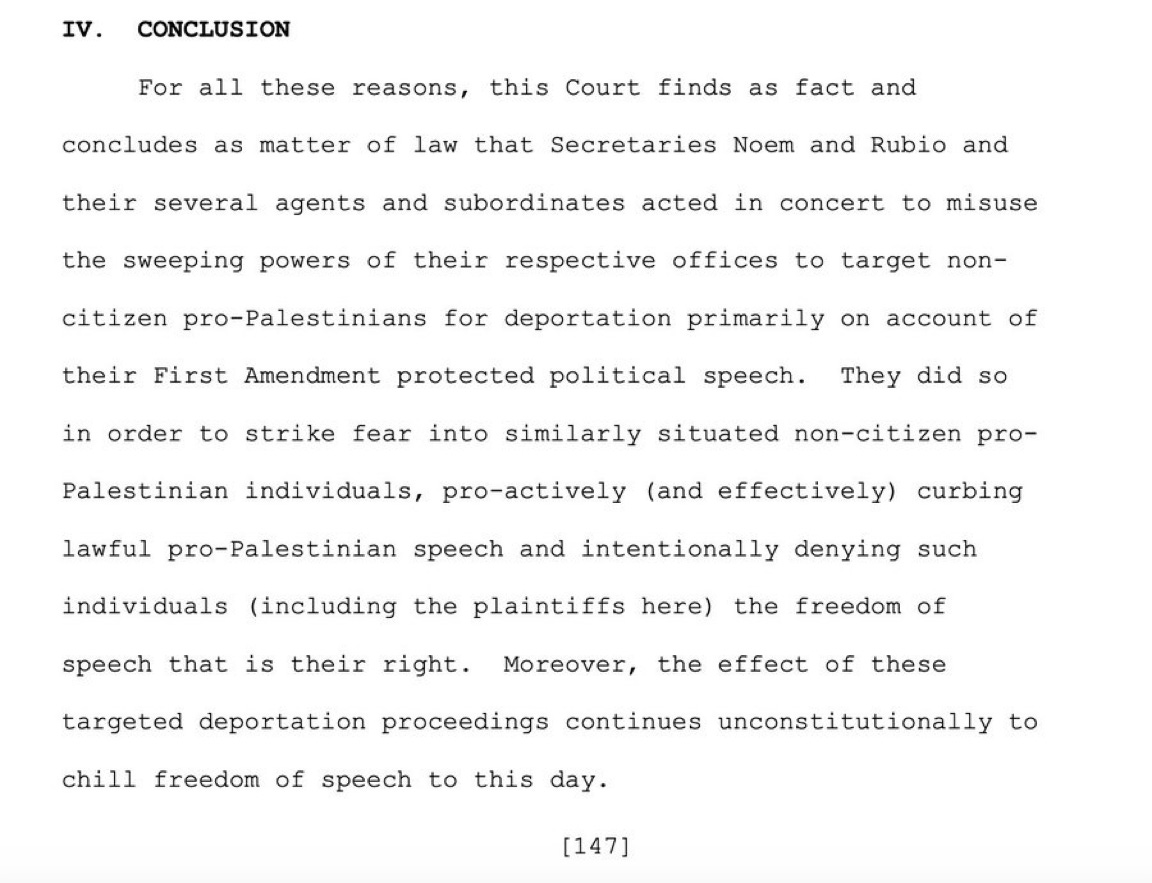
Judge Young was appointed by Ronald Reagan in 1985. He graduated from Harvard undergraduate in 1962 and served for two years in the army as a captain before attending Harvard Law School. So it was particularly poignant when he addressed the issue of masked ICE agents, a theme he returned to throughout the opinion, before concluding:
“Can you imagine a masked marine? It is a matter of honor — and honor still matters. To us, masks are associated with cowardly desperados and the despised Ku Klux Klan. In all our history we have never tolerated an armed masked secret police. Carrying on in this fashion, ICE brings indelible obloquy to this administration and everyone who works in it.”

Four AGs ask FDA to ease burdens on Mifestiprone abortion drug therapy
Based on 25 Years of Evidence and Safe Use, Mifepristone Does Not Need a REMS Program
Based on mifepristone’s extensive safety record established over the last 25 years and the important and often critical benefits that the medication provides patients, the restrictive Mifepristone REMS Program should be eliminated because:(A) the current Mifepristone REMS is medically unjustified under the REMS statutory factors;(B) mifepristone’s safety has remained stable even as its restrictions have been lessened;(C) the Mifepristone REMS Program is unduly burdensome on patients, providers, pharmacies, and states’ healthcare delivery system; and(D) its continuation cannot be squared with the FDA’s lack of REMS programs on drugs that have significantly more risks than mifepristone. Thus, FDA should eliminate the Mifepristone REMS Program and treat mifepristone consistent with other safe, effective medications used by millions of people.


